


UPDATED: Jury reaches not guilty verdict in former HCSO deputy's reckless homicide trial
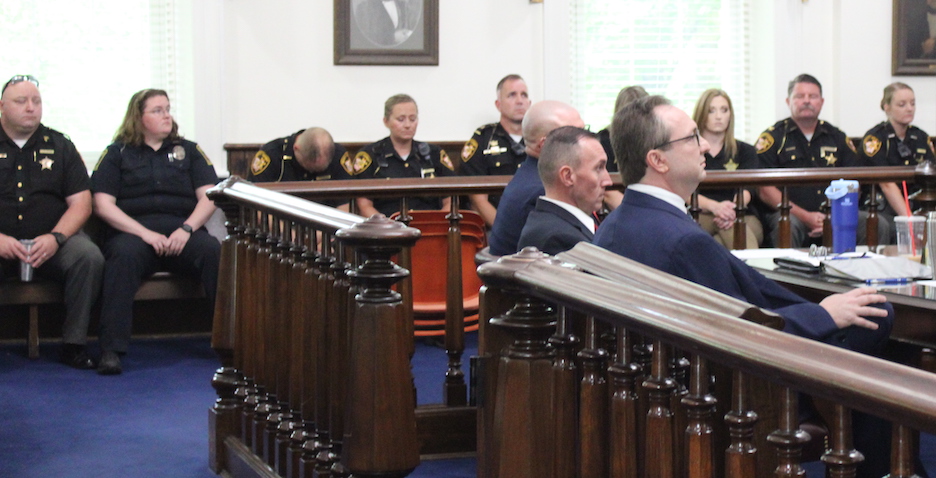
A row of Highland County Sheriff's Office deputies can be seen behind former deputy Jonathan Dustin Malone (pictured between defense attorneys Robert Merkle, left, and Joshua Engel), as they await the verdict. (HCP Photo/Caitlin Forsha)
After two full days at trial and hearing testimony from a final witness Wednesday morning, it took a jury of seven women and five men just under an hour to reach a verdict of not guilty in former Highland County Sheriff’s Deputy Jonathan Dustin Malone’s reckless homicide case.
With a whole row of sheriff’s deputies and many friends and family members of Malone on hand for support, Highland County Clerk of Courts Ike Hodson read the verdict Wednesday just after 1:30 p.m.
After Highland County Common Pleas Court Judge Rocky Coss thanked the jury and exited the courtroom, the crowd burst into applause, with individuals approaching Malone to hug him, some of whom were in tears.
As previously reported, Malone pleaded not guilty to a bill of information charging him with the third-degree felony charge of reckless homicide March 23. The bill of information alleges that on or about July 17, 2022 and in Highland County, Malone “did recklessly cause the death of Richard Poulin, in violation of ORC 2903.041.”
After the state rested Tuesday, Malone took the stand in his own defense. For background on the first two days of the trial, see the stories at: https://highlandcountypress.com/jury-hears-opening-statements-first-wit… and https://highlandcountypress.com/former-hcso-deputy-takes-stand-own-defe….
The defense rested Wednesday morning after presenting their final witness, John Nixon, who is an expert witness on mechanical engineering and firearms, including on the weapon used by Malone the night of Poulin’s death. (As was brought out by both defense attorney Joshua Engel and prosecutor Chris Kinsler, Nixon was paid $395 an hour by the defense for his testimony and work on the case.)
Nixon gave a detailed explanation of striker-fired weapons, their triggers and safeties. He said he tested the weapon used in this case and its trigger. Engel asked why he tested the trigger. Nixon said it is a “good first indicator” of any defects in the weapon.
“What are some of the human factors that make it important to test the triggers on guns?” Engel asked.
“Everyone’s an individual, and different humans have different sensitivities, different strengths and they’re in different states of mind as well,” Nixon said. “If you’re in a tense situation and you’re under stress, you tend to have more strength and less sensitivity. If you’re startled, you can make an involuntary muscle contraction.
“There’s a thing called sympathetic muscle contraction where if you grip something with your right hand, your left hand tends to grip as well. Those are three factors you have to consider.”
Engel asked Nixon to elaborate, and he said “it’s very easy to have an accidental discharge when you’re under stress.
“A lot of people think it takes more effort than it should do, but in reality when you’re using the gun for real — whether you’re a hunter in the woods or you’re in a self-defense situation — you don’t want to have an accidental discharge,” Nixon said.
Engel also asked Nixon to explain the “sympathetic muscle contraction” he mentioned.
“If you were holding a pistol in one hand and you had your finger on the trigger, just for instance, if something dropped off the shelf and you went to catch it and grab it, the sympathetic muscle contraction is when you grip with your right hand, your left hand tends to grip as well,” Nixon said. “If your finger was near the trigger, you may have an accidental discharge for that reason.”
For this particular weapon, Nixon said he performed “10 tests,” evaluating various aspects of the trigger and the force and energy involved in operating this gun compared to other models. He testified for several minutes about those tests, displaying various charts and graphs about his findings.
“Why does all this matter to the case we’re here about today?” Engel asked.
“There was an issue in this case of whether the gun accidentally discharged or not,” Nixon said. “This will give you an indication of what you’re dealing with.”
Nixon continued that it’s “a lot more difficult to have an accident with a Beretta,” for example, “than it is with one of these striker-fired pistols.”
“It takes a lot less effort to discharge one of these striker-fired pistols,” Nixon said. “You don’t need to have such a large response to have an accident with one of these.”
Under cross examination, Kinsler asked Nixon to reiterate or to elaborate on some of his findings.
The defense rested at around 10:15 a.m., with the aforementioned crowd of deputies, family and friends on hand for the morning’s proceedings. After the judge and attorneys conferred, the jury was called back in for their initial instructions and closing arguments.
Coss instructed the jury that in order to reach a guilty verdict, they had to determine that Malone “did recklessly cause” Poulin’s death, defining “recklessness” as well as “cause.”
“It requires more than mere negligence,” the judge said.
In his first closing argument, Kinsler summarized facts of the case, saying that the state agreed that Malone’s action was “unintentional” but argued that he was “reckless” in his actions.
The prosecutor said that circumstantial evidence would lead the jury to infer that Malone’s “hand was on the gun” and that it went off because his “finger was on the trigger and he squeezed it inadvertently.” There was “no testimony to support” any idea that Malone’s “weapon discharged on its own,” Kinsler said.
Kinsler told the jury that the shooting occurred “during physical exertion” — Malone used his right hand to smash the window of Poulin’s truck while holding his gun in his left hand — and that by the defense’s own expert witness testimony, Malone could have involuntarily squeezed his left hand.
The prosecutor said Malone was “either mistaken or lying” about having his finger on the trigger at the time of the shooting.
“In any event, what you have to consider is whether he was being truthful,” Kinsler said. “If he doesn’t fully understand that — the most important moment in this case — is being fully forthright about the other events in this case?”
The prosecutor added that Malone had contradictory testimony on where he had his gun pointed during the incident as well — either at Poulin or “not necessarily pointing at anything” — which is “an inconsistency.” As Malone also testified he had suffered “memory suppression,” Kinsler told the jury to “consider the accuracy of his memory when evaluating” Malone’s statements.
Regarding Malone’s testimony that he saw Poulin “reach for something,” Kinsler pointed out that none of the other three officers at the scene witnessed that.
Kinsler told the jury that the gunshot wound to Poulin was the cause of death, but that the state agreed that Malone’s pursuit of Poulin, the traffic stop, using the baton and having weapons at the ready were all “appropriate.” The issue at hand was “heedless indifference … to substantial and unjustifiable risk,” the prosecutor said.
“The thing that we are arguing is reckless — the thing that amounts to heedless indifference to a substantial risk — is using the ASP [baton] simultaneously with holding the firearm,” Kinsler told the jury. “That was the known risk that took place here in this situation.”
Kinsler also brought out that the “reasonableness” of use of force is “specific to the circumstances.” There were four officers at the scene at the time of the traffic stop, Kinsler said, and any of the other three officers could have “provided cover” with their weapons or used the baton on the windows.
“That is what is reckless in this case, and that is what caused the death of Richard Poulin,” Kinsler told the jury.
Engel began his closing arguments by asserting that Malone is “a hero” for his actions that night.
“Sergeant Malone is a hero,” the defense attorney said. “Everybody faced a significant risk from a suspect who had fled from the police. He took on that risk for everyone else because he was sworn to do so. He took an oath to protect and serve. He acted at every time during that case, in every time you heard about, consistent with policy and his training to arrest the suspect, prevent his escape and defend the public.”
In response to the state’s argument that using the weapon and ASP baton simultaneously was reckless, Engel asked, “Where did they get that from?” He brought out that none of the officers who testified indicated that its was “inappropriate” to do so.
“With all due respect to the government, they’re just making that up.” Engel said. “They have no evidence that doing so is reckless.”
Engel reviewed the elements of the definition of “reckless,” pointing out that just “because there was a risk” involved at pointing a gun at a suspect doesn’t mean it’s unjustifiable. He also went over all of the facts of the pursuit and chase of Poulin. The attorney argued that Malone was doing what he was “supposed” to be doing during a felony traffic stop and pointed out Malone did not jump to conclusions when he saw Poulin “lean forward reaching for something.”
Engel asked the jury to remember “three things” about Malone’s testimony and the recording of radio traffic during the pursuit and subsequent traffic stop: that Malone was “calm and collected” throughout the incident; that he “cooperated with the investigation;” and that he was “sincere and candid in his testimony” and showed “true remorse” both in court and at the time of the incident.
“His job was to make sure everyone gets home safely,” Engel said. “Someone didn’t get home safely, and that tears him up.”
Engel pointed out that the defense’s expert witness on police training and practices, Kevin Davis, testified that Malone’s “actions were consistent with state and national practices and standards.” He said that the Ohio Attorney General’s Office had “access to many, many trainers” and use of force experts and did not consult them. Engel argued that they chose not to because “they all would have said exactly what Kevin Davis said.”
“Nobody on that stand told you this was poor police procedure,” Engel told the jury. “Lots of people had the chance.”
Engel said that law enforcement efforts aware “risk exists” when following “appropriate and good” procedures but that it is “an acceptable risk” because the potential “risk to everyone else is much greater.”
In conclusion, Engel told the jury to “ask yourselves: why are you here?
“You are here because you are a check on the government,” Engel told them. “You are here to prevent the government from blaming someone for something that happened even though they did exactly what the government told them to do.
“You are here to stop them from doing what they want to do today, to stop them from holding an innocent man responsible simply because he was trying to protect the community,” Engel continued. “That is why it is your duty to find Sgt. Malone not guilty.”
In his final argument, Kinsler reminded the jury that only the judge is “the authority on the law,” and that police “policies and procedures are not the law.”
Even if Malone “complied” with “best practices” of law enforcement, “that doesn’t mean you can’t nonetheless find him reckless,” Kinsler told the jury, adding that law enforcement policies don’t “trump” state law.
Kinsler told the jury that none of the five law enforcement officers who testified had ever “trained” or “practiced” the use of an ASP baton and a firearm simultaneously, while the jury also heard testimony on firearm safety practices. He said that Malone was “dividing his attention between two different things” when he struck the window of Poulin’s vehicle while holding a gun in the other hand, which “runs contrary to” the officer safely knowing the direction the gun is pointed and whether he had his finger on the trigger.
“Policies and procedures don’t trump the law,” Kinsler argued. “They can’t account for every situation.
“I ask you to look at the law and the facts of this case. The defendant’s conduct was reckless.”
After closing arguments, the jury was dismissed at 11:15 a.m. for lunch, then returned at 12:25 p.m. to hear their final instructions on how to deliberate. They officially received the case around 12:38 p.m.
After the jury was dismissed to begin deliberations, Coss thanked the attorneys for the “very well tried case.” The judge said it was “an unbelievably difficult situation for everyone.”
While the jurors were deliberating, Coss told the crowd that he would “demand decorum” at the time the verdict was read, and that he would “not tolerate any outburst or disruption.”
“This is not an athletic contest,” he said, and told those in attendance not to “come in the courtroom’ if they felt they wouldn’t be able to “control your emotions.”
At 12:54 p.m, the jury sent the judge what he called a “fairly cryptic” message, asking him to “define ‘mere negligence.’” He returned on the record, with attorneys and Malone present, to read the definition he “intended to give” the jury of both “negligence” and “due care.”
At 1:32 p.m., the jury was brought back into the courtroom to return their verdict. There was an audible gasp and reaction from the audience as Hodson read the words “not guilty.”
Coss thanked the jury “for your service” and attention throughout the trial and dismissed them.
“Mr. Malone, you’re discharged,” the judge said.
After the jury and judge exited, bailiff Ben Reno pointed out, “It’s over,” at which point the crowd began their round of applause.
