


Former HCSO deputy takes stand in own defense during reckless homicide trial

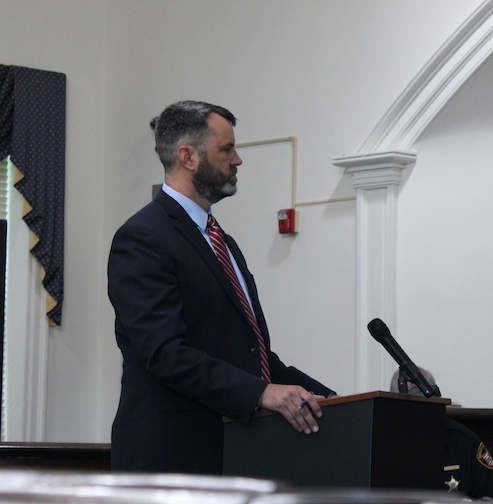
Jonathan Dustin Malone is pictured testifying in his own defense in Highland County Common Pleas Court Tuesday. Also pictured is defense attorney Robert Merkle. (HCP Photos/Caitlin Forsha)
Former Highland County deputy sheriff Jonathan Dustin Malone took the stand in his own defense Tuesday afternoon, as jurors heard testimony from multiple witnesses throughout the second day of Malone’s reckless homicide trial Aug. 8.
As previously reported, Malone pleaded not guilty to a bill of information charging him with the third-degree felony charge of reckless homicide March 23. The bill of information alleges that on or about July 17, 2022 and in Highland County, Malone “did recklessly cause the death of Richard Poulin, in violation of ORC 2903.041.”
Malone testified for approximately 90 minutes Tuesday afternoon. Under examination by defense attorney Robert Merkle, Malone spoke about his career as a law enforcement officer — including stints at the Highland County Sheriff’s Office, the Lynchburg Police Department and the Greenfield Police Department, and as a dispatcher, a road patrol officer and a K-9 handler — and about his training.
Malone said that he had been trained on use of force policies and that “every encounter” in his experience was different. He said that the policy is “a guideline that dictates what you can use force.” Malone testified that he had undergone firearms training and that in his experience as a K-9 handler, he often had a dog lead in one hand and his weapon in another hand.
Regarding the night of July 17, 2022, Malone said it was “sometime after midnight” when he initially observed Poulin running a stop sign in Samantha. He spoke about the pursuit from his perspective, saying that in his contact with radio dispatch, it was found that the truck was registered to a woman from Columbus.
Merkle asked what Malone was thinking at that time.
“Your mind just starts thinking about every possibility,” Malone said. “Why is this person running? Are they a wanted fugitive? Are they bringing drugs into our community and don’t want to be caught? Did they just commit some type of violent crime and don’t want to be caught? Are they on their way to commit a violent crime? There’s multiple things that just start going through your mind.”
Malone said that there were some other vehicles on the road at the time of the pursuit, while he also observed pedestrians in the uptown Hillsboro area, where Poulin ran the red light at the center of town. “Thankfully, he did not hit anyone,” Malone said.
As they neared Muntz Street, Malone said that other motorists had to pull over to avoid being hit by the pursuit, as Poulin also narrowly avoided hitting a utility pole. Malone said that he was trying to look for “silhouettes” and neared Poulin’s vehicle to determine how many individuals were inside, at which point their vehicles “made contact.”
When Poulin’s truck finally came to a stop between Ervin Road and Concord Road, Malone said he exited his cruiser and approached the truck, yelling at Poulin to “show hands” and “exit the vehicle.” Poulin failed to comply, Malone testified.
According to Malone, Poulin initially had his window partly down and that he could see the suspect was an “older white male.”
“Then, he revved up the engine and took off again and traveled probably 20 feet,” Malone said. “That’s when my stress level went up even more because he put his window up and started blaring music.
“I had never had anybody basically completely defy everything the way he was doing it.”
Malone said he got on his PA system to “begin shouting commands again” for Poulin to exit the truck, to show his hands and to turn off the vehicle, with no response from Poulin.
After officers called for a K9 and were advised there was not one available, Malone said he began having “snapshots” inside his mind of footage he had seen of shootouts in which law enforcement had been shot, or in one case “murdered,” by suspects.
“I can still hear that deputy screaming on that camera footage,” Malone said. “I saw pictures of my wife and children. I knew [deputies] Stevie [Alexander], Sarah [McKinzie] and Dylan [Quenneville] all had kids, and I was not going to allow this guy to get the upper hand on us. I’m not going to be murdered. I’m not going to allow my fellow deputies to be murdered.”
Merkle asked if Malone had any “interaction” with Poulin.
“No,” Malone said. “It was the oddest encounter I’ve ever had. The man said nothing. It was absolutely bizarre.”
Malone testified he did not want Poulin to have “any advantage” over the officers, so he proceeded to approach the passenger side of the vehicle, as he thought Poulin would expect him to approach the driver’s side. Malone said in doing so, he was trying to keep himself “safe” and to see inside the vehicle. As he did so, Malone said he continued his verbal commands.
“When did you place your firearm in your non-dominant hand and your ASP [baton] in your dominant hand?” Merkle asked.
“I did that prior to departing my patrol car,” Malone said. “Prior to running up to that car, I had myself set up.
“I knew that I was going to break the window, so I wanted to make sure that I had enough force. I’m stronger in my right arm than I am in my left arm. I wanted to make sure I had enough force to get through that window. My whole career, I’ve shot my pistol one-handed, two-handed, right-handed, left-handed.”
Malone added that he had “absolutely done that before” and that he took those actions for his “safety.”
Malone said he was able to “shatter” the passenger window with one strike. When he looked into the truck, Poulin was “just staring at me,” Malone said. “He did not say anything. He did not move … He just gave me this creepy stare.”
After Alexander was “not successful” at getting the driver’s side window broken, Malone said that Poulin started “reaching forward.
“At that moment, I thought, ‘oh my gosh, this guy’s going for a gun,’” Malone said.
Malone said that with Alexander on the other side of the vehicle, it created the risk of a “crossfire situation,” so Malone ran to the driver’s side.
Malone swung his baton at the window, “splitting” it; with his second strike, he “heard glass shatter and a pop,” he testified.
“I thought to myself, ‘what was that?’” Malone said. “In that brief second, I didn’t know if he shot, or I don’t know what happened.”
Once Malone realized it was his “gun that went off,” he said he reholstered the weapon and dropped his baton. He managed to get the door open and found Poulin, with “blood on his pants,” and “called for a squad.
“He was stationary,” Malone said. “He was not doing anything.”
Malone said he then saw Poulin’s neck injury and called for a medical helicopter.
Merkle asked what Malone’s “intentions” were in breaking the truck windows.
“If things would have went properly, we would have broke the window out, we would have extracted him from the vehicle and placed him in handcuffs and took him to jail,” Malone said. “That was my intentions when I turned my lights on when he ran the stop sign.”
Malone said that he gave the other officers a first aid kit, then “removed” himself “from the scene,” placing Alexander in charge, seating himself in his patrol car and eventually surrendering his weapon to McKinzie.
“That’s standard procedure when an officer is involved in a shooting,” he said.
Merkle asked if Malone “regrets” the incident.
“Oh, absolutely,” Malone said. “Absolutely. I wish I never even went to work. I just regret everything.
“There has not been a day since then that I have not thought about this incident. I was actually in counseling for about three months, and I’m still dealing with it.”
In response to another question from Merkle, Malone said he “violated no policy” and acted according to all of his training and experience.
“Does that make you feel better about what happened?” Merkle asked.
“No,” Malone said. “At no point was that my intention at all.”
Merkle asked if Malone would change “anything you did tactically.”
“No, I would continue the way I’ve operated through my entire career,” Malone said. “But if you’re asking me if I knew I continued and did that whole event again knowing there would be a death at the end, absolutely I wouldn’t.”
Under cross examination, Malone said that the standard placement of his firearm was on the right side of his belt and would be retrieved with his right hand, with the baton placed on his left side and retrieved with his left hand. He switched hand placement for the tools prior to approaching Poulin’s vehicle, he said.
Special prosecutor Chris Kinsler of the Ohio Attorney General’s Office questioned Malone on his statements to Ohio Bureau of Criminal Investigation Special Agent Steve Seitzman, one of the investigators of the case. Malone provided a written statement July 26 and said he had “nine days to live with those thoughts” about the incident. Malone agreed that he had also provided a verbal interview with Seitzman.
“After my counseling, that helped bring out a lot more memories because I suffered from memory suppression,” Malone said.
Kinsler referred to Malone’s testimony about Poulin “staring” at him and “reaching for something.”
“Did you ever see a weapon in the vehicle?” Kinsler asked.
“No, I did not, but there could have been one concealed,” Malone said.
Kinsler then questioned Malone on his written statement that “does not say whether your finger was on the trigger of the gun at the time of the shooting” (which Malone said was “accurate”) or “where you were pointing the muzzle of the gun” (which Malone did not recall). After Malone was given time to review his written statement, he agreed that he did not indicate “where the gun was pointed at the time it was shot.”
In a summary of Malone’s verbal interview with investigators, Kinsler brought out that Malone said he was “not necessarily pointing” his weapon “at anything.” Malone said it was “an issue with terminology.”
“I was pointing the gun at that tinted window because I knew that’s where the suspect was,” Malone said. “That’s what I meant by what I was trying to say.
“I was pointing it at the window with the assumption the suspect was still there.”
Kinsler referred to testimony from Alexander on Monday that Malone said “I don’t know what happened” after the sound of the gunshot. Malone said he was in “shock” and that he “could have” said that.
“You also stated in the recording, ‘I didn’t pull the trigger,’” Kinsler said. “Do you recall stating that?”
“Yes, absolutely,” Malone said. “I have no memory at all of pulling the trigger. Absolutely zero.”
Kinsler said that Malone also told McKinzie, “I didn’t shoot,” which Malone agreed he “more than likely” said.
Malone faced the jury and said, “As I sit here today and look at every one of you, I do not remember shooting.”
In response to more questions, Malone said he was not aware of his weapon striking the truck or coming in contact with anything other than his own hand, and that other officers did not fire their weapons.
Kinsler also questioned Malone on his training on his specific weapon, for which he said he “qualified three or four times” and shot rounds at a range. Malone agreed that the HCSO’s policies are a “general guideline” and that he determined the “level of force” based on “circumstances” of each incident.
“When you were striking the baton at the window, if you had been aiming the gun at the ground, the bullet would not have struck Richard Poulin,” Kinsler said. “Do you agree with that?”
“No, I do not,” Malone said. “I do not agree with that. There very well could have been a ricochet.”
“Do you agree with me that a bullet travels generally in the direction the muzzle is pointed?” Kinsler asked.
“I do agree with that,” Malone said.
Questioned whether keeping the gun pointed downward would have reduced the chances of the bullet hitting Pouin, Malone responded, “It increases the chances of me getting hurt.”
“The weapon could have been pointed in a direction other than at Mr. Poulin, could it not?” Kinsler asked.
“Absolutely not,” Malone said. “I’ve got a right to defend myself.”
Kinsler agreed that Malone had that right but “at that juncture, you were trying to open the window with an ASP” and “hadn’t seen a weapon” in Poulin’s vehicle.
“By that moment, he could have a firearm and ready to shoot me,” Malone said.
“According to your statement to Seitzman, you weren’t necessarily pointing the gun at anything at that time,” Kinsler said.
“I was pointing it in the direction of where I thought Mr. Poulin was,” Malone said. “I could not see the driver.”
Under redirect, Merkle asked Malone why his “initial response was” that he hadn’t fired his weapon.
“I have no recollection of it,” Malone said.
Merkle asked about Malone’s typical hand placement on his weapon. He said it was consistent with training and that he did not typically have his finger on the trigger.
“To the best of my recollection, I think I acted, I think the term is motor memory,” Malone said. “You do things without thinking. My entire career and anytime I’m handling a gun, I’m always in that position.”
In response to questioning from Merkle, Malone said he is “not trained” to keep his gun pointed downward and that it would be equivalent to having it holstered.
“You truly believed that your finger never came in contact with the trigger?” Merkle asked.
“I feel that way even as I sit here,” Malone said. “I don’t recall my finger coming into contact with that trigger.”
Prior to Malone’s testimony was a full day of witnesses, as the state resumed its case at 8:40 a.m., after attorneys conferred and Highland County Common Pleas Court Judge Rocky Coss dismissed a juror to start the day’s proceedings. (As there were three alternates seated Monday, the first alternate was subsequently placed on the jury.)
First to testify Tuesday morning was Dr. Bryan Casto of the Montgomery County Coroner’s Office, an expert witness who spoke about the autopsy performed on Poulin. He said that Poulin suffered a “single gunshot wound” that entered the back of his left shoulder, exited the front of his left shoulder, reentered the left side of his neck and came to rest just above his upper molars.
Casto said that only one shot had apparently been fired but that there were “two different entrances” on Poulin’s body.
As a result, Casto said that Poulin’s carotid artery had been struck, which causes “profuse” bleeding, and he concluded that Poulin died from loss of blood from a gunshot wound to the neck. Poulin also had minor lacerations from the glass breaking, Casto said.
According to Casto, the toxicology report showed that Poulin was intoxicated at the time of his death, with his blood alcohol level as well as his alcohol level in the vitreous fluid of his eyes both being more than twice the legal limit.
Next, Ohio Bureau of Criminal Investigation Special Agent Steve Seitzman, who said he typically investigates officer-involved shootings, spoke about investigating this case. He said he responded to the scene sometime after 3 a.m. Seitzman testified that Malone was cooperative throughout the investigation.
Kinsler played a roughly 20-minute radio dispatch recording from the time Malone first tried to initiate a traffic stop, throughout the chase, Poulin’s eventual stop south of Hillsboro and then Malone’s calls for medical attention.
Malone can be heard on the recording calling for backup and for stop sticks to be deployed. He says that he believes the driver is an “older white male” but is unsure if there are any passengers. At numerous points throughout the call, Malone advises dispatch of violations committed by Poulin — lane violations, running a red light, nearly hitting a utility pole — and makes note of many different speeds at which Poulin is driving.
As Poulin’s tires deflate and his vehicle continually slows, Malone advises the other officers not to approach the suspect vehicle and that it is a “felony stop.” He says he sees the “muffler dragging” and “sparks flying” on the suspect vehicle.
Once Poulin stops, Deputy McKinzie is heard calling for a K9, then reporting that the suspect was attempting to flee again. Dispatch advises that a K9 is not available.
From there, the audio is mostly silent, and then Malone calls for a squad. After a pause, Malone then calls for them to “get the chopper in the air,” signaling the need for a medical helicopter.
Kinsler also played surveillance videos from a business near where the stop sticks were deployed, as the pursuit down U.S. 62 can be seen in the background.
Kinsler asked Seitzman, who was trained and has experience as a law enforcement officer, about his sidearm training. Seitzman said that you “primarily” qualify with your dominant hand and shoot “two or three” rounds with your non-dominant hand. The “basic rules” he outlined were to know what (or who) you are aiming at; know the backdrop of your target, to avoid hitting anyone or anything else unintentionally; and to avoid putting your finger on the trigger unless prepared to shoot.
Kinsler asked if those gun safety laws are different for law enforcement officers, and Seitzman said they were not and that you would still keep your “finger off the trigger until ready to pull” to avoid shooting “somebody you don’t intend to shoot.”
Seitzman also testified that he had been trained to use an ASP baton but was never trained to use one simultaneously with a weapon, nor had he ever wielded both at the same time.
Under cross examination, Seitzman agreed that Malone “fully cooperated” with each step of the investigation. He said that he did not consult any engineers of striker-fired weapons, experts in use of force or experts in law enforcement training. (Under redirect questioning, he said that was not common practice.)
Seitzman said that his job is to “gather facts” of the case and present them to the prosecutor and that his job does not involve making any recommendations of charges or any “conclusions one way or another.”
In response to more questioning from defense attorney Joshua Engel, Seitzman agreed that it was a “high-risk” traffic stop and that a gun would often be out at such a stop, but Seitzman said he would only use a weapon in his dominant hand unless that hand was injured in some way.
Engel asked if there was “any evidence” found to “contradict” Malone’s statements. Seitzman said no.
“Did you have any evidence that [Malone] had his finger on the trigger?” Engel asked.
“Yes,” Seitzman said. “The fact the firearm discharged.”
Under redirect, Seitzman added that there was not evidence that Poulin had a weapon or that he drew or pointed one at officers, or that Poulin used any force against officers. Seitzman also said that he had never seen a baton used with one hand while the officer had a firearm in another hand.
Another Ohio BCI Special Agent, Kevin Wagner, testified regarding processing of the scene. Numerous photos taken by Wagner of the scene, of Poulin’s truck and of evidence were displayed for the jury. Among the evidence seized was an ID card for Poulin that indicated he was not a licensed driver, Wagner said.
As with other officers, Kinsler asked Wagner about his firearms training. Wagner said he had been trained from the time he was young not to point a gun “at anything you’re not willing to destroy,” and to know both your target and what is beyond it; to always treat a gun as if it is loaded; and to never put your finger on a trigger unless prepared to shoot.
Wagner testified that he had also been trained to use a baton. He said he had used a baton before to break a window, but had never done so with a gun in the other hand, nor had he been trained to do so. Wagner said his experience was “dedicate yourself to one tool” at a time and not to use a weapon and another use of force device at the same time.
The state’s final witness was Matt White, an expert witness and a firearms examiner at Ohio BCI. He spoke about the logistics of firing a weapon and its various components as well as how he evaluates a weapon. White testified that he concluded that the fired cartridge case and bullet both came from Malone’s weapon.
White reviewed various photos that showed closeups of Malone’s weapon as well as the fired bullet.
“There was no obvious wear or damage to the external surfaces or internal components of the gun,” White said.
According to White, he performed various tests on the weapons, including a light impact test, and concluded that the “only way” to fire it was “by pulling the trigger.”
After a break for lunch, Engel began cross examination. The attorney called White’s educational background (a college degree in biological science, which White said under redirect examination fulfilled the job requirement) into question. He also questioned if White tested the weapon for gunpowder, which White said was not a test he would do.
Engel asked if gunpowder could cause the trigger to stick, which White said “would be an assumption” and that he was not aware of gunpowder residue ever having such an impact.
White also said that his tests showed the safeties were operable and that he was “unable to defeat any of the safeties.”
Engel asked if White performed a trigger pull test on the weapon, and White said that is “not an examination BCI performs” and is not permissible under their policies. However, he said there was nothing “unusual” observed about the trigger of the gun.
Under redirect, White explained that they do not perform trigger pull tests because there are too many variations on where the shooter “would have their finger” placed. He said he did fire the gun and determined the trigger was “normal.”
After White’s testimony and a brief recess, the state rested at 2:15 p.m., and the defense began presenting their case.
Their first witness was former Highland County Sheriff Ron Ward, who said he was appointed sheriff just after Malone was hired in late 1998. He said he worked with Malone until Malone’s initial resignation from the HCSO in 2009 and characterized him as an “exemplary employee.”

Then, the state presented an expert witness, Kevin Davis, who is an award-winning retired law enforcement officer, instructor and author. He testified that he frequently serves an expert witness for both state and defense counsel throughout Ohio.
As was testified under direct examination, Davis was being paid $2,500 for his court appearance, while Kinsler brought out under cross examination that he had been paid around $4,000 — at a rate of $250 an hour, for approximately 16 hours of work — as well as a retainer fee.
Davis said he reviewed the evidence in the case, including videos, photos and the statements of Malone and other officers. He said the shooting was “tragic” but that Malone’s actions were “within the laws of the state of Ohio, within the laws and guidance on use of force and within the best practices by law enforcement in the state of Ohio and throughout the U.S.”
According to Davis, Malone’s use of a weapon was appropriate based on the perceived risk, as was breaking the windows of Poulin’s truck and the use of a baton to do so.
He also said that Malone’s placement of the weapon in one hand was also appropriate. He said is a weapon is a “handgun, not a hands gun,” and that using the weapon in his non-dominant hand is “commonly done.” Davis said he believed that it was “appropriate” to hold the gun in one hand while using the baton with another hand.
Davis said there are various occasions that could lead to an accidental discharge of a weapon. He repeatedly called the case “tragic” but said that Malone and the other officers on the scene were acting within the “best practices and standards” for law enforcement.
Under cross examination, Kinsler questioned Davis about several different circumstances that could lead unintentional discharge of a weapon. Davis disagreed that as a “general rule,” you should not point a gun at someone unless prepared to shoot — saying it’s “absolutely not true.”
Kinsler also asked Davis about the HCSO policy for use of force. In response to a question, Davis agreed that their office’s guidelines are “not the law” and that the policy does not speak to “finger placement on the trigger” of a firearm or to the use of a baton and firearm simultaneously.
Under redirect, Davis said that law enforcement officers “point guns at people all the time” as part of standard practices, even if there is a risk of shooting someone. “Sadly, accidents happen,” he said.
Under the circumstances of the traffic stop, Davis said he believed that Malone’s actions harmonized with best practices for law enforcement officers.
After Davis, Malone took the stand for his aforementioned testimony, concluding around 5:10 p.m.
The trial is expected to resume Wednesday morning at 8:30 a.m.
To read about the first day of the trial, see the story at: https://highlandcountypress.com/jury-hears-opening-statements-first-wit….