


Temporarily banning data centers draws more interest from state, local officials
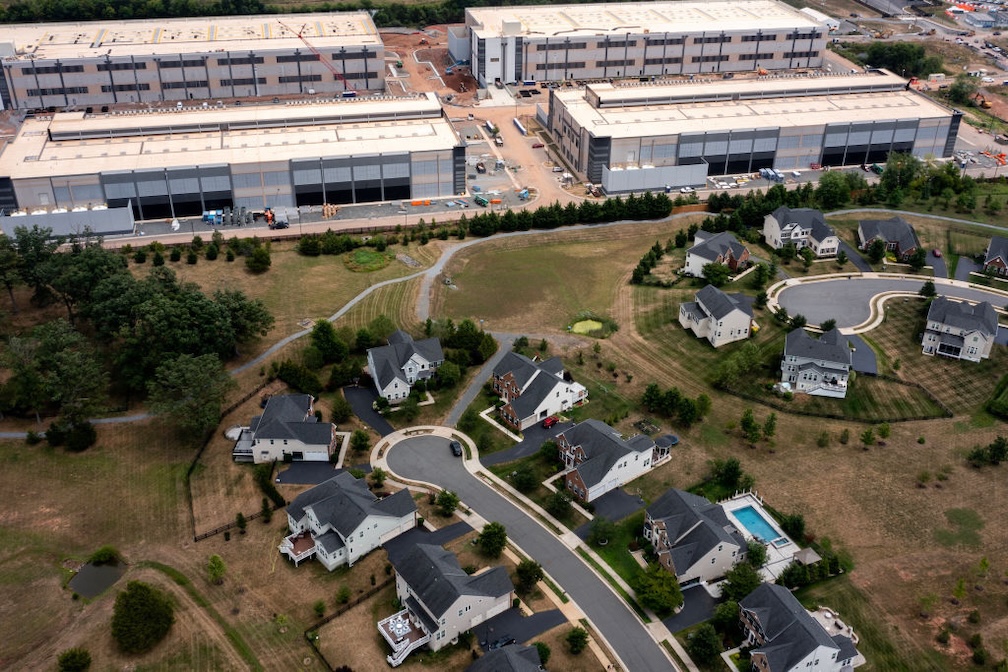
An Amazon Web Services data center is shown situated near single-family homes. Some local and state officials across the country want to halt development of the facilities. (Photo by Nathan Howard/Getty Images.)
By Madyson Fitzgerald
States Newsroom
As communities’ concerns grow over rising electricity prices and the environmental effects of data centers, some local and state officials want to halt development of the facilities.
Lawmakers in at least 11 states — Georgia, Maryland, Michigan, New Hampshire, New York, Oklahoma, South Carolina, South Dakota, Vermont, Virginia and Wisconsin — have introduced legislation this session that would temporarily ban data centers, according to Good Jobs First, a watchdog group that focuses on economic development incentives.
While some of the measures would establish an indefinite moratorium, others would ban new data centers for several years. The Vermont measure, for example, would ban new data center projects through July 2030.
The New Hampshire, New York, Oklahoma and Vermont bills would also require state agencies to study the impacts of data centers on local economies, the environment and more.
Over the past month, state lawmakers in Pennsylvania and Minnesota have also announced plans to introduce moratoriums on data center development.
A handful of the bills have stalled as some state legislatures near the end of their 2026 session. A bill in South Dakota, for example, was tabled by the Senate State Affairs Committee last month after failing to pass.
Likewise, Michigan Democratic Gov. Gretchen Whitmer has said that she opposes any effort to block data center development, according to the Michigan Advance.
While no states have successfully enacted a moratorium, several cities and counties have banned new data center projects over the past year. In August, St. Charles, Missouri, became one of the first cities in the nation to ban data center construction for a year.
Last year, three counties in Indiana also suspended data center developments. This week, Fulton County, Indiana, did the same, with a temporary ban that will be in effect for the next year. DeKalb County, Georgia, has also pushed off new developments through June 2026.
But proposals to ban data centers have fizzled out in other local communities. After Hood County, Texas, received a letter from a state senator threatening legal action and saying that the county did not have the authority to issue a moratorium, commissioners rejected a proposal to ban new data center projects, according to The Texas Tribune.
Beyond moratoriums, state and local leaders are hoping to pass data center regulations to protect consumers from rising utility bills and prevent states from losing millions of dollars through tax breaks.
Stateline reporter Madyson Fitzgerald can be reached at mfitzgerald@stateline.org.
This story was originally produced by Stateline, which is part of States Newsroom, a nonprofit news network which includes Ohio Capital Journal, and is supported by grants and a coalition of donors as a 501c(3) public charity.
Comment
24/7 Energy Hogs
Expect to pay an extra $70 a month for electricity thanks to the plethora of data centers popping up (according to Innovation Ohio). They may soon outnumber dollar stores at the current pace of construction.
Negative impacts
“AI isn’t crucial for society to function,” making its environmental footprint unjustifiable. The growing resistance reflects a broader demand for accountability: communities are no longer willing to be sacrifice zones for unchecked corporate expansion of tech giants prioritizing profit over public welfare. These facilities consume vast amounts of electricity and water often in drought-prone areas while contributing to pollution, increased utility costs, and the degradation of rural landscapes.