


Highland County Historical Society celebrates 50th anniversary, Part XLVIII
By Pamela Nickell
H.C. Historical Society
A newel or newel post is the pillar around which the steps of a winding staircase turn or the post that supports the handrail of a flight of stairs. It is often highly decorative with a newel post cap on the top.
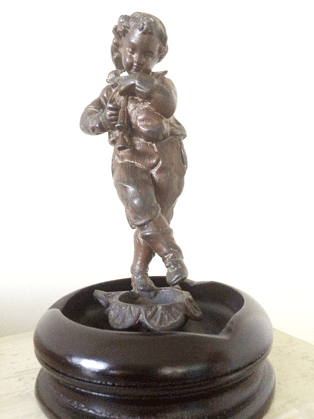
In the Highland House Medical Room, there is a cap from the Highland District Hospital when it was located in a beautiful old home. When given to the museum, it was displayed with the following description.
In the late 1800s, it is reported that the Beecher Estate and the Bower Estate, that stood where The Laurels nursing home sets today, were social rivals in the Hillsboro community.
In 1912, the vacant Bower house was purchased and renovated into a 35-bed hospital, which opened its doors for business in April 1914 as Highland District Hospital.
It remained so until 1962, when the hospital moved to its present location on U.S. 62 (North High Street).
This newel post sprite has a mate and reportedly was on the upper newel posts of the stairway leading to the second floor of the hospital, although no written history reports this.
When the first hospital was torn down, Mrs. Elmer Vogle, a relative of the Bowers gave these statues to Mrs. Leah Rhude of Gable House Antiques. Mrs. Ann Rhude, current owner of Gable House Antiques, has graciously donated this newel statue in memory of her husband, Mr. Tom Rhude, who worked for the hospital for over 39 years.
The old house website relates that newel posts have been used throughout history with changing styles.
In the early American colonies, simple hand-carved or lathe-turned posts were used. In the Georgian period, the turned posts were formed similar to classic architectural columns and then became thinner and delicate in the Federal period. Around 1840, Greek Revival design became popular. By the end of the 1800s, mass production was possible and square, paneled or faceted posts were popular, often with heavy moldings and carvings. Therefore, the caps became larger, heavier and more ornate.
The mass-produced newels were most often hollow, allowing for secret compartments when topped with a cap, either plain or ornate like the one pictured here from the hospital. It is often thought that important papers, perhaps deeds, were stored in the hollow posts underneath the caps.
Another story is that ivory was added to the cap when the mortgage was paid. The author of “Newel Posts and Newel Postlore” by Bill Kibel found on an old house web, writes that he has “never found anything inside of a newel post and hasn’t read anything from a credible source to convince him these stories are fact.”
Readers of his blog, however, tell their own stories stating belief that such folklore could be true.
Lisa Scofield blogged in 2011 that she and her husband had visited Charleston and stopped at a historic B&B where there were coins in the newel post (which apparently had a removable cap).
The owner/operator said it was a “wishing newel.”
Our “sprite” remains in the museum, protected in a glass dome for all to enjoy its beauty or to elicit thoughts of the old hospital and the beautiful Bower House which no longer exists except in picture or memory. Next to the newel cap is a framed picture of the Bower House in which the cap formerly resided for so many years.
Just another case of a conserver of history, generous to the Highland House and to all its visitors.
Thanks, Ann!