


‘We are the luckiest people on earth’: Optimistic look at industry’s future at ‘Ag Is Everyone’s Business’
Lead Summary
By
Caitlin Forsha-crforsha@gmail.com
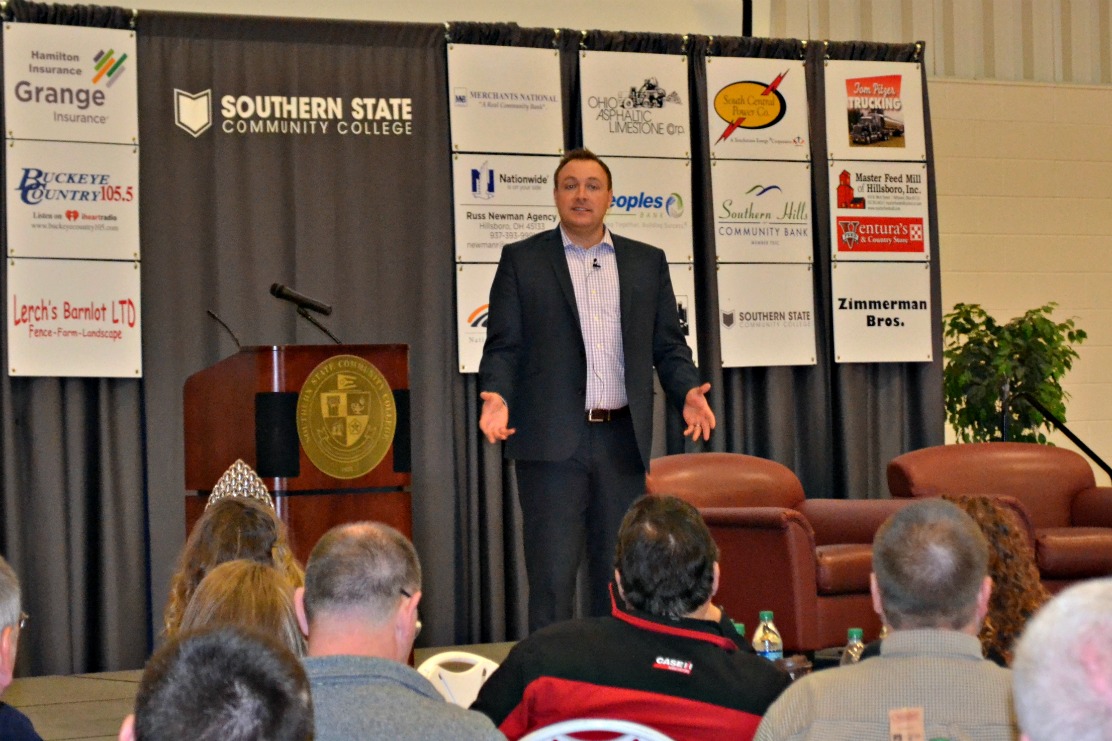
Approximately 400 members of the community, including many local farmers and ag students, enjoyed the Highland County Chamber of Commerce’s fifth annual “Agriculture Is Everyone’s Business” event at Southern State Community College Friday morning.
Discussion of the future of agriculture, as well as regulations on the industry and the impact of new agency leadership and a new presidential administration, were hot topics during the keynote address and Q-and-A session.
The crowd began the morning with breakfast served by Ponderosa, and many of the event’s sponsors set up displays in the SSCC Patriot Center lobby for guests to learn more about their respective businesses.
After watching “The Farmer,” a video produced by Land O’Lakes featuring the poem by Amelia E. Barr, SSCC president Dr. Kevin Boys provided the introduction.
“We’re here to celebrate agriculture, the role that agriculture has in our great county,” Boys said. “We’re here to celebrate the contribution of our farmers that keep this economy clicking along and feed and clothe all of America. Thank you so much.”
Boys recognized public officials in attendance at Friday’s event, including Ohio Department of Agriculture Director David Daniels; Highland County commissioners Shane Wilkin and Terry Britton; Jamie Barker of Ohio Treasurer Josh Mandel’s office; Stephen Caraway, regional liaison for Governor John Kasich’s office; SSCC trustees Mike Pell, Lynn Stevens and Kristy Wilkin; and US Representative Brad Wenstrup. Pell provided the invocation prior to the Pledge of Allegiance.
Wenstrup also spoke at the event, discussing agriculture’s role in the state as well as national endeavors to reduce some of the “regulations and red tape” affecting the industry.
“Ohio is agriculture,” Wenstrup said. “It’s one of the main economic drivers for the state of Ohio. Fifty percent of Ohio has been declared a prime farmland, and that says a lot about the importance of agriculture to Ohio.
“It’s a business, like anything else. I think sometimes people don’t appreciate that. It’s a business, it takes on innovation and is responsible for our food supply and our environment.”
Wenstrup said that many regulations on agriculture are “punitive rather than helpful.” He briefly spoke about Rep. Bob Gibbs’ Reducing Regulatory Burdens Act, which he supports, before thanking the agriculture community.
“I want to thank you all for what you do, how important you are to our economy, how important you are to our state, how important you are to our nutrition and our very well-being,” Wenstrup said. “I want to thank you for your commitment to the community. Just look at this outcome today, with how many people are here. It’s outstanding.
“Let’s let the farmers lead the way.”
Highland County Fair Queen Quinn Walker led the crowd in the Pledge of Allegiance after sharing some comments about her experience as county fair queen and competing at the state contest. Walker said that she has made “lifelong friendships” with fellow fair queens from across the state.
“I would like to thank the people of Highland County,” Walker said. “Without their support and dedication to 4-H and FFA, I wouldn’t have had these opportunities.”
Guest speaker Ryan Matthews, the Ohio FFA vice president at-large and one of three state officers from Highland County, opened his speech with some so-called facts about the ag industry.
“Did you know that the meat we eat isn’t natural?” Matthews said. “Did you know GMOs cause cancer, calves are dragged away from their mothers to be instantly killed and the organizations like 4-H and FFA brainwash thousands of high school students?
“Today, millions of Americans believe these lies to be true, through social media, articles and protests put on by various organizations.”
To address this problem, Matthews said that it “starts with our students.”
“Currently, there are 649,355 members [of the FFA nationwide], with over 26,000 of them living in the state of Ohio,” Matthews said. “Recent studies show that 83 percent of our membership does not come from a rural farm area. I’m truly proud to say that I am one of those members.”
Matthews said that he is now pursuing a career in agriculture after joining FFA in high school. He said that his tenure as state officer has been “amazing,” interacting with FFA students of all backgrounds across the state.
“It is truly outstanding to see that they all have a passion for this organization and for the agriculture industry as a whole,” Matthews said.
“I’ve learned how to judge livestock, run a meeting, discover my own passion for agriculture and even judge soil. The biggest thing I’ve learned from my entire experience is it doesn’t matter who you are, where you come from or what you do, because ag is everybody’s business.”
Highland County Chamber of Commerce executive director Melissa Elmore pointed out that Matthews, a Fairfield graduate, and Hillsboro graduates Meredith Oglesby and Lauren Grover are all serving as state FFA officers.
“That doesn’t happen very often,” Elmore said. “It’s with the hard work and the lessons we learn growing up that develops the dedication and leads to a vast amount of opportunities for these young folks.”
Elmore thanked the community for mentoring these students.
“Whether you know it or not, they’re watching you,” Elmore said. “They’re watching the bankers, they’re watching the farmers, they’re watching all of you because someday they’re going to be stepping into your shoes. Thank you for setting such a fine example in this county.”
Keynote speaker Mike Pearson provided an energetic, optimistic look at farm market trends during his address.
“It’s a tremendous joy to see 400 people in a gym excited about agriculture,” Pearson said.
Pearson, host of the nationally syndicated “Market to Market” television program since 2012. Pearson was raised in south central Iowa, attended Simpson College, where he majored in history, and continued to run the family farm south of Winterset, Iowa. After graduation, he moved to Grinnell, Iowa, where he lives with his wife, Heidi. He is a part-time farmer and has experience as a banker with emphasis on agriculture and residential lending.
Pearson was named the event speaker this week after the original guest, Orion Samuelson, was scheduled to undergo emergency surgery on Friday. Elmore thanked Pearson for going “above and beyond” to accommodate the Chamber for the event.
Pearson said that the agriculture industry has seen “increased specialization over the past 50 years,” with major changes to production industries.
“American agriculture continues to focus on what we do best, and that’s different in every part of this country,” Pearson said. “We continue to find that specialization.
“Every aspect of our business is more complex than it was 15, 20, 35 years ago. Everything we do requires more data management. It requires a sharper head to make sure that we’re able to get things done right, get things done in a timely manner and get things done in a way that leaves us some money.”
One outcome of such specialization is the need for a “much bigger support staff,” Pearson said.
“We need strong accountants in rural America,” He said. “We need folks that understand agronomy and understand data and understand technology in rural America. We need, more than ever, people that understand machinery, people that understand work flow. The American farmer today is a lot more of a corporate manager than your average farmer 25 years ago.”
To answer whether farmers today can be profitable, Pearson – who said that he majored in history in college – discussed “four periods where demand for our products drove prices to the moon.” Those periods were after World War I; after World War II; from 1973 to 1980, with grain exported to the Soviet Union; and in the mid-2000s, with the emergence of the corn ethanol industry.
“The question going forward is what does the next 20 years look like in agriculture?” Pearson said. “Does it look like the 1920 and the 1980s, a period of crisis for agriculture, a period where we had truly overproduced for demand? Or does the next 20 years look like the 1950s and ’60s, where we continue to increase our production, we continue to utilize our technological advances that are available to us and grow production, but that is met by growing global demand?”
Pearson said that he is “an optimist” and “excited” about the industry’s future.
“I strongly believe that the next 20 years are going to look a lot more like the 1950s and ’60s than the 1920s or the 1980s,” Pearson said. “I believe that we are seeing massive increases in international demand. We’re seeing tighter margins on the farm.”
Pearson also pointed out that “for the first time since the Industrial Revolution,” there are “two factors coming together at the same time.”
“We have growing population, which is good, but the more important factor is we have growing per capita wealth globally,” Pearson said. “We are seeing more and more people have more and more money to spend. People, when they have money to spend, want to eat better, and they like to eat meat.”
Growing textile industries in southeast Asia are raising incomes there, which will lead to increased demand for those areas that are unable to “raise corn, soybeans and wheat as well as we do,” he said.
“The goal for the next couple of years is to stay in business,” Pearson said. “When we take a step back and we think about why we want to stay in business, I want us to be thinking about what’s happening globally because the wind is at our back in agriculture. We, in ag and in rural in America, are in the right industry. We are feeding a growing, richer global population.
“We are in the right industry at the right time. Prices are growing, times are challenging, but we’re getting an opportunity to grow our businesses at a price that we can afford long-term.
“Finally, we are in the right industry, at the right time and in the right place. Folks, we are in the heartland of the United States of America. Whatever happens in Washington D.C., whatever happens domestically in our states in our communities – folks, we have so many advantages that people around the world can only dream of. We are the luckiest people on earth.”
Pearson encouraged the crowd to adapt the same optimistic spirit headed into the future.
“Life’s too short, and life’s too hard, to do all this work with a negative outlook,” he said. “Stay excited about the business, and stay passionate about rural America.”
Following Pearson’s keynote address, he and Ohio Director of Agriculture David Daniels accepted questions from the crowd.
To begin the Q-and-A session, Daniels asked Pearson what he believes are the biggest challenges affecting both producers and consumers.
“It’s the split between rural America and everybody in America,” Pearson said. “We have a whole slew of people who have no idea what happens on a farm, let alone what happens in a rural community and how we do tend to look after one another.
“We see it – and Brad Wenstrup addressed it earlier – in regulation. We see it when they don’t understand how our communities operate. They seek to bring in the heavy hand of Washington in a lot of ways to ensure that we’re doing things their way.”
Another question for Pearson dealt with the border tax proposed by President Donald Trump.
“We are an export-based industry,” Pearson said. “We need to be selling everything we can overseas, and to do that, whether we like it or not, a lot of the countries that we sell do demand in reciprocation the fact that they can sell into America.
“Whether or not this border tax or any of these other policies take action, uncertainty costs us money.”
[[In-content Ad]]
Pearson advised the crowd to “keep an eye on” the border tax issue. “It will impact agriculture,” he said.
Boys asked for the speakers’ opinion on Sonny Perdue, whom President Trump selected as secretary of agriculture.
Daniels said that he had not worked with Perdue but believes he will be “great.” He said that he spoke with Georgia’s Commissioner of Agriculture, Gary Black, about Perdue, who was formerly governor of Georgia. Black told Daniels that Perdue “gets along very well” with the agriculture community there.
“I think that Sonny Perdue has a good, solid background in agriculture,” Daniels said.
Pearson pointed out that in addition to being a veterinarian, Perdue also “owned and operated about 11 grain elevators throughout Georgia and South Carolina.”
“He understands the grain trade, what it takes to make money and I think, especially important for agriculture in this administration, he understands how important the external markets are,” Pearson said.
A representative from event sponsor South Central Power asked the speakers to discuss “how energy use is going to change on today’s farm.”
“We’re in the energy production business,” Daniels said. “We’re large energy consumers as well. There’s policies that need to continue to be watched.
“Don’t forget that we have a lot of natural resources here in the state of Ohio that are important to us. Not only natural gas, but coal as well, continues to be a very affordable source of energy. We’re going to be involved in energy production on the farm. We’re going to be involved in energy usage, so it’s important that we all watch what’s going on and pay attention to all those things.”
Pearson added that 800,000 manufacturing jobs have been added to the country in the past few years due to the lower prices in energy.
“By and large, I think we’re going to have a pretty bright future in energy production and consumption,” Pearson said.
Another member of the crowd asked if Pearson believed farmers would “really plant 90 million acres of soybeans this year.” Pearson said that he spoke to a group of producers from several western states during a conference in North Dakota recently.
“There were about 75 farmers in this room, who probably controlled about 10 million acres, and they were all going to plant more beans,” Pearson said. “Will we truly get to 90 million acres? That’s a lot of beans. But could we get to 88 or 89 million acres? Yes.”
Pearson advised the crowd to “be aggressive on your bean sales” this year.
Another question, directed at Daniels, was about being proactive about water quality. Daniels said it’s “not an isolated issue” and that it affects people all over the country.
“Agriculture will respond. We have responded,” Daniels said. “I talk to our producers each and every day. They’re taking extra measures.
“I think that all of us, even Region 5 EPA, has said we are satisfied with the actions Ohio, Michigan, Indiana and Ontario are taking right now.”
The final question was related to the same issue, as Jim Faust asked: “What do you see is going to come about in the next few months with regard to the EPA and all the regulations, particularly where we’re still being pressured by Sierra Club, PETA and all these other agencies?”
Pearson responded that the new head of the EPA, Scott Pruitt, was “no friend to the EPA” when he served as Oklahoma Attorney General.
“From a regulatory standpoint, I think we’ve got the right guy at the helm to reel some of that back in,” Pearson said. “There’s still a pile of employees that believe wholeheartedly in the mission of the EPA. I think it does good things. We don’t have acid rain anymore, in a large part, because of the EPA. The question is, have they overstepped their bounds? To my mind, the answer is yes.”
In response to Faust’s question about activist organizations such as PETA and the Sierra Club, Pearson said that “those folks are going to be more active, I believe, than we have seen over the past eight years.”
“They’ve got a president they hate,” Pearson said. “They’ve got a president they don’t trust. They want to get their voices heard. They will be very, very active.”
Daniels added that it is important to find the right people to fill “regional positions” in such agencies as the EPA under Trump’s administration, not just the people “at the top.”
“Make sure your commodity organizations, your Farm Bureaus, your Corn Growers, your Farmers Union, all those folks are out there talking and looking for talent to fill those regional jobs that are going to be so important,” Daniels said. “Those are the people that we interact with.”
Following the Q-and-A session, Rick Williams of Rick Williams Auction Company auctioned off two pedal tractors. A John Deere 4020 was purchased for $1,100 by Hess Auction Company, United Producers Stockyards, Donald E. Fender Realtors, Charlie Mootz Trucking, Dr. Bohrer of Bohrer Veterinary Services and Rick’s Hometown. The group donated the tractor to the 4-H fund to be auctioned off at the Highland County Fair. The second tractor, a Case IH 340 Magnum, was purchased by Charlie Stevens of Stevens Hardware and donated to the Fairfield FFA.
After tickets were drawn for a raffle of a Stihl chainsaw and two toy tractors, Highland County Chamber of Commerce board member David Fauber of Weastec provided closing remarks. Fauber thanked the crowd for making the event a success.
“Please give us feedback,” Fauber said. “Let us know what you feel regarding this event. We’re proud of it, and we hope you are, too.”
Highland County Chamber board chair Amy Hamilton of First State Bank thanked the event’s sponsors, including: Bane-Welker Equipment; BioGene Seeds; Carraher Ag; Channel Seeds; Crop Production Services; Ervin Hill Inc./Mark Edenfield Fuel/Holtfield LLC; First State Bank; Five Points Implement Company; Hamilton Insurance; iHeart Radio/94 Country WKKJ/Buckeye Country 105.5; Lerch’s Barnlot LTD; Merchants National Bank; NCB; Russ Newman Insurance; Ohio Asphaltic and Limestone; Peoples Bank; Rick Williams Auction Company; South Central Power; Southern Hills Community Bank; Southern State Community College; Tom Pitzer Trucking; Ventura’s Feed and Country Store/Master Feed Mill; and Zimmerman Brothers.
Hamilton also thanked John and Andrea Holt and the Ponderosa staff for serving breakfast and the Highland County FFA chapters and SSCC ag students and their advisers, who helped with serving breakfast and beverages as well as cleaning up.
Bane-Welker Equipment and Five Points Implement were thanked for donating the pedal tractors auctioned off at the end of the event. During her remarks, Elmore also thanked the Chamber’s community relations coordinator, Maddie Cupp, and the Ag is Everyone’s Business committee, which includes Brad Elmore, Jim Hamilton, Jeff Dickey, Amy Hamilton, Tim Parry and Rick Williams.
Discussion of the future of agriculture, as well as regulations on the industry and the impact of new agency leadership and a new presidential administration, were hot topics during the keynote address and Q-and-A session.
The crowd began the morning with breakfast served by Ponderosa, and many of the event’s sponsors set up displays in the SSCC Patriot Center lobby for guests to learn more about their respective businesses.
After watching “The Farmer,” a video produced by Land O’Lakes featuring the poem by Amelia E. Barr, SSCC president Dr. Kevin Boys provided the introduction.
“We’re here to celebrate agriculture, the role that agriculture has in our great county,” Boys said. “We’re here to celebrate the contribution of our farmers that keep this economy clicking along and feed and clothe all of America. Thank you so much.”
Boys recognized public officials in attendance at Friday’s event, including Ohio Department of Agriculture Director David Daniels; Highland County commissioners Shane Wilkin and Terry Britton; Jamie Barker of Ohio Treasurer Josh Mandel’s office; Stephen Caraway, regional liaison for Governor John Kasich’s office; SSCC trustees Mike Pell, Lynn Stevens and Kristy Wilkin; and US Representative Brad Wenstrup. Pell provided the invocation prior to the Pledge of Allegiance.
Wenstrup also spoke at the event, discussing agriculture’s role in the state as well as national endeavors to reduce some of the “regulations and red tape” affecting the industry.
“Ohio is agriculture,” Wenstrup said. “It’s one of the main economic drivers for the state of Ohio. Fifty percent of Ohio has been declared a prime farmland, and that says a lot about the importance of agriculture to Ohio.
“It’s a business, like anything else. I think sometimes people don’t appreciate that. It’s a business, it takes on innovation and is responsible for our food supply and our environment.”
Wenstrup said that many regulations on agriculture are “punitive rather than helpful.” He briefly spoke about Rep. Bob Gibbs’ Reducing Regulatory Burdens Act, which he supports, before thanking the agriculture community.
“I want to thank you all for what you do, how important you are to our economy, how important you are to our state, how important you are to our nutrition and our very well-being,” Wenstrup said. “I want to thank you for your commitment to the community. Just look at this outcome today, with how many people are here. It’s outstanding.
“Let’s let the farmers lead the way.”
Highland County Fair Queen Quinn Walker led the crowd in the Pledge of Allegiance after sharing some comments about her experience as county fair queen and competing at the state contest. Walker said that she has made “lifelong friendships” with fellow fair queens from across the state.
“I would like to thank the people of Highland County,” Walker said. “Without their support and dedication to 4-H and FFA, I wouldn’t have had these opportunities.”
Guest speaker Ryan Matthews, the Ohio FFA vice president at-large and one of three state officers from Highland County, opened his speech with some so-called facts about the ag industry.
“Did you know that the meat we eat isn’t natural?” Matthews said. “Did you know GMOs cause cancer, calves are dragged away from their mothers to be instantly killed and the organizations like 4-H and FFA brainwash thousands of high school students?
“Today, millions of Americans believe these lies to be true, through social media, articles and protests put on by various organizations.”
To address this problem, Matthews said that it “starts with our students.”
“Currently, there are 649,355 members [of the FFA nationwide], with over 26,000 of them living in the state of Ohio,” Matthews said. “Recent studies show that 83 percent of our membership does not come from a rural farm area. I’m truly proud to say that I am one of those members.”
Matthews said that he is now pursuing a career in agriculture after joining FFA in high school. He said that his tenure as state officer has been “amazing,” interacting with FFA students of all backgrounds across the state.
“It is truly outstanding to see that they all have a passion for this organization and for the agriculture industry as a whole,” Matthews said.
“I’ve learned how to judge livestock, run a meeting, discover my own passion for agriculture and even judge soil. The biggest thing I’ve learned from my entire experience is it doesn’t matter who you are, where you come from or what you do, because ag is everybody’s business.”
Highland County Chamber of Commerce executive director Melissa Elmore pointed out that Matthews, a Fairfield graduate, and Hillsboro graduates Meredith Oglesby and Lauren Grover are all serving as state FFA officers.
“That doesn’t happen very often,” Elmore said. “It’s with the hard work and the lessons we learn growing up that develops the dedication and leads to a vast amount of opportunities for these young folks.”
Elmore thanked the community for mentoring these students.
“Whether you know it or not, they’re watching you,” Elmore said. “They’re watching the bankers, they’re watching the farmers, they’re watching all of you because someday they’re going to be stepping into your shoes. Thank you for setting such a fine example in this county.”
Keynote speaker Mike Pearson provided an energetic, optimistic look at farm market trends during his address.
“It’s a tremendous joy to see 400 people in a gym excited about agriculture,” Pearson said.
Pearson, host of the nationally syndicated “Market to Market” television program since 2012. Pearson was raised in south central Iowa, attended Simpson College, where he majored in history, and continued to run the family farm south of Winterset, Iowa. After graduation, he moved to Grinnell, Iowa, where he lives with his wife, Heidi. He is a part-time farmer and has experience as a banker with emphasis on agriculture and residential lending.
Pearson was named the event speaker this week after the original guest, Orion Samuelson, was scheduled to undergo emergency surgery on Friday. Elmore thanked Pearson for going “above and beyond” to accommodate the Chamber for the event.
Pearson said that the agriculture industry has seen “increased specialization over the past 50 years,” with major changes to production industries.
“American agriculture continues to focus on what we do best, and that’s different in every part of this country,” Pearson said. “We continue to find that specialization.
“Every aspect of our business is more complex than it was 15, 20, 35 years ago. Everything we do requires more data management. It requires a sharper head to make sure that we’re able to get things done right, get things done in a timely manner and get things done in a way that leaves us some money.”
One outcome of such specialization is the need for a “much bigger support staff,” Pearson said.
“We need strong accountants in rural America,” He said. “We need folks that understand agronomy and understand data and understand technology in rural America. We need, more than ever, people that understand machinery, people that understand work flow. The American farmer today is a lot more of a corporate manager than your average farmer 25 years ago.”
To answer whether farmers today can be profitable, Pearson – who said that he majored in history in college – discussed “four periods where demand for our products drove prices to the moon.” Those periods were after World War I; after World War II; from 1973 to 1980, with grain exported to the Soviet Union; and in the mid-2000s, with the emergence of the corn ethanol industry.
“The question going forward is what does the next 20 years look like in agriculture?” Pearson said. “Does it look like the 1920 and the 1980s, a period of crisis for agriculture, a period where we had truly overproduced for demand? Or does the next 20 years look like the 1950s and ’60s, where we continue to increase our production, we continue to utilize our technological advances that are available to us and grow production, but that is met by growing global demand?”
Pearson said that he is “an optimist” and “excited” about the industry’s future.
“I strongly believe that the next 20 years are going to look a lot more like the 1950s and ’60s than the 1920s or the 1980s,” Pearson said. “I believe that we are seeing massive increases in international demand. We’re seeing tighter margins on the farm.”
Pearson also pointed out that “for the first time since the Industrial Revolution,” there are “two factors coming together at the same time.”
“We have growing population, which is good, but the more important factor is we have growing per capita wealth globally,” Pearson said. “We are seeing more and more people have more and more money to spend. People, when they have money to spend, want to eat better, and they like to eat meat.”
Growing textile industries in southeast Asia are raising incomes there, which will lead to increased demand for those areas that are unable to “raise corn, soybeans and wheat as well as we do,” he said.
“The goal for the next couple of years is to stay in business,” Pearson said. “When we take a step back and we think about why we want to stay in business, I want us to be thinking about what’s happening globally because the wind is at our back in agriculture. We, in ag and in rural in America, are in the right industry. We are feeding a growing, richer global population.
“We are in the right industry at the right time. Prices are growing, times are challenging, but we’re getting an opportunity to grow our businesses at a price that we can afford long-term.
“Finally, we are in the right industry, at the right time and in the right place. Folks, we are in the heartland of the United States of America. Whatever happens in Washington D.C., whatever happens domestically in our states in our communities – folks, we have so many advantages that people around the world can only dream of. We are the luckiest people on earth.”
Pearson encouraged the crowd to adapt the same optimistic spirit headed into the future.
“Life’s too short, and life’s too hard, to do all this work with a negative outlook,” he said. “Stay excited about the business, and stay passionate about rural America.”
Following Pearson’s keynote address, he and Ohio Director of Agriculture David Daniels accepted questions from the crowd.
To begin the Q-and-A session, Daniels asked Pearson what he believes are the biggest challenges affecting both producers and consumers.
“It’s the split between rural America and everybody in America,” Pearson said. “We have a whole slew of people who have no idea what happens on a farm, let alone what happens in a rural community and how we do tend to look after one another.
“We see it – and Brad Wenstrup addressed it earlier – in regulation. We see it when they don’t understand how our communities operate. They seek to bring in the heavy hand of Washington in a lot of ways to ensure that we’re doing things their way.”
Another question for Pearson dealt with the border tax proposed by President Donald Trump.
“We are an export-based industry,” Pearson said. “We need to be selling everything we can overseas, and to do that, whether we like it or not, a lot of the countries that we sell do demand in reciprocation the fact that they can sell into America.
“Whether or not this border tax or any of these other policies take action, uncertainty costs us money.”
[[In-content Ad]]
Pearson advised the crowd to “keep an eye on” the border tax issue. “It will impact agriculture,” he said.
Boys asked for the speakers’ opinion on Sonny Perdue, whom President Trump selected as secretary of agriculture.
Daniels said that he had not worked with Perdue but believes he will be “great.” He said that he spoke with Georgia’s Commissioner of Agriculture, Gary Black, about Perdue, who was formerly governor of Georgia. Black told Daniels that Perdue “gets along very well” with the agriculture community there.
“I think that Sonny Perdue has a good, solid background in agriculture,” Daniels said.
Pearson pointed out that in addition to being a veterinarian, Perdue also “owned and operated about 11 grain elevators throughout Georgia and South Carolina.”
“He understands the grain trade, what it takes to make money and I think, especially important for agriculture in this administration, he understands how important the external markets are,” Pearson said.
A representative from event sponsor South Central Power asked the speakers to discuss “how energy use is going to change on today’s farm.”
“We’re in the energy production business,” Daniels said. “We’re large energy consumers as well. There’s policies that need to continue to be watched.
“Don’t forget that we have a lot of natural resources here in the state of Ohio that are important to us. Not only natural gas, but coal as well, continues to be a very affordable source of energy. We’re going to be involved in energy production on the farm. We’re going to be involved in energy usage, so it’s important that we all watch what’s going on and pay attention to all those things.”
Pearson added that 800,000 manufacturing jobs have been added to the country in the past few years due to the lower prices in energy.
“By and large, I think we’re going to have a pretty bright future in energy production and consumption,” Pearson said.
Another member of the crowd asked if Pearson believed farmers would “really plant 90 million acres of soybeans this year.” Pearson said that he spoke to a group of producers from several western states during a conference in North Dakota recently.
“There were about 75 farmers in this room, who probably controlled about 10 million acres, and they were all going to plant more beans,” Pearson said. “Will we truly get to 90 million acres? That’s a lot of beans. But could we get to 88 or 89 million acres? Yes.”
Pearson advised the crowd to “be aggressive on your bean sales” this year.
Another question, directed at Daniels, was about being proactive about water quality. Daniels said it’s “not an isolated issue” and that it affects people all over the country.
“Agriculture will respond. We have responded,” Daniels said. “I talk to our producers each and every day. They’re taking extra measures.
“I think that all of us, even Region 5 EPA, has said we are satisfied with the actions Ohio, Michigan, Indiana and Ontario are taking right now.”
The final question was related to the same issue, as Jim Faust asked: “What do you see is going to come about in the next few months with regard to the EPA and all the regulations, particularly where we’re still being pressured by Sierra Club, PETA and all these other agencies?”
Pearson responded that the new head of the EPA, Scott Pruitt, was “no friend to the EPA” when he served as Oklahoma Attorney General.
“From a regulatory standpoint, I think we’ve got the right guy at the helm to reel some of that back in,” Pearson said. “There’s still a pile of employees that believe wholeheartedly in the mission of the EPA. I think it does good things. We don’t have acid rain anymore, in a large part, because of the EPA. The question is, have they overstepped their bounds? To my mind, the answer is yes.”
In response to Faust’s question about activist organizations such as PETA and the Sierra Club, Pearson said that “those folks are going to be more active, I believe, than we have seen over the past eight years.”
“They’ve got a president they hate,” Pearson said. “They’ve got a president they don’t trust. They want to get their voices heard. They will be very, very active.”
Daniels added that it is important to find the right people to fill “regional positions” in such agencies as the EPA under Trump’s administration, not just the people “at the top.”
“Make sure your commodity organizations, your Farm Bureaus, your Corn Growers, your Farmers Union, all those folks are out there talking and looking for talent to fill those regional jobs that are going to be so important,” Daniels said. “Those are the people that we interact with.”
Following the Q-and-A session, Rick Williams of Rick Williams Auction Company auctioned off two pedal tractors. A John Deere 4020 was purchased for $1,100 by Hess Auction Company, United Producers Stockyards, Donald E. Fender Realtors, Charlie Mootz Trucking, Dr. Bohrer of Bohrer Veterinary Services and Rick’s Hometown. The group donated the tractor to the 4-H fund to be auctioned off at the Highland County Fair. The second tractor, a Case IH 340 Magnum, was purchased by Charlie Stevens of Stevens Hardware and donated to the Fairfield FFA.
After tickets were drawn for a raffle of a Stihl chainsaw and two toy tractors, Highland County Chamber of Commerce board member David Fauber of Weastec provided closing remarks. Fauber thanked the crowd for making the event a success.
“Please give us feedback,” Fauber said. “Let us know what you feel regarding this event. We’re proud of it, and we hope you are, too.”
Highland County Chamber board chair Amy Hamilton of First State Bank thanked the event’s sponsors, including: Bane-Welker Equipment; BioGene Seeds; Carraher Ag; Channel Seeds; Crop Production Services; Ervin Hill Inc./Mark Edenfield Fuel/Holtfield LLC; First State Bank; Five Points Implement Company; Hamilton Insurance; iHeart Radio/94 Country WKKJ/Buckeye Country 105.5; Lerch’s Barnlot LTD; Merchants National Bank; NCB; Russ Newman Insurance; Ohio Asphaltic and Limestone; Peoples Bank; Rick Williams Auction Company; South Central Power; Southern Hills Community Bank; Southern State Community College; Tom Pitzer Trucking; Ventura’s Feed and Country Store/Master Feed Mill; and Zimmerman Brothers.
Hamilton also thanked John and Andrea Holt and the Ponderosa staff for serving breakfast and the Highland County FFA chapters and SSCC ag students and their advisers, who helped with serving breakfast and beverages as well as cleaning up.
Bane-Welker Equipment and Five Points Implement were thanked for donating the pedal tractors auctioned off at the end of the event. During her remarks, Elmore also thanked the Chamber’s community relations coordinator, Maddie Cupp, and the Ag is Everyone’s Business committee, which includes Brad Elmore, Jim Hamilton, Jeff Dickey, Amy Hamilton, Tim Parry and Rick Williams.