


UPDATED: Hastings trial begins; jury hears recorded conversation between mayor, Mahorney
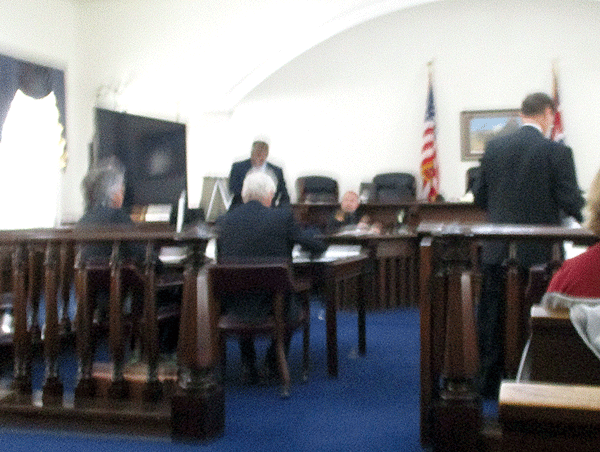
A total of 13 jurors – 11 female and two male – heard opening statements Tuesday, Nov. 8 as the trial of Hillsboro mayor Drew Hastings got under way in Highland County Common Pleas Court.
One of the two alternate jurors was excused prior to the start of the trial.
Summit County Common Pleas Judge Patricia A. Cosgrove (ret.), who is presiding, outlined jurors' instructions and obligations beginning at 8:35 a.m. She reminded jurors that Hastings is "presumed to be not guilty" of the four criminal charges that include:
Election falsification;
• Theft;
• Theft in office; and,
• Tampering with records.
According to Ohio Auditor Dave Yost, the charges against Hastings involve allegedly listing a false address on his Declaration of Candidacy form; for claiming a city refund of $500 for a vacant building he owned and for altering documents related to the refund; and for instructing a contractor to use city Dumpsters to dispose of construction debris.
Hastings’ attorney, James T. Boulger of Chillicothe, entered a plea of not guilty on each of the four counts on Aug. 1.
In his opening statements today, Auditor of State Assistant Legal Counsel Robert Smith, who was appointed special prosecutor in the case, began by telling jurors that the alleged illegal use of a city Dumpster cost taxpayers money.
"City taxpayers pay for this and they pay by the ton – in addition to a monthly fee," Smith said. "You will see a step-by-step increase in Dumpster fees."
According to Smith, the city fees had increased to approximately $6,200 during the time the mayor is alleged to have used the Dumpster or city bin for debris from his property on North High Street (the former County Annex).
"The Rumpke bill is now less than $2,000," Smith said.
Smith said the mayor demonstrated an "abuse of power" and he "cost the city of Hillsboro a great deal of money."
Boulger countered that much of the debris in the Dumpster actually came from the Paint Creek Joint EMS and Fire District building and was placed in the Dumpster under the direction of Hillsboro Safety and Service Director Todd Wilkin.
"He (Wilkin) directed Steve Pence (a former city employee) to do this," Boulger told jurors.
"If, in fact, usage of the Dumpster is a crime, then why haven't there been charges under Wilkin's direction? He was right there. He doesn't say anything. Nobody said anything about it. None of them have been charged."
Boulger frequently referenced that the case against Hastings has political connections.
The state's first witness was Sean Mahorney, a Caleb Road resident who has worked for the mayor in property demolition projects. His testimony was in relation to the allegations of illegally using the city Dumpster.
At 9:45 a.m., Smith played a 12-15-minute recording of a conversation between Mahorney and Hastings on Jan. 6, 2016. The recording was made by Highland County Sheriff's Office Sgt. Chris Bowen, Mahorney testified, with Det. Randy Sanders and Mahorney's wife, Angie, also present.
Mahorney said it was his understanding from local law enforcement that he would not be charged with using the Dumpster.
In the recording, Mahorney expresses his concern to Hastings that law enforcement wants to meet with him.
"I don't know what to tell the cops," Mahorney said.
"Look, if you, if you, if you say something … they'll have you testify," Hastings said. "I'm just saying. They're trying to find anything and everything on me. I don't remember. Hell, I don't know what the hell is dumped down there (at the city Dumpster off Railroad Street)."
Hastings also mentioned that Pence was "down there" and "none of the city employees liked him. He got fired from the county. Oh my gosh. He was bad dude, real bad."
"If this comes down to court, his name is Pence and my name is Mahorney," the witness replied.
"I have a really (expletive) good attorney," Hastings said. "I don't want to put you in a bind."
"You've already put me in a bind," Mahorney said.
"Five (plural expletive) are looking for any stretch of the imagination to hang me," Hastings said. "They want to charge me with a felony for dumping trash in a (expletive) city Dumpster. I pick up (expletive) all over town and put it in the Dumpster. If you don't give them anything, they don't have anything. It's (expletive) off the streets. (Expletive) I don't know. They don't have a case."
Hastings was shaking his head as the courtroom listened to the recorded conversation.
Later in the recording, Mahorney asked Hastings: "What should I do?"
"You don't want to go down to the sheriff's office," Hastings advised. "They might just keep you. These (plural expletive)."
Boulger continued to cross-examine Mahorney after 10 a.m.
Shawn Adkins, public works supervisor for the City of Hillsboro, was the second witness called Tuesday morning. Adkins testified that he oversees the water/sewer maintenance and street departments, which includes overseeing the Dumpster at 223 Railroad Street and ordering new Dumpsters.
“It’s a fenced-in area,” Adkins said. “All the way around’s got a drive-in gate, and it has a big gate for deliveries for semis. The big gate stays locked all the time.”
“What about the drive-in gate?” Smith asked.
“The drive-in gate’s open from 7:30 to 4 during working hours, Monday through Friday,” Adkins said.
Adkins said that the area remains padlocked, but that “all city employees, as far as I am aware” have a key to the padlock.
“When you put things to dump, do they go immediately into the Dumpster?” Smith asked.
“Not always,” Adkins said. “A lot of times we’ll dump them into concrete bins in the back. We use our loader to scoop them up then.”
Smith asked Adkins if he knew the fees imposed by Rumpke for use of the Dumpster.
“We have a flat rate of $60 a month for leaving it set there, and then they charge by the tonnage for the weight, so it varies,” Adkins said.
“What gets dumped in that Dumpster?” Smith asked.
“We pick up trash through the city,” Adkins said. “There’s trash cans in town and we pick those up every Friday and Monday, and the parks, we pick up trash at the parks, too.”
Adkins said that the trash is collected either in trash bags or placed in the dump truck and “scooped up out of the bins.”
“How frequently do you need to replace a Dumpster?” Smith asked.
“Usually, it’s only every two to three months,” Adkins said.
“Do you ever use that Dumpster for any special projects?” Smith asked.
“Yeah, we’ve got what we call a task force, and a lot of times we’ll tear down some old garages, maybe a house or clean up properties,” Adkins said. “That stuff will go in there also.”
“Did you have those special projects in the year 2015?” Smith asked.
“We have not torn anything down in 2015,” Adkins said.
“What about 2016?” Smith asked.
“The city itself has not torn anything down,” Adkins said.
Smith asked Adkins to describe “anything that caught your attention” in December 2015.
“There was a group of four working in the shop and a group of four working in the parks, and the mayor’s truck came in and a young man was driving it,” Adkins said. “I don’t know who it was. It was a maroon Ford truck. There was some construction materials, some 2x4s, maybe some drywall or ceiling tile, stuff like that.”
“What did you observe?” Smith asked.
“The gentleman pulled around the back of the building to the Dumpster and threw it in there,” Adkins said.
Adkins testified that he did not report the incident “because Randy Barr told us he was coming.”
“Earlier in 2015, did you notice any issues of the Dumpster filling up?” Smith asked.
“Yeah, earlier, I want to say in June or July sometime I ordered a new Dumpster, and it only had the trash from that Friday dumped in it,” Adkins said. “When we come back on Monday, it was clear full of stuff – construction material, 2x4s, plywood, drywall. There were also some desks in it. I did report that to Randy Barr and asked him about it. Shortly thereafter, I had to order another Dumpster.”
“Had there been any projects in the city that would have resulted in that?” Smith asked.
“There was nothing,” Adkins said.
“During 2016, how frequently have you ordered new Dumpsters?” Smith asked.
Adkins said he thought about every three months.
“In 2015, it was almost every month, I think,” Adkins said. “Sometime in the summer I ended up ordering two in one month.”
“Is that unusual, based upon what you were dumping?” Smith asked.
“Yes,” Adkins said.
“Did you notice the nature and makeup of what was in the Dumpster, other than the city trash?” Smith asked.
“It was all construction material,” Adkins said.
During cross-examination, Boulger asked if the street sweepings go into the Dumpsters.
“No, they do not,” Adkins said.
“You sure about that?” Boulger asked.
“I’m very sure of that,” Adkins said. “Since I have been in charge, they have never been.”
Boulger asked how many departments use the Dumpster. Adkins said that the public works department is the only department that places trash in the Dumpster, but that it is collected from city buildings, including the police department and formerly the Hillsboro Fire Department.
“Think back to the summer 2015. Do you recall being present at the Railroad Street yard with your safety and service director, Mr. Wilkin?” Boulger asked.
“Yes,” Adkins said.
“Do you recall an occasion when Drew Hastings came in with his pickup truck?” Boulger asked.
“Yes,” Adkins said.
“Was there anything in the back of the pickup truck?” Boulger asked.
“He dropped off some pallets, and he made a comment he’d thrown some trash in the Dumpster,” Adkins said.
“Did you see him throw the trash in the Dumpster?” Boulger asked.
“No, I didn’t,” Adkins said.
“Where were you when he made the statement?” Boulger asked.
“Inside the big maintenance building,” Adkins said.
“Where was Mr. Wilkin? Boulger asked.
“Inside the big maintenance building,” Adkins said.
“Was Mr. Wilkin in a position to hear Drew say he threw something in the Dumpster?” Boulger asked.
“Yes, he was,” Adkins said.
Boulger also questioned Adkins’ process for submitting reports to city council. Adkins said that his monthly reports “summarize” his department’s projects.
“I don’t really spell out everything we do,” Adkins said.
“At any point in time, did you report to city council that the mayor was using the Dumpster down there?” Boulger asked.
“No, I did not,” Adkins said.
“Did you ever caution the mayor that he shouldn’t use that Dumpster?” Boulger asked.
“No, I didn’t,” Adkins said.
“Did you hear anybody else caution him?” Boulger said.
“I can’t say that I heard it,” Adkins said. “I was told that he was cautioned.”
Boulger also asked Adkins if he had reported “unusual usage” of the Dumpster to city council in his reports. Adkins said he had not.
“On this time in December, the truck you identified as Mr. Hastings’ came into the yard – you were there,” Boulger said.
“Yes,” Adkins said. “Twice in one day. Once I was at the park and the other time I was standing at the maintenance shop. The second time it was man with a woman.”
“Did you watch what they did?” Boulger asked.
“Yes, I did,” Adkins said. “They backed up the truck and unloaded the trash. It was 2x4s, some ceiling tile maybe, just construction material.”
Smith asked Adkins if he “would ever challenge the mayor.”
“No, I would not,” Adkins said.
“Why not?” Smith asked.
“When the mayor first took office, the first thing he done was fire an employee,” Adkins said. “The next thing he done was get rid of the fire department. Then we had another employee got fired, and then he had another meeting with the fire department you can hear on YouTube that he was the king.”
• • •
Former street supervisor Steve Pence was the next witness and testified that he was working for the city in the year 2015. Pence also described the use of the Dumpster on Railroad Street as being a place to dispose of city buildings’ trash.
“Have you ever had occasion to see the defendant use the city Dumpster?” Smith asked.
“Yes, I have,” Pence said. “There was numerous times we would see him or his pickup truck going down to the street barn dumping stuff. The exact dates, I don’t remember, except for one exact date was in December of 2014. I seen his pickup truck in front of Bell’s Opera House. At that time, NCB Bank had some offices there that they moved out, I believe. I witnessed his truck there early in the morning. Later on that morning, I observed there were three rolls of carpet in the back of that truck, and later on that afternoon I was on the phone, and in my office at the street barn there’s a window and I seen his truck pull in. By the time I got back to open up the garage door, I seen his truck pulling away, and the three rolls of carpet was laying in the bin.”
“Did you ever have any other occasions to see the mayor’s pickup truck used?” Smith said.
“There were numerous other occasions,” Pence said. “There was an instance where [Mr. Mahorney] was pulling in down by the street barn. He had stopped and asked me where I wanted the debris dumped at, and I kind of looked at him funny and he said ‘The mayor, I’m just doing what the mayor asked me to do.’”
“What vehicle was he driving?” Smith asked.
“I believe at that time it was his maroon pickup truck,” Pence said. “So I told him to just go ahead and dump it back there. We have a Dumpster, and then we also have a bin that we dump a lot of debris in, as far as trash. That was we can scoop it up with a loader bucket and put it in the Dumpster instead of doing it by hand. So that’s where the carpet was laying, in the bin, and that’s also where I instructed Mr. Mahoney to dump his debris.”
“Did you ever report any incidents like that?” Smith asked.
“After I had talked to Shawn [Adkins] and the dumping and stuff continued on, yes,” Pence said. “Rick Giroux, the safety service director at that time, I did say something to him. It went something like ‘hey, Drew’s using the Dumpster over here to dump personal stuff in there, and I really don’t think he should be doing that.’”
“Were you aware of any other dumping related to the old fire house?” Smith asked.
“Right after the fire department had pulled the plug on it and everybody was kind of moved it, we were sent up there by the safety service director,” Pence said.
“Which safety and service director?” Smith asked.
“I believe that was Todd Wilkin at that time,” Pence said. “It might have been Rick. It was right after they moved out.
“Whatever safety service director it was, I usually take my instructions from him. We went up there and we moved, threw away some of the beds and stuff like that from the fire department. Then after Mr. Hastings bought the building and the Times Gazette offices were done, the safety service director – I believe it was Todd Wilkin at that time – sent us up there to remove some construction debris. He also said that Drew would be up there to show us what needed to be thrown away. Mr. Hastings did go up there and show us – it was mostly 2x4s, some drywall and some file cabinets and stuff like that they didn’t need.”
Boulger asked if Pence knew who owned that building.
“The city still owned it when the fire department moved out, and then Mr. Hastings bought the property,” Pence said.
“Was the fire department still there when you went up to remove the debris?” Boulger asked.
“No, sir,” Pence said. “I was up there twice. Once right after the fire department left and once after he completed the Times Gazette office.”
“On both of those occasions, you did so at the direction of the safety and service director?” Boulger asked.
“That is correct,” Pence said.
“You had city employees with you?” Boulger asked.
“That is correct,” Pence said. “I had my crew.”
“And you had a city dump truck?” Boulger asked.
“Yes, and a city loader,” Pence said.
“Do you recall approximately how many loads you hauled out of there?” Boulger asked.
“Probably two or three dump truck loads,” Pence said.
“Where did you take them?” Boulger asked.
“We took them down to the street barn and dumped them in the Dumpster,” Pence said. “Well, we probably dumped them in the bin.
“Did you consider yourself to have committed a crime in doing that?” Boulger asked.
“No, sir,” Pence said.
Pence also testified under cross-examination that in December 2014, Wilkin asked him to pick up some wood at Hastings’ Beech Street property for a city Christmas party obstacle course.
“While I was there, Mr. Hastings asked me what I was doing after I was doing that, and I told him I was going back down to the street barn,” Pence said. “He asked me if I would mind to take some debris, construction material that was back on Beech Street, down to the street barn for him. After I took the wood over there, I went back over there and Drew and I proceeded to load my truck up, and I took it down there.”
“And what did you do with it?” Boulger asked.
“I dumped it in the bin, just as he had asked me to,” Pence said.
“Did you consider yourself to have committed a crime when you did that?” Boulger asked.
“No, because I was doing what my boss asked me,” Pence said.
• • •
City employee John Michael was the next witness called to the stand. Michael, who works on the city’s water meters, told Smith that he followed the mayor’s truck from Beech Street to the Railroad Street Dumpster.
“Another employee and I were in the city truck and saw Drew’s truck leaving the Beech Street area,” Michael said. “Some debris had fell out of the truck. Some construction debris. We kind of followed it up. We picked the stuff up. Basically, it was north on North High, past the old Armory, and we picked some stuff up down around the post office. Then we picked a few more pieces up a block or so on West North before you got to the old street barn. We kind of went in there and throwed some stuff away.”
Michael said the debris was “construction materials.”
Under cross-examination, Michael testified that he could not remember the month nor the year, but “it was when it was warm because we had our windows down.”
Boulger asked if, on that occasion, they had any other debris to dump at the Railroad Street property.
“We didn’t have any other debris, no,” Michael said.
“Who else was there?” Boulger asked.
“I don’t recall any others except for Drew’s truck,” Michael said. “No other employees, other than the fellow that was with me.”
“Did you throw your stuff into the bin or into the Dumpster?” Boulger asked.
“Into the concrete bin there,” Michael said.
“Where was Drew’s truck when you did that?” Boulger asked.
“Right beside us,” Michael said.
“Drew was right there?” Boulger asked.
“Yes, he was,” Michael said.
“Did you tell him what you were doing?” Boulger asked.
“No, sir,” Michael said.
“Did you see what he was doing?” Boulger asked.
“Sitting on his truck and holding the phone,” Michael said.
• • •
Jonathan Blankenship, a member of the water/sewer maintenance crew, provided testimony on what he witnessed near the city Dumpster on Railroad Street.
“We were installing park benches and noticed a maroon Ford when we were down there pulling into the street barn. The bed was loaded with what looked like construction materials,” Blankenship said. “We continued to work, and shortly after that we noticed the truck pull out and the bed was empty.”
Blankenship said the driver “looked like a young boy” and the truck “looked like Drew’s.”
• • •
Harley Stafford, a laborer with the City of Hillsboro, testified that he witnessed “Mr. Hastings’ maroon colored Ford pull in” to the city’s Railroad Street property on one occasion, with debris in the bed of the truck.
Under cross-examination, Stafford testified that he was “not sure of the date” or the month, but that it was “toward the end of last year” and that he did not see what the truck did with the debris.
• • •
Hillsboro Police Chief Todd Whited testified that on Dec. 11, 2015, he was getting breakfast at a local business when he was called to go to the street barn on Railroad Street.
“Did anything catch your attention?” Smith asked.
“Construction materials in the city’s Dumpster,” Whited said.
“Did you observe anybody putting the materials in the Dumpster?” Smith asked.
“I did not,” Whited said.
Whited said that he took photographs of the city’s Dumpster with the construction materials inside and called the Bureau of Criminal Investigation and Identification, asking to meet with them.
“Did you advise them of whoever you suspected was doing the illegal dumping?” Smith asked.
“I did,” Whited said.
“Who was that?” Smith asked.
“Mayor Hastings,” Whited said.
Whited said that he then turned the case over to the sheriff’s office, as it “appeared to be a conflict of interest” for his office to investigate.
Under cross-examination, Boulger asked if the date of Dec. 11 was “before or after you conversed with law director [Fred] Beery concerning what it would take to remove the mayor from office.”
“It was before,” Whited said.
Boulger asked how many times Whited had contacted BCI prior to calling about the Dumpster.
“As chief, one other time,” Whited said.
Whited said that he held a conference with BCI agents, Todd Wilkin and Shawn Adkins, followed by a later conference with Highland County Sheriff Donnie Barrera and detectives from the sheriff’s office.
“Did you involve yourself in the investigation of this refund check of $500?” Boulger asked.
“Other than giving information, no,” Whited said.
Whited said that information was given to him about the check by Wilkin.
“When did that happen?” Boulger asked.
“It would have been later in the day after the meeting with BCI,” Whited said.
“You’ve had differences of opinion with the mayor regarding staffing,” Boulger said. “They predate this December 15th, 2015, do they not?”
“No,” Whited said.
“They’ve arisen since his re-election?” Boulger asked.
“Yes,” Whited said. “If they predated it, it was by a couple of weeks, if that.”
“So at that point of time, when you’re photographing the contents of the Dumpster and receiving materials from safety director Wilkin and contacting BCI, it’s a couple weeks after you’ve developed a difference of opinion with the newly re-elected mayor concerning staffing in your department,” Boulger said.
• • •
Following a lunch recess, the jury heard a video recording of testimony by City of Hillsboro administrative assistant Heather Collins. Collins was examined and cross-examined earlier this fall due to her pregnancy, as her due date was Nov. 8, the date of the trial.
Collins testified that she works with three supervisors: Hastings, Wilkin and administrative assistant to the mayor Debbie Sansone. Collins also works with receptionist Mindy Gall, she said.
“Are you familiar with Hillsboro’s ordinance regarding vacant buildings?” Smith asked.
“Yes, I am,” Collins said.
“Do you have a role in that process?” Smith asked.
“I accepted the registration forms, sent out the letters, kept track of dates and times, time periods for the owners,” Collins said.
“How long has that ordinance been in effect, do you know?” Smith asked.
“I believe it was 2014, but I cannot say for sure,” Collins said.
“Within that role, did you become familiar with the property known as 135 North High Street, Hillsboro, Ohio?” Smith asked.
“Yes, sir, I did,” Collins said.
Collins said that the property was owned by Firehouse Square Partners and that its principal owner was Hastings.
“What is the process for identifying a building as vacant?” Smith asked.
“The code enforcement officer would visually see that a property was vacant,” Collins said. “A letter would be sent out to the owner, then the fire inspector would be scheduled to do an inspection of the property with the owner, and that’s how we found out that it was vacant.”
Collins said that Hastings was sent a letter on Oct. 14, 2014 that his property had been found vacant following an inspection.
“What would be the next step required of the property owner?” Smith asked.
“The property owner would have 30 days to fill out a vacant building registration form, do a checklist, submit a plan and pay the $500 fee,” Collins said.
“In this case, was a vacant commercial building registration form prepared?” Smith asked.
“Yes,” Collins said, and said that she filled out the form and it was signed by Hastings Nov. 13, 2014.
“Did Mr. Hastings also have to tender a fee for that building?” Smith asked.
“Yes, he did,” Collins said, adding that Hastings paid the fee to Collins via check.
“How many fees have been brought in by the city of Hillsboro under the vacant building registration fees?” Smith asked.
“Six,” Collins said.
“Was a plan ever submitted by Mr. Hastings?” Smith asked.
“No, we only received the registration form,” Collins said.
“Did you later come across a document in which the fee was directed to be refunded to Mr. Hastings?” Smith asked.
“Yes, sir,” Collins said. Collins said she first received the document June 24, 2015.
“Under what circumstances did you see that document?” Smith asked.
“I returned from a meeting, and the letter was setting on my chair,” Collins said.
“Was it the original letter or a copy?” Smith asked.
“A copy,” Collins said.
Collins said that she had previously had conversations with Hastings and Wilkin regarding refunding the fee.
“Somewhere in the beginning of June, Drew Hastings pulled me in his office and asked for his vacant building registration fee back,” Collins said. “[I told him] he wasn’t going to get it back. [I told him] the property was still vacant.”
Collins said the mayor responded that “he needed the fee back.”
“I told him the only thing I could do was to talk to Todd Wilkin about it,” Collins said.
Collins said that she did meet with Wilkin but that her opinion on the issue did not change.
“When you saw the copy of the memo, what did you do with it?” Smith asked.
“I threw it across the room,” Collins said. “I was angry. I didn’t feel he deserved his money back.”
“Did you discuss that memo with Todd Wilkin at that time?” Smith asked.
“I did not,” Collins said. “I was too angry with him. I thought he was the one that gave the permission for it.”
“Did you prepare that memo?” Smith asked.
“I did not,” Collins said.
Smith presented Collins with the original copy of the memo, which reads that it is from Wilkin to auditor Gary Lewis, asking for a refund for the vacant building registration fee.
“Do you notice anything that catches your attention about that memo?” Smith asked.
“Yes,” Collins said. “It’s a memo on cream card stock. I do not use cream card stock.”
“Does anybody in that office use cream card stock?” Smith asked.
“Yes,” Collins said. “Debbie Sansone.”
“Is this signed by Todd Wilkin?” Smith asked.
“No, it is not,” Collins said. “That’s the signature stamp that I keep in my desk drawer.”
“Is it locked or secured?” Smith asked.
“No,” Collins said.
“Are other people in the office aware you have that name stamp?” Smith asked.
“Yes,” Collins said. “Mindy Gall, Debbie Sansone, Drew Hastings and Todd Wilkin.”
“Is there anything unusual about that [stamp signature]?” Smith asked.
“My initials aren’t on it, that I used the stamp,” Collins said. “At the beginning of 2015, Gary Lewis, the auditor, told me that he would not accept any documents from me using the stamp unless my initials were on it.”
Collins was also questioned about the mayor’s property on Caleb Hill Road, which she said she had visited.
“Does [Hastings] live there with anybody else?” Smith asked.
“Taryn Hastings and Willow Becker, his stepdaughter,” Collins said.
Collins testified that she had babysat for Willow “frequently, two to five times a week,” for most of 2014 and 2015.
“Describe how Willow would come to you,” Smith said.
“She would be dropped off at my house,” Collins said. “I would pick her up from school. I’ve picked her up from the loft on Beech Street before, and she has been dropped off at the office.”
Collins said that she would then babysit the child at her home, which is about one mile from the Caleb Hill Road property.
“When you are traveling from Hillsboro to your house, did you go past Caleb Hill Road?” Smith asked.
“No,” Collins said.
“So, if you were to go to Caleb Hill Road, you then had to continue on from your house?” Smith asked.
“Yes, about a mile,” Collins said.
Collins said that Hastings’ wife typically picked up her daughter in the evenings.
“Would you see her leaving your house?” Smith asked.
“Yes,” Collins said.
“In what direction would she be going?” Smith asked.
“Towards Caleb Hill Road,” Collins said.
“From your house that would be away from Hillsboro?” Smith asked.
“Yes,” Collins said.
Collins testified that she had been in the mayor’s Beech Street property, describing it as a “one- bedroom apartment” with “one bed.”
Under cross examination, Collins told Boulger that there have been no deposits made regarding the vacant property ordinances in 2016.
“So the six deposits would have been made in either 2014 or 2015?” Boulger asked.
“Correct,” Collins said.
Collins said that only one of the six deposits has been returned.
“Can you recall if there has ever been an inspection made by the fire chief for the purpose of determining whether or not there ought to be a refund of a deposit?” Boulger asked.
“Not to my knowledge,” Collins said.
Collins told Boulger that she saw the copy of the memo following her return to the office after a meeting at the hospital. She said that she did not discuss the letter with Wilkin until January 2016.
“After you learned there was some sort of investigation?” Boulger asked.
“Correct,” Collins said.
“What did you do with the letter?” Boulger asked.
“I filed it,” Collins said. “I put it in the file with all the vacant building registration forms. I have my own personal file for them.”
Collins said that she took it out of the file once to fulfill a records request by Municipal Court Judge David McKenna, and after that it was taken as part of the investigation. The records request came in during the city’s litigation over a vacant building owned by Jack Hope, Collins said.
Collins said that she did not see an original copy of the letter until Oct. 4, 2016.
“I know how our office works, and I feel it’s an original,” Collins said. Collins said she was “100 percent sure” it was a stamp signature because she has used the stamp “hundreds of times.”
“That’s part of your responsibility as a city employee?” Boulger asked.
“Not now, but yes, it was then,” Collins said. Collins said the usage of the stamp stopped in December 2015 when BCI began their investigation.
“Does the city or the auditor’s office in particular have any written protocol for the use of the signature stamp with the auditor?” Boulger asked.
“Not to my knowledge,” Collins said. Collins said that her use of the stamp was always “under written or oral permission” from Wilkin and that she believes Lewis’ request for her initials came in 2014 or early 2015. The memo was written after Lewis’ request, she said.
Collins also testified regarding her babysitting of Hastings’ stepdaughter, saying she often watched the child overnight. Her babysitting began when the mayor began dating his wife and ended when the investigation began in December 2015, she said.
Boulger asked Collins if she had “been given any assurances from law enforcement or counsel.”
“Has anyone ever said to you that you don’t have anything to worry about?” Boulger asked.
“Yes, legal counsel for the city of Hillsboro,” Collins said.
“That would be Mr. Fred Beery?” Boulger asked.
“Yes,” Collins said.
• • •
Paint Creek Joint EMS/Fire District Chief Bradley George also testified on Tuesday afternoon. George described his responsibilities regarding vacant building inspections.
“I was the city inspector for the vacant building inspections from 2014 until – to be honest, I was never notified that we were not,” George said. “The way the ordinance reads, it was the duty of the fire chief to go out and perform the inspection to determine if the building was vacant.”
George said that he had inspected Hastings’ property at 135 North High Street, Hillsboro.
“I was notified to do the inspection,” George said. “As I recall, the administrative assistant, Debbie [Sansone], called and set the appointment up.”
“When was the inspection?” Smith asked.
Upon looking at the state’s exhibit, George said it was Sept. 29, 2014.
“What is your process during an inspection?” Smith asked.
“After it’s set up, I’ll meet with the building representative, usually the owner,” George said.
George said he met with Hastings and that George had done two other inspections on that date.
Smith asked if the building owner can take any steps to have the building declared occupied.
“You would come back with either a plan or a set of plans and get an occupancy permit,” George said.
“Does it have to be re-inspected by the fire chief?” Smith asked.
“Per the ordinance, I believe so,” George said.
George said that he did not re-inspect the property at North High Street. Upon looking at photographs of the building, he said he did not feel it “qualifies as being occupied.”
“You can see where the front of the building is opened up, and it looks like there’s some kind of construction going on,” George said. “The windows on the third floor are nonexistent, just boarded up.”
George said that “nothing’s changed” at the property since his initial inspection.
Boulger asked if George had “familiarized himself with the ordinance,” to which George responded yes.
“You have inspected how many buildings, do you believe, during the period of the effectiveness of this ordinance?” Boulger asked.
“In two years we’ve done it, maybe a dozen,” George said.
“How many inspections have you made of already determined vacant buildings to see whether or not they qualify for occupancy?” Boulger asked.
“After they’ve already been deemed vacant? None,” George said.
“With respect to the fees that are collected once a building is determined to be vacant and is registered, what, if any responsibilities do you have under the ordinance with respect to those fees being refunded?” Boulger asked.
George said he “believed they were done under the city administration.”
Boulger then gave George a copy of the vacant property ordinance and asked him to read a highlighted section.
“Would I be correct that, under this particular ordinance, it is your responsibility to refund registration fees if it is appropriate?” Boulger asked.
“According to what I’m reading here, yes,” George said.
“So your first impression that perhaps it was the auditor’s office’s responsibility to refund the fees doesn’t seem to comply with the text of the ordinance, does it?” Boulger asked.
“No,” George said.
“Have you ever handled any of the registration fees?” Boulger asked.
“No,” George said.
“Do you know where the fund is kept?” Boulger asked.
“No,” George said.
“Do you understand that the exclusive purpose of the funds generated by the registration fees is to pay for the enforcement costs of the ordinance?” Boulger asked.
“No sir, I did not,” George said.
“Would I be correct in concluding that you have not participated in any effort to enforce this ordinance since sometime in the early spring of 2015?” Boulger asked.
“I believe that to be correct,” George said.
• • •
City of Hillsboro receptionist Mindy Gall testified that she worked for the city since May 2015, but that she was not assigned the responsibility of typing until the past month. When presented with a copy of the memo, Gall said that she did not recognize it and that it had no significance to her.
• • •
City of Hillsboro deputy auditor Annette Black was the next witness, and she discussed the city’s Dumpster usage.
Black read from a contract with Rumpke provided by the state that details the city’s fees from the company for use of the Dumpster on Railroad Street. Black stated that the city is billed monthly, including a hauling fee, service fee and for the tonnage of waste.
Black read a detailed expense report dating back to 2012 with the yearly payments to Rumpke, which were: 2012, $3,036.03; 2013, $3,435.41; 2014, $4,290.81; 2015, $6,287.07; and 2016, $1,973.84.
“Do you have any role at the auditor’s office with the vacant building program?” Smith asked.
“Yes,” Black said. “I would issue a refund for paperwork that came back. I would issue the purchase order and submit it for payment.”
“Would you also have received the fees themselves that were submitted by the vacant building owners?” Smith asked.
“Yes, I would have deposited them,” Black said.
Black said that she deposited the check issued by Firehouse Square Partners for the vacant building fee.
“If there’s a refund being issued, whose office would that come through?” Smith asked.
“The service administration,” Black said. “The safety and service director, Todd Wilkin.”
Black said that she received a request for a building refund fee, and upon receiving a copy of a letter requesting the refund, Black said that she recognized her “purchase order writing on it and the account number on it to charge.”
After Black read the letter aloud, Smith asked if she had “any concern” with it.
“Not at the time,” Black said. “I took it to the auditor, Gary Lewis, and asked which account number he wanted to charge this to because this was the first vacant building refund I’d seen.”
Black said Other-Miscellaneous-Refunds was charged.
Upon cross-examination, Black said that she does not create detailed expense spreadsheets for Rumpke costs except when requested. She said that she could not recall who requested her to make a spreadsheet listing the city’s payments or when she issued the report except that it was in 2016.
“Did you do so for any of the other Dumpster rentals for the city of Hillsboro?” Boulger asked.
“Not to my recollection, no,” Black said.
“Does the city of Hillsboro have other Dumpster rental agreements?” Boulger asked.
“Yes we do, with Rumpke,” Black said.
Black said that the city has “probably around 10” Dumpsters in the city, including three on North High Street and ones at the city parks in addition to the Railroad Street Dumpster.
“Are you aware of any city policy that prohibits one department from using another department’s Dumpster if they run out of space?” Boulger asked.
“I don’t know of any policy,” Black said.
Boulger asked Black where she was told to deposit vacant building registration fees received by the auditor’s office. Black said that the funds are placed in a checking account.
“Do you know what purposes that account is dedicated to?” Boulger asked.
“Accounts payable,” Black said. “I’m not sure of anything else.”
Boulger asked if Black knew that the fees were “to fund the enforcement of that ordinance only.”
“They go into that account,” Black said. “They are in our computer system, in our software program. Those monies are deposited into that particular account that they’re specified for.”
“But they go into a general checking account?” Boulger asked.
“Yeah,” Black said.
“Who instructed you that the auditor’s office had the authority to refund a vacant building fee?” Boulger asked.
“I went by the letter,” Black said. “It was signed off by Todd Wilkin, safety service director, so we went with that.”
“Did you not understand that under the express terms of the ordinance, it was the fire chief who had the authority to issue a refund, not the safety service director?” Boulger asked.
“I was not given that information,” Black said.
Boulger show Black a copy of the letter asking for the refund. Black said that she was out of the office June 24-26 and would have seen it the following Monday.
“I went through the paperwork that was left in my tray on my desk,” Black said.
“Didn’t you notice that there was a failure on the face of the document to comply with a requirement your immediate supervisor Gary Lewis had put in place sometime a year earlier, maybe more?” Boulger asked. “Your auditor’s office was not going to accept any instrument that bore a stamp signature without the initials of the person that had used the stamp.”
“Correct,” Black said. “I didn’t think of the signature as being a stamp.”
“You thought it was an original signature?” Boulger asked.
“Yes,” Black said.
Black said that she filed the document and did not see it again until she was “asked about it … I guess when they were questioning the signature.” Black said she thinks Lewis asked her about it but was not sure.
Black also testified that she “didn’t notice anything strange” about the document and that it remained in the city auditor’s office until it was retrieved during the investigation.
• • •
Hillsboro safety and service director Todd Wilkin was the final witness on Tuesday afternoon and began his testimony with background on the vacant building ordinance.
“In 2013, I started with the city of Hillsboro,” Wilkin said. “Soon after starting, the mayor identified that there were several blighted and vacant properties in town, and one of his goals was to remove the blight from Hillsboro. The mayor, myself and law director Beery got together in May 2013 and started writing the legislation. It went through many forms. Finally, in in November 2013, we introduced it to city council. In early 2014, I believe February, council passed the legislation and we started enforcing it thereafter.
“As part of the legislation, the three of us knew in order for the legislation to be effective, we had to have ‘teeth.’”
“What was the purpose of the fee for the building?” Smith asked.
“So the ‘teeth’ I was referring to was the fee that we created within the legislation, and the fee was registration,” Wilkin said.
Wilkin said that in subsequent calendar years, the fee would increase to $1,000 per year.
Smith asked about the procedure for “determining a property to be vacant.”
“There are several factors,” Wilkin said. “In the legislation, we were very clear to say what would identify a building as vacant, so if there was an accumulation of trash within the building, if there was an accumulation outside the building, broken windows, holes in the ceiling or a neighbor could complain about the building.
“The process would then come to the city. The city would write a letter to the property owner asking them to request a meeting with the fire chief. The fire chief would come out and do a walk-through inspection with the property owner. At that point, if the fire chief found that the building was in fact a vacant building, he would declare it a vacant building. You then had 30 days to register as a vacant building within the city of Hillsboro.”
Smith asked if it was possible to obtain a refund.
“Yes,” Wilkin said. “First of all, you had to remove the vacancy, and to remove the vacancy you had to meet the Ohio Building Code standards.
“The other component of getting a refund back was also timetable. The legislation was very specific to say that it’s within a calendar year.”
Wilkin testified that a re-inspection must be performed by the fire chief and by the certified building official of the city. No buildings have qualified for a refund, Wilkin said.
Wilkin was then asked about the property at 135 North High Street.
“In 2014, when the mayor purchased the building – I believe he purchased it under Firehouse Square Partners – I actually went in the building,” Wilkin said. “The building was still intact, meaning there were interior walls, an electrical system was still in intact, HVAC system was still operational, ceilings were installed … the building was as if someone had just moved out.”
In 2014, Wilkin said that Collins was asked to send a letter to the mayor to schedule an inspection meeting to determine if the building was vacant. Upon inspection, the property was declared vacant, Wilkin said.
“Was ever any plan filed to bring the building up to code?” Smith asked.
“There was no plan filed,” Wilkin said. “I did talk to the mayor about a plan. At the time, he had informed that he wanted to demo the walls and that he would be submitting a plan for a coffee house in that location.”
Wilkin said that there was never a re-inspection of the building.
“Did you ever become aware that the mayor wanted his fee refunded to him?” Smith asked.
“Yes,” Wilkin said. “Heather Collins and Debbie Sansone both came to my office demanding on behalf of the mayor that he get his refund back. What I did with Heather Collins and Ms. Sansone is I pulled out the legislation, and I reviewed the legislation with them, showing them why the mayor was in fact not entitled to his refund. I informed them the building was still a vacant building. I also informed them that the timetable had expired for him to be eligible to receive a refund.”
Wilkin said he met with Collins and Sansone on two separate occasions in June 2015.
He then learned of the refund issued to the mayor during a trial for another property owner, whose property was declared vacant and who refused to register the building as a vacant property.
“The pretrial was set in September, and at this time at the pretrial is when I believe I learned that the mayor had received his fee back because I had informed Chief Bradley George at his pretrial that the mayor had indeed received his refund and that I did not agree with why he received his refund and that I did not know who he received his refund,” Wilkin said.
“At what time did you first see any documentation establishing why Mayor Hastings was issued a refund?” Smith asked.
“It would have been December 15, 2015,” Wilkin said. “BCI was in town. They were doing an investigation of theft in office against Mayor Drew Hastings, and they asked me to come out to the sheriff’s department and do an interview with them.”
Wilkin said that he went to the auditor’s office and asked Lewis for a canceled check for the refund.
“For the first time, I saw the letter that had my signature on it,” Wilkin said. “I took the original letter and went over to the copier and made a copy. I asked Mr. Lewis, ‘Now that you know this letter exists, will you be contacting the state auditor? He informed me that he had an obligation to do so.”
Wilkin testified that it was not his signature appearing at the bottom of the letter.
“It’s important to note that when I obtained this letter, I went straight to Heather Collins’ desk and asked her for my signature stamp,” Wilkin said. “I took the signature stamp and went straight back to my office, and I put a Post-It note next to my signature. I took my signature stamp, and I stamped my name, and it matched exactly.”
Wilkin testified that he had not written the letter or asked anyone else to write it on his behalf, and he said that he “did not agree with the content of the letter.”
“The last sentence of the letter says the building is no longer considered to be a vacant building,” Wilkin said.
Wilkin said that is in contradiction to what he witnessed in the fall of 2015, when he helped hang a re-election banner for the mayor on the side of the 135 North High Street property.
“I was in the building on September 10 to help the mayor hang the banner,” Wilkin said.
Wilkin took a photo of the banner inside the property to show “how we proposed laying it out,” but the photo also “shows construction debris, shows no interior walls, no floor finishes, no electrical system within those walls.”
“What was the condition of the inside of that first-floor area?” Smith asked.
“It was a vacant building,” Wilkin said.
Smith also presented another photo as evidence, also taken by Wilkin, of the banner on the outside of the building on Sept. 11, 2015.
“The front of the building, it’s obvious in the picture there was still a large gaping hole in the storefront of the building,” Wilkin said. “There were two sheets of plywood on the inside of the building being held in place, and also on the third floor there was two window panes that were missing, which again does not meet the vacant building legislation standards.”
Wilkin was then asked to describe the mayor’s property on Caleb Hill Road.
“It’s a three bedroom home, and when you walk in through the garage, there’s a dining room there with a patio door that goes out the back deck,” Wilkin said. “A kitchen, a bathroom, the three bedrooms and a living room in the front, and fully furnished.”
“Who have you seen in that house?” Smith asked.
“Drew Hastings,” Wilkin said.
“Any other family members?” Smith asked.
“No,” Wilkin said.
Smith then asked Wilkin about the use of the Dumpster on Railroad Street, which Wilkin said was used to empty the “trash receptacles throughout town” and was paid for by the city with taxpayer dollars.
“Are private citizens allowed to dump?” Smith asked.
“No,” Wilkin said.
Under cross-examination, Boulger asked if the city had an ordinance to “prohibit private use of the city Dumpster.”
“I don’t believe that there is,” Wilkin said.
Wilkin said that there was “a locked gate,” but “no trespassing signs are not present.”
“How many Dumpsters does the city actually rent from Rumpke?” Boulger asked.
“At this location, there’s one Dumpster that is rented,” Wilkin said. “There are several throughout town.”
Boulger asked how Wilkin “gained that knowledge that Mr. Hastings purchased that property” at 135 North High Street.
“Mr. Hastings informed me,” Wilkin said. “It would have been I believe in about 2014.”
“Did the ordinance place any requirements with respect to a seller wishing to sell a vacant building to another person?” Boulger asked.
“There are requirements within there that states that the new buyer has to register the building,” Wilkin said.
Boulger asked if Wilkin and Hastings engaged in conversations on the renovation of the building.
“We had had discussions about several properties that Mr. Hastings owned about possibly being a contractor,” Wilkin said. “There were discussions. No contracts.”
Wilkin testified that he had given his “thoughts based upon construction.”
“Construction that you might have involved yourself in, as far as you knew at that stage?” Boulger asked.
“The mayor always asked construction questions because that was my past job,” Wilkin said.
“Did you understand that your responsibilities under the ordinance included authorization of refunds of fees that had been deposited?” Boulger asked.
“No, the refunds were issued based upon a re-inspection given by the fire chief,” Wilkin said. “It says that he can give the approval.”
Boulger showed Wilkin the text of the vacant building ordinance.
“Does the paragraph provide that the fire chief shall refund the fees?” Boulger asked.
“It says the fire chief shall refund if building codes are met, yes,” Wilkin said.
Boulger then asked if Wilkin first saw the letter asking for a refund at the auditor’s office, to which he responded yes, and why he had gone there.
“The interview that I had with BCI,” Wilkin said.
“Is that the interview where you indicated to BCI that you might have sent an email to the auditor authorizing the reimbursement of the fee?” Boulger asked.
“No,” Wilkin said.
“Do you remember suggesting to the BCI investigator that that might have happened?” Boulger asked.
“No,” Wilkin said.
Boulger showed Wilkin a transcript of an interview between an investigator and Wilkin.
“Did you discuss with an investigator the matter of whether you emailed, or could remember emailing, an authorization to issue the refund?” Boulger asked.
“Based upon this transcript, I would say that I made those comments, yes,” Wilkin said. “I recall going back to Gary Lewis’ office and asking him how it was determined that he received the refund.”
Wilkin again testified that he made a copy of the letter and compared the signature with that of his signature stamp and said that council president Lee Koogler also witnessed this. The stamp was later turned over as part of the investigation, Wilkin said.
Boulger questioned Wilkin on visiting the Caleb Hill Road and Beech Street properties owned by the mayor. Wilkin said that he had been to both locations and was “familiar with the interior.”
“I was actually invited to answer some questions related to construction matters,” Wilkin said. “I went to Caleb Hill Road because the mayor was having plumbing issues, and he asked me questions about issues with plumbing at his home.”
Wilkin indicated that he recognized a Dayton magazine photo spread of Hastings’ Beech Street loft, where he said he had also visited in regards to construction questions. He agreed that the photo was an “accurate representation … as best as I can recall.”
Boulger then referred to earlier testimony that stated that Wilkin instructed the street department, “specifically Steve Pence, to take his crew up there [to the mayor’s property on Governor Trimble] and clean up some of the debris that had been left.”
“There were many documents that was left over by the city, and the mayor had asked me to go down and remove those documents and take them to the fire house, so I did ask Mr. Pence to load up those documents and take them to the fire house, and that’s where they sit today,” Wilkin said.
“You did not direct Mr. Pence to load up debris out of that building into a city dump truck and take it down to the Railroad Street yard and dump it?” Boulger asked.
“I do not recall that discussion, no,” Wilkin said. “I never directed Steve Pence to load a Dumpster.”
“Do you recall being present in the yard down there on Railroad Street at a point in time when Mr. Hastings came into the yard with his pickup truck?” Boulger asked.
“I was in the streets barn, yes,” Wilkin said.
“Did you have a conversation with Mr. Hastings on that occasion?” Boulger asked.
“Mr. Hastings came around the corner and informed us that he had just dumped some materials in the Dumpster and also left some skids for us to store,” Wilkin said. “I believe it was summer of, I believe, 2015.”
“Did you caution Mr. Hastings that he was not privileged to use the Dumpster in that fashion?” Boulger asked.
“Not at that time,” Wilkin said. “The next day, we had the discussion. The mayor informed me it was part of being the mayor. It was a perk, were his exact words.”
Wilkin said that he met with the mayor “away from other employees.”
“When you heard his response at that point, you realized you had a duty to report a crime. Is that true?” Boulger asked.
“Mr. Hastings informed me that it was a perk,” Wilkin said.
“Did you think that you had witnessed criminal behavior?” Boulger asked.
“At the time, I didn’t know what he put in the Dumpster,” Wilkin said.
“What difference does it make what it was?” Boulger asked.
“With being the mayor of Hillsboro, this mayor took ‘no’ very hard,” Wilkin said.
“That isn’t my question,” Boulger said. “Did you think that you had witnessed a crime?”
“I didn’t know what I witnessed, to be honest with you,” Wilkin said.
“Do you recall expressing your concern to the investigators, Howard and Detective Chris Bowen, that if they didn’t speed up this investigation and bring it to a head that you might lose your job?” Boulger asked.
“I don’t recall those words,” Wilkin said. “I don’t recall expressing those thoughts.”
Boulger asked Wilkin about the date of June 24, 2015, when the letter requesting a refund was dated. Boulger said that Wilkin was “able to establish that you weren’t in the office on June 24, 2015.”
“I had a doctor’s appointment in the morning, and I had a meeting at the hospital in the afternoon,” Wilkin said.
Boulger asked if Wilkin had looked at the computer data for the letter. Wilkin said he did not look into it because BCI and the state auditor’s office were handling the investigation at that time.
Smith then interviewed Wilkin a second time, asking him to read a portion of the transcript of his testimony during the investigation. In it, Wilkin said, “I went into [the auditor’s] office and said, ‘Gary, how did he get refunded that money back?’ And it had been six months … I said, ‘Did I send you an email?’ I mean, I asked. I didn’t know.”
“So what’s going through your mind when you’re in Gary Lewis’ office when you’re uttering these words?” Smith asked.
“I simply did not know how the mayor got his refund back, and I was asking him if he knew,” Wilkin said.
“Were you thinking that maybe it was something you had done?” Smith asked.
“Yes,” Wilkin said.
Upon seeing the letter, however, Wilkin testified that he had not written it.
Smith also asked Wilkin about “sending Steve Pence over” to retrieve documents.
“There were checkbooks, receipts, some planning commission notes – it was all city documents left over from when the city sold that building and abandoned that building,” Wilkin said. “The documents are actually all stored up in the ceiling of that property.”
Wilkin said he “had no problem” asking the street department to retrieve the documents because they were city property.
“So what you were talking about were, in fact, city records?” Smith asked.
“That is correct,” Wilkin said.
Wilkin said that he was aware that the city has a records retention policy.
“So you couldn’t just say ‘dump them,’” Smith said.
“That is correct,” Wilkin said.
Boulger responded to the questions by asking about the earlier testimony.
“So if city employees have recalled taking three dump truck loads out of that building over there and taking them down to Railroad Street and dumping them in the Dumpster, they didn’t do it under your direction?” Boulger asked.
“That is correct,” Wilkin said.
“And as far as a refund goes, no one’s ever gotten a refund?” Boulger asked.
“That is correct, except for the mayor,” Wilkin said.
“And nobody’s ever going to get a refund,” Boulger said.
“If the building becomes non-vacant, they will get a refund,” Wilkin said.
“You understand that the fire chief has not made a single inspection since February of 2015, don’t you?” Boulger asked.
“That is not true,” Wilkin said.
Smith asked if “the person who does the vacant building inspections changed.”
“The vacant building legislation has gone through a few modifications,” Wilkin said. “When Chief Bradley George was off on an investigation, the certified building official took his place by direct order of myself and guidance of Fred Beery, and we have done inspections throughout the year of 2015. The last letter that we sent out in 2015 was September the 30th.”
At the conclusion of Wilkin’s testimony, the jury was dismissed for the day and asked to report back at 8 a.m. Wednesday. Check back to highlandcountypress.com on Wednesday for a complete report of the trial proceedings.