


UPDATED: Hastings found not guilty on theft, election falsification; two charges dismissed
Lead Summary
By
Caitlin Forsha-crforsha@gmail.com
A jury of 10 women and two men found Hillsboro mayor Drew Hastings not guilty on charges of theft and election falsification Wednesday afternoon.
Hastings was facing four criminal charges that include:
• Election falsification;
• Theft;
• Theft in office; and,
• Tampering with records.
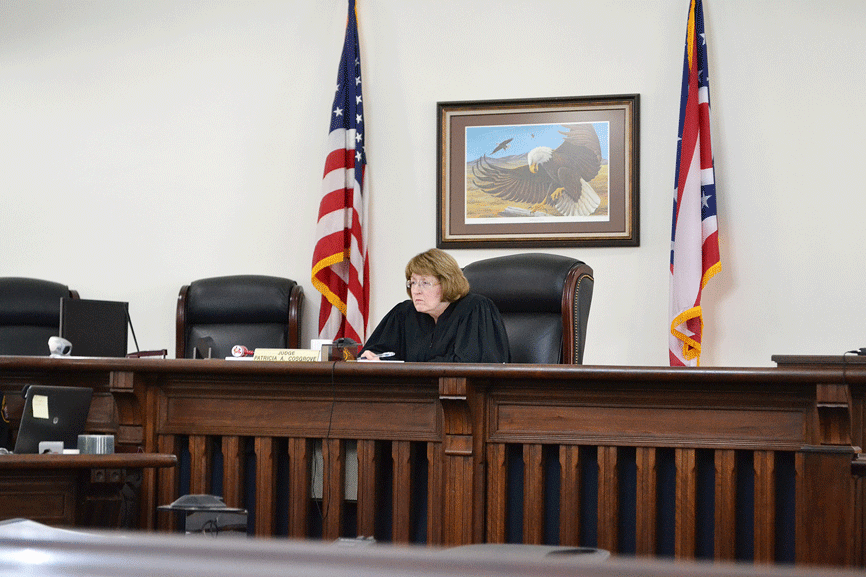
Former Summit County Common Pleas Judge Patricia A. Cosgrove, who presided over the criminal trial Hastings in Highland County Common Pleas Court this week, earlier dismissed the theft in office charge and the tampering with records charge against the Republican mayor.
After the jury received the case around 2 p.m. Wednesday, the court reconvened at 4:08 p.m. Highland County Clerk of Courts Dwight O. "Ike" Hodson read the verdicts delivered by the jury, which stated that the jury found Hastings not guilty of theft and election falsification.
(To read about the first day of the trial, go to: http://highlandcountypress.com/Content/In-The-News/In-The-News/Article/UPDATED-Hastings-trial-begins-jury-hears-recorded-conversation-between-mayor-Mahorney/2/20/35756.)
• • •
Proceedings on Wednesday began with Highland County Board of Elections director Debbie Craycraft appearing on behalf of the state. Craycraft reviewed several documents from the Board of Elections relating to Hastings and verified their authenticity, including:
• A voter registration form from Sept. 21, 2004, listing Hastings’ address as 4710 Caleb Hill Road, Hillsboro.
• A voter confirmation form dated Sept. 1, 2010, listing Hastings’ address as 4710 Caleb Hill Road.
• An application for a provisional ballot, dated Oct. 26, 2010, listing Hastings’ address as 449 East Main Street, Hillsboro.
• A declaration of candidacy to run for mayor, dated Jan. 7, 2011, listing Hastings’ address as 449 East Main Street.
• A voter registration form dated Aug. 31, 2011, listing Hastings’ address as 101 South West Street, Hillsboro.
• A voter registration form dated Jan. 9, 2015, listing Hastings’ address as 107 West Beech Street, Hillsboro.
• A declaration of candidacy form dated Jan. 12, 2015, listing Hastings’ address as 107 West Beech Street.
Prosecutor Robert Smith asked Craycraft for the board’s protocol if someone questions “an officeholder’s residence.”
“If the voter or the person that’s concerned, if they give us their name, we have to call the Secretary of State because we are under them,” Craycraft said. “We contact them, and then they tell us how to proceed.
“We call the state, and depending on what the situation is, they tell us how to proceed from there.”
Craycraft says that their board does not do any investigations.
During cross-examination, Craycraft told defense attorney James Boulger that the board has not done an administrative hearing on such an issue since 2004, when she was not the director.
Boulger asked Craycraft about the paperwork reviewed during the state’s examination.
“When a voter changes their residence, they’re supposed to notify the board, aren’t they?” Boulger asked.
“Yes, so they’re voting in the right precinct,” Craycraft said.
“Was there ever any protest associated with that change of voter residence that’s recorded on that 2010 document?” Boulger asked.
“No, there was not a protest,” Craycraft said. “Phone calls.”
Boulger asked if the board received any complaints on the voter candidacy form filed in 2011.
“No, not a protest, phone calls,” Craycraft said.
Craycraft said that there were no protests from voters on the change to 104 South West Street, but that the board “did have phone calls again” regarding the change to 107 West Beech Street.
• • •
Kenny Howard, a fraud investigator with the Ohio Auditor’s office, testified on his role in the investigation, to which he was assigned in “late December 2015.”
“The first meeting I had with the Highland County Sheriff’s Office was January 4, 2016,” Howard said.
Smith asked Howard to describe his process of investigating the vacant building fee refund.
“We conducted interviews, did a consent to search on two city computers and also a search warrant was issued on a city computer,” Howard said. “The first one we did was for the computer of Heather Collins and then the second one was for Debbie Sansone.”
Howard said that regarding the memo asking for a $500 refund, he performed a keyword search on the computers.
“We had reason to believe this document was created on one of those two computers,” Howard said.
Howard said that they did not find the letter on Collins’ computer but that “Debbie actually pulled this particular file up for us.”
“I took a screen shot of the properties within the file to capture the mega data,” Howard said.
Howard said that the computer was left at the city building, then “turned over to the Bureau of Criminal Investigation’s cyber crime lab” after obtaining a search warrant by the Highland County Sheriff’s Office.
Smith also asked Howard about the “investigation into allegations of illegal Dumpster usage.” Howard said that he visited the Highland County Recorder’s Office to retrieve records for 4710 Caleb Hill Road; 107 West Beech Street; 108 Governor Trimble Place; 135 North High Street; and 109 South High Street.
“Did you review any of the billing records for the Dumpster at the Railroad Street property?” Smith asked.
“Yes,” Howard said, and read the summary of expenses aloud, which was also read by deputy auditor Annette Black during testimony on Tuesday.
“Did you determine how many new Dumpsters were acquired in 2015?” Smith asked.
“Ten Dumpsters,” Howard said.
“What about in 2016?” Smith asked.
“There appears to be four charges,” Howard said.
Following a sidebar, Howard discussed records retrieved from the Highland County Water Department for the Caleb Hill Road property and records from the City of Hillsboro for the West Beech Street property. Howard said that water usage is calculated differently at both offices, and he prepared a spreadsheet to compare the usage at the two properties.
Boulger questioned Howard about the methods involved in the investigation, beginning with the investigation of the computers at the city building.
“Did you bring any software product to conduct a word search?” Boulger asked.
“No,” Howard said.
“You used a word search function on the device itself?” Boulger asked.
“Correct,” Howard said.
Boulger asked about Howard’s search for the memo seeking a refund
“Didn’t anybody let you know that they had already discovered it on a particular computer?” Boulger asked.
“No,” Howard said. “That’s why we searched two that day.”
Howard also testified that they did not know that the computers were part of a network on that date.
“Do you know whether there was any restriction on access from one computer in the network to another?” Boulger asked.
“The limit of my knowledge is that the computers on the network in the mayor’s office are limited to the staff in that office,” Howard said.
Howard said that after Sansone showed them the file, he “just accessed the properties.”
“Did you see whether or not, in any of those properties tabs, there was an author attributed to the document?” Boulger asked.
“Yes,” Howard said. “I believe it was Heather Flint. I don’t know if it said H. Flint. or Heather Flint.”
Howard read the dates from the properties, which were:
• Date of creation: Aug. 24, 2015.
• “Content created” date: June 26, 2015.
• “Last printed” date: May 29, 2015.
Howard told Boulger that he first saw a copy of the original memo “late in the investigation” but was not sure of an exact date.
“Did you participate in any of the interviews that were conducted with safety and service director Todd Wilkin?” Boulger asked.
“Yes,” Howard said. “I don’t have an exact number, the number of times.”
Howard said that he did take notes during their interviews except for when speaking with him “to try to set up another meeting.”
“When, if you can tell us, did you first hear from Mr. Wilkin that he had, at some point in time, spoken to the mayor and told him that he wasn’t supposed to be using the Dumpster down on Railroad Street?” Boulger asked.
“I can’t testify that I ever remember hearing that,” Howard said. “He may have. I don’t recall.”
Boulger asked Howard to go through his notes after his testimony to “look for any note that you may have made reporting a statement by Mr. Wilkin that he told Mayor Hastings he wasn’t supposed to be using the Dumpster down there.”
Boulger also asked if Howard conducted an investigation regarding Wilkin’s signature stamp. Howard said that he had not seen it and that he believed it was seized by Detective Chris Bowen during the investigation.
• • •
Ohio BCI computer forensics specialist Jonathan Robbins was the next witness to testify, and he discussed his role in “dead-box forensics,” in which he analyzes devices “after the crime happens.”
In the BCI cyber crimes unit, Robbins was asked to investigate the City of Hillsboro office computer seized during the investigation. Robbins said he was told to look for the memo seeking a refund of the vacant building fee.
“I did not find the file on that computer,” Robbins said. “I found an LNK file, which is like a shortcut file that’s created when the file was either created or viewed on that computer.”
Robbins said that he provided screen shots to the investigator and read aloud his findings, which were:
• The date “this specific file” was created was June 26, 2015.
• Heather Flint was listed as the author and a last save was performed by Debbie Sansone.
• It was “stored on the L drive, which appears to be a server that is controlled by the city or the mayor’s office.”
“What does the content created date mean?” Smith asked.
“The content created date is kind of the contents inside the file,” Robbins said. “There’s file dates for the file itself, and there’s dates and times that Word associates with the information inside the file.”
Smith asked if it was “possible that it could have been originally created on the 24th but would show up later as being created on the 26th.”
“If it was moved out of the server or saved as out of the server across a different place, then it’s possible,” Robbins said.
Robbins said that the file’s print date was May 29, 2015.
“What would be the significance of the print date? What would that date relate to?” Smith asked.
“The last printed date is when the file was last printed or used the print command to save it as a PDF,” Robbins said.
“What if it was printed from another device?” Smith asked.
“If it was the same file, this exact same file, the print date would change,” Robbins said.
“What if it was stored on another device and printed from another printer?” Smith asked.
“Then the print date would change for that file,” Robbins said.
Smith referred to evidence that shows a created date of Monday, Aug. 24, 2015.
“If there had been previous testimony that this letter was looked at on June 24, 2015, what would you extract from that documentation?” Smith asked.
“That the file was either moved or copied or something changed that file since that date,” Robbins said.
Under cross-examination, Robbins testified that a second computer and a set of flash drives were also turned into BCI for analysis but that the documents in court were unrelated to them.
Boulger asked if the computer Robbins analyzed was connected to a server.
“Would it be possible for an individual who had a computer within that network to move files, such as Word files or Word document files, through the network and place it in another computer?” Boulger asked.
“Yes, depending on the permissions that were set up by the city,” Robbins said. Robbins said he did not investigate the “permission levels.”
Boulger asked Robbins about the “LNK file.”
“It didn’t have a document within it?” Boulger asked.
“That is correct,” Robbins said.
Robbins said that the file itself “was not located on the device.”
“These screen shots were taken from the server,” Robbins said.
“Can you give us any information about what that print date of May 29 signifies?” Boulger asked.
“The print date precedes the created date, and that can be for a couple reasons,” Robbins said. “One common reason is if you have a file and you use it kind of as like a template, and then you make changes to that and save it new, but you use that old file as a template, it’ll keep that last printed date.”
“So you don’t know at this point whether or not the print date of May 29, 2015 relates to a text within a file?” Boulger asked.
“That is correct,” Robbins said.
“You can’t tell us when a print actually occurred of any text that may have been in that LNK file?” Boulger asked.
“The print date is not included in the LNK file,” Robbins said.
After Robbins was dismissed, the jury was excused for a recess, and counsel met with Cosgrove regarding two of the counts against Hastings. Boulger argued that the charges of theft in office and tampering with records should be dismissed. Under Rule 29 of the Ohio Revised Code, Cosgrove dismissed both counts, after the jury returned to the courtroom, due to a lack of evidence.
• • •
Hastings then took the stand in his own defense. He testified that he moved to the Caleb Hill Road property in 2004 and lived there “up until the first election, through ’10 or ’11 … before the first election.”
Hastings reviewed the documents presented earlier from the Board of Elections, saying that he recognized the documents. Boulger asked Hastings about the change of address to 449 East Main Street.
“It was a rental,” Hastings said. “A friend of mine had just bought a house, and I stayed there, lived there, really, with him for a couple of months until I could get a place situated uptown that I liked.”
Boulger then asked if Hastings remembered the next address, 101 South West Street.
“Yeah,” Hastings said. “My mom was looking for a place here, and she was coming up at the time and visiting a lot, and she bought that house. I said, ‘If you buy it, I’ll rent it,’ because I’m living uptown and this is close.”
“How long did you stay there?” Boulger asked.
“Six or eight months, maybe,” Hastings said.
Boulger asked what was “happening on Caleb Hill Road” during that period.
“It was still an active farm,” Hastings said. “I love my farm. I have cattle out there. At various times I’ve had more or less.”
After viewing the next voter registration form, with what Hastings said was his “current address, 107 West Beech Street,” Boulger asked when Hastings purchased that location.
“I don’t know,” Hastings said. “I’ve got about six places uptown. Maybe 2011. I’d have to go back and look.”
Hastings said that he remodeled the building after purchasing it.
“When did you remodel it?” Boulger asked.
“Over a period of time,” Hastings said. “I don’t know. It would have been later than ’11.”
“What, if any, involvement did Mr. Wilkin have in your remodeling efforts over there at 107 West Beech?” Boulger asked.
“I would have him over there – he had a construction background,” Hastings said. “I would ask him his opinion.”
“When did you first begin to occupy that particular loft situation on Beech Street?” Boulger asked.
“I don’t know the exact date,” Hastings said. “I couldn’t wait to get in there because I was down on West Street. I was not married. Well, I wasn’t married at the time, so I was kind of renovating it just for my space.”
“Keep track of the question,” Boulger said.
“What’s the question?” Hastings asked.
“When did you begin to occupy this place?” Boulger asked.
“It would have been before, not too long before, I was married, which was January 3, 2014,” Hastings said.
Boulger presented a “Luxury Ohio Living” magazine cover depicting Hastings and his wife at the loft on West Beech Street.
“Do you know about when that photograph was taken?” Boulger asked.
“Well, this is the December ’14 issue, and we did the photo shoot a few months before that, like August, September,” Hastings said.
Hastings also reviewed another photo that he said was taken “Christmas 2014.”
“That’s my daughter putting up – we had a huge Christmas tree,” Hastings said. “Like 15 feet tall.”
“Back in this time frame – fall of 2014 coming into the first month of 2015 – what is happening to the house out on Caleb Hill Road?” Boulger asked.
“I’d go back and forth out there, four times a week, anyway, for a number of reasons,” Hastings said. “To check on cattle.”
“Were these your cattle?” Boulger asked.
“Usually,” Hastings said.
“In this period of time, coming up through 2015?” Boulger asked.
“I’m not sure,” Hastings said. “I don’t think they were my cattle then. I think I was leasing out the land for someone else’s cattle.”
“How were the cattle being watered?” Boulger asked.
“I have a couple of natural springs on the property that are developed, but they’re only reliable for certain months of the year,” Hastings said. “The balance of the watering of the cattle is right through the county water system.”
“What, if any, use would your now-wife and daughter be making of Caleb Hill in this same time frame?” Boulger asked.
“We’d go back and forth,” Hastings said. “My wife had a garden. If we wanted sometimes to cook a major meal, like a major meal, a holiday meal or a big meal, we’d go out there to cook because we’ve got a better kitchen. We’d just go out there to … it’s nice out there.”
Boulger then gave Hastings a copy of his tax records for the year 2015, on which Hastings paid a city school income tax.
“Do you know whether you had a homestead exemption on Caleb Hill Road?” Boulger asked.
“I do not think that I did,” Hastings said.
“In the fall of 2014, what were your intentions with respect to your Caleb Hill Road property?” Boulger asked.
“There’s been various times I’ve thought about getting rid of my farm, but part of what I do when I’m not mayor is standup comedy, and part of the premise for my comedy is the fact that I’m a pretty unlikely farmer,” Hastings said. “So in a way, the farm, even though there’s times it makes me crazy and I think it’s not worth the effort, I kind of keep it because it’s the basis for it.”
A “right to sell listing contract” for the Caleb Hill Road property, dated June 23, 2014, was also presented by Boulger.
“I take it you were not successful in selling your property under that contract?” Boulger asked.
“No,” Hastings said. “As I recall, we canceled it before the listing was up.”
The cancellation date listed was Oct. 16, 2014.
“Had you decided that you were no longer going to sell your property when you canceled that contract?” Boulger asked.
“Yeah,” Hastings said.
“Was there a reason for that?” Boulger asked.
“Yeah,” Hastings said. “A little bit of it was financial. I’m self-employed, other than the small amount I make as mayor, so I worry sometimes about finance, and I thought at one point maybe we should sell the farm and just focus our energy with the uptown properties.”
Hastings said the contract was canceled after he changed his mind.
In addition to reviewing more income tax returns, which indicated that no “rental income” was reported for the Beech Street property, Boulger asked Hastings how long he “had been living at addresses within the city limits” when he filed for reelection as mayor.
“Since back in probably late 2011, I guess,” Hastings said.
“What was your intention with respect to your ongoing habitation, as of January 12, 2015? Where did you intend to live?” Boulger asked.
“I intended to live in my place here at 107 West Beech Street, until such time that – at least as long as I’m mayor,” Hastings said. “I don’t know how many terms that would be. I like the place. Maybe I’d stay there indefinitely.”
Boulger asked about Hastings’ current use of the Caleb Hill Road property.
“I putter around out there,” Hastings said. “I do bush hogging, tend to the cattle. When I want to forget about everything, I like to just go out there and work.”
“Let’s move on to the situation with respect to your placement of construction debris in the city-owned Dumpster,” Boulger said. “What kind of debris would you be generating here in downtown Hillsboro during this two-year period … if any?”
“Demolition debris,” Hastings said. “I bought a couple of old buildings, and they generally need to be not added to, but detracted from.”
“How did you arrange for the disposal of these materials as they came down?” Boulger asked.
“I had ongoing Dumpster rentals from both Community Sanitation and from Rumpke,” Hastings said.
“What, if any, tonnage assessment was made?” Boulger asked.
“I was not on a tonnage assessment,” Hastings said. “They would charge me a fixed amount for the Dumpster that I was filling up.”
Hastings also said that he owned a maroon pickup truck, which he “probably bought in ’13 or ’14.”
“I’ve used the truck to dispose of construction debris,” Hastings said. “I’ve used it to get rid of not just construction debris, but debris that’s tossed onto my properties uptown or in alleys surrounding them.”
“Can you recall for us on how many occasions you would have driven such debris … and taken it to the Railroad Street yard and unloaded it there?” Boulger asked.
“Half a dozen times, maybe,” Hastings said.
“Over what period?” Boulger asked.
“Probably over a year and a half, maybe,” Hastings said.
Boulger asked Hastings if he was “involved in demolition” efforts at the Governor Trimble property that was discussed in Tuesday’s testimony.
“What, if any, instruction did you give for city employees to remove debris or files or any other material in city vehicles from this building over here?” Boulger asked.
“None, for any debris,” Hastings said. “I did notify the city that I found old boxes of records there, and I thought that they probably should be maintained, and I said somebody from the city should get those out and put them with other city records.”
Boulger asked about Hastings’ employment of Sean Mahorney, who was the first witness to testify in the trial.
“What, if any, usage did he make of that Dumpster down there on your behalf, that you know of?” Boulger asked.
“He went down there a few times,” Hastings said.
“You knew about it?” Boulger asked.
“Yep,” Hastings said.
Boulger referenced the recording of a phone conversation between Hastings and Boulger that was played during Tuesday’s proceedings and asked if Hastings “suggesting to Mr. Mahorney that maybe he could forget about using the Dumpster for some of your stuff” was accurate. Hastings said it was “an accurate recording.”
“Why would you tell him that?” Boulger asked.
“I was freaked out,” Hastings said. “Over the last few years, I’ve had a number of efforts to defame me, or whatever, since I’ve been mayor. Suddenly he calls me, tells me that law enforcement wants to pursue this Dumpster thing, and frankly, it scared the hell out of me. I’ve never been in trouble before. I don’t have a record.
“My first thought was ‘Jiminy Christmas, they want to – they’re actually going to try to somehow now get me with some kind of criminal charge.’ That scared the hell out of me. I freaked out. I didn’t know what … I was like ‘uh, don’t tell them anything.’”
Hastings testified that other city employees and officials did not speak to him about use of the Dumpsters.
“On how many occasions, of the half a dozen or so times you went down there, did you see workers?” Boulger asked.
“Two, three, four times,” Hastings said.
“On any of these occasions, did you run into Mr. Wilkin?” Boulger asked.
“I ran into him at least once, that I remember,” Hastings said.
“Were you dumping that day?” Boulger asked.
“Yeah,” Hastings said. “I would have been tossing stuff out of my pickup, yeah.”
Boulger asked about followup conversations with Wilkin “about the propriety” of Hastings’ usage of the Dumpster.
“There was never any discussion of that,” Hastings said. “I don’t remember. We shot the bull. We were talking about whatever. There was never any talk about Dumpster usage.”
“When did you discover that, under the city contract with Rumpke, there is a tonnage assessment in addition to the Dumpster rental and fees associated with dumping?” Boulger asked.
“Not until this whole thing started,” Hastings said.
Boulger asked if Hastings had ever received “a bill representing your reasonable or unreasonable usage of the Dumpster down there” from the city of Hillsboro.
“Never,” Hastings said.
Smith then interviewed Hastings, first asking if Hastings gave a key to the Dumpster facility to Mahorney.
“I gave him a key to the lock, the gate,” Hastings said. “During the daytime, it’s always open. I gave him a key in case it was shut and locked.”
Hastings said that Mahorney worked at “a couple” of Hastings’ properties uptown in 2015.
“Were you having other people doing tear-out work for you as well, in 2015?” Smith asked.
“Yeah, there was a couple spot laborers I would use,” Hastings said.
Hastings said the laborers may have driven his maroon truck “in a pinch.”
“If they were seen dumping at the city Dumpster, would that have been for you? If they were dumping building debris?” Smith asked.
“If somebody was driving my truck, then yes,” Hastings said.
“You would tell them to dump at the city Dumpster as well?” Smith asked.
“The spot laborer? He never had any specific instructions,” Hastings said. “He wasn’t real supervised.”
Hastings said that the Dumpsters he rented cost “about $400, $450 a load.”
Smith asked how many projects in uptown Hillsboro Hastings had done. Hastings said he had done some work on the 135 North High Street property, along with the loft on West Beech Street, at 122 West Beech Street, at 107 Governor Trimble Place and “at the space next to it.”
“You said you did more tearing out than putting in,” Smith said. “How much would you tear out of each building, and what would the stuff be?”
“Dropped ceilings,” Hastings said. “Interior wall insulation, some drywall, two-by-fours, carpeting, tiles.”
Smith asked Hastings to describe the interior of the 107 West Beech Street property, giving him an easel with paper and a marker to draw the layout of the building.
“It’s open space, originally confined,” Hastings said. “The only contained room with a door on it would be the bathroom.”
Hastings described several aspects of the layout, including a bedroom area; an open space; a kitchen area; a play area for his stepdaughter; and a dining area.
“When did you first move in there?” Smith asked.
“My wife and I were dating at the time,” Hastings said. “It originally was pretty much set up for me, and it’s ideal, more than enough space, for one person. As things change in life, I got married.”
Hastings said that his wife and 7-year-old stepdaughter moved into the property with him.
“When was it completed and you moved in?” Smith asked.
“I would’ve been in there later in ’14,” Hastings said. “I’m trying to think of when it was done. It was worked on for a fairly long period. I was in there with dust and stuff. I guess it was probably sometime in ’14.”
Smith asked Hastings to summarize what he was doing during the month of January 2015, when he filed for re-election.
“I travel a lot,” Hastings said. “At that point, I’m still trying to make a living. I might be out of town two, three weekends a month.”
Hastings said his wife and stepdaughter would sometimes travel with him and that they would return to the Beech Street apartment, “but sometimes, in nicer weather, we’d stay out there more.”
“Out where more?” Smith asked.
“Out at the farm,” Hastings said.
“What time period would that be?” Smith asked.
“Spring-ish, summer-ish,” Hastings said. “Just nicer weather. We’d spend the night.”
“Every night?” Smith asked.
“Not every night,” Hastings said. “It would go in spurts. A couple of nights, and then we’d be back here, and then … it’d just be back and forth. It would just kind of depend, kind of on our whim.”
Hastings said he “probably was not out there as much in ’15 because if I don’t have my own cattle, I’m not as finicky about overseeing everything out there.” In 2016, he said he went out more frequently “to get away from things and do whatever out there.”
Smith asked where the family’s clothing was stored in the West Beech Street apartment. Hastings said all three family members’ clothing was stored in a “slide closet.” Hastings said his own clothes were also piled beside his bed, his wife used a “secondary storage thing” and some of his stepdaughter’s clothes were placed in a “storage cabinet.”
“It’s not ideal for a family of three in there,” Hastings said. “It’s definitely crunched.”
Smith asked if Hastings’ stepdaughter had her own room at the Caleb Hill Road house.
“Yes,” Hastings said.
“Does she have a dresser there?” Smith asked.
“No,” Hastings said.
“Does she keep clothes out there?” Smith asked.
“Yes,” Hastings said.
“Most of her clothes?” Smith asked.
“I would say they get shifted back and forth,” Hastings said. “There’s no room for laundry here. We’re constantly going to the farm to do all the laundry because I have a nice washer and dryer set up in the basement.”
“Where do you use the most water?” Smith asked.
“I don’t know,” Hastings said. “I know the bill at the farm would be higher, partially because of cattle and partially laundry.”
Hastings said that he also showers at the Caleb Hill Road house several times a week.
“So if your water usage shows that in April of 2015 you used 2,000 gallons at the farm and 135 gallons at West Beech, that’s not very much water at West Beech, is it?” Smith asked.
“No,” Hastings said.
Smith said the water bills show usage of 3,200 gallons at the farm and 127.5 gallons at the West Beech Street property in May; 2,200 gallons at the farm and 52.5 gallons at West Beech in June; and 5,600 gallons at the farm and 37.5 at West Beech.
“You don’t use much water at West Beech, do you?” Smith asked.
“I don’t know how much water we use at West Beech,” Hastings said. “We use water. It would seem to be more than that.”
“Thirty-seven and a half – a little more than a gallon a day,” Smith said.
After a pause, Hastings said, “Some of that to me is just a matter of our laundry is done out there. In town, we take out a lot – we don’t cook much.”
Smith asked about Hastings’ residences prior to 107 West Beech Street, starting with 101 South West Street.
“How long did you live there?” Smith asked.
“I don’t know,” Hastings said. “I don’t even know. I was there over a year, maybe a year or two years. When I was there, I was really traveling a lot on tour.”
When asked for “a bracket of the time period” when he lived at the property, Hastings responded “2012, ’13, I guess into ’14.”
“Weren’t you rehabbing 107 West Beech in the middle of ’14?” Smith asked. Hastings said he was.
Smith asked when the photo from Hastings’ magazine shoot was taken, and Hastings estimated it to be September 2014.
“Were you living there then?” Smith asked.
“Yes,” Hastings said.
“Had you been living there for a couple months before then?” Smith asked.
“Yeah, I’d been living there a while,” Hastings said.
“Water records show that in September ’14, you used 9,200 gallons at the farm and 75 at West Beech Street,” Smith said.
“That’s livestock water,” Hastings said. “That’s for cattle. That’s when your springs start drying up out there. You use a lot of county water.”
“Are you surprised that your water usage records at 101 South West Street show that there wasn’t any usage from January 2013 to November 2013?” Smith asked.
“There was no usage?” Hastings asked. “No, I don’t recall that.”
Following Smith’s cross examination of Hastings, Boulger asked Hastings to look at an emergency contact form for his stepdaughter dated August 2015, which listed 107 West Beech Street as her parents’ address.
At Boulger’s request, Hastings also read a list of dates that he was touring as a comedian in January and February 2015, which Hastings said did not include some “travel dates” as well.
Boulger asked if that was unusual.
“They have been slowing up in the last year, but this particular year, 2016, I have had much fewer gigs,” Hastings said.
“But for 2015, those two months were not atypical?” Boulger asked.
“No,” Hastings said. “Before that, it might have been even busier.”
• • •
After a short recess, Boulger called Howard back to the stand upon reviewing his notes of conversations with Wilkin.
“In those notes and transcripts of taped interviews, what, if anything, did Mr. Wilkin have to say about cautioning the mayor about the use of the Dumpster?” Boulger asked.
Howard testified that he “found nothing of that sort.”
Boulger asked if Howard had retrieved records for “any other utilities” for Hastings’ properties, such as heating or cable, aside from the water records.
“We attempted to pull the electricity utility records,” Howard said. “We had some difficulty determining which utility company actually held some of the services at some of the locations, and then the thought came into my mind that you don’t have to present a residence to use electricity, so I figured it would not help nor hurt not having those.”
Howard said that they were able to obtain a search warrant for heating bills for the Beech Street property, but not for Caleb Hill Road, and they did not seek any cable bills.
• • •
After a break, counsel submitted exhibits, and the jury heard closing arguments from counsel on Wednesday afternoon.
Smith began by discussing the charge of theft against Hastings “that involves the illegal use of the Dumpster.” He said that the testimony of the state’s first witness, Sean Mahorney, showed that he dumped debris into the city Dumpster on behalf of the mayor.
“It wasn’t until he read that there was an investigation going on that he realized he’d been lied to,” Smith said.
Smith said that in the recorded phone call between Mahorney and Hastings, the mayor “didn’t accuse Sean of using the Dumpster improperly or illegally.”
“He basically told him to lie,” Smith said. “If he thought what he was doing was OK, why would the mayor tell him ‘don’t talk to the police,’ or ‘avoid the police,’ or ‘don’t bring me into it,’ if what the mayor did is what the mayor thought was OK?”
Smith said evidence shows that Hastings had been doing “a lot of tear-downs in uptown Hillsboro” and had rented his own Dumpsters.
“He paid $450 a load, so he knew they cost money,” Smith said. “He knew they weren’t free. He knew that if he dumped truckload after truckload into those city Dumpsters, the city was going to have to pay for it. You don’t get that as a benefit. You’re not allowed to dump your private building material into a city Dumpster and have the city pay for it, especially when we’re talking about that many dollars’ worth of dumping.”
In the phone call recording, Smith said Hastings “basically admitted to what he was doing.”
“He even walked through what part of my closing argument would be in that tape recording,” Smith said. “He said ‘they’re going to charge me with theft, and they’re going to say that I cost the taxpayers money by dumping here.’ He knew that, and he expressed that.”
Smith argued that Shawn Adkins’ testimony revealed that Adkins had seen “other people dumping using the mayor’s maroon Ford F-150” in the Railroad Street dumpster.
“He said that the only use of the city Dumpster is to collect trash,” Smith said. “Yet you also heard him testify how many Dumpsters he had to go through. In 2015, he went through 10 Dumpsters.”
Smith asked the jury to pay attention to the billing statements for Rumpke that show the charges for 2015 from “the extra dumping that was coming in.”
“What we have in here is a change in billing by Rumpke of $6,200 for 2015 down to under $2,000 thus far in 2016,” Smith said.
The testimony of four other city workers indicated that they had witnessed dumping done on behalf of the mayor, Smith said.
“Why didn’t they call the police? They all work for the mayor,” Smith said. “He’s their boss. I think quite frankly, a lot of people would understand why they might not be so eager to do that.”
Smith said that Black’s testimony provided summaries of the annual billing by Rumpke, including the $6,287 fee assessed in 2015. The difference between 2015 and 2016 is that “on January 6, 2016, when Sean Mahorney made that phone call, the mayor learned he was being investigated for illegal dumping. That’s when it stopped.”
“The defendant is guilty of theft, beyond the scope of expressed or implied consent, in using the city’s Dumpster to dump his own trash,” Smith said. “He tries to excuse it by saying ‘I thought it was OK. OK knowing you paid $450 yourself per dump load, which is what he testified to?”
Smith said that in using the city’s Dumpsters, Hastings “saved himself a lot of money and committed theft.”
Regarding election falsification, Smith told the jury to look at evidence surrounding the mayor’s declaration of candidacy form for re-election filed in January 2015 that stated his residence was 107 West Beech Street.
“You heard the description, if you could follow it, where he said that he lived at 449 East Main Street, at 101 South West Street and a couple of other places before moving into 107 West Beech Street,” Smith said. “As he said, it’s ideal for one person, not so much for a family of three.
“The problem with the family of three is they had one bed there. That’s all he described, that’s all he showed. One bed. You had very little in the way of anything else where you could have had a husband, a wife and a 7-year-old daughter.”
Smith said the mayor’s reported water usage at both properties “doesn’t lie” and asked the jury to consider the spreadsheet of “water usage comparison.”
After Hastings declared his candidacy, Smith said his water usage on Beech Street continued to be lower than at Caleb Hill Road.
“In July, 5,600 gallons [at Caleb Hill] versus 37 and a half gallons at Beech,” Smith said. “Barely a gallon a day. You’re really having a family of three live there and only using almost no water a day?
“The records say he lies. Where he really lived was Caleb Hill Road.”
Boulger then gave his closing arguments, telling the jury that for the election falsification charge, they would need to “pay close attention” to “rules that the state has adopted” on voter residence qualifications.
“When candidates get elected to, say, state office, where do they go?” Bougler asked. “They don’t stay in their home counties, unless it’s Franklin County.
“Can they continue to be candidates after they’ve occupied situations in Franklin County where maybe they’ve moved their wife and their children and they’re going to school in Franklin County? Can they still maintain a voter residence? I think we all understand, and they probably should be able to.”
Boulger told they jury that “what really determines whether or not you can maintain a voter residence is your intention.”
“It’s your intention to return,” Boulger said. “It’s your intention to return indefinitely. Not permanently, but indefinitely.”
Boulger said the jury needed to determine Hastings’ “present intention in terms of his voter residence” on Jan. 12, 2015 when he filed his candidacy form for re-election. He also discussed habitation, where “you don’t lose your residence just move in and out of state.”
“In determining the truthfulness or falsity of his statement of voting residence, you must focus on what Mr. Hastings knew or intended with regard to his residence on the day he filed his petition, not on what happened later,” Boulger said.
Boulger said that contact information for Hastings and his wife was listed as Beech Street on their daughter’s emergency forms for school. “Would you falsify contact information for your daughter?” he asked.
Photos of the family’s Christmas celebration in 2014 at the loft, as well as the photos in the magazine of the apartment, show “pride of ownership,” the attorney said.
“What you have to settle in your own minds is whether or not you have had proof sufficient, under the standard required of this case, proof beyond a reasonable doubt, that his intention on January 12 was not to live, and make his habitation, and return to when he leaves the state of Ohio, that residence,” Boulger said. “When you look at that water bill the state has emphasized as virtually their only evidence concerning intention, you’re going to see in December and January and February a big spike in water usage over at Beech Street, not at Caleb Hill.
“What does that indicate? Is it inconsistent with a present intention on January 12?”
Boulger said that obtaining heating records “was not a matter of concern, apparently,” by the state, along with cable records.
For the charge of theft, Boulger said that Hastings “doesn’t challenge the fact that he did, in fact, bring debris down to that city Dumpster on Railroad Street.”
“He never has denied it, never tried to hide it at all,” Boulger said. “Did it right in front of city workers, time and time again. But how many times? He recalls he may have done that himself a half a dozen times with his pickup truck.
“Then we have Mr. Mahorney. He remembers three or four. So we’ve got six and three or four. Let’s just say that’s 10, and then we’ve got a youngster in December of 2015. He comes down with a pickup truck. I guess nobody actually watches him unload anything, but let’s assume there’s an unloading there.”
Upon reviewing the contract with Rumpke, Boulger estimated the fee as approximately $40 per ton.
“How do we get to a thousand dollars’ worth of value in tonnage assessment?” Boulger asked. “Well, why don’t we divide 40 into 1,000. What are you going to come up with? Twenty-five. Twenty-five what? Twenty-five tons.
“Do any of you suppose, on the evidence before you, you can come to a conclusion that there were 25 tons of material put in that Dumpster with 11 trips with a pickup truck with a conventional bed? I would suggest that you can’t get anywhere near that.”
Boulger said the state wanted the jury to “speculate . whatever the differential is between 2014 and 2015, you’re supposed to say, ‘well, that’s all Drew Hastings,’ even though you have no evidence at all that could support that.
“The only evidence you have before you is that there may have been as many as 11 pickup trucks that were taken down there, right in front of city workers, right in front of Todd Wilkin, right in front of Mr. Pence,” Boulger said. “Remember this, the biggest dump that went was in a dump truck, and it was the city’s truck, and it was under Mr. Todd Wilkin’s direction according to Mr. Pence, although Mr. Wilkin gets up here and denies to you that he even gave that instruction.”
Boulger said that Mahorney’s testimony was that he himself “was not guilty of anything, just following orders.”
“Suppose I’ve got a quarter ounce of crack cocaine and I give it to you and I say ‘go out and sell that for me and I’ll give you $100,” Boulger said. “You think you’re not committing a crime if you go out there and do that? Just because you’re under somebody’s instruction doesn’t mean you haven’t committed a crime.”
Boulger said that Mahorney had “nothing to worry about” because he “was willing to lie for law enforcement” during the phone call with Hastings.
“He understands that this is his way out,” Boulger said. “He also understood that at the time he was doing this stuff in broad daylight during a work day in front of people he knew working for the city, he had no consciousness in his own mind that he was submitted any sort of crime whatsoever.
“Mr. Hastings gets to get nailed on a theft offense that nobody even bothered to say ‘hey, what are you doing? You’re not supposed to do that. You know we’ve got to pay a ton on that thing,’” Boulger said. “Instead, he gets instructions ‘don’t put it in there, throw it in the concrete bin and we’ll get it with the front end loader.’”
In conclusion, Boulger said the jury would have to determine “if this is theft defined by obtaining services beyond expressed or implied consent.
“There never was any expressed consent,” Boulger said. “Nobody ever did say ‘No, don’t do that.’ Is it implied? Implied by what?”
Boulger also reminded the jury that Hastings was never billed by the city for the usage of the Dumpster.
“That would be one way to handle it,” Boulger said. “If they come up with some legitimate estimate of tonnage, not this wild stuff that comes off of those abstractions from the invoices.”
Boulger said that if the mayor had been billed, “we wouldn’t be here today.”
In response, Smith said that the “one constant” address where Hastings returned was the Caleb Hill Road property.
“All the others, Mr. Hastings couldn’t even remotely keep straight when he lived where,” Smith said. “He couldn’t even pin down when he moved into 107 Beech Street.”
Although Boulger argued the magazine photos of the Beech Street apartment show “pride of ownership” in September 2014, Smith said the water records “tell where he was or wasn’t living” in July, August and September.
“You have to determine where the person was actually living,” Smith said. “Just because he said that’s where he was living doesn’t make it so.
“We know the one constant was 4710 Caleb Hill Road. We know that he wasn’t spending enough time at Beech Street, in spite of his testimony, because he wasn’t even showering there. His family members weren’t showering there. There was hardly enough to flush the toilet once a day for some of those months.”
In addition to election falsification, Smith said that Hastings should be found guilty of theft because the dumping of debris was done by “the mayor or people working for him.”
“What happened when that stopped? The bills stopped,” Smith said.
Following the closing arguments, Cosgrove thanked both attorneys, as well as the jurors, for their service in what she called a “short case, but an important case for both sides.” She proceeded to provide the jury with instructions.
Hastings was facing four criminal charges that include:
• Election falsification;
• Theft;
• Theft in office; and,
• Tampering with records.
Former Summit County Common Pleas Judge Patricia A. Cosgrove, who presided over the criminal trial Hastings in Highland County Common Pleas Court this week, earlier dismissed the theft in office charge and the tampering with records charge against the Republican mayor.
After the jury received the case around 2 p.m. Wednesday, the court reconvened at 4:08 p.m. Highland County Clerk of Courts Dwight O. "Ike" Hodson read the verdicts delivered by the jury, which stated that the jury found Hastings not guilty of theft and election falsification.
(To read about the first day of the trial, go to: http://highlandcountypress.com/Content/In-The-News/In-The-News/Article/UPDATED-Hastings-trial-begins-jury-hears-recorded-conversation-between-mayor-Mahorney/2/20/35756.)
• • •
Proceedings on Wednesday began with Highland County Board of Elections director Debbie Craycraft appearing on behalf of the state. Craycraft reviewed several documents from the Board of Elections relating to Hastings and verified their authenticity, including:
• A voter registration form from Sept. 21, 2004, listing Hastings’ address as 4710 Caleb Hill Road, Hillsboro.
• A voter confirmation form dated Sept. 1, 2010, listing Hastings’ address as 4710 Caleb Hill Road.
• An application for a provisional ballot, dated Oct. 26, 2010, listing Hastings’ address as 449 East Main Street, Hillsboro.
• A declaration of candidacy to run for mayor, dated Jan. 7, 2011, listing Hastings’ address as 449 East Main Street.
• A voter registration form dated Aug. 31, 2011, listing Hastings’ address as 101 South West Street, Hillsboro.
• A voter registration form dated Jan. 9, 2015, listing Hastings’ address as 107 West Beech Street, Hillsboro.
• A declaration of candidacy form dated Jan. 12, 2015, listing Hastings’ address as 107 West Beech Street.
Prosecutor Robert Smith asked Craycraft for the board’s protocol if someone questions “an officeholder’s residence.”
“If the voter or the person that’s concerned, if they give us their name, we have to call the Secretary of State because we are under them,” Craycraft said. “We contact them, and then they tell us how to proceed.
“We call the state, and depending on what the situation is, they tell us how to proceed from there.”
Craycraft says that their board does not do any investigations.
During cross-examination, Craycraft told defense attorney James Boulger that the board has not done an administrative hearing on such an issue since 2004, when she was not the director.
Boulger asked Craycraft about the paperwork reviewed during the state’s examination.
“When a voter changes their residence, they’re supposed to notify the board, aren’t they?” Boulger asked.
“Yes, so they’re voting in the right precinct,” Craycraft said.
“Was there ever any protest associated with that change of voter residence that’s recorded on that 2010 document?” Boulger asked.
“No, there was not a protest,” Craycraft said. “Phone calls.”
Boulger asked if the board received any complaints on the voter candidacy form filed in 2011.
“No, not a protest, phone calls,” Craycraft said.
Craycraft said that there were no protests from voters on the change to 104 South West Street, but that the board “did have phone calls again” regarding the change to 107 West Beech Street.
• • •
Kenny Howard, a fraud investigator with the Ohio Auditor’s office, testified on his role in the investigation, to which he was assigned in “late December 2015.”
“The first meeting I had with the Highland County Sheriff’s Office was January 4, 2016,” Howard said.
Smith asked Howard to describe his process of investigating the vacant building fee refund.
“We conducted interviews, did a consent to search on two city computers and also a search warrant was issued on a city computer,” Howard said. “The first one we did was for the computer of Heather Collins and then the second one was for Debbie Sansone.”
Howard said that regarding the memo asking for a $500 refund, he performed a keyword search on the computers.
“We had reason to believe this document was created on one of those two computers,” Howard said.
Howard said that they did not find the letter on Collins’ computer but that “Debbie actually pulled this particular file up for us.”
“I took a screen shot of the properties within the file to capture the mega data,” Howard said.
Howard said that the computer was left at the city building, then “turned over to the Bureau of Criminal Investigation’s cyber crime lab” after obtaining a search warrant by the Highland County Sheriff’s Office.
Smith also asked Howard about the “investigation into allegations of illegal Dumpster usage.” Howard said that he visited the Highland County Recorder’s Office to retrieve records for 4710 Caleb Hill Road; 107 West Beech Street; 108 Governor Trimble Place; 135 North High Street; and 109 South High Street.
“Did you review any of the billing records for the Dumpster at the Railroad Street property?” Smith asked.
“Yes,” Howard said, and read the summary of expenses aloud, which was also read by deputy auditor Annette Black during testimony on Tuesday.
“Did you determine how many new Dumpsters were acquired in 2015?” Smith asked.
“Ten Dumpsters,” Howard said.
“What about in 2016?” Smith asked.
“There appears to be four charges,” Howard said.
Following a sidebar, Howard discussed records retrieved from the Highland County Water Department for the Caleb Hill Road property and records from the City of Hillsboro for the West Beech Street property. Howard said that water usage is calculated differently at both offices, and he prepared a spreadsheet to compare the usage at the two properties.
Boulger questioned Howard about the methods involved in the investigation, beginning with the investigation of the computers at the city building.
“Did you bring any software product to conduct a word search?” Boulger asked.
“No,” Howard said.
“You used a word search function on the device itself?” Boulger asked.
“Correct,” Howard said.
Boulger asked about Howard’s search for the memo seeking a refund
“Didn’t anybody let you know that they had already discovered it on a particular computer?” Boulger asked.
“No,” Howard said. “That’s why we searched two that day.”
Howard also testified that they did not know that the computers were part of a network on that date.
“Do you know whether there was any restriction on access from one computer in the network to another?” Boulger asked.
“The limit of my knowledge is that the computers on the network in the mayor’s office are limited to the staff in that office,” Howard said.
Howard said that after Sansone showed them the file, he “just accessed the properties.”
“Did you see whether or not, in any of those properties tabs, there was an author attributed to the document?” Boulger asked.
“Yes,” Howard said. “I believe it was Heather Flint. I don’t know if it said H. Flint. or Heather Flint.”
Howard read the dates from the properties, which were:
• Date of creation: Aug. 24, 2015.
• “Content created” date: June 26, 2015.
• “Last printed” date: May 29, 2015.
Howard told Boulger that he first saw a copy of the original memo “late in the investigation” but was not sure of an exact date.
“Did you participate in any of the interviews that were conducted with safety and service director Todd Wilkin?” Boulger asked.
“Yes,” Howard said. “I don’t have an exact number, the number of times.”
Howard said that he did take notes during their interviews except for when speaking with him “to try to set up another meeting.”
“When, if you can tell us, did you first hear from Mr. Wilkin that he had, at some point in time, spoken to the mayor and told him that he wasn’t supposed to be using the Dumpster down on Railroad Street?” Boulger asked.
“I can’t testify that I ever remember hearing that,” Howard said. “He may have. I don’t recall.”
Boulger asked Howard to go through his notes after his testimony to “look for any note that you may have made reporting a statement by Mr. Wilkin that he told Mayor Hastings he wasn’t supposed to be using the Dumpster down there.”
Boulger also asked if Howard conducted an investigation regarding Wilkin’s signature stamp. Howard said that he had not seen it and that he believed it was seized by Detective Chris Bowen during the investigation.
• • •
Ohio BCI computer forensics specialist Jonathan Robbins was the next witness to testify, and he discussed his role in “dead-box forensics,” in which he analyzes devices “after the crime happens.”
In the BCI cyber crimes unit, Robbins was asked to investigate the City of Hillsboro office computer seized during the investigation. Robbins said he was told to look for the memo seeking a refund of the vacant building fee.
“I did not find the file on that computer,” Robbins said. “I found an LNK file, which is like a shortcut file that’s created when the file was either created or viewed on that computer.”
Robbins said that he provided screen shots to the investigator and read aloud his findings, which were:
• The date “this specific file” was created was June 26, 2015.
• Heather Flint was listed as the author and a last save was performed by Debbie Sansone.
• It was “stored on the L drive, which appears to be a server that is controlled by the city or the mayor’s office.”
“What does the content created date mean?” Smith asked.
“The content created date is kind of the contents inside the file,” Robbins said. “There’s file dates for the file itself, and there’s dates and times that Word associates with the information inside the file.”
Smith asked if it was “possible that it could have been originally created on the 24th but would show up later as being created on the 26th.”
“If it was moved out of the server or saved as out of the server across a different place, then it’s possible,” Robbins said.
Robbins said that the file’s print date was May 29, 2015.
“What would be the significance of the print date? What would that date relate to?” Smith asked.
“The last printed date is when the file was last printed or used the print command to save it as a PDF,” Robbins said.
“What if it was printed from another device?” Smith asked.
“If it was the same file, this exact same file, the print date would change,” Robbins said.
“What if it was stored on another device and printed from another printer?” Smith asked.
“Then the print date would change for that file,” Robbins said.
Smith referred to evidence that shows a created date of Monday, Aug. 24, 2015.
“If there had been previous testimony that this letter was looked at on June 24, 2015, what would you extract from that documentation?” Smith asked.
“That the file was either moved or copied or something changed that file since that date,” Robbins said.
Under cross-examination, Robbins testified that a second computer and a set of flash drives were also turned into BCI for analysis but that the documents in court were unrelated to them.
Boulger asked if the computer Robbins analyzed was connected to a server.
“Would it be possible for an individual who had a computer within that network to move files, such as Word files or Word document files, through the network and place it in another computer?” Boulger asked.
“Yes, depending on the permissions that were set up by the city,” Robbins said. Robbins said he did not investigate the “permission levels.”
Boulger asked Robbins about the “LNK file.”
“It didn’t have a document within it?” Boulger asked.
“That is correct,” Robbins said.
Robbins said that the file itself “was not located on the device.”
“These screen shots were taken from the server,” Robbins said.
“Can you give us any information about what that print date of May 29 signifies?” Boulger asked.
“The print date precedes the created date, and that can be for a couple reasons,” Robbins said. “One common reason is if you have a file and you use it kind of as like a template, and then you make changes to that and save it new, but you use that old file as a template, it’ll keep that last printed date.”
“So you don’t know at this point whether or not the print date of May 29, 2015 relates to a text within a file?” Boulger asked.
“That is correct,” Robbins said.
“You can’t tell us when a print actually occurred of any text that may have been in that LNK file?” Boulger asked.
“The print date is not included in the LNK file,” Robbins said.
After Robbins was dismissed, the jury was excused for a recess, and counsel met with Cosgrove regarding two of the counts against Hastings. Boulger argued that the charges of theft in office and tampering with records should be dismissed. Under Rule 29 of the Ohio Revised Code, Cosgrove dismissed both counts, after the jury returned to the courtroom, due to a lack of evidence.
• • •
Hastings then took the stand in his own defense. He testified that he moved to the Caleb Hill Road property in 2004 and lived there “up until the first election, through ’10 or ’11 … before the first election.”
Hastings reviewed the documents presented earlier from the Board of Elections, saying that he recognized the documents. Boulger asked Hastings about the change of address to 449 East Main Street.
“It was a rental,” Hastings said. “A friend of mine had just bought a house, and I stayed there, lived there, really, with him for a couple of months until I could get a place situated uptown that I liked.”
Boulger then asked if Hastings remembered the next address, 101 South West Street.
“Yeah,” Hastings said. “My mom was looking for a place here, and she was coming up at the time and visiting a lot, and she bought that house. I said, ‘If you buy it, I’ll rent it,’ because I’m living uptown and this is close.”
“How long did you stay there?” Boulger asked.
“Six or eight months, maybe,” Hastings said.
Boulger asked what was “happening on Caleb Hill Road” during that period.
“It was still an active farm,” Hastings said. “I love my farm. I have cattle out there. At various times I’ve had more or less.”
After viewing the next voter registration form, with what Hastings said was his “current address, 107 West Beech Street,” Boulger asked when Hastings purchased that location.
“I don’t know,” Hastings said. “I’ve got about six places uptown. Maybe 2011. I’d have to go back and look.”
Hastings said that he remodeled the building after purchasing it.
“When did you remodel it?” Boulger asked.
“Over a period of time,” Hastings said. “I don’t know. It would have been later than ’11.”
“What, if any, involvement did Mr. Wilkin have in your remodeling efforts over there at 107 West Beech?” Boulger asked.
“I would have him over there – he had a construction background,” Hastings said. “I would ask him his opinion.”
“When did you first begin to occupy that particular loft situation on Beech Street?” Boulger asked.
“I don’t know the exact date,” Hastings said. “I couldn’t wait to get in there because I was down on West Street. I was not married. Well, I wasn’t married at the time, so I was kind of renovating it just for my space.”
“Keep track of the question,” Boulger said.
“What’s the question?” Hastings asked.
“When did you begin to occupy this place?” Boulger asked.
“It would have been before, not too long before, I was married, which was January 3, 2014,” Hastings said.
Boulger presented a “Luxury Ohio Living” magazine cover depicting Hastings and his wife at the loft on West Beech Street.
“Do you know about when that photograph was taken?” Boulger asked.
“Well, this is the December ’14 issue, and we did the photo shoot a few months before that, like August, September,” Hastings said.
Hastings also reviewed another photo that he said was taken “Christmas 2014.”
“That’s my daughter putting up – we had a huge Christmas tree,” Hastings said. “Like 15 feet tall.”
“Back in this time frame – fall of 2014 coming into the first month of 2015 – what is happening to the house out on Caleb Hill Road?” Boulger asked.
“I’d go back and forth out there, four times a week, anyway, for a number of reasons,” Hastings said. “To check on cattle.”
“Were these your cattle?” Boulger asked.
“Usually,” Hastings said.
“In this period of time, coming up through 2015?” Boulger asked.
“I’m not sure,” Hastings said. “I don’t think they were my cattle then. I think I was leasing out the land for someone else’s cattle.”
“How were the cattle being watered?” Boulger asked.
“I have a couple of natural springs on the property that are developed, but they’re only reliable for certain months of the year,” Hastings said. “The balance of the watering of the cattle is right through the county water system.”
“What, if any, use would your now-wife and daughter be making of Caleb Hill in this same time frame?” Boulger asked.
“We’d go back and forth,” Hastings said. “My wife had a garden. If we wanted sometimes to cook a major meal, like a major meal, a holiday meal or a big meal, we’d go out there to cook because we’ve got a better kitchen. We’d just go out there to … it’s nice out there.”
Boulger then gave Hastings a copy of his tax records for the year 2015, on which Hastings paid a city school income tax.
“Do you know whether you had a homestead exemption on Caleb Hill Road?” Boulger asked.
“I do not think that I did,” Hastings said.
“In the fall of 2014, what were your intentions with respect to your Caleb Hill Road property?” Boulger asked.
“There’s been various times I’ve thought about getting rid of my farm, but part of what I do when I’m not mayor is standup comedy, and part of the premise for my comedy is the fact that I’m a pretty unlikely farmer,” Hastings said. “So in a way, the farm, even though there’s times it makes me crazy and I think it’s not worth the effort, I kind of keep it because it’s the basis for it.”
A “right to sell listing contract” for the Caleb Hill Road property, dated June 23, 2014, was also presented by Boulger.
“I take it you were not successful in selling your property under that contract?” Boulger asked.
“No,” Hastings said. “As I recall, we canceled it before the listing was up.”
The cancellation date listed was Oct. 16, 2014.
“Had you decided that you were no longer going to sell your property when you canceled that contract?” Boulger asked.
“Yeah,” Hastings said.
“Was there a reason for that?” Boulger asked.
“Yeah,” Hastings said. “A little bit of it was financial. I’m self-employed, other than the small amount I make as mayor, so I worry sometimes about finance, and I thought at one point maybe we should sell the farm and just focus our energy with the uptown properties.”
Hastings said the contract was canceled after he changed his mind.
In addition to reviewing more income tax returns, which indicated that no “rental income” was reported for the Beech Street property, Boulger asked Hastings how long he “had been living at addresses within the city limits” when he filed for reelection as mayor.
“Since back in probably late 2011, I guess,” Hastings said.
“What was your intention with respect to your ongoing habitation, as of January 12, 2015? Where did you intend to live?” Boulger asked.
“I intended to live in my place here at 107 West Beech Street, until such time that – at least as long as I’m mayor,” Hastings said. “I don’t know how many terms that would be. I like the place. Maybe I’d stay there indefinitely.”
Boulger asked about Hastings’ current use of the Caleb Hill Road property.
“I putter around out there,” Hastings said. “I do bush hogging, tend to the cattle. When I want to forget about everything, I like to just go out there and work.”
“Let’s move on to the situation with respect to your placement of construction debris in the city-owned Dumpster,” Boulger said. “What kind of debris would you be generating here in downtown Hillsboro during this two-year period … if any?”
“Demolition debris,” Hastings said. “I bought a couple of old buildings, and they generally need to be not added to, but detracted from.”
“How did you arrange for the disposal of these materials as they came down?” Boulger asked.
“I had ongoing Dumpster rentals from both Community Sanitation and from Rumpke,” Hastings said.
“What, if any, tonnage assessment was made?” Boulger asked.
“I was not on a tonnage assessment,” Hastings said. “They would charge me a fixed amount for the Dumpster that I was filling up.”
Hastings also said that he owned a maroon pickup truck, which he “probably bought in ’13 or ’14.”
“I’ve used the truck to dispose of construction debris,” Hastings said. “I’ve used it to get rid of not just construction debris, but debris that’s tossed onto my properties uptown or in alleys surrounding them.”
“Can you recall for us on how many occasions you would have driven such debris … and taken it to the Railroad Street yard and unloaded it there?” Boulger asked.
“Half a dozen times, maybe,” Hastings said.
“Over what period?” Boulger asked.
“Probably over a year and a half, maybe,” Hastings said.
Boulger asked Hastings if he was “involved in demolition” efforts at the Governor Trimble property that was discussed in Tuesday’s testimony.
“What, if any, instruction did you give for city employees to remove debris or files or any other material in city vehicles from this building over here?” Boulger asked.
“None, for any debris,” Hastings said. “I did notify the city that I found old boxes of records there, and I thought that they probably should be maintained, and I said somebody from the city should get those out and put them with other city records.”
Boulger asked about Hastings’ employment of Sean Mahorney, who was the first witness to testify in the trial.
“What, if any, usage did he make of that Dumpster down there on your behalf, that you know of?” Boulger asked.
“He went down there a few times,” Hastings said.
“You knew about it?” Boulger asked.
“Yep,” Hastings said.
Boulger referenced the recording of a phone conversation between Hastings and Boulger that was played during Tuesday’s proceedings and asked if Hastings “suggesting to Mr. Mahorney that maybe he could forget about using the Dumpster for some of your stuff” was accurate. Hastings said it was “an accurate recording.”
“Why would you tell him that?” Boulger asked.
“I was freaked out,” Hastings said. “Over the last few years, I’ve had a number of efforts to defame me, or whatever, since I’ve been mayor. Suddenly he calls me, tells me that law enforcement wants to pursue this Dumpster thing, and frankly, it scared the hell out of me. I’ve never been in trouble before. I don’t have a record.
“My first thought was ‘Jiminy Christmas, they want to – they’re actually going to try to somehow now get me with some kind of criminal charge.’ That scared the hell out of me. I freaked out. I didn’t know what … I was like ‘uh, don’t tell them anything.’”
Hastings testified that other city employees and officials did not speak to him about use of the Dumpsters.
“On how many occasions, of the half a dozen or so times you went down there, did you see workers?” Boulger asked.
“Two, three, four times,” Hastings said.
“On any of these occasions, did you run into Mr. Wilkin?” Boulger asked.
“I ran into him at least once, that I remember,” Hastings said.
“Were you dumping that day?” Boulger asked.
“Yeah,” Hastings said. “I would have been tossing stuff out of my pickup, yeah.”
Boulger asked about followup conversations with Wilkin “about the propriety” of Hastings’ usage of the Dumpster.
“There was never any discussion of that,” Hastings said. “I don’t remember. We shot the bull. We were talking about whatever. There was never any talk about Dumpster usage.”
“When did you discover that, under the city contract with Rumpke, there is a tonnage assessment in addition to the Dumpster rental and fees associated with dumping?” Boulger asked.
“Not until this whole thing started,” Hastings said.
Boulger asked if Hastings had ever received “a bill representing your reasonable or unreasonable usage of the Dumpster down there” from the city of Hillsboro.
“Never,” Hastings said.
Smith then interviewed Hastings, first asking if Hastings gave a key to the Dumpster facility to Mahorney.
“I gave him a key to the lock, the gate,” Hastings said. “During the daytime, it’s always open. I gave him a key in case it was shut and locked.”
Hastings said that Mahorney worked at “a couple” of Hastings’ properties uptown in 2015.
“Were you having other people doing tear-out work for you as well, in 2015?” Smith asked.
“Yeah, there was a couple spot laborers I would use,” Hastings said.
Hastings said the laborers may have driven his maroon truck “in a pinch.”
“If they were seen dumping at the city Dumpster, would that have been for you? If they were dumping building debris?” Smith asked.
“If somebody was driving my truck, then yes,” Hastings said.
“You would tell them to dump at the city Dumpster as well?” Smith asked.
“The spot laborer? He never had any specific instructions,” Hastings said. “He wasn’t real supervised.”
Hastings said that the Dumpsters he rented cost “about $400, $450 a load.”
Smith asked how many projects in uptown Hillsboro Hastings had done. Hastings said he had done some work on the 135 North High Street property, along with the loft on West Beech Street, at 122 West Beech Street, at 107 Governor Trimble Place and “at the space next to it.”
“You said you did more tearing out than putting in,” Smith said. “How much would you tear out of each building, and what would the stuff be?”
“Dropped ceilings,” Hastings said. “Interior wall insulation, some drywall, two-by-fours, carpeting, tiles.”
Smith asked Hastings to describe the interior of the 107 West Beech Street property, giving him an easel with paper and a marker to draw the layout of the building.
“It’s open space, originally confined,” Hastings said. “The only contained room with a door on it would be the bathroom.”
Hastings described several aspects of the layout, including a bedroom area; an open space; a kitchen area; a play area for his stepdaughter; and a dining area.
“When did you first move in there?” Smith asked.
“My wife and I were dating at the time,” Hastings said. “It originally was pretty much set up for me, and it’s ideal, more than enough space, for one person. As things change in life, I got married.”
Hastings said that his wife and 7-year-old stepdaughter moved into the property with him.
“When was it completed and you moved in?” Smith asked.
“I would’ve been in there later in ’14,” Hastings said. “I’m trying to think of when it was done. It was worked on for a fairly long period. I was in there with dust and stuff. I guess it was probably sometime in ’14.”
Smith asked Hastings to summarize what he was doing during the month of January 2015, when he filed for re-election.
“I travel a lot,” Hastings said. “At that point, I’m still trying to make a living. I might be out of town two, three weekends a month.”
Hastings said his wife and stepdaughter would sometimes travel with him and that they would return to the Beech Street apartment, “but sometimes, in nicer weather, we’d stay out there more.”
“Out where more?” Smith asked.
“Out at the farm,” Hastings said.
“What time period would that be?” Smith asked.
“Spring-ish, summer-ish,” Hastings said. “Just nicer weather. We’d spend the night.”
“Every night?” Smith asked.
“Not every night,” Hastings said. “It would go in spurts. A couple of nights, and then we’d be back here, and then … it’d just be back and forth. It would just kind of depend, kind of on our whim.”
Hastings said he “probably was not out there as much in ’15 because if I don’t have my own cattle, I’m not as finicky about overseeing everything out there.” In 2016, he said he went out more frequently “to get away from things and do whatever out there.”
Smith asked where the family’s clothing was stored in the West Beech Street apartment. Hastings said all three family members’ clothing was stored in a “slide closet.” Hastings said his own clothes were also piled beside his bed, his wife used a “secondary storage thing” and some of his stepdaughter’s clothes were placed in a “storage cabinet.”
“It’s not ideal for a family of three in there,” Hastings said. “It’s definitely crunched.”
Smith asked if Hastings’ stepdaughter had her own room at the Caleb Hill Road house.
“Yes,” Hastings said.
“Does she have a dresser there?” Smith asked.
“No,” Hastings said.
“Does she keep clothes out there?” Smith asked.
“Yes,” Hastings said.
“Most of her clothes?” Smith asked.
“I would say they get shifted back and forth,” Hastings said. “There’s no room for laundry here. We’re constantly going to the farm to do all the laundry because I have a nice washer and dryer set up in the basement.”
“Where do you use the most water?” Smith asked.
“I don’t know,” Hastings said. “I know the bill at the farm would be higher, partially because of cattle and partially laundry.”
Hastings said that he also showers at the Caleb Hill Road house several times a week.
“So if your water usage shows that in April of 2015 you used 2,000 gallons at the farm and 135 gallons at West Beech, that’s not very much water at West Beech, is it?” Smith asked.
“No,” Hastings said.
Smith said the water bills show usage of 3,200 gallons at the farm and 127.5 gallons at the West Beech Street property in May; 2,200 gallons at the farm and 52.5 gallons at West Beech in June; and 5,600 gallons at the farm and 37.5 at West Beech.
“You don’t use much water at West Beech, do you?” Smith asked.
“I don’t know how much water we use at West Beech,” Hastings said. “We use water. It would seem to be more than that.”
“Thirty-seven and a half – a little more than a gallon a day,” Smith said.
After a pause, Hastings said, “Some of that to me is just a matter of our laundry is done out there. In town, we take out a lot – we don’t cook much.”
Smith asked about Hastings’ residences prior to 107 West Beech Street, starting with 101 South West Street.
“How long did you live there?” Smith asked.
“I don’t know,” Hastings said. “I don’t even know. I was there over a year, maybe a year or two years. When I was there, I was really traveling a lot on tour.”
When asked for “a bracket of the time period” when he lived at the property, Hastings responded “2012, ’13, I guess into ’14.”
“Weren’t you rehabbing 107 West Beech in the middle of ’14?” Smith asked. Hastings said he was.
Smith asked when the photo from Hastings’ magazine shoot was taken, and Hastings estimated it to be September 2014.
“Were you living there then?” Smith asked.
“Yes,” Hastings said.
“Had you been living there for a couple months before then?” Smith asked.
“Yeah, I’d been living there a while,” Hastings said.
“Water records show that in September ’14, you used 9,200 gallons at the farm and 75 at West Beech Street,” Smith said.
“That’s livestock water,” Hastings said. “That’s for cattle. That’s when your springs start drying up out there. You use a lot of county water.”
“Are you surprised that your water usage records at 101 South West Street show that there wasn’t any usage from January 2013 to November 2013?” Smith asked.
“There was no usage?” Hastings asked. “No, I don’t recall that.”
Following Smith’s cross examination of Hastings, Boulger asked Hastings to look at an emergency contact form for his stepdaughter dated August 2015, which listed 107 West Beech Street as her parents’ address.
At Boulger’s request, Hastings also read a list of dates that he was touring as a comedian in January and February 2015, which Hastings said did not include some “travel dates” as well.
Boulger asked if that was unusual.
“They have been slowing up in the last year, but this particular year, 2016, I have had much fewer gigs,” Hastings said.
“But for 2015, those two months were not atypical?” Boulger asked.
“No,” Hastings said. “Before that, it might have been even busier.”
• • •
After a short recess, Boulger called Howard back to the stand upon reviewing his notes of conversations with Wilkin.
“In those notes and transcripts of taped interviews, what, if anything, did Mr. Wilkin have to say about cautioning the mayor about the use of the Dumpster?” Boulger asked.
Howard testified that he “found nothing of that sort.”
Boulger asked if Howard had retrieved records for “any other utilities” for Hastings’ properties, such as heating or cable, aside from the water records.
“We attempted to pull the electricity utility records,” Howard said. “We had some difficulty determining which utility company actually held some of the services at some of the locations, and then the thought came into my mind that you don’t have to present a residence to use electricity, so I figured it would not help nor hurt not having those.”
Howard said that they were able to obtain a search warrant for heating bills for the Beech Street property, but not for Caleb Hill Road, and they did not seek any cable bills.
• • •
After a break, counsel submitted exhibits, and the jury heard closing arguments from counsel on Wednesday afternoon.
Smith began by discussing the charge of theft against Hastings “that involves the illegal use of the Dumpster.” He said that the testimony of the state’s first witness, Sean Mahorney, showed that he dumped debris into the city Dumpster on behalf of the mayor.
“It wasn’t until he read that there was an investigation going on that he realized he’d been lied to,” Smith said.
Smith said that in the recorded phone call between Mahorney and Hastings, the mayor “didn’t accuse Sean of using the Dumpster improperly or illegally.”
“He basically told him to lie,” Smith said. “If he thought what he was doing was OK, why would the mayor tell him ‘don’t talk to the police,’ or ‘avoid the police,’ or ‘don’t bring me into it,’ if what the mayor did is what the mayor thought was OK?”
Smith said evidence shows that Hastings had been doing “a lot of tear-downs in uptown Hillsboro” and had rented his own Dumpsters.
“He paid $450 a load, so he knew they cost money,” Smith said. “He knew they weren’t free. He knew that if he dumped truckload after truckload into those city Dumpsters, the city was going to have to pay for it. You don’t get that as a benefit. You’re not allowed to dump your private building material into a city Dumpster and have the city pay for it, especially when we’re talking about that many dollars’ worth of dumping.”
In the phone call recording, Smith said Hastings “basically admitted to what he was doing.”
“He even walked through what part of my closing argument would be in that tape recording,” Smith said. “He said ‘they’re going to charge me with theft, and they’re going to say that I cost the taxpayers money by dumping here.’ He knew that, and he expressed that.”
Smith argued that Shawn Adkins’ testimony revealed that Adkins had seen “other people dumping using the mayor’s maroon Ford F-150” in the Railroad Street dumpster.
“He said that the only use of the city Dumpster is to collect trash,” Smith said. “Yet you also heard him testify how many Dumpsters he had to go through. In 2015, he went through 10 Dumpsters.”
Smith asked the jury to pay attention to the billing statements for Rumpke that show the charges for 2015 from “the extra dumping that was coming in.”
“What we have in here is a change in billing by Rumpke of $6,200 for 2015 down to under $2,000 thus far in 2016,” Smith said.
The testimony of four other city workers indicated that they had witnessed dumping done on behalf of the mayor, Smith said.
“Why didn’t they call the police? They all work for the mayor,” Smith said. “He’s their boss. I think quite frankly, a lot of people would understand why they might not be so eager to do that.”
Smith said that Black’s testimony provided summaries of the annual billing by Rumpke, including the $6,287 fee assessed in 2015. The difference between 2015 and 2016 is that “on January 6, 2016, when Sean Mahorney made that phone call, the mayor learned he was being investigated for illegal dumping. That’s when it stopped.”
“The defendant is guilty of theft, beyond the scope of expressed or implied consent, in using the city’s Dumpster to dump his own trash,” Smith said. “He tries to excuse it by saying ‘I thought it was OK. OK knowing you paid $450 yourself per dump load, which is what he testified to?”
Smith said that in using the city’s Dumpsters, Hastings “saved himself a lot of money and committed theft.”
Regarding election falsification, Smith told the jury to look at evidence surrounding the mayor’s declaration of candidacy form for re-election filed in January 2015 that stated his residence was 107 West Beech Street.
“You heard the description, if you could follow it, where he said that he lived at 449 East Main Street, at 101 South West Street and a couple of other places before moving into 107 West Beech Street,” Smith said. “As he said, it’s ideal for one person, not so much for a family of three.
“The problem with the family of three is they had one bed there. That’s all he described, that’s all he showed. One bed. You had very little in the way of anything else where you could have had a husband, a wife and a 7-year-old daughter.”
Smith said the mayor’s reported water usage at both properties “doesn’t lie” and asked the jury to consider the spreadsheet of “water usage comparison.”
After Hastings declared his candidacy, Smith said his water usage on Beech Street continued to be lower than at Caleb Hill Road.
“In July, 5,600 gallons [at Caleb Hill] versus 37 and a half gallons at Beech,” Smith said. “Barely a gallon a day. You’re really having a family of three live there and only using almost no water a day?
“The records say he lies. Where he really lived was Caleb Hill Road.”
Boulger then gave his closing arguments, telling the jury that for the election falsification charge, they would need to “pay close attention” to “rules that the state has adopted” on voter residence qualifications.
“When candidates get elected to, say, state office, where do they go?” Bougler asked. “They don’t stay in their home counties, unless it’s Franklin County.
“Can they continue to be candidates after they’ve occupied situations in Franklin County where maybe they’ve moved their wife and their children and they’re going to school in Franklin County? Can they still maintain a voter residence? I think we all understand, and they probably should be able to.”
Boulger told they jury that “what really determines whether or not you can maintain a voter residence is your intention.”
“It’s your intention to return,” Boulger said. “It’s your intention to return indefinitely. Not permanently, but indefinitely.”
Boulger said the jury needed to determine Hastings’ “present intention in terms of his voter residence” on Jan. 12, 2015 when he filed his candidacy form for re-election. He also discussed habitation, where “you don’t lose your residence just move in and out of state.”
“In determining the truthfulness or falsity of his statement of voting residence, you must focus on what Mr. Hastings knew or intended with regard to his residence on the day he filed his petition, not on what happened later,” Boulger said.
Boulger said that contact information for Hastings and his wife was listed as Beech Street on their daughter’s emergency forms for school. “Would you falsify contact information for your daughter?” he asked.
Photos of the family’s Christmas celebration in 2014 at the loft, as well as the photos in the magazine of the apartment, show “pride of ownership,” the attorney said.
“What you have to settle in your own minds is whether or not you have had proof sufficient, under the standard required of this case, proof beyond a reasonable doubt, that his intention on January 12 was not to live, and make his habitation, and return to when he leaves the state of Ohio, that residence,” Boulger said. “When you look at that water bill the state has emphasized as virtually their only evidence concerning intention, you’re going to see in December and January and February a big spike in water usage over at Beech Street, not at Caleb Hill.
“What does that indicate? Is it inconsistent with a present intention on January 12?”
Boulger said that obtaining heating records “was not a matter of concern, apparently,” by the state, along with cable records.
For the charge of theft, Boulger said that Hastings “doesn’t challenge the fact that he did, in fact, bring debris down to that city Dumpster on Railroad Street.”
“He never has denied it, never tried to hide it at all,” Boulger said. “Did it right in front of city workers, time and time again. But how many times? He recalls he may have done that himself a half a dozen times with his pickup truck.
“Then we have Mr. Mahorney. He remembers three or four. So we’ve got six and three or four. Let’s just say that’s 10, and then we’ve got a youngster in December of 2015. He comes down with a pickup truck. I guess nobody actually watches him unload anything, but let’s assume there’s an unloading there.”
Upon reviewing the contract with Rumpke, Boulger estimated the fee as approximately $40 per ton.
“How do we get to a thousand dollars’ worth of value in tonnage assessment?” Boulger asked. “Well, why don’t we divide 40 into 1,000. What are you going to come up with? Twenty-five. Twenty-five what? Twenty-five tons.
“Do any of you suppose, on the evidence before you, you can come to a conclusion that there were 25 tons of material put in that Dumpster with 11 trips with a pickup truck with a conventional bed? I would suggest that you can’t get anywhere near that.”
Boulger said the state wanted the jury to “speculate . whatever the differential is between 2014 and 2015, you’re supposed to say, ‘well, that’s all Drew Hastings,’ even though you have no evidence at all that could support that.
“The only evidence you have before you is that there may have been as many as 11 pickup trucks that were taken down there, right in front of city workers, right in front of Todd Wilkin, right in front of Mr. Pence,” Boulger said. “Remember this, the biggest dump that went was in a dump truck, and it was the city’s truck, and it was under Mr. Todd Wilkin’s direction according to Mr. Pence, although Mr. Wilkin gets up here and denies to you that he even gave that instruction.”
Boulger said that Mahorney’s testimony was that he himself “was not guilty of anything, just following orders.”
“Suppose I’ve got a quarter ounce of crack cocaine and I give it to you and I say ‘go out and sell that for me and I’ll give you $100,” Boulger said. “You think you’re not committing a crime if you go out there and do that? Just because you’re under somebody’s instruction doesn’t mean you haven’t committed a crime.”
Boulger said that Mahorney had “nothing to worry about” because he “was willing to lie for law enforcement” during the phone call with Hastings.
“He understands that this is his way out,” Boulger said. “He also understood that at the time he was doing this stuff in broad daylight during a work day in front of people he knew working for the city, he had no consciousness in his own mind that he was submitted any sort of crime whatsoever.
“Mr. Hastings gets to get nailed on a theft offense that nobody even bothered to say ‘hey, what are you doing? You’re not supposed to do that. You know we’ve got to pay a ton on that thing,’” Boulger said. “Instead, he gets instructions ‘don’t put it in there, throw it in the concrete bin and we’ll get it with the front end loader.’”
In conclusion, Boulger said the jury would have to determine “if this is theft defined by obtaining services beyond expressed or implied consent.
“There never was any expressed consent,” Boulger said. “Nobody ever did say ‘No, don’t do that.’ Is it implied? Implied by what?”
Boulger also reminded the jury that Hastings was never billed by the city for the usage of the Dumpster.
“That would be one way to handle it,” Boulger said. “If they come up with some legitimate estimate of tonnage, not this wild stuff that comes off of those abstractions from the invoices.”
Boulger said that if the mayor had been billed, “we wouldn’t be here today.”
In response, Smith said that the “one constant” address where Hastings returned was the Caleb Hill Road property.
“All the others, Mr. Hastings couldn’t even remotely keep straight when he lived where,” Smith said. “He couldn’t even pin down when he moved into 107 Beech Street.”
Although Boulger argued the magazine photos of the Beech Street apartment show “pride of ownership” in September 2014, Smith said the water records “tell where he was or wasn’t living” in July, August and September.
“You have to determine where the person was actually living,” Smith said. “Just because he said that’s where he was living doesn’t make it so.
“We know the one constant was 4710 Caleb Hill Road. We know that he wasn’t spending enough time at Beech Street, in spite of his testimony, because he wasn’t even showering there. His family members weren’t showering there. There was hardly enough to flush the toilet once a day for some of those months.”
In addition to election falsification, Smith said that Hastings should be found guilty of theft because the dumping of debris was done by “the mayor or people working for him.”
“What happened when that stopped? The bills stopped,” Smith said.
Following the closing arguments, Cosgrove thanked both attorneys, as well as the jurors, for their service in what she called a “short case, but an important case for both sides.” She proceeded to provide the jury with instructions.