


SSCC board weighs options on Truck Driving Academy
Lead Summary
By
Brandy Chandler-brandychandler@gmail.com
The Southern State Community College Board of Trustees discussed alternatives to a 12-percent raise to the college’s truck driving academy tuition, proposed to offset a pending $62,000 deficit.
The board met Feb. 9 at the SSCC South Campus in Fincastle.
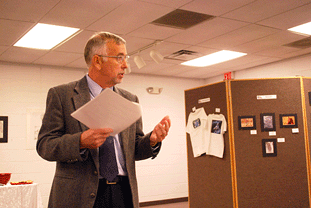
John Joy, of SSCC’s corporate and community services, presented an overview of what the truck driving academy (TDA) does, and the costs to run the program.
The 160-hour program allows students to obtain a Commercial Driver’s License (CDL), or passenger and school bus endorsement, he said. The program is considered a “first choice” institution for job training by employers, he said. SSCC partners with several other colleges to provide the training centers across southern Ohio, including Wilmington, Piketon, Pomeroy, New Lexington, Lebanon, Columbus and Cincinnati.
Joy said the program has always had fluctuating enrollment with spikes of highs and lows, and he presented the board with historical enrollment and funding data. December 2010 was a low with only four students enrolled. Four part-time instructors were laid off, he said, to curb the costs of the program. Presently there are 32 students enrolled.
Because the TDA is only a three-week or eight-week course, students do not qualify for traditional funding or loan plans, such as Pell Grants. Joy said that “from Jan. 1, 2010, until Feb. 1, 2011, of the 385 student records examined, 30 percent were self-pay. The remaining 70 percent were paid through displaced worker and other funding streams. Most funding (was) administered by the county WIA (Workforce Investment Act) programs (through county One-Stop offices).”
A breakdown of the enrollment and surplus funds for the academy showed that in 2006-07 there were 456 students, which left a $14,513 surplus; 2007-08, 397 students with a surplus of $6,537; 2008-09, 448 students, with a surplus of $392,402; 2009-10, 415 students, with a surplus of $155,701. Though fiscal year 2010-2011 is not complete yet, there have been a total of 181 students, leaving a projected deficit of $62,749.
During those times of surplus, the TDA fixed equipment and replenished its fleet, which includes 12-14 trucks. Fluctuations in gas prices have also affected the budget, Joy said.
Board President Kay Ayres later said that the surplus did not stay entirely in the academy, rather the surplus was returned to the college’s general fund.
Even though enrollment is currently low, there was discussion that jobs in the trucking industry would likely encourage more students to enroll in future years.
Joy said that there is, and will be a need for truck drivers, and provided data on industry outlook, which included, 17,000 jobs nationwide with Swift Transportation, 600 of which are in the Columbus terminal; FTR Associates say that “by 2012 the industry will be looking at a shortage of 400,000 drivers;” trucking company Schneider National “has 21 Ohio jobs
posted on their website.” Additionally, new regulations to push drivers with unsafe records out of the industry could open up 7 percent of the jobs.
Out of the nine public and private CDL training schools in Ohio, Joy said that Southern State was tied for the lowest tuition with the private Ohio Business College at $3,995. The proposed increase to tuition would take the cost at SSCC to $4,495. The highest is the public Apollo Career Center at a cost of $5,000.
There are increasing costs to run the academy at SSCC, Joy said, which included maintaining the aging truck fleet at a cost of $247 per student since 2009. There has also been a “significant” reduction in “endorsements,” agencies funding students.
Measures have been taken to “contain” the costs of the program to weather the low enrollment, which included the personnel downsizing, management controls on fuel purchasing, tire and rim inventory reduction, fleet management, a more sophisticated management level reporting, and internal collaboration for marketing and public relations.
SSCC President Dr. Kevin Boys said the deficit spending in the TDA had been at $115,000, but with the modifications mentioned by Joy, it had been reduced to the $62,000 figure.
“So, it’s going in the right direction,” he said.
Vice President of Business and Finance Jim Buck likened the situation to a few years ago when the board considered closing the college’s daycare facilities because they were operating in the red. After restructuring its operations, the facilities, located in Hillsboro and Wilmington, are operating at a surplus.
The board questioned Joy on several steps, and offered suggestions.
Ayres asked if enrollment could be an issue because students couldn’t come up with the full tuition on their own. Joy said that was likely.
He said that in previous years, people would leave jobs they weren’t happy with and try truck driving, knowing they could always “come back and get a job at ABX or DHL” if they didn’t like trucking. “We know those days are over,” Joy said, and that many people who would consider trucking are already unemployed, without those funds.
Board member Rory Ryan asked if the annual administrative and instructional costs had increased or decreased over the past five years. Joy said that he felt they had decreased, in particular with the layoff of an instructor who had administrative duties, and that instructional costs have also gone down. Ryan asked if there were too many locations across the state, and if funds could be saved by shutting some of the centers. Joy said that he felt the college benefited from the number of locations, and that in the areas where they partnered with other colleges, SSCC was bringing in funds.
By the end of 2011, Joy said they have projected to have between 310-380 students enroll.
Board member Michelle Cimis said that in looking at the proposed tuition increase, which she said was around 12 percent, it seemed that with the projected enrollment, it would only bring in enough funds to break about even, and not leaving funds for improvements. “Even though, this is a significant increase,” she said.
Joy said, “The wild card is the enrollment.”
Board member Paul Hall said that the college needed to look to private enterprise for funds instead of “depending on the government,” and get the potential employers in the trucking industry to start considering paying the costs for students they would eventually hire. He also said that some of the other Ohio academies seemed to have in-house funding programs, and that Southern State should consider that themselves.
Joy said he did not mean to give the impression the academy was relying solely on the government for funds, and that they were looking into alternatives, but companies were not funding potential hires as they have in the past. And if the college financed the students themselves, he said they would absorb the risk themselves as well.
“You’re thinking like you have thought for 10 years,” Hall said, and that if the funding was working for SSCC’s competitors, they should see how they are making it work. There also needs to be more outreach to the companies who are needing truck drivers, he said.
“As an institution, we’re here to help local people,” Hall said. “We need to help fund it.”
Board member Ben Houser said, “As the world changes, and we don’t change, we can’t be surprised we’re not successful. What changes are we going to do? How are we going to adapt?”
Ayres said that she didn’t like the idea of increasing tuition because, “If you’re not selling hamburgers at $2, then you don’t raise the price to $2.40.”
Hall said that “I’m not concerned with a $60,000 loss” because the academy had made money in the past, and in private enterprise when there’s a potential for profit you don’t get rid of a product.
“We’ve lost major money and (the enrollment drop) was not just a little blip in December,” Houser said. “We need to address it.”
Ayres said they had addressed it in their conversation.
“No one has brought us a solution other than ‘give me more money,’” Houser said.
Ayres said she felt that was not how the discussion went.
“I’m not panicked about this,” Boys said.
Boys said it’s a valuable program, and one of the few where displaced workers who have little education can receive training and consistently find a job. He said it’s a program that is constantly asked about at county One-Stop centers.
Boys also praised Joy’s efforts to curb spending, to stay on top of enrollment numbers and cost projections, and his efforts to increase enrollment.
After the meeting Boys told The Highland County Press that due to the discussion that took place, the college had other avenues to consider before going for the tuition increase, which had been proposed to take effect in March.
Joy’s presentation, he said, was not a formal request to increase the tuition, rather an informational presentation. Ayres said that because it is a tuition increase, the matter would come before the board if that is the choice the college went with.
In other business:
• Buck told the board that the finance committee should schedule a meeting for sometime in March to begin addressing the college budget. Figures from the state regarding the next two-year budget are projected to be released in mid-March.
• The board voted to approve the strategic vision and 2011 goals.
• The board heard a presentation from Coby Long, an SSCC faculty member in the education department, regarding distance learning.
• The board voted to approve policy manual revisions.
• The next board meeting is scheduled for March 9 at 6 p.m. at the community center at Fayette Campus.[[In-content Ad]]
The board met Feb. 9 at the SSCC South Campus in Fincastle.
John Joy, of SSCC’s corporate and community services, presented an overview of what the truck driving academy (TDA) does, and the costs to run the program.
The 160-hour program allows students to obtain a Commercial Driver’s License (CDL), or passenger and school bus endorsement, he said. The program is considered a “first choice” institution for job training by employers, he said. SSCC partners with several other colleges to provide the training centers across southern Ohio, including Wilmington, Piketon, Pomeroy, New Lexington, Lebanon, Columbus and Cincinnati.
Joy said the program has always had fluctuating enrollment with spikes of highs and lows, and he presented the board with historical enrollment and funding data. December 2010 was a low with only four students enrolled. Four part-time instructors were laid off, he said, to curb the costs of the program. Presently there are 32 students enrolled.
Because the TDA is only a three-week or eight-week course, students do not qualify for traditional funding or loan plans, such as Pell Grants. Joy said that “from Jan. 1, 2010, until Feb. 1, 2011, of the 385 student records examined, 30 percent were self-pay. The remaining 70 percent were paid through displaced worker and other funding streams. Most funding (was) administered by the county WIA (Workforce Investment Act) programs (through county One-Stop offices).”
A breakdown of the enrollment and surplus funds for the academy showed that in 2006-07 there were 456 students, which left a $14,513 surplus; 2007-08, 397 students with a surplus of $6,537; 2008-09, 448 students, with a surplus of $392,402; 2009-10, 415 students, with a surplus of $155,701. Though fiscal year 2010-2011 is not complete yet, there have been a total of 181 students, leaving a projected deficit of $62,749.
During those times of surplus, the TDA fixed equipment and replenished its fleet, which includes 12-14 trucks. Fluctuations in gas prices have also affected the budget, Joy said.
Board President Kay Ayres later said that the surplus did not stay entirely in the academy, rather the surplus was returned to the college’s general fund.
Even though enrollment is currently low, there was discussion that jobs in the trucking industry would likely encourage more students to enroll in future years.
Joy said that there is, and will be a need for truck drivers, and provided data on industry outlook, which included, 17,000 jobs nationwide with Swift Transportation, 600 of which are in the Columbus terminal; FTR Associates say that “by 2012 the industry will be looking at a shortage of 400,000 drivers;” trucking company Schneider National “has 21 Ohio jobs
posted on their website.” Additionally, new regulations to push drivers with unsafe records out of the industry could open up 7 percent of the jobs.
Out of the nine public and private CDL training schools in Ohio, Joy said that Southern State was tied for the lowest tuition with the private Ohio Business College at $3,995. The proposed increase to tuition would take the cost at SSCC to $4,495. The highest is the public Apollo Career Center at a cost of $5,000.
There are increasing costs to run the academy at SSCC, Joy said, which included maintaining the aging truck fleet at a cost of $247 per student since 2009. There has also been a “significant” reduction in “endorsements,” agencies funding students.
Measures have been taken to “contain” the costs of the program to weather the low enrollment, which included the personnel downsizing, management controls on fuel purchasing, tire and rim inventory reduction, fleet management, a more sophisticated management level reporting, and internal collaboration for marketing and public relations.
SSCC President Dr. Kevin Boys said the deficit spending in the TDA had been at $115,000, but with the modifications mentioned by Joy, it had been reduced to the $62,000 figure.
“So, it’s going in the right direction,” he said.
Vice President of Business and Finance Jim Buck likened the situation to a few years ago when the board considered closing the college’s daycare facilities because they were operating in the red. After restructuring its operations, the facilities, located in Hillsboro and Wilmington, are operating at a surplus.
The board questioned Joy on several steps, and offered suggestions.
Ayres asked if enrollment could be an issue because students couldn’t come up with the full tuition on their own. Joy said that was likely.
He said that in previous years, people would leave jobs they weren’t happy with and try truck driving, knowing they could always “come back and get a job at ABX or DHL” if they didn’t like trucking. “We know those days are over,” Joy said, and that many people who would consider trucking are already unemployed, without those funds.
Board member Rory Ryan asked if the annual administrative and instructional costs had increased or decreased over the past five years. Joy said that he felt they had decreased, in particular with the layoff of an instructor who had administrative duties, and that instructional costs have also gone down. Ryan asked if there were too many locations across the state, and if funds could be saved by shutting some of the centers. Joy said that he felt the college benefited from the number of locations, and that in the areas where they partnered with other colleges, SSCC was bringing in funds.
By the end of 2011, Joy said they have projected to have between 310-380 students enroll.
Board member Michelle Cimis said that in looking at the proposed tuition increase, which she said was around 12 percent, it seemed that with the projected enrollment, it would only bring in enough funds to break about even, and not leaving funds for improvements. “Even though, this is a significant increase,” she said.
Joy said, “The wild card is the enrollment.”
Board member Paul Hall said that the college needed to look to private enterprise for funds instead of “depending on the government,” and get the potential employers in the trucking industry to start considering paying the costs for students they would eventually hire. He also said that some of the other Ohio academies seemed to have in-house funding programs, and that Southern State should consider that themselves.
Joy said he did not mean to give the impression the academy was relying solely on the government for funds, and that they were looking into alternatives, but companies were not funding potential hires as they have in the past. And if the college financed the students themselves, he said they would absorb the risk themselves as well.
“You’re thinking like you have thought for 10 years,” Hall said, and that if the funding was working for SSCC’s competitors, they should see how they are making it work. There also needs to be more outreach to the companies who are needing truck drivers, he said.
“As an institution, we’re here to help local people,” Hall said. “We need to help fund it.”
Board member Ben Houser said, “As the world changes, and we don’t change, we can’t be surprised we’re not successful. What changes are we going to do? How are we going to adapt?”
Ayres said that she didn’t like the idea of increasing tuition because, “If you’re not selling hamburgers at $2, then you don’t raise the price to $2.40.”
Hall said that “I’m not concerned with a $60,000 loss” because the academy had made money in the past, and in private enterprise when there’s a potential for profit you don’t get rid of a product.
“We’ve lost major money and (the enrollment drop) was not just a little blip in December,” Houser said. “We need to address it.”
Ayres said they had addressed it in their conversation.
“No one has brought us a solution other than ‘give me more money,’” Houser said.
Ayres said she felt that was not how the discussion went.
“I’m not panicked about this,” Boys said.
Boys said it’s a valuable program, and one of the few where displaced workers who have little education can receive training and consistently find a job. He said it’s a program that is constantly asked about at county One-Stop centers.
Boys also praised Joy’s efforts to curb spending, to stay on top of enrollment numbers and cost projections, and his efforts to increase enrollment.
After the meeting Boys told The Highland County Press that due to the discussion that took place, the college had other avenues to consider before going for the tuition increase, which had been proposed to take effect in March.
Joy’s presentation, he said, was not a formal request to increase the tuition, rather an informational presentation. Ayres said that because it is a tuition increase, the matter would come before the board if that is the choice the college went with.
In other business:
• Buck told the board that the finance committee should schedule a meeting for sometime in March to begin addressing the college budget. Figures from the state regarding the next two-year budget are projected to be released in mid-March.
• The board voted to approve the strategic vision and 2011 goals.
• The board heard a presentation from Coby Long, an SSCC faculty member in the education department, regarding distance learning.
• The board voted to approve policy manual revisions.
• The next board meeting is scheduled for March 9 at 6 p.m. at the community center at Fayette Campus.[[In-content Ad]]