


Southern State Community College considers five-county tax levy
By Caitlin Forsha
The Highland County Press
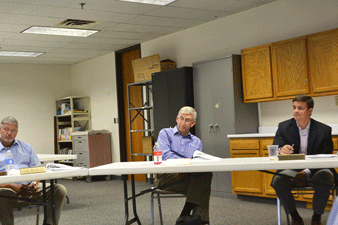
At their October meeting Wednesday evening, the Southern State Community College Board of Trustees met with representatives of Burges & Burges Strategists (http://www.burgesandburges.com/) regarding a study conducted to gauge local opinions on implementing a five-county tax levy to “further support the college’s impact on the area.”
As pointed out in the college’s May board of trustees meeting, “SSCC would be the first state community college to pass a local levy that did not originally start with one.” College administrators and the board of trustees began discussions in May regarding a local levy option and contracted Burges & Burges to begin local evaluations.
After conducting interviews with local political, business and faith leaders, Dr. Bill Burges and Jill Billman-Royer presented a summary of their findings at the meeting at SSCC’s central campus in Hillsboro.
“Interviewees felt the close relationship between SSCC and the community,” Burges said. “They report that the college effectively meets real needs and is an excellent partner. Positioning higher education’s value and SSCC’s plans for the future is the next critical step.”
Burges reported that discussion of “becoming a locally supported college and the required levy brought understandable skepticism” from the people who were interviewed. Several challenges were addressed, including local anti-tax attitudes; challenges such as the education, income levels and age of voters; and questions of the “value” of college who should be responsible for paying for education, Burges said.
However, Burges said the interviewees also named reasons to support becoming a locally supported college, including “increased local control; keeping the cost very low; having an important enough purpose, tied to the economy; a clear need for funding; and if the affinity for and reputation of SSCC is widespread enough.”
Burges summarized that interviewees felt that the college “must make a value case based on real need, regional impact, individual opportunity and very low cost.”
Burges recommended that the college continue to “sustain and increase educational and economic partnerships” and “focus program alignment and development on tomorrow’s jobs.” In order to “make a value case,” the college is encouraged to “communicate the case for college,” sharing success stories and increasing local resources and outreach, Burges said.
In his presentation, Burges reported the following findings:
• The college is “highly rated,” with a positive overall impression and “quality, affordability, accessibility and opportunity praised.” SSCC was also complimented for its role in the community, its diverse range of majors and programs and “the potential for more partnerships and collaboration around careers.”
• The five counties the college covers – Adams, Brown, Clinton, Fayette and Highland – are perceived as “still recovering” from the recession and from the closure of DHL in Wilmington, which Burges said is clearly still a factor despite having closed seven years ago. However, the community also has the potential “for first-generation college completion” and “to create more qualified, educated workforce” through SSCC.
• SSCC is considered “an important asset” to the region for “quality job training, a vital starting point for higher education, open access for traditional, College Credit Plus, adult and workforce students and continuing to encourage and help first-time college families.”
• Reasons students choose to enroll at SSCC are “cost and affordability, it’s local and convenient, they have job training goals, will transfer credits to a university and/or have positive information about SSCC.” Students who choose not to enroll at SSCC do so because they “want to go away to college, don’t want a two-year college, [are] intimidated by any college and/or lack information about college programs, financing and value.”
Following Burges’ presentation, trustees asked questions about the data the strategists collected.
“What was your total interview base?” board member Donald Moore asked.
“We only interviewed 25 or 30 people,” Burges said.
“That’s six per county,” Moore said.
[[In-content Ad]]
“The questions were not about counties, and an election for this would not have to pass in every county,” Burges said.
“But the counties vary in environment,” Moore said.
“We get that, and that’s why we’re recommending this,” Burges said. “We were trying to keep the cost really reasonable here, and everybody who was working on this project agreed that was the right number. The counties do differ, but we’ve worked in many other places with a lot of geographic spread, too. In terms of finding out how people think, although we could take this another 25 people, I think we’d be back with a really similar report.
“You get to a point where there’s diminishing returns here, and none of these questions were about individual counties. They were all about the region.”
“My concern is we were asked for certain names to be interviewed, and the people whose names I gave were never interviewed,” Moore said.
Billman-Royer responded that the firm “starts with a list that is approximately four to five times the number of interviews we hope to complete” and that they attempted “more than once” to contact everyone on the lists they were given.
“Did you balance this between business and political people?” Moore asked.
“We categorized the names that were submitted from the board and from our own research, and from Southern State, to make sure that we had different sectors,” Billman-Royer said. “They weren’t all elected, they weren’t all political. There were some business leaders, some faith leaders, thought leaders. We made sure there was a representation from all those groups.”
Burges told the college that this is a “first step,” but a larger poll would have to be done with students, faculty, staff, alumni and others in the community as they move forward. Burges suggested “community listening sessions,” telephone and online surveys.
“Having done a lot of first-time levies, this is an important first step,” Burges said. “We’re not sitting here saying you should do a levy. We’re not sitting here saying you need to spend ungodly amounts of money on stuff. This was a pretty low-cost project in the amount of time, and I know what some comparable projects cost.
“We feel pretty good about the value here, but it’s one step in a process. If you’d come in and just done a poll blind, which most people do, I would say that’s the worst thing you can do.”
Board member Kyle Rudduck asked Burges to “compare the sentiment of people you interviewed about Southern State to some of the other community colleges” the firm serves.
“I think the sentiment was very, very strong,” Burges said.
Burges said there was “no anger at all, no ‘it’s another school levy’” from the people they contacted.
Billman-Royer said that Dr. Nicole Roades, SSCC vice-president of institutional advancement, said that the college often hears that “everybody knows somebody” who went to Southern State, and the same was true of their interviews.
“Honestly, I hear that from a lot of organizations, but we heard it repeatedly,” Billman-Royer said. “It wasn’t just one person. A lot of people feel connected, not only because of partnerships or because of the presence in the community, but because they knew several people and several personal stories in terms of what Southern State and that experience meant to them. That tie was really strong personally.”
“This levy would cover all five counties,” Moore said. “We presently already have a school levy in all five counties. Did that come up in any of the discussion?”
“If you want to avoid school levies, you’ve got to go live somewhere else,” Burges said. “There’s school levies in every community. In Cuyahoga, Lake, Lorain, Montgomery, Franklin counties, they all have community college levies, and all but one have two levies. In Lorain, the levy covers not just the first two years, but four years of coverage.
“There’s countless townships that have levies for schools, police, fire, roads, etc. … I don’t view the notion that there’s school levies in place as an impediment to this, and I’ve been around this a long time.”
• • •
Trustees unanimously passed a resolution presented by SSCC President Dr. Kevin Boys “for a submission to the Ohio Department of Higher Education to reduce students’ cost of earning a degree by at least 5 percent,” in response to the Senate 5% Challenge.
House Bill 64 includes the “5% Challenge,” which “requires all state institutions of higher education to implement a plan … to reduce the student cost of earning a degree by five percent.” This can be done through reducing the cost of tuition, supplies or number of credit hours required to complete a program, among other steps.
“Our total actually is 13.1 percent,” Boys said. “I was hesitant reporting all of these activities because I’m not sure that’s the end of it. We may turn around this time next year and be asked to find another 5 percent of savings, but this is what we’re doing.
“Each one of these reductions may not apply to each student, so they weren’t applied to every student. It was essentially based on the portion of students that individual strategy would apply to.”
Trustees also voted unanimously to approve “a modified tuition schedule that establishes a full-time rate for students taking between 15 and 18 hours,” which is also required under House Bill 64.
“This does not increase tuition on any student,” Boys said. “It actually brings about a decrease in tuition for students who are taking between 15 and 18 hours. There is an associated reduction in revenue as well.”
Boys said that the proposal outlines a schedule based anywhere from “one credit hour to the end.”
“We will be setting the full-time rate by adopting this schedule, defining a full-time student as 15 to 18 hours,” Boys said.
“Are most colleges 12 hours full-time?” board member Paul Hall asked.
“The federal government defines a full-time student as 12 hours,” Boys said.
“What happens if the student has 15 hours and drops a course? Do you send their money back?” Hall asked.
“Yes,” Buck said.
“That’s crazy,” Hall said.
Board member Brian Prickett asked if the change in credit hours would affect student loans.
“It doesn’t impact the student loans,” SSCC vice president of academic affairs Dr. Ryan McCall said. “Part of the reason the state one was 15 hours is because they’re asking us to reduce our total credit hours down to 60 to 65. To get a student to complete in two years, they’re trying to get them to take 15 or more hours, so they do that in two semesters and complete in two years as they’re supposed to, if they’re going to be full-time.
“This is another impetus to try to help students get to that 15, and more, because now they can take more hours and not pay extra to get more hours in there, to complete it in that two-year time frame.”
McCall also gave a presentation on course and program evaluation, another requirement of House Bill 64.
McCall said the comprehensive review of course and program enrollment primarily analyzes the technical programs offered by the college.
Highlights of McCall’s report include:
• The agricultural program has doubled since adding a full-time faculty member.
“For every nine dollars we were bringing in, we’re only spending one,” McCall said. “We obviously had the revenue coming in to support that full-time faculty member.
“In one year, credit hours went from 250 to 500 because we had a full-time faculty member out there promoting the program, talking to people and talking to students.”
• The real estate program declined during the recession and housing market. Instead of discontinuing the program, it was simplified into a fast-track program, which has proven to be more successful.
• The computer science program has benefitted from the implementation of a professionalism program by professor Josh Montgomery, along with a reorganization of the computer science program schedule by Jeff Montgomery.
The reorganization came after McCall attended a conference on the meta-majors program, “the process of taking courses that are similar across multiple programs within a major or degree area and aligning those so that they happen at the same time.”
Previously, the program made it difficult for students to switch majors within the computer science field because “you had to go back up, pick up a bunch of classes and then you were off schedule with everything else,” McCall said.
“The first two and almost three semesters, a student can take any one of those majors in computer science, and if they decide to change, they may have one or two classes they’ll have to go back and pick up just because of the difference within the majors themselves,” McCall said. “It lines it up better, so I look to see computer science growing as we go along as well.”
• The electronics and engineering programs “are really starting to grow,” with full classrooms and increased partnerships with local businesses.
• Two programs – the emergency medical technician/paramedic program and food science program – were discontinued due to low enrollment and/or accreditation issues.