


Jurors dismissed for weekend WATCH THE VIDEO
At 8:55 p.m. Friday, the court received a request to adjourn for the evening as well as an additional note from the jury. Upon reading the note, Judge Rocky Coss asked to see the attorneys in chambers. When the court reassembled, the note was not read on the record. Coss dismissed the jury for the weekend and told the jury foreperson to report back Monday at 8:30 a.m. and the rest of the jury to report back at 9 a.m., when deliberations will continue.
Coss told the foreperson, "We will address the issue at that time." When court was dismissed, Coss told the Highland County Press that the note would be read on the record at some point, but he wanted to take the time to research the issue further before making any decisions.
---
Coonrod takes stand in own defense
For the second time, Coonrod's fate is in the hands of a jury.
Coonrod took the stand on Friday in Pickaway County Common Pleas Court to defend himself against charges that he set the fire that killed his 3- and 4-year old sons, Stephen and Thomas.
The jury began deliberations at approximately 2:15 p.m. Friday. At 6 p.m. they were given a break for dinner, and then deliberations resumed at 7 p.m.
At approximately 7:20 p.m., the court assembled to address a question from the jury. According to Coss, jurors asked for an example and definition of substantial risk to the health and safety of the child in relation to child endangering. Child endangering, according to the court, is an element of the manslaughter charge.
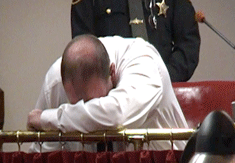
As defense attorney Jerry McHenry questioned Coonrod, he wiped away tears and at one point, lost his composure completely, put his head down on the stand and wept.
"I loved my sons. My sons was my life," Coonrod said. "That's all I cared about was my boys. I tried to raise them with the best of my knowledge. I tried to be a father and a mother."
McHenry asked Coonrod if he caused the deaths of his sons.
"No, sir," Coonrod said.
Coonrod, 43, of Greenfield, was found guilty in October in Highland County Common Pleas Court on two counts of felony endangering children. He had faced aggravated murder charges with death penalty specifications stemming from a March fire in his apartment on Lafayette Street in Greenfield, during which his sons Thomas, 4, and Stephen, 3, were killed. The jury was unable to reach a verdict on the aggravated murder charges, two charges of murder with lesser charges of manslaughter and reckless homicide, and aggravated arson. The state will not seek to retry him on the aggravated murder charges, so he is no longer facing the death penalty. The jury will also consider a lesser charge of involuntary manslaughter. The trial was moved to Pickaway County in so that a jury could be more easily seated than in Highland County.
While testifying, Coonrod described what happened in the early morning hours of March 7 when a fire broke out in his apartment at 150 A Lafayette Street in Greenfield.
Coonrod described it as a bad dream, like it "wasn't really happening" and that "everything was in slow motion."
He described being awoken by smoke, and when he opened his bedroom door, located at the rear of the house, there was smoke in the hallway. Coonrod said that he had a fire extiguisher in the hall closet, but he could not get to it. He opened his bedroom window, he testified, and climbed out. He does not remember shutting the window, he said.
Once outside, he attempted to kick down the back door, which was locked. Because he was not wearing shoes, and only had on his boxer shorts, he was unable to kick in the door. Around that time, he said, neighbors started running over to the house. Coonrod said he also tried to break open a window with a rock, but it would not break.
Coonrod said that a burn he had on his hand was from trying to open his bedroom door.
Fire investigator Trace Lawless testified that the injuries Coonrod sustained appeared to be from radiant heat, not a contact burn.
The state alleges that Coonrod set the fire in the hallway by pouring liquid accelerant, specifically charcoal lighter fluid, and lit it with a childproof Bic cigarette lighter, which was recovered at the scene, and walked out the front door.
The defense says that either Thomas or Stephen set the fire by playing with a cigarette lighter.
Witnesses testified earlier this week that when they arrived to the scene of the house, they could hear the children screaming and crying. When they asked Coonrod, multiple times, where the children were, he did not respond. Some witnesses said the only time he spoke was to ask for a cigarette.
Coonrod testified that he never asked for a cigarette. McHenry asked him why he did not respond when people asked him where his children were.
"I never asked anyone for a cigarette. There was so much stuff going on, there was nothing I could do," Coonrod said. "It was like it was happening, but it wasn't happening. It was like in slow motion. I can't explain."
Witnesses to the fire had made entry to the house but were forced back out because of the heat and smoke. Everyone who got near the house ended up covered in soot, witnesses testified. Those present at the scene testified Coonrod did not have any soot on him.
Coonrod said that that officers with the Greenfield Police Department told bystanders to hold him back to keep him from going back into the house. No other witnesses testified to that this week. Coonrod said Sgt. Jimmie "J.D." Dunn knocked him to the ground to keep from going into the house. Dunn did not testify to doing that.
Witnesses to the fire testified that they smelled a strong odor of alcohol on Coonrod. He denied that Friday that he was intoxicated at the time of the fire.
Coonrod said that, while at the Adena Greenfield Area Medical Center, he learned that CareFlight had been called off and that his children were pronounced dead and he became distraught.
"I picked my boy up in my arms," Coonrod said, starting to sob. "Thomas ... I blowed in his mouth and tried to get him breathing. I tried to wake my kid up. I kept asking, 'Why? Why couldn't you save my kids?'"
Lost his composure and couldn't speak. He put his head in his hands and began sobbing loudly. McHenry asked Judge Rocky Coss if the court could take a few minutes. Coonrod put his head on the witness stand and cried.
"Mr. Coonrod," Coss said. "Will you be able to get ahold of yourself?"
After a moment, Coonrod said up, and muttered, "Oh my goodness," with his face in his hand. Court bailiff Dan Music handed Coonrod tissues and water, and testimony continued.
"It's almost more than one man can bear," Coonrod said.
On cross examination, Highland County Prosecutor Jim Grandey asked, "Did you know where your boys were that night?" Coonrod said that he did.
"They was asleep in bed in sleeping bags (in the front bedroom)," Coonrod said.
"Explain to me, Mr. Coonrod, why, when people are coming up to you and screaming at you, and you knew that, why didn't you tell them where the boys were?" Grandey asked.
Coonrod said, "Sir, it was like it was all happening in slow motion. It was like you could see the people but you couldn't hear what they was saying."
He then testified that he did not know how the fire stated.
"Do you honestly believe that your children started this fire?" Grandey asked.
"Sir, I don't know how the fire stared," Coonrod said.
"There were only three people there that night," Grandey said. "Two boys, two little babies. One 3 years old, one 4 years old. Even your own expert says that he cannot rule out this fire was set by an intentional human act. Which of the three of you set this fire?"
Coonrod said, "Sir, I was in bed. My boys was in bed. I woke up, my house was on fire. How the fire started, I could not tell you."
Also on Friday, Coonrod's brother, John Coonrod testified that he did not smell alcohol on his brother the night of the fire, and he also testified that he suffered from the same eye disorder that afflicts the defendant.
The state then offered one rebuttal witness, Richard Palmer, an expert on juvenile fire-setters from the Fire Marshal's Office of the State of Ohio.
Under direct examination, Palmer said that due to the age of Thomas and Stephen, it was "unlikely" they had set the fire using an accelerant, and that it would have been typical that once a fire started to run to an adult for help, not to hide in a closet.
Palmer said on cross examination that juvenile fire-setters, even young ones, must be evaluated on an individual basis, and that factors such as instability, moving, divorces, trauma, and exposure to other fires can lead to a pattern of fire experimentation and fire-starting.
In closing arguments, Grandey said that Coonrod had a duty to save his children.
On March 7, Grandey said, Coonrod was,"A man so intoxicated, he won't even try to get his babies out of a burning house. He won't even tell firefighters where they are."
The only ignition source - the childproof, blue Bic lighter - Grandey said, was found seven feet inside the front door of the apartment. Had one of the children set it, Grandey said, he would have had to drop the lighter in the hall, and pass back through the flames to get to the closet where both children were found. Grandey said the coroner's report does not indicate burns on their hands or feet.
In closing arguments for the defense, McHenry said that this is a very complicated case that can be very simple. McHenry said the case is complicated because of the science involved, but at its heart, it was a simple matter.
"The heart and soul of this case is whether or not (the prosecutors for the state) have proved beyond a reasonable doubt to your satisfaction, that this man, this father, Wesley Coonrod, poured some sort of ignitable liquid on the floor of this house, set it on fire, and then somehow got out of the house, leaving his two children to die," McHenry said.
McHenry said the jurors will have to decide if there was an arson, and if Wesley Coonrod committed the arson. If not, there is no murder.
"There's tragedy," McHenry said. "Oh my goodness, there's great tragedy. There's enough tragedy to go around."
McHenry said that the case is emotional, for the defendant, his family, the children's family, as well as for the jury and other members of the court. He asked that they not let their emotions cloud their judgment.
Coonrod's emotions, McHenry said, cannot please the state, saying, "he's damned if he does, damned if he doesn't. At the scene he was too passive, too complacent. At the hospital, he's too aggressive."
There is "no objective scientific evidence" that proves the presence of an ignitable liquid, McHenry said. Laboratory tests show that the carpet, combined with the padding, was enough to cause a large flame. The state's assertion that the fluid must have burned away in the fire was "a convenient way to explain away" why no hard evidence was found.
Regarding the "contention" that Coonrod didn't do anything to save his children, McHenry said, "You know, we'd all like to think that in difficult times, in emergency situations, in tragic times, we will be brave, and we will do the right thing, and that somehow or another we will keep our composure. Somehow, we will be brave as a lion, we will run back into that burning house, through the flames, rescue our children, take one under each arm, and run out, being heroic. "He's not a firefighter. He's just a father."
In reality, "How many of us will know how we will in an emergency? How many of us know what the appropriate behavior might be in such an emergency?"
Coonrod is legally blind, McHenry said, night blind, without shoes on, and in shock.
The defense asked that the jury appeal to logic, but also to look in their hearts to see if Coonrod was guilty.
"Are you comfortable, not only in your head and in your brain, but here in your heart, are you convinced that the prosecution has proven that Wes Coonrod set this fire?" McHenry asked. "He sat there, bent over and ultimately hung his head on this (witness stand) crying. If that tells you anything, it tells you he loved his boys.
Because the state has the burden of proof, Grandey gave a second closing statement following McHenry, summarizing the case, and telling the jury that though parts of the case were circumstantial, the case has been proved beyond a reasonable doubt.
"Three people in the house, ignitable liquid, boys found in the closet where it would be atypical for them to be if they were playing with fire, and one person. Wesley Coonrod," Grandey said. "All three experts claim that they cannot rule out that this fire was an intentional human act. That's arson. Wesley Coonrod, you can find from the evidence, beyond a reasonable doubt, set this fire. That's arson. And by committing arson, he killed his two little babies. That, ladies and gentlemen, is murder."
For more on this story, check back to highlandcountypress.com, and check our facebook page for updates on the trial as it happens.
[[In-content Ad]]