


Investigator: Fire caused by intentional human act WATCH THE VIDEO
CIRCLEVILLE - Firefighters, EMTs and hospital personnel worked for more than an hour to revive the two little boys covered in soot and smudges after they were pulled from a closet of their burning home. But they were not successful in bringing the two "babies" back to life, according to testimony heard Tuesday in the re-trial of Wesley Coonrod.
According to witnesses, while "chaos" surrounded the burning apartment at 150 A Lafayette St. in Greenfield, as neighbors kicked down doors and broke through windows to find the screaming children, the boys' father, Wesley Coonrod, Sr., 42, stood on the sidewalk in his underwear and asked for cigarettes.
Coonrod, 42, was found guilty in October in Highland County Common Pleas Court on two counts of felony endangering children. He had faced aggravated murder charges with death penalty specifications stemming from a March fire in his apartment on Lafayette Street in Greenfield, during which his sons Thomas, 4, and Stephen, 3, were killed. The jury was unable to reach a verdict on the aggravated murder charges, two charges of murder with lesser charges of manslaughter and reckless homicide, and aggravated arson. The state will not seek to retry him on the aggravated murder charges, so he is no longer facing the death penalty. The trial was moved to Pickaway County so that a jury could be more easily seated than in Highland County.
Much of the testimony during this week's trial has been very similar, to nearly identical, to the testimony heard in the first trial.
On Tuesday, jurors, who are not being told about the first trial or Coonrod's endangering children convictions, heard testimony from eight witnesses, including a fire investigator for the property owner's insurance company, witnesses to the fire, law enforcement, and firefighter/EMTs.
Testimony from fire investigator James Hunter took up all of Tuesday morning, as he presented a slide show of photos of the apartment, explained his process of investigating the origin and cause of the fire, and what he determined the cause to be.
Hunter testified that the cause of the fire was "an intentional human act; arson," based on an "irregular burn pattern" that appeared to have been caused by a liquid accelerant.
The defense has stated that the fire could have been caused by one of the children playing with a cigarette lighter.
Hunter testified that, based on his experience, the alleged actions of Thomas and Stephen are not consistent with juvenile fire-setters.
During March 2010, Hunter was a fire investigator for Kelly and Associates, which investigated the Lafayette Street fire on behalf of Nationwide Insurance. Property owner Matthew Unger was the policy holder, Hunter said.
The photos Hunter took, entered as state's evidence, showed the outside of the structure, as well as inside. He explained that fire burns "upward and outward" and will always follow the path of least resistance, seeking additional fuel.
Burn patterns on the front of the home near the front door and window, he said, indicates that they were open or broken out during the time of the fire. The back door and window were closed at the time of the fire, he testified.
Coonrod has previously said that he climbed out the back bedroom window to get out of the house. The defense says that the window had gone missing and was not available to test to confirm or deny Coonrod's claims.
Hunter showed photos of the closet where Thomas and Stephen were found. The white walls, he said, indicate that the door was closed during the time of the fire. However, there are dark smudges of handprints and footprints.
"The foot prints on the bottom of the door is indicating to me that at some point in that closet they were pushing against this door with their bare feet, trying to get out," Hunter said.
Handprints are on each wall of the interior of the closet.
"In my opinion, they're trying to feel their way out of there," Hunter said.
The defense objected to that statement and Highland County Prosecutor Jim Grandey rephrased a question. Hunter said that based on his professional experience, and based on the evidence, he was able to form an opinion, which is that the children were trying to feel their way out of the closet.
Hunter said that even though he determined that the cause of the fire was intentional, and that the source was an ignitable liquid, he found no accelerant at the scene. Hunter said that either the accelerant burned away or that he did not cut a carpet sample for testing that contained accelerant.
Hunter likened the accelerant evidence to a bullet in a shooting investigation.
"Maybe this makes it easier to understand," he said. "If this were someone who was shot, and we had a small hole in the front and the shirt's pulled in, and a large hole in the back and the cloth's blown out, we would have an indication. The physical evidence indicates this person has been shot in the front. Everyone would like to find that bullet ... but if they can't find it, it doesn't mean that this person was not shot. The physical evidence of this fire scene indicates we've got ignitable liquid, on the floor and the hall in the rear bedroom ... it doesn't mean ignitable liquid was not there. It just means that we didn't find it."
Jessica Harris, a former EMT with the Paint Creek Joint Fire and Ambulance District, testified that due to the events she witnessed during the March 7 fire, she is no longer an EMT.
Under director examination from Assistant Highland County Prosecutor Anneka Collins, Harris testified that she arrived on the scene in an ambulance just as firefighters had pulled Thomas Coonrod, 4, from the structure.
When Collins asked here to describe what Thomas looked like, Harris took a long pause.
"He looked like ... a dead baby," Harris said, as she stared at the floor.
Harris said the boy's face was covered in soot and he had a burn on his cheek and on his hand. When she opened his mouth to begin CPR, "the inside of his mouth was black."
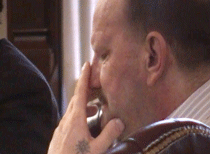
While Harris was testifying, Coonrod began wiping his eyes and eventually broke down crying.
The ambulance waited a few minutes, she testified, so that Wesley Coonrod could board the vehicle, and he sat in the front seat. When they arrived at Adena Greenfield Area Medical Center, she said that Coonrod became disruptive of their efforts, yelling at EMTs and hospital personnel as they attempted life-saving procedures on the children.
Both children were on the same bed, she said, but Coonrod kept asking where Stephen was, moving in and out of the area where they were working.
At one point, Harris said, she stopped working on Thomas in order to address Coonrod.
"Did you ever get a pulse on Thomas?" Collins asked. "No," Harris
said.
Collins asked her how the event has affected her.
"How hasn't it affected me?" she said. "I have a 5-year old son, and when I see him, when I pick him up from school. I see them when I sleep."
Harris said that she and three other firefighters, including fire Chief Bradley George, returned to the scene later that day as a way to "wrap my brain around what we had just been through, what we had just dealt with."
Collins asked Harris what she saw.
"There were more beer cans than toys," Harris said.
The jurors also heard testimony from firefighters Bill Strain and Mike Gilbert, and neighbors Rhonda Lester and Jason Jenkins.
Lester testified that while Coonrod's neighbors were trying to break down the doors to get in the house, Coonrod stood motionless, did not approach the house and acted "like he was in awe. Like he couldn't believe it was happening."
People, she said, asked Coonrod multiple times, where his children were. Lester said he never responded.
Lester said that from where she stood, she could hear the children screaming. Coonrod stood next to her, she said, and asked for a cigarette.
Firefighter and EMT/Paramedic Bill Strain testified that when Stephen Coonrod was brought out of the apartment, the child was handed off to him and he immediately began CPR. The squad had not yet arrived to the scene, so he and a bystander performed CPR on the sidewalk.
"All the other manpower was in the house trying to find the other child," Strain said.
Sgt. J.D. Dunn, of the Greenfield Police Department, offered his cruiser to Strain to take the child to the hospital, which was minutes away from the scene. Strain said that he held the child in his lap and continued chest compressions while Dunn drove to the hospital.
Dunn testified that he drove Strain and Stephen to the hospital. Using law enforcement jargon, Dunn said he ran "2/7," meaning lights and sirens, to the hospital.
"I ran 2/7 just as fast as I could go," Dunn said.
Once he reached Adena Greenfield Area Medical Center, he started to return to the scene but was called back to the hospital to handle "a disturbance."
Dunn testified that Coonrod was at the hospital and "was under the influence of something," and that he tried to calm him down.
"One minute he was nice and calm, and the next he was stiffening up like he was ready to fight the world," Dunn said.
Dunn said that in his experience as a law enforcement officer, over the years he'd had the occasion to witness Coonrod while he was intoxicated, "and that's just how he acts."
The defense asked Dunn if he had performed a drug or alcohol test on Coonrod, and he said that he did not.
Dunn was asked if Coonrod had just been informed that his children were dead.
"Initially no, but he learned that later," Dunn said.
The jurors also heard testimony from firefighter Mike Gilbert; Rhonda Lester and Jason Jenkins, witnesses who were next door to the Lafayette Street property when the fire started; Dara Gullette, an advocate at the Alternative to Violence Center in Hillsboro; and fire investigator James Hunter.
Lester testified that while Coonrod's neighbors were trying to break down the doors to get in the house, Coonrod stood motionless, did not approach the house and acted "like he was in awe. Like he couldn't believe it was happening."
People, she said, asked Coonrod multiple times where his children were. Lester said he never responded.
Lester said that from where she stood she could hear the children screaming. Coonrod stood next to her, she said, and asked for a cigarette.
"He was incoherent," Lester said. "He was standing there like he was watching a bonfire go. He was ... no emotion, incoherent, just ... speechless. Like he was in a trance ... He was not doing nothing at all. He was not trying to get into the apartment. He was not worried about where his kids was at. He couldn't even answer us. All of us ... kept asking him, 'Where's the kids at?Where's the boys at?' He never showed no emotion. Nothing. I mean nothing at all. He just stood there. Even when they went to go take the second little fellow to the hospital in the ambulance, Jason (Jenkins) had to tell him, 'Man, aren't you going?'"
The defense stated during the last trial, and during opening arguments Monday, that Coonrod suffers from a degenerative eye disorder that has made him night blind with severe tunnel vision, which could account for some of the behavior witnessed the night of the fire.
Jenkins testified that he, and other bystanders, tried to get water to put on the fire, and broke out windows, and kicked in both the front and back doors in order to get inside to the children.
Jenkins said that while he was trying to kick down the back door, Coonrod stood looking in the window.
"When we couldn't get an answer out of Wes, we had to take it upon ourselves to get in. That's when we heard the kids screaming," Jenkins said.
He had testified that the firefighters arrived about 20-30 minutes after they first noticed the fire.
Defense attorney William Mooney asked Jenkins on cross examination if he was wearing shoes while he tried to kick down the door, and he said that he was. When asked how many times he had to kick at the door in order to break it open, Jenkins said it was five to 10 times. McHenry asked if Jenkins noticed what Coonrod was wearing, and then indicated that Coonrod could not have kicked down the door himself because he was not wearing shoes.
Jenkins said that he did notice that Coonrod was not wearing shoes, and that he was only wearing boxer shorts. He also said that he did not have soot on him and, "He hadn't been nowhere near a fire."
He also said that Coonrod smelled of alcohol.
Mooney asked Jenkins how Coonrod acted.
"I wouldn't have acted that way if they were my children," Jenkins said.
Mooney asked if the back door was open for about 20 minutes before firefighters arrived, and Jenkins said that it had been.
On re-direct examination, Assistant Highland County Prosecutor David Henry asked Jenkins how he would have acted, and the defense objected, stating it was irrelevant. The attorneys approached the bench and after discussions with Coss, Henry asked a different question.
"Did you call 911?" Henry asked.
"I was too busy," Jenkins said.
Dara Gullette testified that as part of her job at the Alternative to Violence Center, she acted as a mediator between Wesley Coonrod and Felicia Coonrod (now Felicia Elliot), the mother of Thomas and Stephen. She said that she had previously had to mediate between them during the boys' funeral and visitation.
When questioned by Highland County Prosecutor Jim Grandey, Gullette said that while at the funeral home, she was sitting next to Felicia Elliot when she had a conversation with Coonrod about what happened the night. Gullette said that Coonrod changed his story three times over the course of six hours. She testified she heard him say that Thomas was asleep on the couch and Stephen was in bed with him when the fire started, he then said that both boys were asleep in their bedroom in sleeping bags, and he eventually said that he didn't know where the boys were when the fire started.
Defense attorney Jerry McHenry, on cross examination, asked Gullette about why she was at the funeral home. She said that she worked with the court, not for the court, and that she was there to support Coonrod, "Felicia and the boys."
"The boys are dead, they didn't need support, did they?" McHenry asked.
"That's not true," Gullette said, and McHenry said that was her opinion.
McHenry asked why a mediator was needed, and Gullette said because it was a tense situation. McHenry asked why it was a tense situation.
"Because two boys are dead," Gullette said.
The state has five witnesses left to present, and told Judge Coss that they anticipate completing the presentation of the case by early Wednesday afternoon. At that time, the defense will begin with its case.
The state has five witnesses left to present, and told Judge Coss that they anticipate completing the presentation of the case by early Wednesday afternoon. At that time, the defense will begin with its case.
[[In-content Ad]]