


Highland County commissioners weigh in on Paint Creek Scenic River proposal
As reported in an Ohio Department of Natural Resources press release last month, Director Mary Mertz announced the state’s intent to designate portions of Paint Creek and its tributaries as Ohio’s 16th state Scenic River.
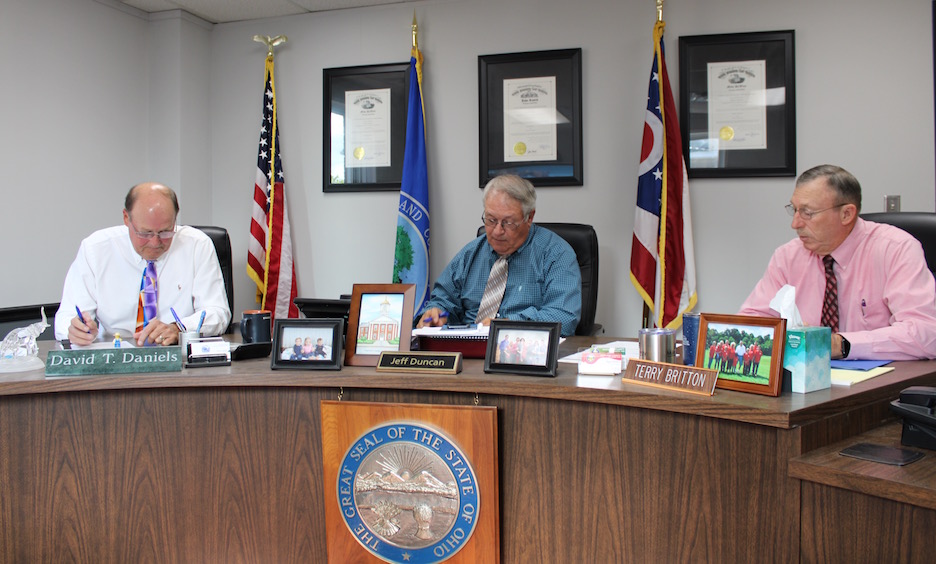
Scenic Rivers program manager Bob Gable answered questions and concerns from commissioners and residents during the Aug. 4 county commission meeting. One week later, at the Aug. 11 meeting, additional residents urged the commission to rescind the letter of support previously submitted to ODNR.
During their Wednesday, Dec. 30 meeting, the commission had voted to send the letter in support of the village of Greenfield’s efforts to gain “scenic waterway” status for a section of Paint Creek. Greenfield council member Phil Clyburn has been working to gain this designation from the state for a number of years, as commissioners voted to send a similar letter in September 2016.
The third straight week of debate began with two property owners in the Paint Creek area, Todd Campbell and Matt Ingles, asking to be placed on the Aug. 18 meeting agenda.
Campbell, who also read a prepared letter Aug. 4, read a new statement Wednesday, asking county representatives to “side with” the landowners opposed to the proposal. He referenced a letter from Highland County Prosecutor Anneka Collins written to a landowner concerned about solar farms (which can be read at https://highlandcountypress.com/Content/In-The-News/In-The-News/Article/UPDATED-Commissioners-OK-sheriff-s-vehicle-purchases-hold-bid-opening/2/20/69297).
“I would like our commissioners and even our prosecutor to stand with private property owners and oppose the scenic waterways designation that could affect landowners like myself negatively in the future, and possibly sooner, by adding more traffic to our waterways here,” Campbell said. “Commissioners so far are failing at their oath of office by not standing or rejecting or opposing this. Paint Township trustees voted 3-0 to oppose, and we are seeing the same exact action all the way to Chillicothe.”
Ingles told commissioners that he and his brother had spoken to property owners living in Scenic River-designated areas.
“Out of the landowners we had talked to, they said there was no big concern as of now, but stuff is already changing in their areas,” he said. “We never had one of them say it was a great idea, except for one who owns a livery or kayak rental.
“Basically, all it amounts to is personal profits for people that’s involved in it. That’s one of the reasons we oppose it. The waters that we’ve got already that they’re wanting to use for the scenic stuff are the cleanest in the area. There’s no reason for the ODNR to be involved in it.”
Ingles added that there’s “no sense in having another form of government in control of stuff that they shouldn’t be involved in.”
Commission president Jeff Duncan told Campbell, Ingles and other citizens in attendance that he had also done some research, but his findings were that people had “nothing negative to say” about the Scenic River designation. Duncan said that he spoke to the manager of a fertilizer plant that is “within 400 feet” of Big Darby Creek, which has both state and national scenic destinations.
“He said they had no issues that he was aware of,” he said. “I asked if he had any customers that had issues, and he said none that he was aware of. He did give me the name of a customer and a township trustee in the area, and I called him yesterday. He farms in the area and said that the township had never had any issues.”
Duncan said that the fertilizer plant manager also advised that he had “a home within 300 feet of the creek, and they had put in a leach field and didn’t have to have any special permits or anything of that nature.” He also indicated that they didn’t have to obtain permits for a “shelter” equipped with electric and water that they built near the creek, according to Duncan.
Duncan added that the individuals he spoke to in Union County also told him that “some canoe liveries along the way that have sprung up,” but they were run by private landowners and not the state.
“There’s no public access anywhere through this, from Paint Creek up to Rocky Fork,” Campbell said.
Ingles told commissioners that a cattle farmer in one area in Ohio had advised him that the state was “trying to get him to remove his cattle” because they “interfere with the traffic moving through the creek.”
“Even though he owns the land below the creek, ODNR has asked him to move his cattle back off of the creek already because it’s interfering with boat traffic,” Ingles said.
Duncan said that it was his understanding the state wants to “keep cattle away from any kind of a creek.” Ingles responded that “most Homestead Acts have already granted water rights for cattle.”
Commissioner David Daniels said that he has also reviewed the proposal and spoken to individuals, and thus far has seen “no adverse, negative effects on property owners anyplace we’ve been able to find.”
“If there are people out there that have experienced negative consequences, I’d like to know who they are, because I’d like to talk to them,” Daniels said.
Ingles said Daniels could read reports online of “out west where they’ve done this stuff” and affected property owners.
“Not ‘out west,’ in Ohio,” Daniels said. “There’s an Ohio designation that’s Ohio law. Read the entire law. The law in its entirety is very clear. It’s to protect the quality of water in the stream, and it protects landowner rights.”
Daniels repeated that he would like to “have a firsthand conversation” with anyone in Ohio who could speak to the “negative effects” of the designation.
“That’s going to be the thing that makes at least me reconsider my position,” he said. “Another community has voted on it. Their elected officials have voted on it and said they would like to have this designation. We like to support the local communities and the taxpayers as well as we can with good information.”
Ingles asked when their “deadline” was to contact ODNR. Daniels said “until the director says we’re done.” Ingles said they would ask people to “get in touch” with the commission.
Campbell reminded commissioners that he — and his wife, who addressed the commission Aug. 11 — had come to the meetings with other residents and petitions with “several pages of signatures saying that the residents, the taxpayers here in Highland County, the voters, don’t want this.” There are “more reaching out to me on a daily basis” wanting to sign the petitions, he said.
Ingles said that at his business, he is sharing the laws for the Scenic Rivers designations, which is also prompting residents to sign the petitions. “It’s not like we’re telling them something,” he said. “We don’t just make this stuff up.”
Campbell said that he also asked Gable about the “government control.”
“I said, can you get Governor DeWine to sign an agreement that says the next 200 years, you will not do anything to try to take my property or any rights to my property?” Campbell said. “He said, I can’t do that, because I don’t know what the next policy will read. Policy is what changes this, and policy is not a law. Policy is also not voted on by the people. That is an administrator setting the policy, and they can change the designation at any given point in time.”
Daniels disagreed, saying that ODNR’s “reading of the law is very clear” in relation to property rights.
As previously reported, ORC 1547.81 reads, in part, that the Scenic River designation “does not authorize the director or any governmental agency or political subdivision to restrict the use of land by the owner thereof or any person acting under the landowner's authority or to enter upon the land and does not expand or abridge the regulatory authority of any governmental agency or political subdivision over the area.”
“It’s very clear that the law as written — not policy, the law — when read in its entirety says that the designation does not give any government agency or any unit of government any control over private property rights or landowner rights,” Daniels said. “It does not grant ingress or egress across private property for any reason. There are certain reasons that property can be taken by eminent domain, and recreation is not one of them. It has to be for a public purpose, such as a dam, such as a waterway or flood control.
“When you read the law in its entirety, it is very clear what can and can’t be done, and the intent of the law is to protect private property rights and protect the scenic waterway.”
Daniels reminded the residents that “a community in our county has come and asked for this” support. As he said, the village of Greenfield wants the designation as “part of their economic development portfolio.” Campbell said that they are “not looking to change anything with Greenfield” and their plan or “any public land owned against the waterway.”
“If they want to designate it over there, that is fine with us,” he said. “That doesn’t affect us. We’re all private property owners, not public — private property owners — that are opposed to this from Rocky Fork Lake to Paint Creek.”
As Greenfield City Manager Todd Wilkin was also present for the meeting, Duncan invited him to comment on the village’s behalf. Wilkin said it was part of Greenfield’s goal to promote “destination tourism” for Greenfield, and in turn, Highland County.
“For us, we represent 4,700 people in the village of Greenfield,” Wilkin said. “They elect your council over there, and council goes forth and set forth policy and/or economic development plans. Three years ago, they put forth an economic development plan, and it was passed. It was actually put out for comment to all the citizens of Greenfield.”
Wilkin added that Paint Creek “is all federally owned land already” in the Greenfield area, so “there’s no private property.”
“From a standpoint of what this can do, the waterways are already used,” Wilkin said. “They’re already used by many kayakers, canoeists. They go right down the creek, and right now, private property owners may not even know that they’re back there. I don’t know that the Scenic River [designation] is going to change the amount of traffic in a negative way.”
Wilkin said he thought the designation will promote the area and “increase the amount of traffic to bring them to Highland County,” leading to increased revenues from people “spending their money” in the area. The “word of mouth” from those who visit will also lead to promoting the county and village of Greenfield, he said.
“That’s why we wrote our letter,” Wilkin added. “That’s why we supported this. We are doing our job as it relates to attracting destination tourism to our community, and that’s where we’re at from a community standpoint.”
Campbell responded that he doesn’t “live in the city of Greenfield, and you don’t represent me.” Ingles said that he has a business near “three areas for hotspots for kayaks” and that “you don’t see people on kayaks from out of town spending their money around here.”
“I don’t know that I agree with that,” Wilkin said.
Daniels interrupted and said that they weren’t “going to get into a back-and-forth” between the residents and Wilkin.
“If you want to do that, take it outside,” he said.
However, Daniels told Ingles if his report that people aren’t spending money on kayaks is true, “then this is completely a nonissue.” “Then you’ve controlled your private property, and this designation does not give anybody the right to cross your property,” Daniels said.
Campbell said that Daniels “can’t tell me what the future’s going to hold.” Duncan replied, “Well, you can’t, either.”
“We appreciate you coming in and sharing your thoughts,” Duncan added.
• • •
In other action, commissioners approved the following resolutions, each by a 3-0 vote:
• A request from the county auditor to establish a new fund S-23, Coronavirus Local Fiscal Recovery Fund. Also requested is a new line item, Other Expense, and an appropriation of $8,383,518.
• An additional appropriation from unappropriated funds within the Engineer’s budget in the amount of $23,671.37.
• Commissioners also voted 3-0 to accept a $29,680 bid from Weller’s Plumbing to replace an HVAC unit at the Highland County Justice Center. As discussed Aug. 11, the unit is approximately 20 years old, as commissioner Terry Britton said it is the “last unit not replaced” of the building’s original HVAC units.
• Also during the commission meeting, representatives from Weastec announced a return to the village of Greenfield. For more, see the story at: https://highlandcountypress.com/Content/In-The-News/In-The-News/Article/Weastec-announces-plan-to-resume-operations-at-Greenfield-facility/2/20/70769.
• • •
Not discussed during the meeting, but included on the agenda, were several items of correspondence.
• Wilkin sent a letter on behalf of the village of Greenfield “expressing our continued support of the Scenic River declaration for Paint Creek, North Fork, Rocky Fork and Rattlesnake creeks.”
• Commissioners received a copy of a letter from Paint Creek Joint EMS/Fire District Chief David Manning, Fire Safety Inspector Jerry Quigley and City of Hillsboro Building Inspector Steve Rivera addressed to “property owners, business owner or occupants.”
The letter is asking building owners to schedule “a fire safety inspection” as well as a “building inspection.”
• There were several emails related to solar farms. Three residents sent emails asking commissioners not to support the farms and/or the PILOT (Payment In Lieu of Taxes) program, while another email was sent in support of solar farms. The commissioners office also received separate requests from a group supporting solar farms and a group opposed to solar farms asking to be placed on upcoming agendas.
• Commissioners also received an email from Tom Schwartz of FDC Enterprises seeking information on the economic development board.
• FEMA sent a letter regarding the National Floodplain Insurance Program.