


Council members propose disbanding CIC, Design Review Board in separate ordinances
Lead Summary
By
Caitlin Forsha-crforsha@gmail.com
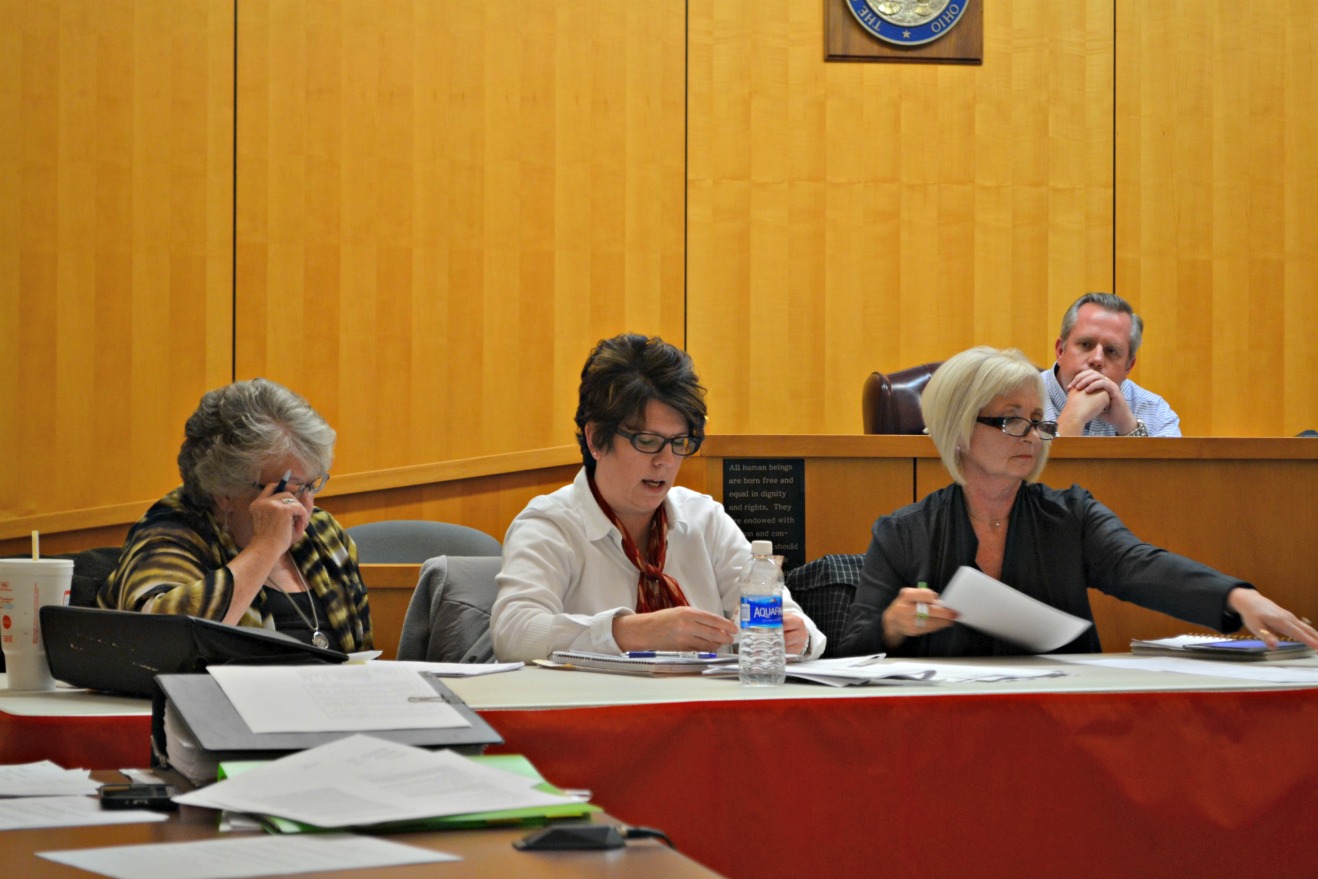
Hillsboro City Council members heard the first reading of two ordinances presented by council members Tracy Aranyos, Claudia Klein and Ann Morris to repeal existing city boards during council’s regular November meeting Monday night.
The first ordinance is to repeal the establishment of the Community Improvement Corporation, which was established by a council ordinance in May 2015 after being proposed by Hillsboro mayor Drew Hastings. An ordinance to repeal the Design Review Board, as suggested by Aranyos at the Sept. 13, 2016 council meeting, was also introduced.
Aranyos explained her reasoning for the ordinances, as discussed at earlier meetings, as a desire to “make things easier” for citizens.
“I’ve had personal occurrences with some members of the CIC,” Aranyos said. “It turns into more of a political power tool. I have a problem when it becomes argumentative.
“My whole thoughts behind these boards is where they’re supposed to be easier for the community to use this and to move businesses and questions and answers faster, I’ve had a lot of people contact me that it’s not moving very fast. It’s very slow.”
For the CIC, Aranyos said, she has an issue “when a member of the board comes up and tries to tell me how I should do my job, and if I don’t do my job the way I want, they’ll just go around me.”
“You get into the political games where people don’t want to work on a project or they’ll slow it up or speed [it up],” she said. “When a board becomes like that, I don’t see a need for it.
“I also feel like council can move a lot faster on these boards.”
Aranyos said it would be easier if requirements and applications were available online for citizens to access.
“We can move it much quicker than the boards that meet once a month,” Aranyos said. “Sometimes, there’s members on these boards that’s a conflict of interest, which slows things up. For appearance sake, it doesn’t look good.”
Hastings responded that he believed “the disposition of property” legally had to be done through the CIC.
“Our blighted properties have to be disposed of, or received, through another entity other than the city of Hillsboro,” Hastings said. “That’s pretty much always the case with real property that we have.”
Council president Lee Koogler clarified that a CIC was “a conduit for municipalities” to do so.
Hastings provided copies of a letter, written by Bob Hodson in support of the CIC, to council members and discussed the letter during the mayor’s report. In the letter, Hodson discusses “how there’s always a need for an active CIC,” Hastings said. The letter also provided a history of the CIC in the city, although Hastings said that it has been called different names throughout its history.
“It’s been the same entity, going down through the years,” Hastings said. “You can read it through the ’60s, the ’70s, the ’80s and into the ’90s, but the CIC has been used for a lot of very large and small projects throughout Hillsboro, and Hillsboro would not, without question, be the city it is today without the use of that CIC and what it was able to accomplish.”
Hastings said the letter shows that “the CIC is very important to business expansion and economic development of this city.”
“We don’t have to have a CIC, and if we need one, we have a county one, if we absolutely had to use [it],” Aranyos said. “Besides that, we went many years where we didn’t use it, because this council right here just recently approved and created the current CIC. Along with that, we turned over two projects, and the CIC rejected both of them.”
Hastings proposed that council meet with the CIC to further discuss “exactly how it works and its relationship with the city.”
“I would like to keep [the ordinance] just as is, and we vote,” Aranyos said.
“We’re not asking for an emergency,” Klein said.
For the ordinance to repeal the Design Review Board, Aranyos said citizens “have complained that it’s not very user-friendly.”
“I just feel like a lot of that could be very easily be put on the city’s website,” Aranyos said. “There’s a lot of people that have a real simple, basic request, and it could be moved through within days, if not a week, when they’re having to wait a minimum of a month or longer. Some of these people are under time constraints or weather constraints, and they just want it to move faster.”
Klein added that citizens have complained to them about the rules being unclear because they aren’t online.
“If you don’t have the rules set down what you’re expected to do, how you’re expected to do it and how it’s supposed to look, it becomes a matter of a simply personalities,” Klein said. “That’s the way it looks to everybody. No one knows what the rules are. The Design Review Board may say one thing now and another thing now and another thing now, unless there is actually a set of rules and guidelines you go by that can be given to anybody.”
Council member Rebecca Wilkin said that she also had an issue with the fact that the Design Review Board had not provided copies of their manual to council, despite being asked to do so on Sept. 26.
“I’ve not been given that by anybody that’s a member of the Design Review Board,” Wilkin said. “I think that’s a simple request that should probably take two seconds to put in the inbox of my email.”
Hastings said that Klein’s statement that “it’s personality-based is really not the case.”
“This manual has been worked on for over a year,” Hastings said. “The whole name of the game is to get it a way so that anybody can come in and say that ‘this type of vinyl window is not allowed, this type of wooden thing is, this kind of downspout is not.’”
Hastings said that he had received a copy of the manual in his email Monday morning and could forward it to council.
“Aren’t you a member?” Wilkin asked.
“Yeah,” Hastings said.
“Didn’t you have a copy already? I mean, besides today?” Wilkin asked.
“I’m not on the committee that’s working on it,” Hastings said. “Mary [Hardeman] tends to get involved in updating, and I don’t always have the latest draft of the manual.”
Koogler allowed Hardeman, who was in attendance, to address council as well. Hardeman said the board has “worked extensively on developing, amending and revising” the manual.
“The mayor does have a copy of the manual and has had one for months,” Hardeman said. “I guess that has slipped his mind. I don’t know why they weren’t provided to you. The staff was supposed to get them to you, and I apologize for that. I don’t know why it didn’t happen.”
Hardeman said that “the staff is working” on getting the information online.
“Anyone who comes to the administration office for information about signage and permits and building permits, when it is discovered that their property is in the designated uptown historic and business district, they are given the materials that they need,” Hardeman said. “If it involves the Design Review Board, they do get a copy of the manual. They’re given the blank certificate of appropriateness. The staff gives them whatever information they’re supposed to have. They’re told, if it’s a sign, what happens with the sign permit as well.
“As far as comments that it’s not timely, as I said last time, we do meet on the first Wednesday and the third Wednesday of the month. The only times we don’t meet are if we don’t have any business to conduct or if we don’t have enough members for a quorum.”
Hardeman said that they have also “tried to accommodate” anyone under strict deadlines.
Council member Justin Harsha said that he “sees the importance of the Design Review Board.”
“I don’t want to see things happen in the historic district, and there’s a group in place to keep certain things from happening,” Harsha said. “I would like to see this go to committee to see if it can be restructured so council has a little bit more to do with it.”
Hardeman said that perhaps “one or two” council members could become members of the board.
Aranyos said that she stands by the ordinance.
“I would like to disband it,” Aranyos said. “We already have zoning, we already have historic ordinances and rules, you have a safety service director, you have building code rules. We have all this stuff in place.
“I just don’t see the need to keep having more meetings, more meetings, to make it harder, harder, harder for citizens.”
Harsha responded that he “sees the [Design Review Board] as a speedy process, if it’s done correctly.”
“I think Justin’s right about that,” Hastings said. “My overall belief is city council is – not to denigrate [the Design Review Board] – a more important body than to look at wood trim and color samples every month in a meeting here. I just think you have a lot more important issues to deal with than that.”
“But if those were all online, available to anybody, they could go through and decide that, fill out their forms, take their pictures of their design or whatever – it would be as easy as getting a sign permit,” Klein said.
“Some of these would be very quick and expedient,” Aranyos said. “We make hard decisions and easy decisions, so we can debate this all night long. It’s not like we’re not intelligent enough or they’re not intelligent enough. We have all kinds of things thrown at us, same as them. I’m just trying to make it faster. That’s all.”
“Faster and easier,” Klein said.
As the council members introducing the ordinances were not attempting to pass the ordinances as an emergency, Koogler placed the ordinances in the finance committee for further discussion.
Later in the meeting, council passed a resolution to approve the mayor’s appointment of Sally Renk and Betty Ann Walker to the Design Review Board. Renk was appointed to fill an existing vacancy on the board, and Walker will complete the unfinished term of Chad Shelton, who Hardeman said resigned.
“I know the issue continues to remain in committee with legislation to abolish it, essentially, being before council,” Koogler said. “However, I am a believer of us being able to have our bodies function while we are looking at any sort of issue.”
Council voted 7-0 to approve the resolution.
• • •
In his report, Hastings proposed the idea of a “municipal downtown development district,” which was discussed at the Ohio Municipal League’s annual conference he attended recently.
Hastings said that the Ohio House of Representatives passed House Bill 233 in August, which provides for such districts.
According to www.legislature.ohio.gov, the legislation was passed “to authorize municipal corporations to create downtown redevelopment districts and innovation districts for the purposes of promoting the rehabilitation of historic buildings, creating jobs, encouraging economic development in commercial and mixed-use areas, and supporting grants and loans to technology-oriented and other businesses, to specifically extend the charitable use property tax exemption to certain museum property that is open to the public and that belongs to a public or charitable organization, and to authorize collections of a special lodging tax that may be levied by certain counties to be used to not only construct, but to acquire or equip, a port authority facility.”
“It’s a defined area that cannot be more than 10 acres,” Hastings said. “If we decide we want to do an area that’s more than 10 acres, you can have two districts side by side, for example.”
Hastings said such a district would “have to have a continuous boundary” with “at least one historic building.”
“Our uptown area, and actually expanded a little bit beyond the historic uptown area if we wanted, is perfectly suited for this sort of thing,” Hastings said. “It promotes, overall, the historic redevelopment of uptown and downtown areas. It authorizes new property tax exemptions and allows for redevelopment charges.
“There are revenue-producing mechanisms in the district. It encourages people to work and live downtown, with specific means to do that. It includes facade improvements, it includes historic preservation, street-scaping, amenities to accommodate downtown living and incentives to accelerate business incubation growth.”
Hastings said this plan encompasses efforts the city has “made stabs at” in recent years, “but this ties it all into one formal district that we write a simple ordinance for.”
“It can be as simple or as complex as we like,” Hastings said. “We submit a plan for the ordinance. Funds that are received stay within the scope of what it is that we decided this district is to be for. It’s in conjunction with the state, and of course the state has specific rules, so they monitor this.”
Hastings asked that the proposal be placed in committee. Koogler placed the matter in the property maintenance and restoration committee, with the provision that other committees may eventually need to look into it as well.
In the Hillsboro Planning Commission report, Hastings told council that the owners of Downtown Drug – located in Bell’s Opera House, which the mayor owns – “want to move their pharmacy to the space in the opera house at the south end of the building, adjacent to the alley, and install a drive-thru window.”
“The owners of the pharmacy feel they need a drive-thru window to compete with other pharmacies in town,” Hastings said. “If they cannot install a drive-thru window, they will probably have to move to a different location, out of the uptown district.”
Hastings said the commission “discussed the precedent set with the drive-thru at TwentyFour Exchange,” which is owned by council member Morris and her family.
Morris responded that she was “100-percent behind” the proposed drive-thru window for the pharmacy.
“I don’t feel like we have changed the look of the historic district by having a pickup window for the food, so I don’t think that that would happen with the drugstore, either,” Morris said. “In order to keep businesses uptown, I think we have to be progressive about that.”
Hastings said that he was “not a fan” of the idea initially but realized that such windows in the uptown area “make sense” for businesses “to compete with Harry Sauner and North High Street.”
Safety and service director Todd Wilkin said that he received the request and that he was looking into several factors, although he said he was “not a fan of drive-thrus in every alley uptown.”
“I asked the mayor to contact the State Historical Society because I know that the mayor had received some funds from the State Historical Society for his building,” Wilkin said. “He’s getting that information.
“The Design Review Board is supposed to review items like this within the historical district. Because the mayor’s on that board currently, we’ll be going to an outside, third-party Design Review Board to look at this installation of a window. We’ll either be contacting Wilmington or Lebanon’s Design Review Board to look at installing a window.”
Wilkin said that the visiting Design Review Board’s decision will be based on Hillsboro’s Design Review Board standards.
Wilkin said that he was “not a fan” of the idea because of “the amount of calls and complaints that I’ve gotten, even from city officials” regarding drive-thru windows in the uptown area.
“There’s an awful lot of citizens that don’t complain, that use that drive-thru every day,” Morris said. “I wouldn’t take just a few people’s complaints and change the whole city, or you’ll have a vacant uptown.”
“The item at hand, as the mayor’s brought out through the planning commission notes, is a drive-thru window to be installed on his property,” Wilkin said. “I’m basing my next steps on a letter that we received from law director [Fred] Beery that states that any official who has the perception of getting special treatment, their permits or their applications must be reviewed by a third party.”
• • •
Todd Wilkin told council that the city is working with the 91st Civil Affairs Battalion, who are “analyzing the current conditions of all of our city streets,” during the safety and service director's report.
“Not only will they be providing this critical information on the condition of our streets, but also the condition of our sidewalks throughout town,” Wilkin said. “The goal of this project is to obtain the total amount of street assets for our auditor and also provide a plan for what streets are in critical need of repair and can be added to our capital improvement program and/or our budget.”
Wilkin also thanked local CPA David A. Collins for donating a $50 gift card for a randomly selected participant in the city’s parks survey, as well as the winner of the gift card, Deborah Harsha. As previously reported in The Highland County Press, Harsha donated her gift card to Girl Scout Troop 321 to be used for planting trees at Liberty Park.
“We are thankful to Ms. Harsha for her generosity and also are excited about the projects the Girl Scouts want to implement at the park,” Wilkin said. “The survey turned to be a win-win for everyone involved. The city was able to glean good information about our parks, and the awarded gift card will be utilized to benefit the park.”
Wilkin also reminded council that the finance committee, along with the administration, would need to review next year’s budget.
• • •
Near the beginning of the meeting, Koogler referenced the “challenge” of the mayor’s litigation in the past year for everyone involved with the city and his hopes for the city moving forward.
“We, as a public body, are here to serve the citizens,” Koogler said. “That’s our official function. I know that I plan on, and expect all of us, to work with the administration – with [Hastings] personally, as well as the administration – in moving forward and meeting the needs of our citizens because that’s what we’re entrusted to do.”
• • •
Council also heard from Highland County Visitors Bureau Destiny Bryson, who addressed the finance committee at a meeting earlier this month. Bryson introduced herself and provided a brief summary of her personal background, along with information on a “strategic plan” proposed by the Visitors Bureau director and board.
During his report, finance committee chair Dick Donley said that the committee met, along with Bryson and members of the CVB board, to discuss the mayor’s request for the city to increase funding to the board.
Donley said that the committee “was recommending an amount for the city to put into the bureau.”
“However, since that meeting, I have come to be enlightened by the safety director and some discussions with the auditor, that we’re in the midst of the budget for the upcoming year,” Donley said. “It’s looking pretty tight at this juncture. It’s something that I’m not going to say that we’re not going to do. There will be some legislation presented at the next council meeting, and we’re going to continue to have discussions with the auditor and the administration on the budget for next year. I’m confident we’ll be able to come up with some figures to give to the visitors bureau.”
• • •
Morris reported that the property maintenance and restoration committee met on Monday evening, prior to the regular council meeting. The committee discussed blighted properties and an update on the Colony Theatre.
• • •
Harsha reported that he and members of the Festival of the Bells committee have been discussing entertainment for the 2017 festival. Harsha said that he has been appointed co-chair of the festival.
• • •
In other action:
• Council voted 7-0 approve an additional one-month moratorium on water and sewer rates, for the third consecutive month.
• Council heard the first reading of an ordinance to approve an ordinance to establish a charge to fund inflow and infiltration abatement in the Sewer Department. The ordinance states that the city “shall bill each customer for each sewer connection the sum of $2 each month for the purpose of funding inflow and infiltration abatement in the wastewater collection system of the city,” as discussed at previous meetings.
• Council voted 7-0 to approve and adopt a resolution to adjust appropriations and transfer funds, introduced by the auditor. Lewis said that the resolution was a “housekeeping measure” affecting the law director’s budget.
• Council voted to suspend the three-reading rule and unanimously approved a resolution authorizing the city to prepare and submit an application to ODNR Land and Water Conservation Fund Program (for the Harmony Lake Trail).
The first ordinance is to repeal the establishment of the Community Improvement Corporation, which was established by a council ordinance in May 2015 after being proposed by Hillsboro mayor Drew Hastings. An ordinance to repeal the Design Review Board, as suggested by Aranyos at the Sept. 13, 2016 council meeting, was also introduced.
Aranyos explained her reasoning for the ordinances, as discussed at earlier meetings, as a desire to “make things easier” for citizens.
“I’ve had personal occurrences with some members of the CIC,” Aranyos said. “It turns into more of a political power tool. I have a problem when it becomes argumentative.
“My whole thoughts behind these boards is where they’re supposed to be easier for the community to use this and to move businesses and questions and answers faster, I’ve had a lot of people contact me that it’s not moving very fast. It’s very slow.”
For the CIC, Aranyos said, she has an issue “when a member of the board comes up and tries to tell me how I should do my job, and if I don’t do my job the way I want, they’ll just go around me.”
“You get into the political games where people don’t want to work on a project or they’ll slow it up or speed [it up],” she said. “When a board becomes like that, I don’t see a need for it.
“I also feel like council can move a lot faster on these boards.”
Aranyos said it would be easier if requirements and applications were available online for citizens to access.
“We can move it much quicker than the boards that meet once a month,” Aranyos said. “Sometimes, there’s members on these boards that’s a conflict of interest, which slows things up. For appearance sake, it doesn’t look good.”
Hastings responded that he believed “the disposition of property” legally had to be done through the CIC.
“Our blighted properties have to be disposed of, or received, through another entity other than the city of Hillsboro,” Hastings said. “That’s pretty much always the case with real property that we have.”
Council president Lee Koogler clarified that a CIC was “a conduit for municipalities” to do so.
Hastings provided copies of a letter, written by Bob Hodson in support of the CIC, to council members and discussed the letter during the mayor’s report. In the letter, Hodson discusses “how there’s always a need for an active CIC,” Hastings said. The letter also provided a history of the CIC in the city, although Hastings said that it has been called different names throughout its history.
“It’s been the same entity, going down through the years,” Hastings said. “You can read it through the ’60s, the ’70s, the ’80s and into the ’90s, but the CIC has been used for a lot of very large and small projects throughout Hillsboro, and Hillsboro would not, without question, be the city it is today without the use of that CIC and what it was able to accomplish.”
Hastings said the letter shows that “the CIC is very important to business expansion and economic development of this city.”
“We don’t have to have a CIC, and if we need one, we have a county one, if we absolutely had to use [it],” Aranyos said. “Besides that, we went many years where we didn’t use it, because this council right here just recently approved and created the current CIC. Along with that, we turned over two projects, and the CIC rejected both of them.”
Hastings proposed that council meet with the CIC to further discuss “exactly how it works and its relationship with the city.”
“I would like to keep [the ordinance] just as is, and we vote,” Aranyos said.
“We’re not asking for an emergency,” Klein said.
For the ordinance to repeal the Design Review Board, Aranyos said citizens “have complained that it’s not very user-friendly.”
“I just feel like a lot of that could be very easily be put on the city’s website,” Aranyos said. “There’s a lot of people that have a real simple, basic request, and it could be moved through within days, if not a week, when they’re having to wait a minimum of a month or longer. Some of these people are under time constraints or weather constraints, and they just want it to move faster.”
Klein added that citizens have complained to them about the rules being unclear because they aren’t online.
“If you don’t have the rules set down what you’re expected to do, how you’re expected to do it and how it’s supposed to look, it becomes a matter of a simply personalities,” Klein said. “That’s the way it looks to everybody. No one knows what the rules are. The Design Review Board may say one thing now and another thing now and another thing now, unless there is actually a set of rules and guidelines you go by that can be given to anybody.”
Council member Rebecca Wilkin said that she also had an issue with the fact that the Design Review Board had not provided copies of their manual to council, despite being asked to do so on Sept. 26.
“I’ve not been given that by anybody that’s a member of the Design Review Board,” Wilkin said. “I think that’s a simple request that should probably take two seconds to put in the inbox of my email.”
Hastings said that Klein’s statement that “it’s personality-based is really not the case.”
“This manual has been worked on for over a year,” Hastings said. “The whole name of the game is to get it a way so that anybody can come in and say that ‘this type of vinyl window is not allowed, this type of wooden thing is, this kind of downspout is not.’”
Hastings said that he had received a copy of the manual in his email Monday morning and could forward it to council.
“Aren’t you a member?” Wilkin asked.
“Yeah,” Hastings said.
“Didn’t you have a copy already? I mean, besides today?” Wilkin asked.
“I’m not on the committee that’s working on it,” Hastings said. “Mary [Hardeman] tends to get involved in updating, and I don’t always have the latest draft of the manual.”
Koogler allowed Hardeman, who was in attendance, to address council as well. Hardeman said the board has “worked extensively on developing, amending and revising” the manual.
“The mayor does have a copy of the manual and has had one for months,” Hardeman said. “I guess that has slipped his mind. I don’t know why they weren’t provided to you. The staff was supposed to get them to you, and I apologize for that. I don’t know why it didn’t happen.”
Hardeman said that “the staff is working” on getting the information online.
“Anyone who comes to the administration office for information about signage and permits and building permits, when it is discovered that their property is in the designated uptown historic and business district, they are given the materials that they need,” Hardeman said. “If it involves the Design Review Board, they do get a copy of the manual. They’re given the blank certificate of appropriateness. The staff gives them whatever information they’re supposed to have. They’re told, if it’s a sign, what happens with the sign permit as well.
“As far as comments that it’s not timely, as I said last time, we do meet on the first Wednesday and the third Wednesday of the month. The only times we don’t meet are if we don’t have any business to conduct or if we don’t have enough members for a quorum.”
Hardeman said that they have also “tried to accommodate” anyone under strict deadlines.
Council member Justin Harsha said that he “sees the importance of the Design Review Board.”
“I don’t want to see things happen in the historic district, and there’s a group in place to keep certain things from happening,” Harsha said. “I would like to see this go to committee to see if it can be restructured so council has a little bit more to do with it.”
Hardeman said that perhaps “one or two” council members could become members of the board.
Aranyos said that she stands by the ordinance.
“I would like to disband it,” Aranyos said. “We already have zoning, we already have historic ordinances and rules, you have a safety service director, you have building code rules. We have all this stuff in place.
“I just don’t see the need to keep having more meetings, more meetings, to make it harder, harder, harder for citizens.”
Harsha responded that he “sees the [Design Review Board] as a speedy process, if it’s done correctly.”
“I think Justin’s right about that,” Hastings said. “My overall belief is city council is – not to denigrate [the Design Review Board] – a more important body than to look at wood trim and color samples every month in a meeting here. I just think you have a lot more important issues to deal with than that.”
“But if those were all online, available to anybody, they could go through and decide that, fill out their forms, take their pictures of their design or whatever – it would be as easy as getting a sign permit,” Klein said.
“Some of these would be very quick and expedient,” Aranyos said. “We make hard decisions and easy decisions, so we can debate this all night long. It’s not like we’re not intelligent enough or they’re not intelligent enough. We have all kinds of things thrown at us, same as them. I’m just trying to make it faster. That’s all.”
“Faster and easier,” Klein said.
As the council members introducing the ordinances were not attempting to pass the ordinances as an emergency, Koogler placed the ordinances in the finance committee for further discussion.
Later in the meeting, council passed a resolution to approve the mayor’s appointment of Sally Renk and Betty Ann Walker to the Design Review Board. Renk was appointed to fill an existing vacancy on the board, and Walker will complete the unfinished term of Chad Shelton, who Hardeman said resigned.
“I know the issue continues to remain in committee with legislation to abolish it, essentially, being before council,” Koogler said. “However, I am a believer of us being able to have our bodies function while we are looking at any sort of issue.”
Council voted 7-0 to approve the resolution.
• • •
In his report, Hastings proposed the idea of a “municipal downtown development district,” which was discussed at the Ohio Municipal League’s annual conference he attended recently.
Hastings said that the Ohio House of Representatives passed House Bill 233 in August, which provides for such districts.
According to www.legislature.ohio.gov, the legislation was passed “to authorize municipal corporations to create downtown redevelopment districts and innovation districts for the purposes of promoting the rehabilitation of historic buildings, creating jobs, encouraging economic development in commercial and mixed-use areas, and supporting grants and loans to technology-oriented and other businesses, to specifically extend the charitable use property tax exemption to certain museum property that is open to the public and that belongs to a public or charitable organization, and to authorize collections of a special lodging tax that may be levied by certain counties to be used to not only construct, but to acquire or equip, a port authority facility.”
“It’s a defined area that cannot be more than 10 acres,” Hastings said. “If we decide we want to do an area that’s more than 10 acres, you can have two districts side by side, for example.”
Hastings said such a district would “have to have a continuous boundary” with “at least one historic building.”
“Our uptown area, and actually expanded a little bit beyond the historic uptown area if we wanted, is perfectly suited for this sort of thing,” Hastings said. “It promotes, overall, the historic redevelopment of uptown and downtown areas. It authorizes new property tax exemptions and allows for redevelopment charges.
“There are revenue-producing mechanisms in the district. It encourages people to work and live downtown, with specific means to do that. It includes facade improvements, it includes historic preservation, street-scaping, amenities to accommodate downtown living and incentives to accelerate business incubation growth.”
Hastings said this plan encompasses efforts the city has “made stabs at” in recent years, “but this ties it all into one formal district that we write a simple ordinance for.”
“It can be as simple or as complex as we like,” Hastings said. “We submit a plan for the ordinance. Funds that are received stay within the scope of what it is that we decided this district is to be for. It’s in conjunction with the state, and of course the state has specific rules, so they monitor this.”
Hastings asked that the proposal be placed in committee. Koogler placed the matter in the property maintenance and restoration committee, with the provision that other committees may eventually need to look into it as well.
In the Hillsboro Planning Commission report, Hastings told council that the owners of Downtown Drug – located in Bell’s Opera House, which the mayor owns – “want to move their pharmacy to the space in the opera house at the south end of the building, adjacent to the alley, and install a drive-thru window.”
“The owners of the pharmacy feel they need a drive-thru window to compete with other pharmacies in town,” Hastings said. “If they cannot install a drive-thru window, they will probably have to move to a different location, out of the uptown district.”
Hastings said the commission “discussed the precedent set with the drive-thru at TwentyFour Exchange,” which is owned by council member Morris and her family.
Morris responded that she was “100-percent behind” the proposed drive-thru window for the pharmacy.
“I don’t feel like we have changed the look of the historic district by having a pickup window for the food, so I don’t think that that would happen with the drugstore, either,” Morris said. “In order to keep businesses uptown, I think we have to be progressive about that.”
Hastings said that he was “not a fan” of the idea initially but realized that such windows in the uptown area “make sense” for businesses “to compete with Harry Sauner and North High Street.”
Safety and service director Todd Wilkin said that he received the request and that he was looking into several factors, although he said he was “not a fan of drive-thrus in every alley uptown.”
“I asked the mayor to contact the State Historical Society because I know that the mayor had received some funds from the State Historical Society for his building,” Wilkin said. “He’s getting that information.
“The Design Review Board is supposed to review items like this within the historical district. Because the mayor’s on that board currently, we’ll be going to an outside, third-party Design Review Board to look at this installation of a window. We’ll either be contacting Wilmington or Lebanon’s Design Review Board to look at installing a window.”
Wilkin said that the visiting Design Review Board’s decision will be based on Hillsboro’s Design Review Board standards.
Wilkin said that he was “not a fan” of the idea because of “the amount of calls and complaints that I’ve gotten, even from city officials” regarding drive-thru windows in the uptown area.
“There’s an awful lot of citizens that don’t complain, that use that drive-thru every day,” Morris said. “I wouldn’t take just a few people’s complaints and change the whole city, or you’ll have a vacant uptown.”
“The item at hand, as the mayor’s brought out through the planning commission notes, is a drive-thru window to be installed on his property,” Wilkin said. “I’m basing my next steps on a letter that we received from law director [Fred] Beery that states that any official who has the perception of getting special treatment, their permits or their applications must be reviewed by a third party.”
• • •
Todd Wilkin told council that the city is working with the 91st Civil Affairs Battalion, who are “analyzing the current conditions of all of our city streets,” during the safety and service director's report.
“Not only will they be providing this critical information on the condition of our streets, but also the condition of our sidewalks throughout town,” Wilkin said. “The goal of this project is to obtain the total amount of street assets for our auditor and also provide a plan for what streets are in critical need of repair and can be added to our capital improvement program and/or our budget.”
Wilkin also thanked local CPA David A. Collins for donating a $50 gift card for a randomly selected participant in the city’s parks survey, as well as the winner of the gift card, Deborah Harsha. As previously reported in The Highland County Press, Harsha donated her gift card to Girl Scout Troop 321 to be used for planting trees at Liberty Park.
“We are thankful to Ms. Harsha for her generosity and also are excited about the projects the Girl Scouts want to implement at the park,” Wilkin said. “The survey turned to be a win-win for everyone involved. The city was able to glean good information about our parks, and the awarded gift card will be utilized to benefit the park.”
Wilkin also reminded council that the finance committee, along with the administration, would need to review next year’s budget.
• • •
Near the beginning of the meeting, Koogler referenced the “challenge” of the mayor’s litigation in the past year for everyone involved with the city and his hopes for the city moving forward.
“We, as a public body, are here to serve the citizens,” Koogler said. “That’s our official function. I know that I plan on, and expect all of us, to work with the administration – with [Hastings] personally, as well as the administration – in moving forward and meeting the needs of our citizens because that’s what we’re entrusted to do.”
• • •
Council also heard from Highland County Visitors Bureau Destiny Bryson, who addressed the finance committee at a meeting earlier this month. Bryson introduced herself and provided a brief summary of her personal background, along with information on a “strategic plan” proposed by the Visitors Bureau director and board.
During his report, finance committee chair Dick Donley said that the committee met, along with Bryson and members of the CVB board, to discuss the mayor’s request for the city to increase funding to the board.
Donley said that the committee “was recommending an amount for the city to put into the bureau.”
“However, since that meeting, I have come to be enlightened by the safety director and some discussions with the auditor, that we’re in the midst of the budget for the upcoming year,” Donley said. “It’s looking pretty tight at this juncture. It’s something that I’m not going to say that we’re not going to do. There will be some legislation presented at the next council meeting, and we’re going to continue to have discussions with the auditor and the administration on the budget for next year. I’m confident we’ll be able to come up with some figures to give to the visitors bureau.”
• • •
Morris reported that the property maintenance and restoration committee met on Monday evening, prior to the regular council meeting. The committee discussed blighted properties and an update on the Colony Theatre.
• • •
Harsha reported that he and members of the Festival of the Bells committee have been discussing entertainment for the 2017 festival. Harsha said that he has been appointed co-chair of the festival.
• • •
In other action:
• Council voted 7-0 approve an additional one-month moratorium on water and sewer rates, for the third consecutive month.
• Council heard the first reading of an ordinance to approve an ordinance to establish a charge to fund inflow and infiltration abatement in the Sewer Department. The ordinance states that the city “shall bill each customer for each sewer connection the sum of $2 each month for the purpose of funding inflow and infiltration abatement in the wastewater collection system of the city,” as discussed at previous meetings.
• Council voted 7-0 to approve and adopt a resolution to adjust appropriations and transfer funds, introduced by the auditor. Lewis said that the resolution was a “housekeeping measure” affecting the law director’s budget.
• Council voted to suspend the three-reading rule and unanimously approved a resolution authorizing the city to prepare and submit an application to ODNR Land and Water Conservation Fund Program (for the Harmony Lake Trail).