


Busy commission meeting includes talks with county officials, business reps, FFA students

Pictured (l-r) are Highland County commissioners David Daniels, Brad Roades and Terry Britton. (HCP Photos/Caitlin Forsha)
Highland County commissioners David Daniels, Brad Roades and Terry Britton hosted guests from county offices and a local high school, as well as workforce development, land conservancy and and renewable energy companies, during a nearly two-hour meeting Wednesday, March 20.
As part of their regular passage of resolutions, commissioners authorized a funding transfer related to foster care costs, while commissioners also voiced their opinion on county voters’ rejection of the proposed Highland County Children Services tax levy on the March 19 primary ballot.
Commissioners voted 3-0 to approve a transfer of funds from Public Assistance Fund, 2050 to Children Services Fund, 2115 in the amount of $110,546 for foster care cost utilizing Title XXT funding.
“That's an example of our federal Title XX TANF [Temporary Assistance for Needy Families] transfer money,” Highland County Job & Family Services Director Jeremy Ratcliff said of the resolution. “We divert as much as that as we possibly can to pay foster care costs. Not all of our federal dollars allow us to pay foster care placement costs, but that one does, and so we divert as many of those dollars, unfortunately, from other social service activities to pay foster care costs.”
Later in the meeting, Daniels said he wished “to express my disappointment that the Children Services levy didn’t pass last night,” as Ratcliff said the agency faces a potential shortfall of $900,000.
Unofficial results show the 0.9-mill Highland County Children Services replacement levy failing with 3,961 votes against the levy (55.4 percent) and 3,193 votes for the levy.
As previously reported, a proposed five-year, one-mill replacement levy for the agency also failed in the Nov. 7 general election.
The previous tax levy, which was first approved in November 2013 and renewed by voters in November 2018, was a five-year, .9-mill levy for Children Services placement costs and expired Dec. 31, 2023. The levy the agency was seeking in the primary would have been at the same rate.
At their March 13 meeting, Highland County commissioners voted via resolution to officially endorse the levy. Among the reasons for the endorsement were the fact that “the total number of children in the agency custody since 2018 has increased 67 percent, and [there has been a] 111-percent increase in placement costs,” as “Highland County spends more than $10,000 a day in foster care costs,” according to the resolution.
Last November, after the proposed replacement levy failed, Ratcliff said that HCCS was "approaching $4 million in placement costs this year [2023].”
“Obviously, we're probably going to have to look and see what other options are on the table,” Daniels said Wednesday. “I think we tried to explain the necessity for it. We've assisted in some of those funding challenges that we've had through the general fund, and I think that sometimes that goes unnoticed that that can cause some problems with other agencies that are dealing with some of the same problems. The general fund dollars that go toward funding our sheriff's department and our prosecutorial division that are also engaged in these activities that Children Services has, they need their resources as well.
“Jeremy, I'm sure that you're going to be working to come up with some kind of solutions. Obviously, we've got other opportunities to ask the voters once again.”
Daniels added that he realizes there is “levy fatigue,” but this levy would support “something that is extremely necessary.
“We're talking about protecting children that need to come out of places that put them in harm's way,” Daniels said. “They're in a situation that is, in some cases, life and death for them.
“I applaud the work that [Children Services is] doing, and hopefully we can meet some of these challenges head on and see where we go from here.”
Ratcliff thanked commissioners as well as the other levy supporters.
“It was a disappointing result,” Ratcliff said. “We will be looking at other alternatives, other options. November remains an option.
“It’s not a fear tactic, but our budget requests are due in June, and this is a potential $900,000 shortfall without those levy dollars next calendar year. I know we'll continue to have those discussions, and you're right, I am cognizant of the impact on many other county agencies that rely on the general fund, and it's a delicate walk, for sure.”
In an unrelated meeting with another county department head, Highland County Auditor Alex Butler shared the latest permissive sales tax receipt report and also asked commissioners to approve the county’s continued participation in the CCAO Workers Compensation Group Rating Plan.
For a third straight month, the county has seen increases over the previous year’s monthly totals, with $889,269.01 collected in March 2024 compared to $879,309.81 a year ago. The March 2024 is a 1.1-percent increase over March 2023, and for the first three months of 2024, the county has seen a 3.8-percent increases, Butler said.
“Next month, I do anticipate a six-figure drop, but no cause for concern,” Butler said. “If you look through previous years, that always happens in April, so just a heads up.”
At Butler’s recommendation, commissioners also voted to remain in the County Commissioners Association of Ohio’s group rating plan for workers’ compensation.
“We did get our estimate for 2025 group savings,” Butler said. “The estimated savings if we participate in this pool group will be $16,441, so I would encourage you all to move forward with this.”
In other appointments:
• Highland County Economic Development Director Julie Bolender introduced commissioners to Lacy Wise, marketing communications specialist with TechSolve, who spoke about the company’s efforts across the region.
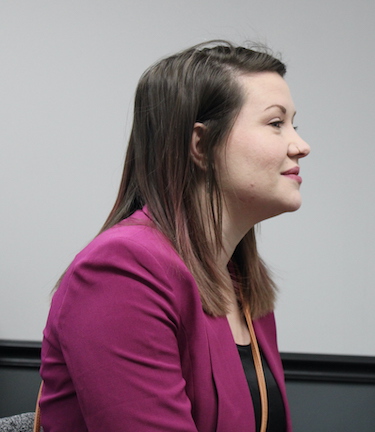
According to TechSolve’s website (techsolve.org), they are “committed to making a lasting impact on the manufacturing industry by enabling companies to achieve operational excellence, increase productivity and stay ahead of the competition.”
Wise said they “want to help this county,” as their coverage area includes Highland, Brown, Butler, Clinton, Clermont, Hamilton and Warren counties.
According to Wise and the company website, “As a subrecipient of the Ohio Manufacturing Extension Partnership (MEP), TechSolve is part of the National Institute of Standards Technology MEP National Network. The MEP National Network is a unique public-private partnership that delivers comprehensive, proven solutions to U.S. manufacturers, fueling growth and advancing U.S. manufacturing.
“There are 51 of those throughout the entire nation that are helped ran by NIST, which is the National Institute for Science and Technology,” Wise said. “Ohio, due to the saturation of manufacturing, actually has six separate recipients, and TechSolve is one of them.
“Our main mission is to support manufacturers. We are measured on our funding that we get from the state on the number of jobs that we create, the monetary value of economic impact, along with numerous things. We can help manufacturers with their workforce. We can help them process in the technology that's in their building. We can help coordinate various different things. As we continue to immerse ourselves in the community, we just wanted to offer ourselves as a resource for you all and for any of the businesses that might need an additional help or consultant to come in and discuss what’s needed.”
Britton asked how TechSolve gets involved with businesses. Wise said they meet with businesses to review “the pain points and challenges to determine where they need to see growth.
“We have four pillars of our business, so we have the manufacturing/processing side, and that dates back to our origin [in 1982],” Wise said. “We have a cybersecurity unit, we have a business advisory unit and then we have a workforce side.”
In response to another question from Britton, Wise said their “target market” is “small to medium manufacturers having less than 150 employees.”
Britton pointed out that from the county’s perspective, Bolender is the individual most likely “to know whether [manufacturers] need help or your expertise or not.” Bolender said that her office works with “a couple different partners,” including MEPs, to help meet local businesses’ specific needs.
Daniels asked how TechSolve’s “services align with what the Business Advisory Council is doing.”
In February, TechSolve helped facilitate a Manufacturing Awareness Day across the county for high school students participating in the Highland County ACCESS Program, which is dedicated to workforce development. Wise said TechSolve “immerses ourselves within the business advisory councils and work to fulfill any pieces that we can help out with, whether that's particular grant money that we are awarded through the state of Ohio, or helping them navigate other resources in areas.”
Commissioners thanked Wise for the information.
“If we need you, we’ll give you a call,” Daniels said.
On an unrelated topic, Bolender told commissioners that the new phlebotomy classes at the Workforce Development Center are scheduled to begin Monday, March 25. As previously reported, on Feb. 21, commissioners agreed to enter a memorandum of understanding with Great Oaks Career Campuses for local high school students to enroll in no-cost phlebotomy and/or medical assisting courses, funded by Great Oaks.
Bolender said that at least two of the students are high school seniors who will be pursuing a nursing degree.
“They're taking advantage of the class because it gives them a heads up for nursing school, and they can start working as they go through college,” she said. “They will complete classes and take their test prior to graduation, so they'll graduate high school with an employable credential.”
Similar to the aforementioned Manufacturing Awareness Day, Bolender said that the next “sector day” will focus on jobs in the health care industry and will be held May 8.
“Our next sector day is going to take place during In Demand Jobs Week,” Bolender said. “We're working with our hospitals and providers to get those tours set up.”
• After hearing from Shannon Disbennett of the Cardinal Land Conservancy, commissioners approved two agricultural easement resolutions.
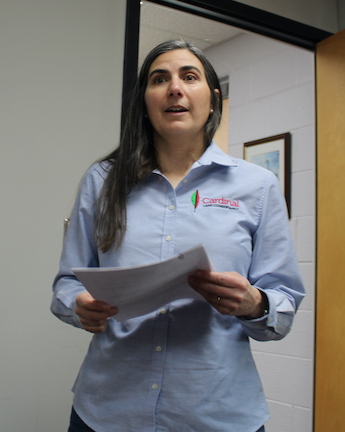
Commissioners voted 3-0 to authorize a request from Donald L. and Cheryl A. Geer for support of their application to the State of Ohio for purchase of an agricultural easement on their property located at 10700 state Route 73, New Vienna; and a request from Kim R. Hiatt for support of her application to the State of Ohio for purchase of an agricultural easement on her property located at 6080 New Vienna Road, New Vienna.
Commissioners approved easement resolutions for the same two farms in 2023 through the Ohio Department of Agriculture’s Local Agricultural Easement Purchase Program (LAEPP), as pointed out by Disbennett.
“[Last year], Geer was selected and is going through funding right now for 220 acres,” Disbennett said. “This year, both Geer and Hiatt have applied again, so Hiatt is reapplying for the 102 acres from last year, and Geer is putting in another 76 acres.
“Cardinal, representing five counties, was given $200,000 to fund whatever farmers that are put in. That really only covers one farm. The maximum per acre that is allowed is $2,000, so that's 100 acres. Hiatt scored the highest this year. She has 100 acres but has decided to take less money to also find Geer. They’re neighbors, they want to preserve the farmland, and so they're splitting it this year.”
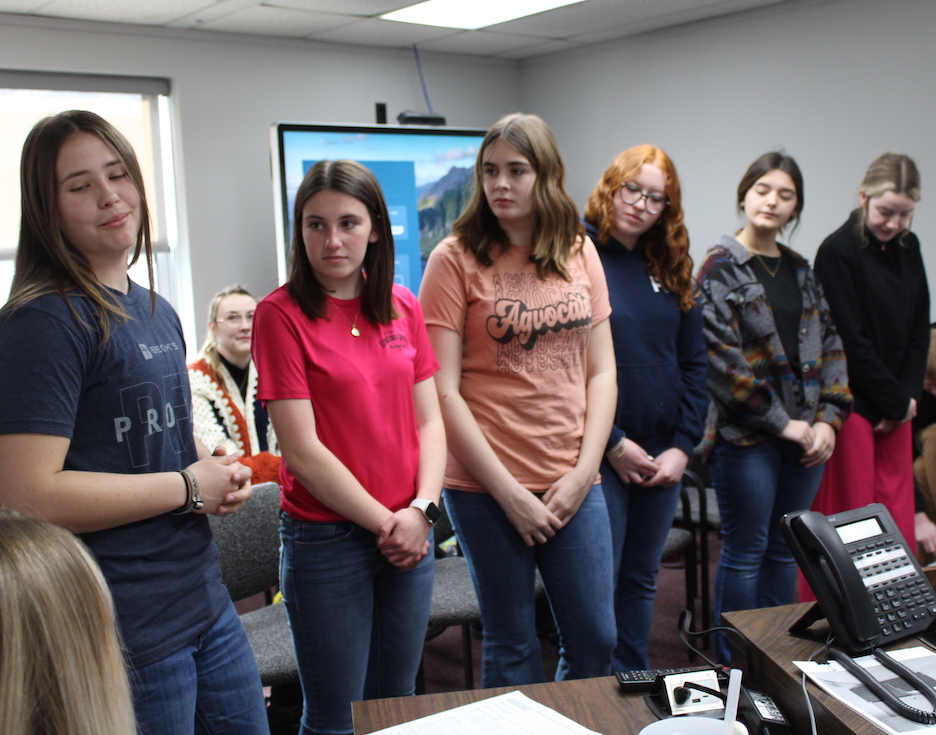
• Commissioners enjoyed a presentation by McClain FFA students and Agricultural Issues team members Brooke Baldwin, Addison Goddard, Avery Murphy, Reese Roble, Maguire Ross and Olivia Stegbauer during the meeting.
According to McClain FFA adviser Madison Schumacher, the group is “working toward competing in the Agricultural Issues Forum demonstration in April.
“Students have to select a relevant agriculturally related issue and create a presentation that will then be presented to different agriculture-related groups, entities, businesses and civic organizations,” Schumacher said. “They come up with different ideas on who they wanted to present to, and they selected the Highland County commissioners as one of those groups this year.”
Schumacher said the girls’ presentation — which is a skit they have memorized — is in the form of a podcast, where they normally sit with microphones for their presentation. The students stood in front of the commissioners’ desk instead to perform their skit Wednesday.
The team’s format was that Ross, the “host” of the “Cultivating Conversations” podcast, was speaking to several ag professionals about social media, with some in favor of it and some of them saying that it could be dangerous for the industry. Ross asked questions and facilitated the conversation among her “guests,” much like a regular podcast host would, as their presentation lasted approximately 11 minutes.
Goddard acted as a cattle rancher and ag lifestyle blogger who said she used social media to share her family’s story and believes social media can help build trust in the industry. Murphy spoke from the perspective of an FFA adviser and ag teacher, who said social media helps build interest in the FFA chapter and strengthens relationships with her students. Roble, who portrayed a public relations director at a major food company, spoke about the importance of social media for marketing the business as well as sharing important recall information with customers.
Baldwin spoke from the perspective of a crop farmer whose family has farmed for 40 years and who doesn’t see “a need to evolve with the times,” also sharing concerns about misinformation. Stegbauer portrayed a cattle farmer who said she found social media to be “a hassle” and risky because extremists can “completely flip the story” of their operations.
After the group finished their presentation, they received a round of applause from everyone in the room.
In response to questions from commissioners, Murphy said they had been working on that particular presentation “since the end of Christmas break.” Baldwin also said that they chose their own topic, as she said they selected social media because it’s “something our generation is pretty fluent in.”
“I think you picked a great topic and performed very, very well,” Britton said.
“We wish you all the luck,” Daniels added.
• Innergex community and government relations representative Janet Grothe attended the meeting and introduced commissioners to two other Innergex employees, Jemmy Barrera and Madison Walsh. Innergex is the developer for both the Hillcrest Solar farm in Brown County as well as the Palomino Solar project in Highland County.
• During their morning session, commissioners received an update on the long-discussed new Revolutionary War memorial at the Highland County Courthouse. Read more at: https://highlandcountypress.com/news/latest-revolutionary-war-memorial-….
• Later on Wednesday, commissioners held a work session with records manager Julie Wallingford, where no action was taken; and met with Ross, Pickaway, Highland, Fayette Joint Solid Waste Management District representatives. According to commission clerk Ashleigh Willey, the SWMD’s 2024-2038 revised draft of the Solid Waste Management Plan has “been through preliminary approval, so now commissioners will need to pass a resolution of support between April 1 and July 1.”
Commissioners also made the following approvals, each by a 3-0 vote:
• A budget modification within the 2170 Probation Services fund from Salaries to Medicare in the amount of $500.
• An additional appropriation from unappropriated funds within County Land Bank Fund 2505 in the amount of $1,250.
• A motion to authorize the commission president to execute a Family Children First Council grant application.
• Commissioners voted 3-0 to reject a change order request from Alpha Construction, regarding a footer undercut; and voted 3-0 to approve a change order for a material change, which will result in savings of $31,843.11, according to ARPA funding coordinator Nicole Oberrecht. Both change orders are related to the county’s records storage building construction project.
Publisher's note: A free press is critical to having well-informed voters and citizens. While some news organizations opt for paid websites or costly paywalls, The Highland County Press has maintained a free newspaper and website for the last 25 years for our community. If you would like to contribute to this service, it would be greatly appreciated. Donations may be made to: The Highland County Press, P.O. Box 849, Hillsboro, Ohio 45133. Please include "for website" on the memo line.