


Auditor, mayor spar over bond issue, sale of new fire department
Lead Summary
By
Caitlin Forsha-crforsha@gmail.com
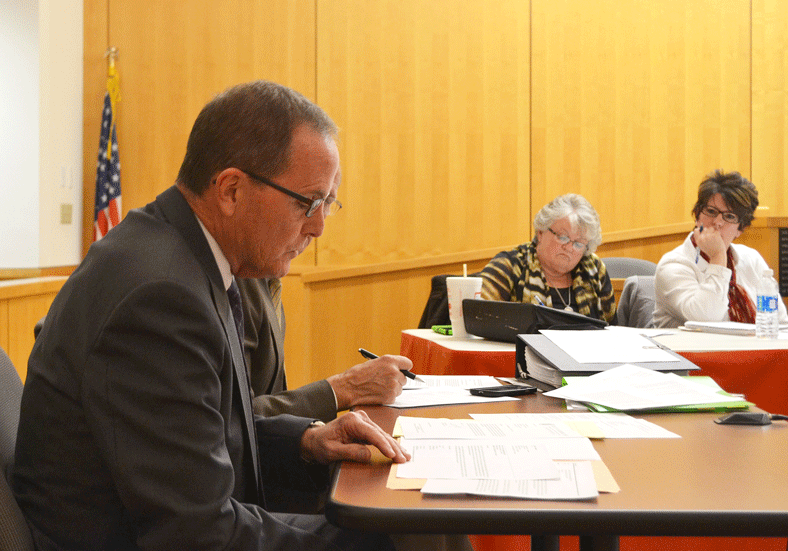
After discussing funding reports and a resolution on the agenda, Hillsboro City Auditor Gary Lewis read correspondence between the mayor and bond counsel during the November Hillsboro City Council meeting, Monday night.
“Back in January, the mayor indicated that he thought transparency to be the best policy, and I agree with him there,” Lewis said.
As previously reported in The Highland County Press, council heard a presentation from Michael Burns of Baird & Co. at their Aug. 9, 2016 meeting regarding the refunding of several bonds. Burns told council that the proposed bonds would be a 6.75-percent savings to the city.
Following Burns’ report, council voted to approve three ordinances for the refunding of various purpose bonds and street improvement bonds for the city.
Last week, Burns told Lewis that Hillsboro mayor Drew Hastings had written to Burns about the refunding of the bonds, according to Lewis.
“I hadn’t been copied on that, so I asked this morning for a copy,” Lewis said.
In the letter, Lewis said that Hastings wrote that he was "writing because I have been in negotiations with our fire district to sell them our fire department building, which is currently financed with a bond that was part of the refunding package. I met with Dinsmore & Shohl recently to discuss the building sale and was told that the refunding that your firm recently completed may have an impact on the costs associated with that sale.
“I would like to do a side-by-side analysis of the 'before and after' of the August refunding. Could I ask you to send me the bond payment schedule that was in place before refunding, including the final payoff date, and the new schedule of payments through the new payoff date? This information would be very helpful with the negotiations. I appreciate your assistance.”
Upon receiving a copy of the letter, Lewis said that he reached out to the city’s bond counsel, Brenda Wehmer of Dinsmore & Shohl, to ask for a copy of the “summary of the meeting” between her and Hastings and to send her a copy of Hastings’ letter to Burns.
Wehmer responded that she and Hastings met “to discuss the possibility of a sale or lease of the fire station. The mayor requested a written summary of the meeting, and I am preparing a written memo. I'll have the memo finished within the next few days and will forward it then. The mayor asked that the memo be confidential, and I reminded him that the city (i.e. Council) was the client, and any documents would be shared with any city official requesting such documents, and it would be confidential in that we would not share the memo with anyone outside the city without express written permission from the city.”
Wehmer told Lewis that she and Hastings “discussed the IRS rules prohibiting private use of tax-exempt financed property/assets” and “reviewed the organizational documents of the fire district and determined that they were a governmental entity and would not create the same IRS issues that a private entity would.”
“‘We included an extraordinary call provision when we did the refunding in case the facts of a potential sale changed,’” Lewis read in the email from Wehmer. “‘I also reviewed the issues surrounding the general obligation full faith and credit pledge of the city and indicated that given the facts, this would be more of a concern than the IRS issues. The extraordinary call provision cannot be utilized for the general obligation pledge issue, it can only be utilized for an IRS problem.’”
Lewis said that according to Wehmer, Hastings “implied that the city was worse off after the refunding than before the refunding and that the city council did not know anything about the refunding.”
“‘I informed the mayor that the refunding saved the city money over the life of the bonds and pulled the transcript to let him know exactly what the dollar amount of the savings were,’” Lewis read from Wehmer’s email. “‘I told him that unless there was a substantial business reason for undertaking a refunding without savings, refundings that did not save money were not permitted by the IRS.’”
After reading the correspondence, Lewis said that he “looks forward to working with the mayor to take care of this issue.”
“That information that you would like to have, with regard to a side-by-side comparison, is readily available in my office,” Lewis said. “Please make a date where we can get together and discuss this, and we can do that analysis for you.”
Koogler said that he would allow Hastings, along with council members, respond to Lewis’ report.
“Where to begin?” Hastings said. “First of all, did council understand, for the most part, what Mr. Lewis just read and the refunding mechanisms involved with it? Was council familiar with the terms of the refunding or any of the financial particulars of that deal in what he just summarized?”
“My understanding is it was presented to us as a cost-saving mechanism,” Koogler said. “It would also put us in a position, in the event that we were able to move forward with the sale of the fire department …”
“Yes, but Mr. President, that isn’t the question I asked,” Hastings interrupted. “The question I asked was: were council members, or yourselves, able to comprehend it? Understand it? Because I wasn’t, and I felt that it bore some more explanation.
“I felt it was somewhat glossed over when I originally asked Mr. Lewis about why, when he did the refunding, because it affects the budget. Whether it’s to the good or to the bad, it affects the budget, and he told me that he did not owe me an explanation, that the auditor is not required to discuss any bond refunding with administration, that by law he’s allowed to do it and he wasn’t going to give me anything.”
“That’s such a blatant lie,” Lewis said.
“No, it’s not,” Hastings said.
“Absolutely, it is,” Lewis said.
“We’re going to talk one at a time,” Koogler said. “We’re going to talk when it’s our turn, OK, and one, I was trying to answer your question about what I understood when I was cut off.”
Koogler told the auditor and mayor that if they “can’t have a civil discussion about it, I’ll start looking at other options that I have as president of council,” before completing his initial answer to Hastings’ question. Koogler said that his understanding was if the city “were able to move forward with the sale” of the fire department building, “it would give us flexibility.”
“I’m going to ask council: was that your understanding?” Koogler asked.
Council member Tracy Aranyos said that the refunding of the bonds was described as “a huge savings.”
“It all sounded positive,” Aranyos said. “It wasn’t a negative. I understood that.”
“Because you asked the question, what we thought, I think it’s only fair for council to respond to that,” Koogler said to Hastings.
“I think the report that we got was very open, let us know exactly what the savings was, what we were paying now, what we would pay then, what the cost savings was over the lifetime of the bonds,” council member Claudia Klein said. “That was all presented in paperwork.”
“We basically were refinancing, and it was going to save 150 grand,” Aranyos said.
Koogler then allowed Hastings to respond.
“You asked us a question and then you proceeded forward,” Koogler said. “I’m going to give you a minute to say what you would like, then I’m going to give Mr. Lewis an opportunity to present what he would like, and then council’s going to weigh in on the issue.”
Hastings said that he “did not say, in that letter, that money was not saved.”
“The reason this issue came up for me was I had a meeting for the negotiation for the sale of the fire department, and because certain financial – the financial picture had changed, that told me that maybe there was an impact to the negotiation,” Hastings said. “From what Ms. Wehmer told me, whether or not I understood that correctly or not, was that there could be an impact, and one of the things was that in the refunding, the 2009 or 2010 South West Street bond project was rebonded into this, refinanced into this.”
Hastings said that Wehmer told him that the reason there was an extraordinary call option was because she and Lewis and discussed the sale of the fire department and that Lewis “had said ‘that deal isn’t going to happen, it’s off the table, let’s go forward.”
“So I had to assume that she had operated, financially, from the standpoint that maybe there wasn’t going to be a fire department sale,” Hastings said. “Then she told me she had, just to play it safe in the back of her head, that’s why she put in the extraordinary callability option.”
Hastings said that he “wanted to do due diligence” and said that either he or safety and service director Todd Wilkin had asked Lewis “a week or so ago for the same information,” to which Hastings said Lewis responded “I’m uncomfortable giving that information to you. Get it from the bond people.”
“Which is what I did,” Hastings said. “You either told Todd that or myself, I don’t recall who. But I doubt it was me, because you and I haven’t spoken in months, really.
“I did not think that there was, necessarily, not savings in it. I was concerned that the terms had changed for negotiating the sale of the fire department, and if we were going to change title on the fire department, that we might have to come up with considerably more money because the 2010 West Street bond had been rolled into it. And it’s still above my pay grade, so I was looking into it as best I could.”
Lewis provided a rebuttal to Hastings’ response.
“First off, the speed at which his first comment was flipped over, from where I directly told him that I didn’t have to tell him anything to the point of, I understood, ‘I’m uncomfortable giving this information, contact Mike,’ is absolutely amazing,” Lewis said. “I applaud you for that. That takes talent.
“Nobody has ever contacted me about this issue. The only contact I’ve had with this issue is last week when Mike Burns contacted me and told me about the letter that he had received from the mayor.”
Lewis said that while he initially told Wehmer that “it did not appear that anything was going forward with” selling the firehouse, he contacted her the day after the mayor “discussed that possibility” at a council meeting.
“I told her that I was incorrect, that things had changed and that there is a possibility of the fire department building to be sold,” Lewis said. “Then, she worked from that point and put in the extraordinary call provision because she did not know at that time, with regard to Paint Creek’s status, whether it was a private entity or whether it was a public entity.”
Lewis said there was “no reason for letters to be sent to these people without including me in that loop.”
“I am, after all, the chief financial officer for the city,” Lewis said. “To ask for the conversation be confidential, I will grant the mayor this that perhaps he wanted it to be confidential because of the negotiations with Paint Creek’s district, but with regard to keeping it confidential from any of the officers of the city or members of council, it’s publicly just not allowed. You know that by law.”
Koogler asked where the city stands “with the bonding process.”
“Oh, it’s done,” Lewis said. “It’s complete, and the city is in the process of saving money, as we go on and pay the bond as we should.”
“From the provision that was put in, are we all of the opinion that that creates the ability, should a sale be contemplated, that it can occur?” Koogler asked.
“It can occur,” Lewis said. “However, we all must understand that this is bonds. We’re not talking about a loan. You can’t just take that money and pay it off. You never could. You couldn’t do it with the original bond. You can’t do that with the existing bond. That is simply not possible. What does happen in those cases is the money, the proceeds, are put into an escrow account. When the bond payments come due, you pay from that escrow account until which time you take care of it.
“It still basically has that same effect of paying it off, so there’s no issues, but we are not, repeat, not, in a worse position now than we were before we refunded that bond. I consider that kind of an attack on my integrity, and I’m going to defend that. I’m going to defend it aggressively, every single time.”
Hastings said that he requested the “side-by-side comparison” because Wehmer “described a situation, which is what made my ears perk up, where she said ‘if you do the extraordinary callability, you’re going to have to come up with, you’re going to have to pay, close to $2 million.’”
“When I heard that, that’s when I was taken aback, and I was like, ‘whoa, OK, well, we’re beyond the scope of what I know about this,’” Hastings said. “So I just would like to keep it simple, and that’s when I requested a comparison, so I could just simply see what we were paying before and what we would be paying afterwards and what would the difference be. And if it didn’t come to anything, then it doesn’t come to anything, but I don’t understand why the auditor is getting defensive [with] me just trying to do some due diligence on my end. I guess that’s what I don’t understand. All I’m trying to do is do my homework.”
Council member Bill Alexander concluded the report with “a recommendation” to the auditor and mayor.
“I think that it is really incumbent upon all of the members of the council, of course, but especially the auditor and the mayor and safety and service director, to be in constant communication over matters of this sort,” Alexander said. “I think that questions can be answered when there is communication among them.
“It seems to me that the lines of communication have been obstructed, and I’m hoping that it would be opened up.”
“Back in January, the mayor indicated that he thought transparency to be the best policy, and I agree with him there,” Lewis said.
As previously reported in The Highland County Press, council heard a presentation from Michael Burns of Baird & Co. at their Aug. 9, 2016 meeting regarding the refunding of several bonds. Burns told council that the proposed bonds would be a 6.75-percent savings to the city.
Following Burns’ report, council voted to approve three ordinances for the refunding of various purpose bonds and street improvement bonds for the city.
Last week, Burns told Lewis that Hillsboro mayor Drew Hastings had written to Burns about the refunding of the bonds, according to Lewis.
“I hadn’t been copied on that, so I asked this morning for a copy,” Lewis said.
In the letter, Lewis said that Hastings wrote that he was "writing because I have been in negotiations with our fire district to sell them our fire department building, which is currently financed with a bond that was part of the refunding package. I met with Dinsmore & Shohl recently to discuss the building sale and was told that the refunding that your firm recently completed may have an impact on the costs associated with that sale.
“I would like to do a side-by-side analysis of the 'before and after' of the August refunding. Could I ask you to send me the bond payment schedule that was in place before refunding, including the final payoff date, and the new schedule of payments through the new payoff date? This information would be very helpful with the negotiations. I appreciate your assistance.”
Upon receiving a copy of the letter, Lewis said that he reached out to the city’s bond counsel, Brenda Wehmer of Dinsmore & Shohl, to ask for a copy of the “summary of the meeting” between her and Hastings and to send her a copy of Hastings’ letter to Burns.
Wehmer responded that she and Hastings met “to discuss the possibility of a sale or lease of the fire station. The mayor requested a written summary of the meeting, and I am preparing a written memo. I'll have the memo finished within the next few days and will forward it then. The mayor asked that the memo be confidential, and I reminded him that the city (i.e. Council) was the client, and any documents would be shared with any city official requesting such documents, and it would be confidential in that we would not share the memo with anyone outside the city without express written permission from the city.”
Wehmer told Lewis that she and Hastings “discussed the IRS rules prohibiting private use of tax-exempt financed property/assets” and “reviewed the organizational documents of the fire district and determined that they were a governmental entity and would not create the same IRS issues that a private entity would.”
“‘We included an extraordinary call provision when we did the refunding in case the facts of a potential sale changed,’” Lewis read in the email from Wehmer. “‘I also reviewed the issues surrounding the general obligation full faith and credit pledge of the city and indicated that given the facts, this would be more of a concern than the IRS issues. The extraordinary call provision cannot be utilized for the general obligation pledge issue, it can only be utilized for an IRS problem.’”
Lewis said that according to Wehmer, Hastings “implied that the city was worse off after the refunding than before the refunding and that the city council did not know anything about the refunding.”
“‘I informed the mayor that the refunding saved the city money over the life of the bonds and pulled the transcript to let him know exactly what the dollar amount of the savings were,’” Lewis read from Wehmer’s email. “‘I told him that unless there was a substantial business reason for undertaking a refunding without savings, refundings that did not save money were not permitted by the IRS.’”
After reading the correspondence, Lewis said that he “looks forward to working with the mayor to take care of this issue.”
“That information that you would like to have, with regard to a side-by-side comparison, is readily available in my office,” Lewis said. “Please make a date where we can get together and discuss this, and we can do that analysis for you.”
Koogler said that he would allow Hastings, along with council members, respond to Lewis’ report.
“Where to begin?” Hastings said. “First of all, did council understand, for the most part, what Mr. Lewis just read and the refunding mechanisms involved with it? Was council familiar with the terms of the refunding or any of the financial particulars of that deal in what he just summarized?”
“My understanding is it was presented to us as a cost-saving mechanism,” Koogler said. “It would also put us in a position, in the event that we were able to move forward with the sale of the fire department …”
“Yes, but Mr. President, that isn’t the question I asked,” Hastings interrupted. “The question I asked was: were council members, or yourselves, able to comprehend it? Understand it? Because I wasn’t, and I felt that it bore some more explanation.
“I felt it was somewhat glossed over when I originally asked Mr. Lewis about why, when he did the refunding, because it affects the budget. Whether it’s to the good or to the bad, it affects the budget, and he told me that he did not owe me an explanation, that the auditor is not required to discuss any bond refunding with administration, that by law he’s allowed to do it and he wasn’t going to give me anything.”
“That’s such a blatant lie,” Lewis said.
“No, it’s not,” Hastings said.
“Absolutely, it is,” Lewis said.
“We’re going to talk one at a time,” Koogler said. “We’re going to talk when it’s our turn, OK, and one, I was trying to answer your question about what I understood when I was cut off.”
Koogler told the auditor and mayor that if they “can’t have a civil discussion about it, I’ll start looking at other options that I have as president of council,” before completing his initial answer to Hastings’ question. Koogler said that his understanding was if the city “were able to move forward with the sale” of the fire department building, “it would give us flexibility.”
“I’m going to ask council: was that your understanding?” Koogler asked.
Council member Tracy Aranyos said that the refunding of the bonds was described as “a huge savings.”
“It all sounded positive,” Aranyos said. “It wasn’t a negative. I understood that.”
“Because you asked the question, what we thought, I think it’s only fair for council to respond to that,” Koogler said to Hastings.
“I think the report that we got was very open, let us know exactly what the savings was, what we were paying now, what we would pay then, what the cost savings was over the lifetime of the bonds,” council member Claudia Klein said. “That was all presented in paperwork.”
“We basically were refinancing, and it was going to save 150 grand,” Aranyos said.
Koogler then allowed Hastings to respond.
“You asked us a question and then you proceeded forward,” Koogler said. “I’m going to give you a minute to say what you would like, then I’m going to give Mr. Lewis an opportunity to present what he would like, and then council’s going to weigh in on the issue.”
Hastings said that he “did not say, in that letter, that money was not saved.”
“The reason this issue came up for me was I had a meeting for the negotiation for the sale of the fire department, and because certain financial – the financial picture had changed, that told me that maybe there was an impact to the negotiation,” Hastings said. “From what Ms. Wehmer told me, whether or not I understood that correctly or not, was that there could be an impact, and one of the things was that in the refunding, the 2009 or 2010 South West Street bond project was rebonded into this, refinanced into this.”
Hastings said that Wehmer told him that the reason there was an extraordinary call option was because she and Lewis and discussed the sale of the fire department and that Lewis “had said ‘that deal isn’t going to happen, it’s off the table, let’s go forward.”
“So I had to assume that she had operated, financially, from the standpoint that maybe there wasn’t going to be a fire department sale,” Hastings said. “Then she told me she had, just to play it safe in the back of her head, that’s why she put in the extraordinary callability option.”
Hastings said that he “wanted to do due diligence” and said that either he or safety and service director Todd Wilkin had asked Lewis “a week or so ago for the same information,” to which Hastings said Lewis responded “I’m uncomfortable giving that information to you. Get it from the bond people.”
“Which is what I did,” Hastings said. “You either told Todd that or myself, I don’t recall who. But I doubt it was me, because you and I haven’t spoken in months, really.
“I did not think that there was, necessarily, not savings in it. I was concerned that the terms had changed for negotiating the sale of the fire department, and if we were going to change title on the fire department, that we might have to come up with considerably more money because the 2010 West Street bond had been rolled into it. And it’s still above my pay grade, so I was looking into it as best I could.”
Lewis provided a rebuttal to Hastings’ response.
“First off, the speed at which his first comment was flipped over, from where I directly told him that I didn’t have to tell him anything to the point of, I understood, ‘I’m uncomfortable giving this information, contact Mike,’ is absolutely amazing,” Lewis said. “I applaud you for that. That takes talent.
“Nobody has ever contacted me about this issue. The only contact I’ve had with this issue is last week when Mike Burns contacted me and told me about the letter that he had received from the mayor.”
Lewis said that while he initially told Wehmer that “it did not appear that anything was going forward with” selling the firehouse, he contacted her the day after the mayor “discussed that possibility” at a council meeting.
“I told her that I was incorrect, that things had changed and that there is a possibility of the fire department building to be sold,” Lewis said. “Then, she worked from that point and put in the extraordinary call provision because she did not know at that time, with regard to Paint Creek’s status, whether it was a private entity or whether it was a public entity.”
Lewis said there was “no reason for letters to be sent to these people without including me in that loop.”
“I am, after all, the chief financial officer for the city,” Lewis said. “To ask for the conversation be confidential, I will grant the mayor this that perhaps he wanted it to be confidential because of the negotiations with Paint Creek’s district, but with regard to keeping it confidential from any of the officers of the city or members of council, it’s publicly just not allowed. You know that by law.”
Koogler asked where the city stands “with the bonding process.”
“Oh, it’s done,” Lewis said. “It’s complete, and the city is in the process of saving money, as we go on and pay the bond as we should.”
“From the provision that was put in, are we all of the opinion that that creates the ability, should a sale be contemplated, that it can occur?” Koogler asked.
“It can occur,” Lewis said. “However, we all must understand that this is bonds. We’re not talking about a loan. You can’t just take that money and pay it off. You never could. You couldn’t do it with the original bond. You can’t do that with the existing bond. That is simply not possible. What does happen in those cases is the money, the proceeds, are put into an escrow account. When the bond payments come due, you pay from that escrow account until which time you take care of it.
“It still basically has that same effect of paying it off, so there’s no issues, but we are not, repeat, not, in a worse position now than we were before we refunded that bond. I consider that kind of an attack on my integrity, and I’m going to defend that. I’m going to defend it aggressively, every single time.”
Hastings said that he requested the “side-by-side comparison” because Wehmer “described a situation, which is what made my ears perk up, where she said ‘if you do the extraordinary callability, you’re going to have to come up with, you’re going to have to pay, close to $2 million.’”
“When I heard that, that’s when I was taken aback, and I was like, ‘whoa, OK, well, we’re beyond the scope of what I know about this,’” Hastings said. “So I just would like to keep it simple, and that’s when I requested a comparison, so I could just simply see what we were paying before and what we would be paying afterwards and what would the difference be. And if it didn’t come to anything, then it doesn’t come to anything, but I don’t understand why the auditor is getting defensive [with] me just trying to do some due diligence on my end. I guess that’s what I don’t understand. All I’m trying to do is do my homework.”
Council member Bill Alexander concluded the report with “a recommendation” to the auditor and mayor.
“I think that it is really incumbent upon all of the members of the council, of course, but especially the auditor and the mayor and safety and service director, to be in constant communication over matters of this sort,” Alexander said. “I think that questions can be answered when there is communication among them.
“It seems to me that the lines of communication have been obstructed, and I’m hoping that it would be opened up.”