


Appeals court: No valid contract existed between city, stockyards; decision reversed
Lead Summary
By
Brandy Chandler-brandychandler@gmail.com
Ohio's Fourth District Court of Appeals has reversed the trial court's judgment in the civil suit between the city of Hillsboro and the Union Stock Yards.
According to the court's entry, filed Dec. 2, "(The city's) essential argument is that no valid contract exists between the parties," the court wrote in the decision. "We agree. The undisputed evidence shows that as a matter of law, no valid contract existed. Accordingly, we sustain (the city's) first assignment of error and reverse the trial court's judgment."
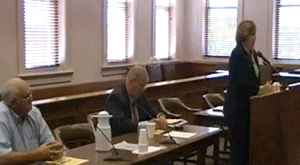
Oral arguments were held June 3 before presiding Judge Matthew W. McFarland, Judge William Harsha and Judge Roger Kline. The hearing took place in a courtroom of Adams County Common Pleas Court.
Union Stock Yards owners Bill and Janet Butler, who is represented by Loveland attorney Tom Tepe, sued the city in 2008, following Hillsboro City Council’s passage of an emergency resolution on Oct. 2, 2007, which authorized Mayor Dick Zink to purchase 1.53 acres of the stock yards property for no more than $325,000. The court ruled in favor of the Butlers and ordered the city pay $140,000 in damages.
The city, represented by deputy Hillsboro Law Director Kathryn Hapner, appealed the trial court's decision and submitted four assignments of error: That the trial court erred in overruling the city's motion for summary judgment; that "the trial court erred in its determination that a valid real estate purchase contract existed between appellant and appellee even though appellant, the purchaser, did not execute said contract; the court erred in determining that plaintiff was ready, willing and able to close the transaction and that therefore, specific performance was appropriate"; "the decision of the court is against the manifest weight of the evidence (according to the Ohio Revised Code) which lists various formalities that are prerequisites in order to bind a municipal corporation to a contract were not met."
In the decision, McFarland and Kline concurred in opinion and judgement, but Harsha concurred in judgment only.
"A plain reading of the city council's resolution reveals not that the city council entered into a contract with appellee but that the city council authorized and delegated the authority to enter into the contract to the mayor," according to the court. "Because the mayor never entered into a contract with appellee, there is no valid contract up on which the appellee can base its breach of contract claim. Moreover, even if one could construe council's resolution as a contract, the contract did not define the purchase price, but rather, apparently left it open to further negotiation. There is no evidence that the city council consented, by its resolution, to purchase the property for $325,000. Instead, the evidence shows that the council's resolution authorizes the purchase as long as the price does not exceed $325,000. No evidence exists that the mayor, the person council gave the authority to contract, ever agreed to purchase the property for any price, let alone $325,000. Because there was no meeting of the minds regarding the purchase price, no valid contract exists."
The court wrote that "The resolution contemplated that the mayor would take further action to complete the contract formation. The mayor did not accept (the Butlers') offer to sell for $325,000. Instead, he requested and obtained an appraisal of the property, after which the mayor declined to execute a contract (with the Butlers).
Additional stipulations in the contract, according to court documents, required the purchase be completed before the end of the 2007 calendar year, the property must pass an environmental study, and if a new survey is required the seller would pay for it. "Although an agreement was prepared and the appellee signed it, the mayor never executed an agreement to purchase the real estate.
"Even if certain council members made promises to (the stockyards) regarding the purchase of its property, (the stockyards) could not have justifiably relied on those promises when the council resolution plainly gave the authority to contract to the mayor, not to the council or to any individual council member. Liability cannot attach simply because (the stockyards) mistakenly interpreted the resolution as a contract to purchase the property. Furthermore, the mayor's decision not enter into the contract resulted from his consideration of the city's financial resources, which is a valid consideration (under case law). "
The court of appeals stated that the trial court "erroneously denied (the city's) summary judgment motion ... Accordingly, because the undisputed evidence shows that the mayor did not enter into a contract with (the Butlers), no valid contract exists. Additionally, any alleged contract is null and void due to noncompliance with statutory procedures. Consequently, we sustain (the city's) first assignment of error and reverse the trial court's judgment. The remaining assignments of error are moot and we need not address them."
Ohio's Fourth District Court of Appeals has reversed the trial court's judgment in the civil suit between the city of Hillsboro and the Union Stock Yards.
According to the court's entry, filed Dec. 2, "(The city's) essential argument is that no valid contract exists between the parties," the court wrote in the decision. "We agree. The undisputed evidence shows that as a matter of law, no valid contract existed. Accordingly, we sustain (the city's) first assignment of error and reverse the trial court's judgment."
Oral arguments were held June 3 before presiding Judge Matthew W. McFarland, Judge William Harsha and Judge Roger Kline. The hearing took place in a courtroom of Adams County Common Pleas Court.
Union Stock Yards owners Bill and Janet Butler, who is represented by Loveland attorney Tom Tepe, sued the city in 2008, following Hillsboro City Council’s passage of an emergency resolution on Oct. 2, 2007, which authorized Mayor Dick Zink to purchase 1.53 acres of the stock yards property for no more than $325,000. The court ruled in favor of the Butlers and ordered the city pay $140,000 in damages.
The city, represented by deputy Hillsboro Law Director Kathryn Hapner, appealed the trial court's decision and submitted four assignments of error: That the trial court erred in overruling the city's motion for summary judgment; that "the trial court erred in its determination that a valid real estate purchase contract existed between appellant and appellee even though appellant, the purchaser, did not execute said contract; the court erred in determining that plaintiff was ready, willing and able to close the transaction and that therefore, specific performance was appropriate"; "the decision of the court is against the manifest weight of the evidence (according to the Ohio Revised Code) which lists various formalities that are prerequisites in order to bind a municipal corporation to a contract were not met."
In the decision, McFarland and Kline concurred in opinion and judgement, but Harsha concurred in judgment only.
"A plain reading of the city council's resolution reveals not that the city council entered into a contract with appellee but that the city council authorized and delegated the authority to enter into the contract to the mayor," according to the court. "Because the mayor never entered into a contract with appellee, there is no valid contract up on which the appellee can base its breach of contract claim. Moreover, even if one could construe council's resolution as a contract, the contract did not define the purchase price, but rather, apparently left it open to further negotiation. There is no evidence that the city council consented, by its resolution, to purchase the property for $325,000. Instead, the evidence shows that the council's resolution authorizes the purchase as long as the price does not exceed $325,000. No evidence exists that the mayor, the person council gave the authority to contract, ever agreed to purchase the property for any price, let alone $325,000. Because there was no meeting of the minds regarding the purchase price, no valid contract exists."
The court wrote that "The resolution contemplated that the mayor would take further action to complete the contract formation. The mayor did not accept (the Butlers') offer to sell for $325,000. Instead, he requested and obtained an appraisal of the property, after which the mayor declined to execute a contract (with the Butlers).
Additional stipulations in the contract, according to court documents, required the purchase be completed before the end of the 2007 calendar year, the property must pass an environmental study, and if a new survey is required the seller would pay for it. "Although an agreement was prepared and the appellee signed it, the mayor never executed an agreement to purchase the real estate.
"Even if certain council members made promises to (the stockyards) regarding the purchase of its property, (the stockyards) could not have justifiably relied on those promises when the council resolution plainly gave the authority to contract to the mayor, not to the council or to any individual council member. Liability cannot attach simply because (the stockyards) mistakenly interpreted the resolution as a contract to purchase the property. Furthermore, the mayor's decision not to enter into the contract resulted from his consideration of the city's financial resources, which is a valid consideration (under case law). "
The court of appeals stated that the trial court "erroneously denied (the city's) summary judgment motion ... Accordingly, because the undisputed evidence shows that the mayor did not enter into a contract with (the Butlers), no valid contract exists. Additionally, any alleged contract is null and void due to noncompliance with statutory procedures. Consequently, we sustain (the city's) first assignment of error and reverse the trial court's judgment. The remaining assignments of error are moot and we need not address them."
In reversing the trial court's decision, the court of appeals the city is to "recover (of the Union Stock Yards) costs herein taxed."
[[In-content Ad]] President of the Hillsboro City Council Lee Koogler said that while the city is pleased with the court's decision, the case may not yet be completely resolved.
"Certainly given the financial situation of the city, I can say the city is pleased with the outcome at this point. However, as with any litigation, we will have to wait and see if the Butlers appeal to the (Ohio) Supreme Court, and the city that will have to make a decision as of our action. Until the final ruling by the Supreme Court, in my opinion, we will continue to treat it as pending."