


Property managers, tenants speak out against proposed utilities ordinance
Lead Summary
By
Caitlin Forsha-crforsha@gmail.com
Although several city council members and city administrators wore smiley face buttons at the April Hillsboro City Council meeting, the mood was tense as property managers and tenants spoke out against the proposed ordinance to “amend Section 51.041 of the City Code to provide for additional definitions and requirements for shut-off and turn-on fees.”
At the March council meeting, utilities committee chair Rebecca Wilkin said her committee met twice to discuss the ordinance, which proposes charging the “minimum rate per unit as opposed to per meter,” she said. An approximate $122,000 increase in revenue was estimated as a result of the ordinance if enacted.
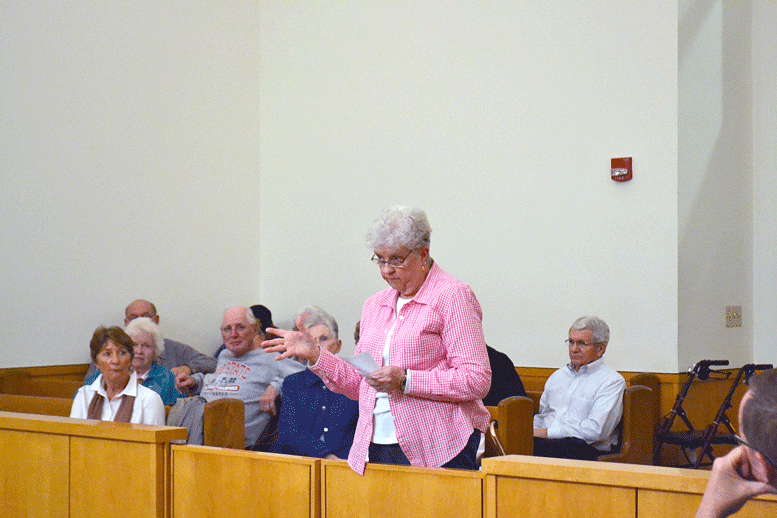
Julia Wise spoke first at Monday night's meeting, on behalf of Highland County Community Action, and asked council to clarify whether the proposed ordinance applied to commercial properties or solely residential properties. Safety and service director Todd Wilkin said that the ordinance applied to “an address with one meter that’s feeding multiple users.” Council president pro tem Dick Donley, who presided over the meeting as council president Lee Koogler was absent for business reasons, said that if a “strip mall” or other such building had several tenants and only one meter, it would apply to them.
“We obviously have concerns,” Wise said. “The three groups that I’m with, our housing, people are paying $400 to $600 a month to live in our housing. When they come in, they’re working individuals. I think all of you that raise families, you realize an additional $18 a month is going to cost something. That may mean that child doesn’t get a new pair of shoes or whatever. It may seem minimal, but it’s going to be really hard to come up with it, whether it’s a senior citizen, whether it’s a low-income person.”
Wise said that the county’s median income is lower than the state and national averages.
“I think some people think ‘oh, we’re just working with the low-income people, and they’re only paying a small amount of rent, and it’s government-subsidized,’” Wise said. “That’s not the case necessarily, particularly with the one we own, which is Highland Heights, but also some of the others.
“These are working individuals living in these households. We’re doing this for multi-units. How about those households where you have three or four families living in the same household so they can get by and it’s second-generational? I mean, are we going to start metering them based on the number of families living in that single-family home? Because you’ve got a lot of those as well.”
Property manager Robyn Coomer argued that the proposed legislation is “unfair” and said the city should increase rates for everyone, not just the multiple-unit housing.
“I don’t think this is fair,” Coomer said. “I also don’t think it’s fair that the rest of the city goes two years without an increase.
“It’s understandable that the city can’t function without the income, but you need to increase the income straight across. If they’re not going to pay their increase, that’s not fair either, when multi-family users are being increased.”
Coomer said her housing units “can’t sustain an increase in rent.”
“[The properties] will be vacant,” Coomer said. “My owner will be out of business. That will affect my income, and it’s a trickle-down effect.”
The “trickle-down effect” will also reach the tenants, Coomer said.
“It’s going to affect tenants, “Coomer said. “It has to, because somebody’s going to have to pay the water bill. I personally think that if everybody pays their fair share – and I don’t know why the city didn’t do it for the last two years, and I hope nobody’s mad at me for suggesting it, but get over it.
“They said they wouldn’t increase the rates years ago because people couldn’t afford it. When they raised it, it went so high people were screaming about it. If you raise it a little bit at a time, it’s a little more manageable to do. I see this legislation as attacking the multi-units.”
Council member Tracy Aranyos responded that the legislation is “fair.”
“We’re not trying to be mean,” Aranyos said. “We’re just trying to do per unit. There’s no law about how many people live in a unit. We don’t have any say over there. We’re just making it fair because there’s already 6,000 citizens roughly who have already been paying the minimum, and the rest of them haven’t been.”
“My tenants are paying their fair share, because you better believe water is included in their rent,” Coomer said. “My tenants are paying for their usage.”
“Yes, but sometimes you don’t use the minimum, and I still have to pay the minimum whether I use it or not,” Aranyos said.
Coomer said the ordinance is “taxing the multi-units more money because we’re paying for what we’re using.”
“The other 6,000 people are too and are paying more, so why is it fair for you guys to not have to pay the minimum and you’re paying for what you use, and there’s some of the 6,000 people that aren’t using all of theirs either,” Aranyos said. “They have to pay that minimum. We’re just trying to make it fair all the way across.”
“If your people are already paying their own water bill, you can deduct their rent $18.07 and give that to the water department and they would still paying be the same, right?” council member Ann Morris said.
“When you call me and I say ‘it’s $500 a month and that includes water and sewer,’ I have calculated water and all my owner’s expenses in my rental rates,” Coomer said. “If I take that extra $18 off what they’re currently paying, then my owner’s making less money.”
“Well, then it’s one way or the other,” Morris said.
“My issue is you’ve got this two-year freeze on the water,” Coomer said. “Why are we doing that? You’re going to be in the same shape you were six, 10 years ago when they didn’t increase the water [rates].”
“But they’ve already been paying their amount all this time,” Morris said.
“So then you’re going to charge each unit, and later you’re going to increase the water rates?” Coomer said.
“It’ll be the same for everyone,” Aranyos said. “We’re keeping the moratorium the last two years instead of staying on that chart like you’re talking about. We’re trying to do whatever we can to keep it down, and we’re going to look at it again. We don’t know if we’ll keep it down or if there’ll be an increase.
“What we’re saying now is we’re trying to make it fair for everyone across the board for the minimum.”
“But the unfair I’m saying is it’s making it harder for owners to make a living on their properties,” Coomer said. “Someone’s going to have to pay for it. It’s probably going to be the owners, because if not, the units are going to sit vacant.”
“There’s no other cities that give them free water, either, so they’re going to do just as well here as anywhere else,” Morris said.
“I’m paying for my water,” Coomer said. “I don’t know anybody that’s getting any free water.”
“When you only pay the minimum, that means not everyone’s paying the same,” Aranyos said.
“If you own a house, you’ve got your minimum,” Coomer said. “There are reasons people move into apartments because they don’t want to do yards, they don’t want the maintenance. They want one package deal, pay their rent and live comfortably.
“If the owner’s paying water, he can’t afford to upgrade his property.”
“He probably can afford it,” Morris said. “If he’s going to own that many apartments, he can afford it. He’s going to have to, one way or the other.”
“Who are you to tell him what his income potential is?” Coomer said.
“Then he’ll raise their rates $18.07,” Morris said. “It has to be one or the other.”
“He’ll either afford it or raise it,” Aranyos said.
Diana Salen of Treewood Apartments and Provident Management said that they are charged $2,000 per month for their 40 properties.
“We are paying more than the minimum,” Salen said. “We are paying $50 per property. If this $18 go through, we will be paying $68 per unit.
“Now, you think that everyone’s making a lot of money here. A lot of our properties are – we’re losing money. We have to put money into the properties. One of the problems with Treewood is it’s not a HUD property where people pay $30 a month for their rent. This is a rural assistance property where their rates are set. People can only make a certain amount of money and live there.
“They’re paying maybe 50 percent of their income, and $18 is a lot of money. They’re already paying more than your minimum of $37.50, and we would be happy to bring back documentation of our water bill to show you. I understand that you don’t want to feel that all these people are not paying a minimum and getting away with something, but they actually are because $50 is figured into their rent.”
Salen said that the amount they charge tenants is “up to the federal government and the Ohio state government.”
“No, we are not rolling in money,” Salen said. We want these properties to have enough money in the reserve fund so they can be rehabbed, look beautiful and be a good place for someone.”
Salen said the rate increase will “have to go to the tenant, and they can barely afford it.”
“This is not a wealthy community,” Salen said. “They’re lucky if they have a minimum-wage job. They’re struggling to make it. They’re not looking for a handout, and this $18 makes a difference. I think the important thing to note is they are already paying their minimum. Even though they’re paying more than their minimum, even though you don’t see that.”
Utilities committee chair Rebecca Wilkin said there are “plenty of people who are low-income are renting a house, and they have to pay.
“Everybody else pays,” Wilkin said.
“But they are paying what everyone else is paying,” Salen said. “They’re paying more. We are paying $2,000 a month in water and sewer. That’s $50 per apartment. That is part of their rent, so they are paying their fair share.
“Some of these other HUD properties, the way they are structured, they’re paying very low-income and their utility and water bills are being picked up by the government. Those properties will have to go to HUD, see if they can get that $18 for each property.”
“Right now, you’re not paying a minimum,” Aranyos said. “You’re paying your usage, and that’s what your usage is every month.
“If you have to pay the minimum, it’ll be $37.10 for some, and some obviously are using more because you’re dividing it up.”
“How do you figure that out with not each unit being metered?” Salen asked.
“That would be for you to divide,” Aranyos said. “You can put a meter in, but it’s a huge expense. I’m just saying you’re not comparing apples to apples. You’re saying ‘well, they’re paying $37.10.’ You’re dividing yours, and so you might have unit with a family of two or three or four, versus a single person.”
“That’s nitpicking,” Salen said.
Hillsboro mayor Drew Hastings compared the situation to a pizza restaurant special.
“You buy your first pizza for $10, your second one is $5,” Hastings said. “You’re getting a lot of $5 pizzas, and a lot of people in the city are paying for $10 pizzas so that other people can get $5 pizzas.
“I take issue with the fact that Ms. Wise, yourself and Robyn are kind of trying to make us look like bad guys here in that we are somehow targeting the poor or people that are in a particular unit that make a certain income when we are not at all. We are capturing 600 and some-odd households that have been un-captured for a long time – well, they’ve never been captured. It’s making an equitable arrangement for the water/sewer bill. It’s irrelevant to us who’s in there.”
Salen asked the city to explain what the minimum entailed as far as amount of usage.
“The first 133 cubic feet is the minimum, and you pay 28 cents per cubic foot,” Todd Wilkin said. “For every cubic foot in the one-hundreds, it’s 14 cents. So what we’re capturing is the 13.5 cents within that first 133, and that’s where we come up with the $18.07.”
“With that minimum, if usage stays the same, is it possible that we will not have an increase?” Salen asked.
“No, you’ll have an increase,” Wilkin said. “It’ll still be an $18.07 difference.”
As Rebecca Wilkin discussed at the March Meeting, Todd Wilkin told Salen that if this ordinance is implemented, the city and utilities committee can determine in September whether they can continue the moratorium and may be able to also increase the minimum cubic feet or reduce the minimum fee per month “for everybody in the city.”
“The plan of attack was to go in and say ‘we’ll grab these users, but we also want to lower the minimum bill or give more cubic foot,’” Wilkin said. “What the utilities committee recommended was, let’s put this into place now, and in September, we want to reevaluate for the moratorium and look to give more cubic feet of water or reduce the minimum bill. It can go either way, and your water bill will come down.”
Melinda Slife of Fairfield Homes/Gorsuch Management said that the company she represents owns “100 properties in the state of Ohio, and this county is one of the highest water bills that we pay,” later adding that it’s within the two highest of the utility bills they pay in the state.
Slife said that Highland Heights Apartments paid $3,465 in a one-month period earlier this year.
“That’s an average of $72.20 per unit, and we have two meters that are read,” Slife said. “Now we’re being asked to pay 18 additional dollars, which would bring the bill up considerably.
“You’re not doing anything. You’re not putting extra meters in at the properties. There should be no overhead cost to you guys. You have to read two meters. Why are we getting billed 18 additional dollars when there’s no more work being done?”
Slife said that the $3,500 per month charge “is staggering.”
“We can’t ask these residents to withstand that kind of an increase because they simply can’t afford it,” Slife said. “We’re not in the business to make money. We’re in the housing business because people need housing and they don’t have income to live like other people, so no, not all owners have the money. There’s a lot of owners that are having to pay out of their pocket, and they’re doing that so we can have people have homes in the state of Ohio.”
Like Coomer, Slife said that “small increments” would be easier than accepting an $18 per month increase.
“Really, in a lot of ways, the 600 and some units like yourself that we have captured, that we’ve found weren’t being included in our building … were lucky enough to get away with not paying it for years and years,” Hastings said. “Now, suddenly, we’re asking for parity and have everyone paying the same rate so that it’s fair.”
“I understand it was found because someone had a single-family home and they turned it into a three-person home or four-person home,” Slife said. “We are all now being penalized. We didn’t cause that mistake. It was found by you, and that’s why you made the changes and are doing the increase, but it certainly wasn’t our fault. We were paying what you were billing us every month. Just because you found an error that was happening in your system … that’s not our fault. I just don’t understand.”
“Bear in mind, this is not something we invented or came up with,” Hastings said. “We took a lot of our prototypes for legislation from other towns. I would just say it’s really a matter of making it equitable to everybody.”
Hastings also suggested that other property developers who have proposed bringing subsidized housing to the city may have been doing so because of “inequitable decisions like this.”
“We’ve gotten a number of requests in the last year or two where they ask me, ‘we would like to bring in more either subsidized or income-based housing to Hillsboro,’” Hastings said. “It occurs to me that part of the reason maybe a number of them have been chomping at the bit to get here is because we do have inequitable situations like this that make it advantageous for them.”
“I don’t think paying $3,500 a month is – I mean, we pay our fair share,” Slife said.
“But that’s proportionate to you,” Hastings said. “You have a lot of units. It all works out the same.”
“To me, $72 per unit sounds like a lot of money per unit,” Slife said.
Hastings said tenants may “have no impetus to monitor their usage, so of course it will be higher because it doesn’t really matter to them.”
“I don’t know if that’s a fair assessment,” Slife said. “They’re conscientious of how they use their water.”
“What I am saying is it’s $72 per month because there’s not a built-in incentive there,” Hastings said.
Sharry Moore of Hillsboro spoke on behalf of the Lilly Hill senior condos, as many of their residents were in attendance at the meeting.
“We get nothing from the city at all except fire and police,” Moore said. “We pay for our own street care, we repair our own streets, we pave our own streets. We take care of everything.
“We are going to have our water bill raised $700 a month plus what we normally pay. It’s going to cost each unit owner $18 more a month on their condo fee. A lot of these people are very limited-income, and a lot of their adult children pay for them to live there.
“It’s going to cause a lot of difficulty for us, too. I can see where all these people are coming from. We are not low-income, we are not in government subsidies, but we have to pay this just like everybody else.”
Moore said that the city subjected the condos to “an overflow meter” for 20 years, for which residents were charged an additional $9 per month and “never, ever used any excess water.”
“It’s just very upsetting for us,” Moore said.
Nancy Couser of Millennia Housing said that their apartments currently pay $68,000 per year for water, which will increase to approximately $80,000 per year.
“Government subsidy is not guaranteed at all,” Couser said. “At any day, we could get a memo ‘you’re done.’ We have a contract with HUD, but it’s not for any length of time. When you take $20,000 out of our budget that is already high, there’s going to be cuts made somewhere.
“We spent $48,000 last year for repaving our parking lot. Those things are not going to happen with a rate increase like this.”
Couser said the “livelihood of our residents” will be affected, as the management will not be able to afford upgrades to the facility.
Donley spoke on behalf of counsel and thanked the crowd for attending.
“I really appreciate each and every one of you for coming tonight and expressing your views,” Donley said. “We welcome you to be here. Council sometimes has a difficult decision to make. That’s why it goes into committee.
“[The ordinance] is up for its second reading tonight, so there’s nothing going to be finalized tonight. I’m sure they’re going to try to absorb everything you folks have mentioned this evening and take that into consideration for their decision-making.”
Hastings also thanked them for their participation in his mayor’s report.
“Thank you for coming and being involved,” Hastings said. “I take a lot of responsibility for this legislation.
“I always try to be fair. One of the things I look at is the big picture, and I know that you make very valid points, all of you. There’s also 6,300 people that didn’t come here tonight, and I have to look at them, too.”
Hastings said the proposed legislation will generate an additional $122,000 for the city to benefit its infrastructure.
“I’m just asking you to look at the whole big picture in this,” Hastings said.
At the March council meeting, utilities committee chair Rebecca Wilkin said her committee met twice to discuss the ordinance, which proposes charging the “minimum rate per unit as opposed to per meter,” she said. An approximate $122,000 increase in revenue was estimated as a result of the ordinance if enacted.
Julia Wise spoke first at Monday night's meeting, on behalf of Highland County Community Action, and asked council to clarify whether the proposed ordinance applied to commercial properties or solely residential properties. Safety and service director Todd Wilkin said that the ordinance applied to “an address with one meter that’s feeding multiple users.” Council president pro tem Dick Donley, who presided over the meeting as council president Lee Koogler was absent for business reasons, said that if a “strip mall” or other such building had several tenants and only one meter, it would apply to them.
“We obviously have concerns,” Wise said. “The three groups that I’m with, our housing, people are paying $400 to $600 a month to live in our housing. When they come in, they’re working individuals. I think all of you that raise families, you realize an additional $18 a month is going to cost something. That may mean that child doesn’t get a new pair of shoes or whatever. It may seem minimal, but it’s going to be really hard to come up with it, whether it’s a senior citizen, whether it’s a low-income person.”
Wise said that the county’s median income is lower than the state and national averages.
“I think some people think ‘oh, we’re just working with the low-income people, and they’re only paying a small amount of rent, and it’s government-subsidized,’” Wise said. “That’s not the case necessarily, particularly with the one we own, which is Highland Heights, but also some of the others.
“These are working individuals living in these households. We’re doing this for multi-units. How about those households where you have three or four families living in the same household so they can get by and it’s second-generational? I mean, are we going to start metering them based on the number of families living in that single-family home? Because you’ve got a lot of those as well.”
Property manager Robyn Coomer argued that the proposed legislation is “unfair” and said the city should increase rates for everyone, not just the multiple-unit housing.
“I don’t think this is fair,” Coomer said. “I also don’t think it’s fair that the rest of the city goes two years without an increase.
“It’s understandable that the city can’t function without the income, but you need to increase the income straight across. If they’re not going to pay their increase, that’s not fair either, when multi-family users are being increased.”
Coomer said her housing units “can’t sustain an increase in rent.”
“[The properties] will be vacant,” Coomer said. “My owner will be out of business. That will affect my income, and it’s a trickle-down effect.”
The “trickle-down effect” will also reach the tenants, Coomer said.
“It’s going to affect tenants, “Coomer said. “It has to, because somebody’s going to have to pay the water bill. I personally think that if everybody pays their fair share – and I don’t know why the city didn’t do it for the last two years, and I hope nobody’s mad at me for suggesting it, but get over it.
“They said they wouldn’t increase the rates years ago because people couldn’t afford it. When they raised it, it went so high people were screaming about it. If you raise it a little bit at a time, it’s a little more manageable to do. I see this legislation as attacking the multi-units.”
Council member Tracy Aranyos responded that the legislation is “fair.”
“We’re not trying to be mean,” Aranyos said. “We’re just trying to do per unit. There’s no law about how many people live in a unit. We don’t have any say over there. We’re just making it fair because there’s already 6,000 citizens roughly who have already been paying the minimum, and the rest of them haven’t been.”
“My tenants are paying their fair share, because you better believe water is included in their rent,” Coomer said. “My tenants are paying for their usage.”
“Yes, but sometimes you don’t use the minimum, and I still have to pay the minimum whether I use it or not,” Aranyos said.
Coomer said the ordinance is “taxing the multi-units more money because we’re paying for what we’re using.”
“The other 6,000 people are too and are paying more, so why is it fair for you guys to not have to pay the minimum and you’re paying for what you use, and there’s some of the 6,000 people that aren’t using all of theirs either,” Aranyos said. “They have to pay that minimum. We’re just trying to make it fair all the way across.”
“If your people are already paying their own water bill, you can deduct their rent $18.07 and give that to the water department and they would still paying be the same, right?” council member Ann Morris said.
“When you call me and I say ‘it’s $500 a month and that includes water and sewer,’ I have calculated water and all my owner’s expenses in my rental rates,” Coomer said. “If I take that extra $18 off what they’re currently paying, then my owner’s making less money.”
“Well, then it’s one way or the other,” Morris said.
“My issue is you’ve got this two-year freeze on the water,” Coomer said. “Why are we doing that? You’re going to be in the same shape you were six, 10 years ago when they didn’t increase the water [rates].”
“But they’ve already been paying their amount all this time,” Morris said.
“So then you’re going to charge each unit, and later you’re going to increase the water rates?” Coomer said.
“It’ll be the same for everyone,” Aranyos said. “We’re keeping the moratorium the last two years instead of staying on that chart like you’re talking about. We’re trying to do whatever we can to keep it down, and we’re going to look at it again. We don’t know if we’ll keep it down or if there’ll be an increase.
“What we’re saying now is we’re trying to make it fair for everyone across the board for the minimum.”
“But the unfair I’m saying is it’s making it harder for owners to make a living on their properties,” Coomer said. “Someone’s going to have to pay for it. It’s probably going to be the owners, because if not, the units are going to sit vacant.”
“There’s no other cities that give them free water, either, so they’re going to do just as well here as anywhere else,” Morris said.
“I’m paying for my water,” Coomer said. “I don’t know anybody that’s getting any free water.”
“When you only pay the minimum, that means not everyone’s paying the same,” Aranyos said.
“If you own a house, you’ve got your minimum,” Coomer said. “There are reasons people move into apartments because they don’t want to do yards, they don’t want the maintenance. They want one package deal, pay their rent and live comfortably.
“If the owner’s paying water, he can’t afford to upgrade his property.”
“He probably can afford it,” Morris said. “If he’s going to own that many apartments, he can afford it. He’s going to have to, one way or the other.”
“Who are you to tell him what his income potential is?” Coomer said.
“Then he’ll raise their rates $18.07,” Morris said. “It has to be one or the other.”
“He’ll either afford it or raise it,” Aranyos said.
Diana Salen of Treewood Apartments and Provident Management said that they are charged $2,000 per month for their 40 properties.
“We are paying more than the minimum,” Salen said. “We are paying $50 per property. If this $18 go through, we will be paying $68 per unit.
“Now, you think that everyone’s making a lot of money here. A lot of our properties are – we’re losing money. We have to put money into the properties. One of the problems with Treewood is it’s not a HUD property where people pay $30 a month for their rent. This is a rural assistance property where their rates are set. People can only make a certain amount of money and live there.
“They’re paying maybe 50 percent of their income, and $18 is a lot of money. They’re already paying more than your minimum of $37.50, and we would be happy to bring back documentation of our water bill to show you. I understand that you don’t want to feel that all these people are not paying a minimum and getting away with something, but they actually are because $50 is figured into their rent.”
Salen said that the amount they charge tenants is “up to the federal government and the Ohio state government.”
“No, we are not rolling in money,” Salen said. We want these properties to have enough money in the reserve fund so they can be rehabbed, look beautiful and be a good place for someone.”
Salen said the rate increase will “have to go to the tenant, and they can barely afford it.”
“This is not a wealthy community,” Salen said. “They’re lucky if they have a minimum-wage job. They’re struggling to make it. They’re not looking for a handout, and this $18 makes a difference. I think the important thing to note is they are already paying their minimum. Even though they’re paying more than their minimum, even though you don’t see that.”
Utilities committee chair Rebecca Wilkin said there are “plenty of people who are low-income are renting a house, and they have to pay.
“Everybody else pays,” Wilkin said.
“But they are paying what everyone else is paying,” Salen said. “They’re paying more. We are paying $2,000 a month in water and sewer. That’s $50 per apartment. That is part of their rent, so they are paying their fair share.
“Some of these other HUD properties, the way they are structured, they’re paying very low-income and their utility and water bills are being picked up by the government. Those properties will have to go to HUD, see if they can get that $18 for each property.”
“Right now, you’re not paying a minimum,” Aranyos said. “You’re paying your usage, and that’s what your usage is every month.
“If you have to pay the minimum, it’ll be $37.10 for some, and some obviously are using more because you’re dividing it up.”
“How do you figure that out with not each unit being metered?” Salen asked.
“That would be for you to divide,” Aranyos said. “You can put a meter in, but it’s a huge expense. I’m just saying you’re not comparing apples to apples. You’re saying ‘well, they’re paying $37.10.’ You’re dividing yours, and so you might have unit with a family of two or three or four, versus a single person.”
“That’s nitpicking,” Salen said.
Hillsboro mayor Drew Hastings compared the situation to a pizza restaurant special.
“You buy your first pizza for $10, your second one is $5,” Hastings said. “You’re getting a lot of $5 pizzas, and a lot of people in the city are paying for $10 pizzas so that other people can get $5 pizzas.
“I take issue with the fact that Ms. Wise, yourself and Robyn are kind of trying to make us look like bad guys here in that we are somehow targeting the poor or people that are in a particular unit that make a certain income when we are not at all. We are capturing 600 and some-odd households that have been un-captured for a long time – well, they’ve never been captured. It’s making an equitable arrangement for the water/sewer bill. It’s irrelevant to us who’s in there.”
Salen asked the city to explain what the minimum entailed as far as amount of usage.
“The first 133 cubic feet is the minimum, and you pay 28 cents per cubic foot,” Todd Wilkin said. “For every cubic foot in the one-hundreds, it’s 14 cents. So what we’re capturing is the 13.5 cents within that first 133, and that’s where we come up with the $18.07.”
“With that minimum, if usage stays the same, is it possible that we will not have an increase?” Salen asked.
“No, you’ll have an increase,” Wilkin said. “It’ll still be an $18.07 difference.”
As Rebecca Wilkin discussed at the March Meeting, Todd Wilkin told Salen that if this ordinance is implemented, the city and utilities committee can determine in September whether they can continue the moratorium and may be able to also increase the minimum cubic feet or reduce the minimum fee per month “for everybody in the city.”
“The plan of attack was to go in and say ‘we’ll grab these users, but we also want to lower the minimum bill or give more cubic foot,’” Wilkin said. “What the utilities committee recommended was, let’s put this into place now, and in September, we want to reevaluate for the moratorium and look to give more cubic feet of water or reduce the minimum bill. It can go either way, and your water bill will come down.”
Melinda Slife of Fairfield Homes/Gorsuch Management said that the company she represents owns “100 properties in the state of Ohio, and this county is one of the highest water bills that we pay,” later adding that it’s within the two highest of the utility bills they pay in the state.
Slife said that Highland Heights Apartments paid $3,465 in a one-month period earlier this year.
“That’s an average of $72.20 per unit, and we have two meters that are read,” Slife said. “Now we’re being asked to pay 18 additional dollars, which would bring the bill up considerably.
“You’re not doing anything. You’re not putting extra meters in at the properties. There should be no overhead cost to you guys. You have to read two meters. Why are we getting billed 18 additional dollars when there’s no more work being done?”
Slife said that the $3,500 per month charge “is staggering.”
“We can’t ask these residents to withstand that kind of an increase because they simply can’t afford it,” Slife said. “We’re not in the business to make money. We’re in the housing business because people need housing and they don’t have income to live like other people, so no, not all owners have the money. There’s a lot of owners that are having to pay out of their pocket, and they’re doing that so we can have people have homes in the state of Ohio.”
Like Coomer, Slife said that “small increments” would be easier than accepting an $18 per month increase.
“Really, in a lot of ways, the 600 and some units like yourself that we have captured, that we’ve found weren’t being included in our building … were lucky enough to get away with not paying it for years and years,” Hastings said. “Now, suddenly, we’re asking for parity and have everyone paying the same rate so that it’s fair.”
“I understand it was found because someone had a single-family home and they turned it into a three-person home or four-person home,” Slife said. “We are all now being penalized. We didn’t cause that mistake. It was found by you, and that’s why you made the changes and are doing the increase, but it certainly wasn’t our fault. We were paying what you were billing us every month. Just because you found an error that was happening in your system … that’s not our fault. I just don’t understand.”
“Bear in mind, this is not something we invented or came up with,” Hastings said. “We took a lot of our prototypes for legislation from other towns. I would just say it’s really a matter of making it equitable to everybody.”
Hastings also suggested that other property developers who have proposed bringing subsidized housing to the city may have been doing so because of “inequitable decisions like this.”
“We’ve gotten a number of requests in the last year or two where they ask me, ‘we would like to bring in more either subsidized or income-based housing to Hillsboro,’” Hastings said. “It occurs to me that part of the reason maybe a number of them have been chomping at the bit to get here is because we do have inequitable situations like this that make it advantageous for them.”
“I don’t think paying $3,500 a month is – I mean, we pay our fair share,” Slife said.
“But that’s proportionate to you,” Hastings said. “You have a lot of units. It all works out the same.”
“To me, $72 per unit sounds like a lot of money per unit,” Slife said.
Hastings said tenants may “have no impetus to monitor their usage, so of course it will be higher because it doesn’t really matter to them.”
“I don’t know if that’s a fair assessment,” Slife said. “They’re conscientious of how they use their water.”
“What I am saying is it’s $72 per month because there’s not a built-in incentive there,” Hastings said.
Sharry Moore of Hillsboro spoke on behalf of the Lilly Hill senior condos, as many of their residents were in attendance at the meeting.
“We get nothing from the city at all except fire and police,” Moore said. “We pay for our own street care, we repair our own streets, we pave our own streets. We take care of everything.
“We are going to have our water bill raised $700 a month plus what we normally pay. It’s going to cost each unit owner $18 more a month on their condo fee. A lot of these people are very limited-income, and a lot of their adult children pay for them to live there.
“It’s going to cause a lot of difficulty for us, too. I can see where all these people are coming from. We are not low-income, we are not in government subsidies, but we have to pay this just like everybody else.”
Moore said that the city subjected the condos to “an overflow meter” for 20 years, for which residents were charged an additional $9 per month and “never, ever used any excess water.”
“It’s just very upsetting for us,” Moore said.
Nancy Couser of Millennia Housing said that their apartments currently pay $68,000 per year for water, which will increase to approximately $80,000 per year.
“Government subsidy is not guaranteed at all,” Couser said. “At any day, we could get a memo ‘you’re done.’ We have a contract with HUD, but it’s not for any length of time. When you take $20,000 out of our budget that is already high, there’s going to be cuts made somewhere.
“We spent $48,000 last year for repaving our parking lot. Those things are not going to happen with a rate increase like this.”
Couser said the “livelihood of our residents” will be affected, as the management will not be able to afford upgrades to the facility.
Donley spoke on behalf of counsel and thanked the crowd for attending.
“I really appreciate each and every one of you for coming tonight and expressing your views,” Donley said. “We welcome you to be here. Council sometimes has a difficult decision to make. That’s why it goes into committee.
“[The ordinance] is up for its second reading tonight, so there’s nothing going to be finalized tonight. I’m sure they’re going to try to absorb everything you folks have mentioned this evening and take that into consideration for their decision-making.”
Hastings also thanked them for their participation in his mayor’s report.
“Thank you for coming and being involved,” Hastings said. “I take a lot of responsibility for this legislation.
“I always try to be fair. One of the things I look at is the big picture, and I know that you make very valid points, all of you. There’s also 6,300 people that didn’t come here tonight, and I have to look at them, too.”
Hastings said the proposed legislation will generate an additional $122,000 for the city to benefit its infrastructure.
“I’m just asking you to look at the whole big picture in this,” Hastings said.