


Ohio Supreme Court upholds $2.5 billion Medicaid expansion
In a 4-3 decision, the Ohio Supreme Court has upheld the Ohio Controlling Board's vote in favor of the $2.56 billion expansion of Medicaid.
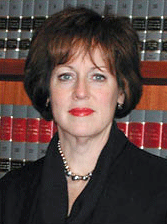
Chief Justice Maureen O’Connor wrote the majority opinion, stating the definition of legislative intent is not what state lawmakers send to the governor, but the policy that prevails at the end of the legislative process.
Also voting with the majority were Justices Paul Pfeifer, William O’Neill and Justice Judith Ann Lanzinger.
Dissenting were Justices Terrence O’Donnell, Sharon Kennedy and Judith French.
According to the Ohio Supreme Court, "Although this case arises in the context of a complex social and political debate, our task is limited. Quite simply, a single question of law is presented to us: Did the Ohio Controlling Board violate R.C. 127.17 by approving the Ohio Department of Medicaid’s request for increased appropriation authority for the Hospital Care Assurance Match Fund? For the reasons that follow, we must answer that question in the negative. Therefore, we deny relators’ request for a writ of mandamus.
• The federal Medicaid statutes require participating states to provide medical coverage for certain populations. 42 U.S.C. 1396(a)(10). As originally enacted, mandatory coverage applied to individuals who received cash assistance under one of four programs: Old Age Assistance, 42 U.S.C. 301 et seq.; Aid to Families with Dependent Children, 42 U.S.C. 601 et seq.; Aid to the Blind, 42 U.S.C. 1201 et seq.; and Aid to the Permanently and Totally Disabled, 42 U.S.C. 1351 et seq. Id.; see also Schweiker v. Gray Panthers, 453 U.S. 34, 37, 101 S.Ct. 2633, 69 L.Ed.2d 460 (1981).
• Over time, Congress has amended the Medicaid program on multiple occasions to expand the scope of those to whom mandatory coverage must apply. The term used for this concept is “mandatory eligibility.” For example, between 1988 and 1990, Congress required states to include as program beneficiaries pregnant women with family incomes up to 133 percent of the federal poverty line, children up to six at the same income levels, and children ages 6 to 18 with family incomes up to 100 percent of the federal poverty line. 42 U.S.C. 1396a(a)(10)(A)(i) and 1396a(l).
• States may also provide optional coverage for the “medically needy,” meaning persons whose income exceeds financial eligibility criteria for those programs, and hence for Medicaid, but who otherwise satisfy the criteria for one or more of those assistance programs. ...
• On June 27, 2013, the General Assembly passed Am. Sub.H.B. No. 59, the omnibus budget bill. It added two relevant provisions to the Revised Code, R.C. 5163.03 and 5163.04.
R.C. 5163.03 provided: Subject to sections 5163.04 and 5163.05 of the Revised Code, the medicaid program shall cover all mandatory eligibility groups. (B) The medicaid program shall cover all of the optional eligibility groups that state statutes require the medicaid program to cover. (C) The medicaid program may cover any of the optional eligibility groups to which either of the following applies: (1) State statutes expressly permit the medicaid program to cover the optional eligibility group. (2) State statutes do not address whether the medicaid program may cover the optional eligibility group. (D) The medicaid program shall not cover any eligibility group that state statutes prohibit the medicaid program from covering.
R.C. 5163.04. as passed by the General Assembly stated: The medicaid program shall not cover the group described in the “Social Security Act,” section 1902 (a)(10)(A)(i)(VIII), 42 U.S.C. 1396a(a)(10(A)(i)(VIII).
Thus, by passing R.C. 5163.04, the General Assembly refused to provide coverage for Group VIII that, by virtue of Natl. Fedn. of Indep. Business, was entitled to optional coverage.
• On June 30, 2013, Governor John Kasich signed Am.Sub.H.B. No. 59, but only after exercising his line-item veto authority to strike certain provisions. Most notably, the governor vetoed R.C. 5163.04, the prohibition on Medicaid coverage for Group VIII.
Thus, after the governor’s veto, the statute, as enrolled, gave the state Medicaid program authority to cover any federal optional eligibility group that is not addressed by state law. R.C. 5163.03(C)(2). And the law, as enrolled, no longer expressly prohibited optional coverage for Group VIII.
• On October 11, 2013, the Ohio Department of Medicaid submitted an application to the Controlling Board for an increase in its appropriation authority from the accounts holding federal Medicaid funds. Specifically, the director asked the Controlling Board to increase its appropriation authority. The request made clear that every dollar of increased spending would come from the federal government, and not a single dollar of state money would be expended.
The controlling board approved the department’s request on October 21, 2013.
Relators filed the present request for writs of mandamus and prohibition on October 22, 2013.
ANALYSIS
• A state agency can receive permission to spend federal dollars in one of three ways: a specific appropriation by the General Assembly, by executive order of the governor pursuant to R.C. 107.17 (which is inapplicable because the governor never issued an executive order), or by way of a request to, and approval from, the Controlling Board. R.C. 131.35(A)(1).
As noted above, Ohio has authorized participation in the federal Medicaid plan. The federal funds at issue here constitute excess money over and above the amounts appropriated by the General Assembly. And the Revised Code expressly permits expenditure of excess federal funds when authorized by the controlling board. R.C. 131.35(A)(2).
Relators dispute the applicability of R.C. 131.35(A)(2) because they do not consider this a modification of the preexisting Medicaid program. Rather, they view the extension of Medicaid services to Group VIII as the implementation of an entirely new healthcare law.
However, characterizing the “Fund 3F00” refers to a fund created by R.C. 5168.11(B) (formerly R.C. 5112.18) to hold federal matching funds received as a result of certain department health care expenditures. The Ohio Administrative Code refers to this fund as the “Hospital Care Assurance Match Act.”
This leads to the central question in relators’ complaint: whether the controlling board exceeded its statutory authority when it authorized participation in the program because it acted contrary to the intentions of the General Assembly.
The limitations on the authority of the Controlling Board can be found in R.C. 127.17: The controlling board shall take no action which does not carry out the legislative intent of the general assembly regarding program goals and levels of support of state agencies as expressed in the prevailing appropriation acts of the General Assembly.
Finally we note that the Ohio Constitution provides the mechanism by which the General Assembly may override a veto: repass the legislation by a vote of three-fifths of the members of both houses. Constitution, Article II, Section 16. The legislature cannot circumvent this constitutional option by obtaining a writ from this court that forbids the Controlling Board to comply with the law, as that law is modified by the governor’s veto.
We therefore reject relators’ prayer because the relators have not established a legal basis for the issuance of an extraordinary writ. More specifically, the relators fail to establish a clear legal right to the requested relief and a clear legal duty on the part of the Controlling Board to undo the authorization of the expenditure of additional federal funds to provide medical insurance for Group VIII members.
[[In-content Ad]]