


Commissioners considering 1.9 mill levy for children services
Lead Summary
By
Caitlin Forsha-crforsha@gmail.com
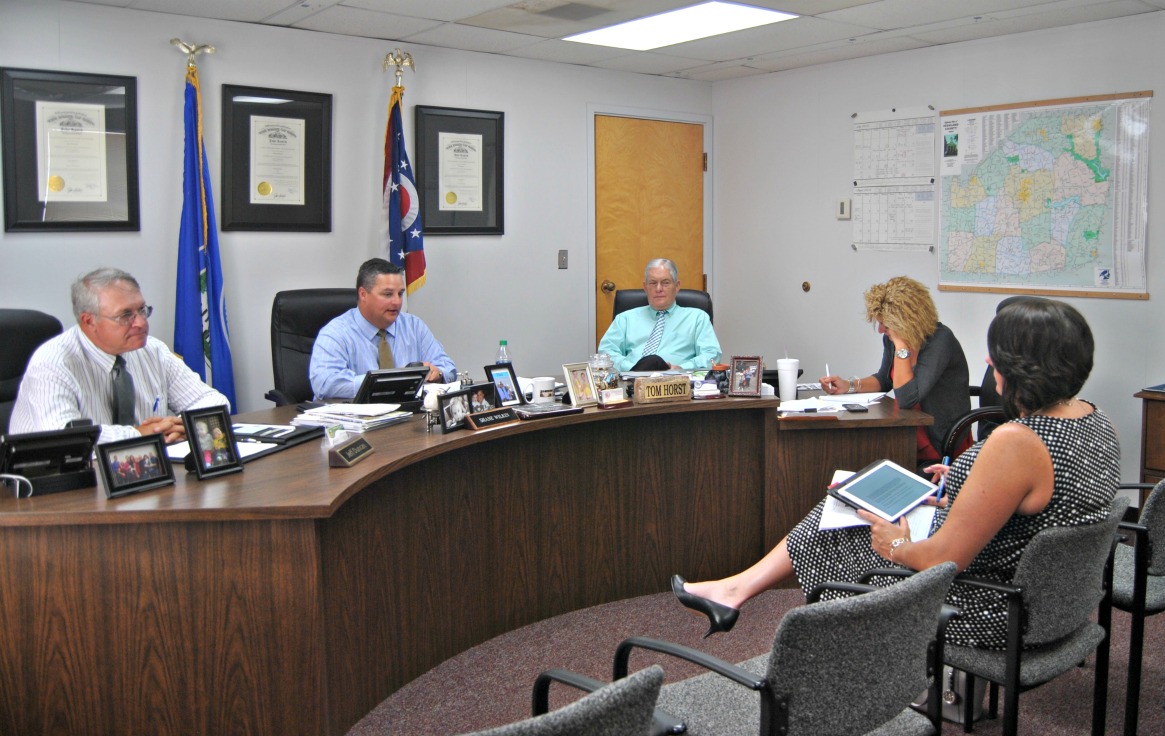
Highland County Commissioners Shane Wilkin, Tom Horst and Jeff Duncan met with Job and Family Services Director Katie Adams in a special meeting Tuesday morning to discuss Adams’ request for a five-year, 1.9 mill levy estimated to bring an additional $1.47 million in funding for children services.
Also present for the meeting were Highland County Prosecutor Anneka Collins and Highland County Auditor Bill Fawley.
The Highland County Press reported on June 22 that Highland County Job and Family Services proposed an additional levy for children services on the November general election ballot.
Wilkin said Tuesday the county has “reached a point now where we have to address this issue.”
“If this is not addressed now, we stand to look at a point where we look at more General Fund cuts, and that’s another issue that we hope to not get into,” Wilkin said.
The proposed levy “would bring us about $1.479 million,” Wilkin said.
Fawley said the current children services levy initially ran in 2009, and Wilkin said it is nine-tenths of a mill.
“It was set up and designed to basically handle a workload of about 60 kids in care, and most of them were going to be located in our county, which saves cost and travel time and things like that,” Wilkin said. “It’s a requirement that they are visited and made sure they’re taken care of.
“We’ve been as high as the 150 range for [number of] kids in care, with in some instances kids being as high as $400 a day considering some of their either development issues or other issues that increased the costs of their care.”
Fawley said that the levy reflected “what we had projected at that time,” but that the number of cases and costs have increased since 2009.
“It has generated a little over a half a million dollars, which is pretty much what we had projected at the time, thinking that that was sufficient for the number of kids we had,” Fawley said. “Of course, now since that point, things have changed a lot. Thank goodness when the levy was run in 2013, it was kept on, and we’d like to thank the voters for that.”
Wilkin also presented numbers from three neighboring counties’ levies, with Clinton County having a 1.9 mill levy bringing in $1 million; Adams County with two levies at 2 mills, bringing in over $1 million; and a $391,000 levy for Pike County.
Adams said that Clinton County currently has approximately 58 kids in care, with 67 in Adams County, 43 of whom are in paid care. Wilkin noted that although these counties both have smaller caseloads than Highland County, their levies generate much more funding for their respective agencies.
Fawley also mentioned the possibility of the county losing tax revenues from Medicaid managed care organizations (MCOs) in the next two years, which could also present issues.
“There’s been a change in how Ohio is to collect the sales tax on Medicaid MCOs,” Fawley said. “They’re projecting that at the end of the state fiscal year, that will be gone. That means as of the end of June of next year, we will not be able to collect that.
“Out of our $6.5 million in sales tax that we collected in 2015, a little over $800,000 of it came from that one source. So if something isn’t done on the state level to change that, starting late next year, our sales tax receipts are going to go down dramatically. In 2018, if we lose the whole $800,000, we’ll be back to where we were in 2008 and ’09, when every general fund office was laying off people because there just won’t be any money there to do it.”
Although Wilkin said that things are “headed in the right direction” with the costs of kids in care lowered from $2.5 million to under $2 million since November and the number of kids in care under 100, Adams said that the agency currently faces “a deficit of $1.4 million for placement costs, over and above what the [current] levy brings.”
Adams said that there has been a “huge increase in the number of children who have been removed due to drugs.”
“In 2015, we removed 113 children, and 80 percent of the removals were due to an initial report of drug involvement,” Adams said. “We currently have 150 adults associated with our open cases, and over half of those adults have a heroin or opiate involvement or addiction at this point, with several other drugs mixed in.”
Adams said that despite efforts to reduce placement costs by almost $600,000 in the last seven months, they will not be able to “reduce another $600,000 in the next six months.”
“We’re just not going to get much below $1.8, $1.9 million in placement costs for the foreseeable future,” Adams said.
Adams said that the agency has increased outreach for foster parents to recruit local foster parents to cut down on costs, “but that’s a time-consuming process.”
“It’s going to take two to four months to become a licensed foster parent, and then we’re not going to just move a child from the home they’re in to one of our foster homes simply because of money,” Adams said. “We’re going to honor the child’s attachments to where they are, so the children we currently have in placement, we’re going to leave them where they are because they’re attached and doing well.”
Collins said she too wanted to “reiterate, and can’t stress this enough, the volume of the cases.”
Collins said that when she began working for the prosecutor’s office over 10 years ago, she was able to personally handle all of the juvenile court cases “with no problem.”
“We may have had 30 pending cases in children services at most, and when I say 30 cases, that’s 30 kids,” Collins said. “That was about the average.”
Collins said that now, two attorneys in the prosecutor’s office are devoted to Juvenile Court cases.
“I had one filing cabinet drawer, one drawer, for children services cases for four or five years,” Collins said. “Now, it’s a bigger filing cabinet, and it’s three drawers. That’s no exaggeration. There’s just so many more cases.”
Commissioners thanked Adams for her efforts to reduce costs thus far and said that they have not found any alternative to the proposed levy. Fawley agreed, saying “there aren’t a lot of choices.”
“We have looked and looked,” Fawley said. “This isn’t something that we just jump in and say ‘gee, let’s run a levy.’ It’s just one of those things where you look at the numbers, there aren’t a lot of choices out there.”
Collins also clarified that the agency is receiving state and federal funding as well, but that is not enough.
“I’ve heard a lot of people say ‘why aren’t you getting federal or state dollars?’ We are,” Collins said. “We are applying for and getting every last dime. We started a contract with JFS to do the Children Services work because that gives us federal reimbursement.”
Collins said that the agency has also received incentive dollars for meeting state mandates.
“We’re doing everything we can,” Collins said.
Wilkin said that the county has been “as prudent as we can with all of our funds.”
“I don’t think there’s anyone sitting on this board or sitting in this room or in any county office that looks forward to adding a levy or running a levy,” Wilkin said. “We do not. I can tell you personally, from my side, I don’t want to pay any more taxes than I have to. However, we have to look at worst-case scenarios in some instances.
“Hopefully we can get rid of a levy when things get better. But I’m afraid we would look at a reduction in other services and personnel, and I don’t know if we’re in a situation where we’re terribly overstaffed anywhere.”
Duncan said that the county needs to “try to find a way to take care of” the children in their care.
“I think it’s unfortunate that we’re talking about kids that are suffering under this system because of decisions that they didn’t make,” Duncan said. “They’re innocent.
“Like Tom and Shane both said, we’ve looked through our numbers, and we honestly haven’t been able to come up with another method.”
“We have no place to cut,” Horst said. “It’s that simple.”
“We’re dealing with some children that are put in bad spots, essentially by no fault of their own,” Wilkin said. “It is poor decisions by adults that have placed them here, and I think it’s good that we have a judge that recognizes it in Judge Greer.
“The important thing is to get these kids out of those situations to where they’re not seeing these practices as a way of life. We want them to know that there’s a different way and a better way, and part of that is what they’re seeing.”
The county officials also thanked fellow county department heads for their assistance last year in assisting with the children services budget deficit.
“Every department head was very cooperative and helped us, and that’s the only way we were able to garner enough money to pay our bills from last year for children services,” Wilkin said.
“We’re thankful that the commissioners and all the county agencies stepped in last year and bailed us out,” Adams said.
Fawley said that the department heads’ support was “unheard of.”
“When I’ve talked to other county auditors about how everybody was willing to let us transfer money back in, they kind of look at me like I’m crazy,” Fawley said.
Wilkin said that the commissioners chose to have the special meeting Tuesday to give them time to discuss the matter at length, but they will continue to discuss the issue at their regular Wednesday morning meeting.
“I personally would rather us not vote on anything today,” Wilkin said.
“I don’t think we should,” Horst said.
Wilkin said the commissioners will most likely vote on the levy tomorrow, and if approved, the levy would appear on the ballot this fall during the general election.
Fawley also noted that the auditor’s office would be happy to calculate the levy’s effect on local property owners’ tax bills.
“I especially encourage that for farmers or CAUV because that is a lot different number than if you just look at the market value,” Fawley said.
“On a $100,000 residential property, a 1.9 mill levy would cost the taxpayer $59.85 a year. That’s what it’s going to take to get through this.”
Also present for the meeting were Highland County Prosecutor Anneka Collins and Highland County Auditor Bill Fawley.
The Highland County Press reported on June 22 that Highland County Job and Family Services proposed an additional levy for children services on the November general election ballot.
Wilkin said Tuesday the county has “reached a point now where we have to address this issue.”
“If this is not addressed now, we stand to look at a point where we look at more General Fund cuts, and that’s another issue that we hope to not get into,” Wilkin said.
The proposed levy “would bring us about $1.479 million,” Wilkin said.
Fawley said the current children services levy initially ran in 2009, and Wilkin said it is nine-tenths of a mill.
“It was set up and designed to basically handle a workload of about 60 kids in care, and most of them were going to be located in our county, which saves cost and travel time and things like that,” Wilkin said. “It’s a requirement that they are visited and made sure they’re taken care of.
“We’ve been as high as the 150 range for [number of] kids in care, with in some instances kids being as high as $400 a day considering some of their either development issues or other issues that increased the costs of their care.”
Fawley said that the levy reflected “what we had projected at that time,” but that the number of cases and costs have increased since 2009.
“It has generated a little over a half a million dollars, which is pretty much what we had projected at the time, thinking that that was sufficient for the number of kids we had,” Fawley said. “Of course, now since that point, things have changed a lot. Thank goodness when the levy was run in 2013, it was kept on, and we’d like to thank the voters for that.”
Wilkin also presented numbers from three neighboring counties’ levies, with Clinton County having a 1.9 mill levy bringing in $1 million; Adams County with two levies at 2 mills, bringing in over $1 million; and a $391,000 levy for Pike County.
Adams said that Clinton County currently has approximately 58 kids in care, with 67 in Adams County, 43 of whom are in paid care. Wilkin noted that although these counties both have smaller caseloads than Highland County, their levies generate much more funding for their respective agencies.
Fawley also mentioned the possibility of the county losing tax revenues from Medicaid managed care organizations (MCOs) in the next two years, which could also present issues.
“There’s been a change in how Ohio is to collect the sales tax on Medicaid MCOs,” Fawley said. “They’re projecting that at the end of the state fiscal year, that will be gone. That means as of the end of June of next year, we will not be able to collect that.
“Out of our $6.5 million in sales tax that we collected in 2015, a little over $800,000 of it came from that one source. So if something isn’t done on the state level to change that, starting late next year, our sales tax receipts are going to go down dramatically. In 2018, if we lose the whole $800,000, we’ll be back to where we were in 2008 and ’09, when every general fund office was laying off people because there just won’t be any money there to do it.”
Although Wilkin said that things are “headed in the right direction” with the costs of kids in care lowered from $2.5 million to under $2 million since November and the number of kids in care under 100, Adams said that the agency currently faces “a deficit of $1.4 million for placement costs, over and above what the [current] levy brings.”
Adams said that there has been a “huge increase in the number of children who have been removed due to drugs.”
“In 2015, we removed 113 children, and 80 percent of the removals were due to an initial report of drug involvement,” Adams said. “We currently have 150 adults associated with our open cases, and over half of those adults have a heroin or opiate involvement or addiction at this point, with several other drugs mixed in.”
Adams said that despite efforts to reduce placement costs by almost $600,000 in the last seven months, they will not be able to “reduce another $600,000 in the next six months.”
“We’re just not going to get much below $1.8, $1.9 million in placement costs for the foreseeable future,” Adams said.
Adams said that the agency has increased outreach for foster parents to recruit local foster parents to cut down on costs, “but that’s a time-consuming process.”
“It’s going to take two to four months to become a licensed foster parent, and then we’re not going to just move a child from the home they’re in to one of our foster homes simply because of money,” Adams said. “We’re going to honor the child’s attachments to where they are, so the children we currently have in placement, we’re going to leave them where they are because they’re attached and doing well.”
Collins said she too wanted to “reiterate, and can’t stress this enough, the volume of the cases.”
Collins said that when she began working for the prosecutor’s office over 10 years ago, she was able to personally handle all of the juvenile court cases “with no problem.”
“We may have had 30 pending cases in children services at most, and when I say 30 cases, that’s 30 kids,” Collins said. “That was about the average.”
Collins said that now, two attorneys in the prosecutor’s office are devoted to Juvenile Court cases.
“I had one filing cabinet drawer, one drawer, for children services cases for four or five years,” Collins said. “Now, it’s a bigger filing cabinet, and it’s three drawers. That’s no exaggeration. There’s just so many more cases.”
Commissioners thanked Adams for her efforts to reduce costs thus far and said that they have not found any alternative to the proposed levy. Fawley agreed, saying “there aren’t a lot of choices.”
“We have looked and looked,” Fawley said. “This isn’t something that we just jump in and say ‘gee, let’s run a levy.’ It’s just one of those things where you look at the numbers, there aren’t a lot of choices out there.”
Collins also clarified that the agency is receiving state and federal funding as well, but that is not enough.
“I’ve heard a lot of people say ‘why aren’t you getting federal or state dollars?’ We are,” Collins said. “We are applying for and getting every last dime. We started a contract with JFS to do the Children Services work because that gives us federal reimbursement.”
Collins said that the agency has also received incentive dollars for meeting state mandates.
“We’re doing everything we can,” Collins said.
Wilkin said that the county has been “as prudent as we can with all of our funds.”
“I don’t think there’s anyone sitting on this board or sitting in this room or in any county office that looks forward to adding a levy or running a levy,” Wilkin said. “We do not. I can tell you personally, from my side, I don’t want to pay any more taxes than I have to. However, we have to look at worst-case scenarios in some instances.
“Hopefully we can get rid of a levy when things get better. But I’m afraid we would look at a reduction in other services and personnel, and I don’t know if we’re in a situation where we’re terribly overstaffed anywhere.”
Duncan said that the county needs to “try to find a way to take care of” the children in their care.
“I think it’s unfortunate that we’re talking about kids that are suffering under this system because of decisions that they didn’t make,” Duncan said. “They’re innocent.
“Like Tom and Shane both said, we’ve looked through our numbers, and we honestly haven’t been able to come up with another method.”
“We have no place to cut,” Horst said. “It’s that simple.”
“We’re dealing with some children that are put in bad spots, essentially by no fault of their own,” Wilkin said. “It is poor decisions by adults that have placed them here, and I think it’s good that we have a judge that recognizes it in Judge Greer.
“The important thing is to get these kids out of those situations to where they’re not seeing these practices as a way of life. We want them to know that there’s a different way and a better way, and part of that is what they’re seeing.”
The county officials also thanked fellow county department heads for their assistance last year in assisting with the children services budget deficit.
“Every department head was very cooperative and helped us, and that’s the only way we were able to garner enough money to pay our bills from last year for children services,” Wilkin said.
“We’re thankful that the commissioners and all the county agencies stepped in last year and bailed us out,” Adams said.
Fawley said that the department heads’ support was “unheard of.”
“When I’ve talked to other county auditors about how everybody was willing to let us transfer money back in, they kind of look at me like I’m crazy,” Fawley said.
Wilkin said that the commissioners chose to have the special meeting Tuesday to give them time to discuss the matter at length, but they will continue to discuss the issue at their regular Wednesday morning meeting.
“I personally would rather us not vote on anything today,” Wilkin said.
“I don’t think we should,” Horst said.
Wilkin said the commissioners will most likely vote on the levy tomorrow, and if approved, the levy would appear on the ballot this fall during the general election.
Fawley also noted that the auditor’s office would be happy to calculate the levy’s effect on local property owners’ tax bills.
“I especially encourage that for farmers or CAUV because that is a lot different number than if you just look at the market value,” Fawley said.
“On a $100,000 residential property, a 1.9 mill levy would cost the taxpayer $59.85 a year. That’s what it’s going to take to get through this.”