


Kerr authors the story of Buck Ewing
Lead Summary
By
Stephen Forsha-sforsha@gmail.com
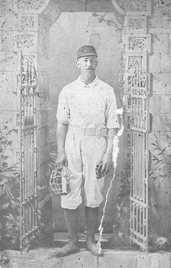
Highland County’s William “Buck” Ewing – the first catcher inducted into the National Baseball Hall of Fame – is the subject of a new biography written by baseball historian Roy Kerr.
The biography, titled “Buck Ewing: A Baseball Biography” and published by McFarland, is set to hit the shelves in July, but before the book is released, Kerr, who has authored three other books, spoke about who Ewing really was, saying "Buck was a character."
To set the record straight, contrary to other reports, Kerr said without a doubt Ewing was born in Hoagland in Highland County and once even returned at the end of his playing days to face a local team in Hillsboro.
"What I found interesting was in 1897, at the end of his playing career, he was also a manager, and was a part of a team that was barnstorming and they played a game in Hillsboro," Kerr said. "While in Hillsboro, he said he was from a small town a few miles outside of Hillsboro."
Kerr said the tough part in researching Ewing's life was his personal side.
"You have to remember, before 1880, there were no birth certificates in Ohio. Jean Wallis of the Highland County Historical Society set me on the right track," Kerr said. "I found census information from 1857 on his parents, stating they had a 1-year-old child, and that confirmed he was born in Hoagland."
Compared to today's superstars, Ewing was one of the biggest stars of his day, being on the cover of the most popular magazine of that time-frame along with being on posters advertising beer in saloons.
"He was the greatest player of his era. Buck was the subject in novels, in cigar advertisements, beer advertisements, and he once was considered to be on a U.S. Postal stamp," Kerr said. "During his playing days, he was a national star.
"I found a beer lithograph with Buck on it, and this tells you how popular he was … his name is nowhere on it, but everyone knew him just by his photo all around the country. He was on the cover of Harper’s Illustrated in 1889, and it wasn't even a sports magazine."
Just how did Kerr obtain all the information?
He did it like any other historian … he researched Ewing and only wrote the book on factual information he found in articles published during the time when Ewing was playing.
"For all my biographies that I've written, I research their playing days on microfilm of newspapers that were published for any particular game," Kerr said. "I only use primary sources because I will get every box score from every newspaper I can obtain and use that with my notes."
How did Kerr first get involved with writing baseball biographies, concentrating on players from the 19th century?
"I retired early from being a professor, and my wife is a college president. We have a young son, but I became restless," Kerr said. "From all I learned in academia researching, I used those skills, and it helps that I am a great fan of baseball.”
"I read and was fascinated with 19th century baseball and spent two years reading all I could about that time frame of the game. I wanted to tell their stories because most of those players are unknown today."
In writing his previous baseball biographies, Kerr was invited to speak at the National Baseball Hall of Fame.
"I played baseball growing up in American Legion and Babe Ruth leagues, but my high school didn't have a baseball team," Kerr said. "As for being invited to speak at the Hall of Fame, I had a long career as a professor, but that was the thrill of my life."
Speaking of the Hall of Fame, with Ewing being the first catcher inducted in the hallowed Hall, some may not know the Highland County native actually played every position on the field, including pitcher.
"Buck played half his games at catcher, but you have to realize it wasn't the same game as it is today. Buck's catcher's mitt was just a small glove with the fingers cut out of it, plus he had a small mask, and that was it," Kerr said. "Catchers back then didn't have chest protectors or shin guards, and that caused them to be injured a lot."
Ewing's techniques from behind the plate are still being used today.
"Buck established the catching from the crouching position in 1880, and he was the first catcher to have a snap throw to a base," Kerr said. "He would throw runners out from second from the crouch, and that shows just how strong his arm was.
"Sometimes he would dare the runner to steal a base on him."
Kerr said Ewing was a career .303 hitter and once hit a home run 430 feet, during what is known as the "dead ball era."
"He used a 42-inch baseball bat; he wasn't even a power hitter, he hit with his wrists," Kerr said. "With his style at the plate, he was great at the hit-and-run. He could hit the ball wherever he wanted.
"Steals weren't counted at the start of his career, but for at least 10 years Buck had 35 steals per season. In 1888, as a third baseman, Buck stole six bases in a game, and he wasn't even fast. He studied everything about the pitcher, knew their movements … he could analyze."
As a 14-year-old, to help make ends meet, Ewing delivered barrels of whisky to local salons six days a week, learning the ways of the world through tough labor. Fast-forward to his playing days, and Ewing was known as a "boss kicker."
"A boss kicker means he argued with the umpires, and that was known as kicking them," Kerr said. "He used every advantage he could to win a game. He would talk to the fans and media, he would talk to the batter to distract them and he would talk to the umpires.
"At first he would start off positive with the umpires, but if they were lousy, he would intimidate them. In articles that I researched, I would read where it would say something like Buck officiated the game and he was assisted by the officials."
Ewing, who from the start of his career until the end saw complete change in baseball, got praise from his opponents, including Hall of Fame manager John McGraw.
"Buck played against McGraw, Connie Mack and they would say how great of a player he was," Kerr said, "He was just an all-around great player, but it all came crashing down in 1891 when he threw out his arm against Boston."
Kerr also spoke about what he described as a "tragic ending" for Ewing.
"Buck died in 1906 at the age of 46. He had Bright's disease, and today that is kidney failure," Kerr said. "In those days they couldn’t cure it, but in his later seasons, he was sick a lot, and it was probably from years of getting the disease.
"When Buck played … it wasn't easy by any means. A lot of guys were sick, and the travel was unbearable, which led to a lot of the sickness."
Kerr tells of one travel story in particular.
"When he was managing the Reds in 1896, they were playing in Boston and the game ended late. They hop onto a train, then go across on a boat which takes overnight to reach New York City," Kerr explained. "After not sleeping much on the boat, they reach New York, and hop onto a train to Washington D.C., and once they reach there, they play in a game and lose.
"In the paper the next day, it said the Reds played listless baseball. So when people say players from back then couldn't play in today's game, I say players today couldn't play back then."
In looking at the complete life of Ewing, Kerr described it as a "Huck Finn kind of life."
"He lived by his wits, delivered whiskey to low-life places as a youth, was the greatest player of his time, but he also had humanitarian thoughts, though most thought he only looked out for himself," Kerr said. "Buck was noble, but players called him 'bread and butter Buck' because he always had an angle.
"In the last two years of his life, he knew he was dying. He was down to around 80 pounds, and he would travel 40 miles and help coach the Miami Military School. He did that until a few months before he died. I have a photo in the book where he is with those kids, and I think that's how he wanted to be remembered."
For the entire book, all Kerr wants to do is to make sure people know and remember who Ewing really was.
"There was no equal to Buck Ewing," Kerr said. "It's sad he's forgotten. Go to his gravesite, and it has a lack of funds, and it's just dusty and dirty."
Kerr summed up Ewing's career simply.
"He (Ewing) was the greatest player of the 19th century … a working boy who made it to the big leagues," Kerr said. "With everything said and written, I can say I still don't know who he completely was."[[In-content Ad]]
The biography, titled “Buck Ewing: A Baseball Biography” and published by McFarland, is set to hit the shelves in July, but before the book is released, Kerr, who has authored three other books, spoke about who Ewing really was, saying "Buck was a character."
To set the record straight, contrary to other reports, Kerr said without a doubt Ewing was born in Hoagland in Highland County and once even returned at the end of his playing days to face a local team in Hillsboro.
"What I found interesting was in 1897, at the end of his playing career, he was also a manager, and was a part of a team that was barnstorming and they played a game in Hillsboro," Kerr said. "While in Hillsboro, he said he was from a small town a few miles outside of Hillsboro."
Kerr said the tough part in researching Ewing's life was his personal side.
"You have to remember, before 1880, there were no birth certificates in Ohio. Jean Wallis of the Highland County Historical Society set me on the right track," Kerr said. "I found census information from 1857 on his parents, stating they had a 1-year-old child, and that confirmed he was born in Hoagland."
Compared to today's superstars, Ewing was one of the biggest stars of his day, being on the cover of the most popular magazine of that time-frame along with being on posters advertising beer in saloons.
"He was the greatest player of his era. Buck was the subject in novels, in cigar advertisements, beer advertisements, and he once was considered to be on a U.S. Postal stamp," Kerr said. "During his playing days, he was a national star.
"I found a beer lithograph with Buck on it, and this tells you how popular he was … his name is nowhere on it, but everyone knew him just by his photo all around the country. He was on the cover of Harper’s Illustrated in 1889, and it wasn't even a sports magazine."
Just how did Kerr obtain all the information?
He did it like any other historian … he researched Ewing and only wrote the book on factual information he found in articles published during the time when Ewing was playing.
"For all my biographies that I've written, I research their playing days on microfilm of newspapers that were published for any particular game," Kerr said. "I only use primary sources because I will get every box score from every newspaper I can obtain and use that with my notes."
How did Kerr first get involved with writing baseball biographies, concentrating on players from the 19th century?
"I retired early from being a professor, and my wife is a college president. We have a young son, but I became restless," Kerr said. "From all I learned in academia researching, I used those skills, and it helps that I am a great fan of baseball.”
"I read and was fascinated with 19th century baseball and spent two years reading all I could about that time frame of the game. I wanted to tell their stories because most of those players are unknown today."
In writing his previous baseball biographies, Kerr was invited to speak at the National Baseball Hall of Fame.
"I played baseball growing up in American Legion and Babe Ruth leagues, but my high school didn't have a baseball team," Kerr said. "As for being invited to speak at the Hall of Fame, I had a long career as a professor, but that was the thrill of my life."
Speaking of the Hall of Fame, with Ewing being the first catcher inducted in the hallowed Hall, some may not know the Highland County native actually played every position on the field, including pitcher.
"Buck played half his games at catcher, but you have to realize it wasn't the same game as it is today. Buck's catcher's mitt was just a small glove with the fingers cut out of it, plus he had a small mask, and that was it," Kerr said. "Catchers back then didn't have chest protectors or shin guards, and that caused them to be injured a lot."
Ewing's techniques from behind the plate are still being used today.
"Buck established the catching from the crouching position in 1880, and he was the first catcher to have a snap throw to a base," Kerr said. "He would throw runners out from second from the crouch, and that shows just how strong his arm was.
"Sometimes he would dare the runner to steal a base on him."
Kerr said Ewing was a career .303 hitter and once hit a home run 430 feet, during what is known as the "dead ball era."
"He used a 42-inch baseball bat; he wasn't even a power hitter, he hit with his wrists," Kerr said. "With his style at the plate, he was great at the hit-and-run. He could hit the ball wherever he wanted.
"Steals weren't counted at the start of his career, but for at least 10 years Buck had 35 steals per season. In 1888, as a third baseman, Buck stole six bases in a game, and he wasn't even fast. He studied everything about the pitcher, knew their movements … he could analyze."
As a 14-year-old, to help make ends meet, Ewing delivered barrels of whisky to local salons six days a week, learning the ways of the world through tough labor. Fast-forward to his playing days, and Ewing was known as a "boss kicker."
"A boss kicker means he argued with the umpires, and that was known as kicking them," Kerr said. "He used every advantage he could to win a game. He would talk to the fans and media, he would talk to the batter to distract them and he would talk to the umpires.
"At first he would start off positive with the umpires, but if they were lousy, he would intimidate them. In articles that I researched, I would read where it would say something like Buck officiated the game and he was assisted by the officials."
Ewing, who from the start of his career until the end saw complete change in baseball, got praise from his opponents, including Hall of Fame manager John McGraw.
"Buck played against McGraw, Connie Mack and they would say how great of a player he was," Kerr said, "He was just an all-around great player, but it all came crashing down in 1891 when he threw out his arm against Boston."
Kerr also spoke about what he described as a "tragic ending" for Ewing.
"Buck died in 1906 at the age of 46. He had Bright's disease, and today that is kidney failure," Kerr said. "In those days they couldn’t cure it, but in his later seasons, he was sick a lot, and it was probably from years of getting the disease.
"When Buck played … it wasn't easy by any means. A lot of guys were sick, and the travel was unbearable, which led to a lot of the sickness."
Kerr tells of one travel story in particular.
"When he was managing the Reds in 1896, they were playing in Boston and the game ended late. They hop onto a train, then go across on a boat which takes overnight to reach New York City," Kerr explained. "After not sleeping much on the boat, they reach New York, and hop onto a train to Washington D.C., and once they reach there, they play in a game and lose.
"In the paper the next day, it said the Reds played listless baseball. So when people say players from back then couldn't play in today's game, I say players today couldn't play back then."
In looking at the complete life of Ewing, Kerr described it as a "Huck Finn kind of life."
"He lived by his wits, delivered whiskey to low-life places as a youth, was the greatest player of his time, but he also had humanitarian thoughts, though most thought he only looked out for himself," Kerr said. "Buck was noble, but players called him 'bread and butter Buck' because he always had an angle.
"In the last two years of his life, he knew he was dying. He was down to around 80 pounds, and he would travel 40 miles and help coach the Miami Military School. He did that until a few months before he died. I have a photo in the book where he is with those kids, and I think that's how he wanted to be remembered."
For the entire book, all Kerr wants to do is to make sure people know and remember who Ewing really was.
"There was no equal to Buck Ewing," Kerr said. "It's sad he's forgotten. Go to his gravesite, and it has a lack of funds, and it's just dusty and dirty."
Kerr summed up Ewing's career simply.
"He (Ewing) was the greatest player of the 19th century … a working boy who made it to the big leagues," Kerr said. "With everything said and written, I can say I still don't know who he completely was."[[In-content Ad]]