


Historical Society hosts presentation on historic farms
Lead Summary
By
Courtesy of John Kellis-
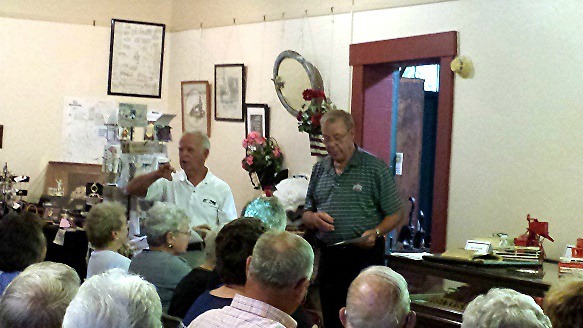
Forty-five area farm owners and interested parties visited the Highland House Museum for a presentation about the formation of Highland County and the Historic Farms in Highland County on Thursday evening. John Levo and Dr. Robert Carey made the presentation to the group.
The presentation was the first program to be held as part of the Historical Society’s 2016 effort to highlight local agriculture.
Levo began the presentation discussing the history of Highland County from 1780, when Ohio was part of the Virginia Territories, to 1878, when Ohio in its recognizable form was part of the Northwest Territory. In 1790, the state was split into three counties and later around 1800 was further subdivided into five counties of Wayne, Jefferson, Hamilton, Washington and Adams counties.
Highland County was part of the Virginia Military District and was divided in a metes and bounds survey rather than a townships, range and section techniques, with all roads running north and south as found in much of the State.
[[In-content Ad]]
“I can still remember surveying property as a summer job in the early 1970s, going 3,507 feet to a five-foot diameter beech tree to find a property corner,” John Kellis, Society Trustee, said. “Fat chance that that 150-year-old tree, described in the plat 100 years before my survey, was still there in 1971. It was simply an easier way to survey the hills of this area than blocking it off in squares, I guess.”
In 1800, there were 17 counties in Ohio, and in 1802, Highland County was first carved out from Ross and Clermont counties. It was primarily the “high land” between the Little Miami and Scioto Rivers.
The county was initially much larger, stretching as far north as Madison County west of Columbus. It was in 1810 before Highland County looked like it does today, though small changes were made as late as 1874, when all the counties we now know were in place. Recorder Chad McConnaughey shared with Levo the dates of the formation of the 17 townships through the first half of the 1800s.
Levo led the group through some feeling for the farms in Highland County, with 26,521 acres in 1,417 farms. Wayne County has the most farms of any county, mainly due to the number of small Amish farms in that area, a phenomenon that is quickly becoming common here in Highland County.
Mr. Levo then discussed the “Ohio Century Program” that was created in 2003. As the Program grew, it was changed to “The Ohio Historic Farm Family Program” earlier this year. That change was prompted by other changes, including the creation of Sesquicentennial (150-year-old) Farms and recognizing Bicentennial (200-year-old) Farms.
Highland County currently has 23 Century Farms. Clinton and Adams counties have 18 each in the program, Brown County has 17, Ross has 12, Fayette has nine and Pike County has three. Seventeen farms had been deeded and described even before Ohio was a state, the oldest of these being the Smiley Farm just south of Belfast, with a deed dated in 1792 and signed by King George III.
Families need to prove that the farm in question has been in one family for the 100, 150 or 200 years. Much of the research can be provided by the recorder’s office. There are several other farms that would qualify, and Levo encouraged those families to initiate the application.
“Questions can be directed to Chad McConnaughey’s office,” said Levo, who has been recognized as an ambassador for the program by Governor Kasich and the Ohio Department of Agriculture.
Dr. Carey added to the discussion and walked the crowd through the application process.
“It will take some time to connect the dots and document the application, but it is well worth it to pull your family together and honor the history of your family and the farm,” Carey said.
Both Carey and Levo shared photos with the audience, as they also encouraged the families to erect their signs if they have not done so.
To be eligible, the farm must still contain more than 10 acres of the original farm, and the unbroken family chain needs to be documented. Some even do the application and present the plaque as a gift to their parents or grandparents. There are no easements or restrictions placed upon the farm, though the farm’s recognition will gain a family points if they wanted to apply for an agricultural easement on the land.
The group dismissed after audience members shared stories about their farms and their thoughts about the recognition. The Society invited the group for refreshments and invited them to enjoy the “Farms of Highland County” and the quilt show, both on display at the Museum.
Jim Rooney, Society Chair, noted that it was a little different group to visit the museum for the agricultural-based program, which is exactly as the committee had hoped. Several there commented how they wanted to return when they had more time to spend at the Highland House and how they appreciated the wonderful new handicapped-accessible rear entrance to the Museum.
The presentation was the first program to be held as part of the Historical Society’s 2016 effort to highlight local agriculture.
Levo began the presentation discussing the history of Highland County from 1780, when Ohio was part of the Virginia Territories, to 1878, when Ohio in its recognizable form was part of the Northwest Territory. In 1790, the state was split into three counties and later around 1800 was further subdivided into five counties of Wayne, Jefferson, Hamilton, Washington and Adams counties.
Highland County was part of the Virginia Military District and was divided in a metes and bounds survey rather than a townships, range and section techniques, with all roads running north and south as found in much of the State.
[[In-content Ad]]
“I can still remember surveying property as a summer job in the early 1970s, going 3,507 feet to a five-foot diameter beech tree to find a property corner,” John Kellis, Society Trustee, said. “Fat chance that that 150-year-old tree, described in the plat 100 years before my survey, was still there in 1971. It was simply an easier way to survey the hills of this area than blocking it off in squares, I guess.”
In 1800, there were 17 counties in Ohio, and in 1802, Highland County was first carved out from Ross and Clermont counties. It was primarily the “high land” between the Little Miami and Scioto Rivers.
The county was initially much larger, stretching as far north as Madison County west of Columbus. It was in 1810 before Highland County looked like it does today, though small changes were made as late as 1874, when all the counties we now know were in place. Recorder Chad McConnaughey shared with Levo the dates of the formation of the 17 townships through the first half of the 1800s.
Levo led the group through some feeling for the farms in Highland County, with 26,521 acres in 1,417 farms. Wayne County has the most farms of any county, mainly due to the number of small Amish farms in that area, a phenomenon that is quickly becoming common here in Highland County.
Mr. Levo then discussed the “Ohio Century Program” that was created in 2003. As the Program grew, it was changed to “The Ohio Historic Farm Family Program” earlier this year. That change was prompted by other changes, including the creation of Sesquicentennial (150-year-old) Farms and recognizing Bicentennial (200-year-old) Farms.
Highland County currently has 23 Century Farms. Clinton and Adams counties have 18 each in the program, Brown County has 17, Ross has 12, Fayette has nine and Pike County has three. Seventeen farms had been deeded and described even before Ohio was a state, the oldest of these being the Smiley Farm just south of Belfast, with a deed dated in 1792 and signed by King George III.
Families need to prove that the farm in question has been in one family for the 100, 150 or 200 years. Much of the research can be provided by the recorder’s office. There are several other farms that would qualify, and Levo encouraged those families to initiate the application.
“Questions can be directed to Chad McConnaughey’s office,” said Levo, who has been recognized as an ambassador for the program by Governor Kasich and the Ohio Department of Agriculture.
Dr. Carey added to the discussion and walked the crowd through the application process.
“It will take some time to connect the dots and document the application, but it is well worth it to pull your family together and honor the history of your family and the farm,” Carey said.
Both Carey and Levo shared photos with the audience, as they also encouraged the families to erect their signs if they have not done so.
To be eligible, the farm must still contain more than 10 acres of the original farm, and the unbroken family chain needs to be documented. Some even do the application and present the plaque as a gift to their parents or grandparents. There are no easements or restrictions placed upon the farm, though the farm’s recognition will gain a family points if they wanted to apply for an agricultural easement on the land.
The group dismissed after audience members shared stories about their farms and their thoughts about the recognition. The Society invited the group for refreshments and invited them to enjoy the “Farms of Highland County” and the quilt show, both on display at the Museum.
Jim Rooney, Society Chair, noted that it was a little different group to visit the museum for the agricultural-based program, which is exactly as the committee had hoped. Several there commented how they wanted to return when they had more time to spend at the Highland House and how they appreciated the wonderful new handicapped-accessible rear entrance to the Museum.