


Highland County Historical Society celebrates 50th anniversary, Part XXXII
By Pamela Nickell
H.C. Historical Society
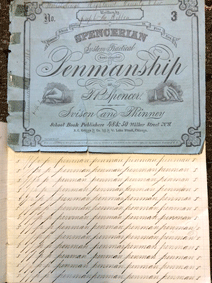
On Dec. 6, 1860, Joseph M. Hibben of Hillsborough in Highland County, Ohio, commenced penmanship practice in the “Spencerian System Practical Penmanship Workbook No. 3” by Professor J.R. Spencer.
This was before the Civil War and when Highland County was just over 50 years old. The book is completely filled with the same precise and beautiful handwriting as is on the cover identifying the student and is so elegantly and perfectly done that it can hardly be distinguished from that printed by the publisher.
This booklet was discovered when we were temporarily relocating the Highland House Schoolroom items during the reconstruction of the back wall. The booklet is complete, but the cover is unattached. Marks show where it has previously been taped, but now it is in acid-free plastic and clipped together to protect it and keep it safely preserved.
The adult Mr. Hibben, according to Elsie Johnson Ayres’ “Hills of Highland,” had a newspaper column entitled ‘Hibbens Ramblings’ (p. 226). He spoke at the unveiling of the portrait of Rev. Wm. J. McSurely painted by Mary McArthur Thompson Tuttle, daughter of Mother Thompson. Mr. Hibben had known Rev. McSurley and had observed the women’s temperance march (p. 281).
And, in April of 1924, as the last survivor of the Highland Institute Trustees, asked the court’s permission to deed its property to the Highland County Children’s Home Board.
Spencerian handwriting had fewer flourishes than preceding penmanship but still required much lifting of the pen from paper. It dominated instruction until after the Civil War.
The Palmer method was introduced in 1888 and quickly displaced Spencerian. Palmer was simplified and quicker with the pen not leaving the page while writing a word. Zaner Bloser was another method introduced in the late 1800s also streamlining style. It was the first to differentiate between right and left handedness.
In 1978, D’Nealian was introduced. The uniqueness of this style is that manuscript is also sloped as a better building block to cursive.
Some advocates of cursive writing emphasize that the regimentation is useful to increase discipline and character. Others advocate the resulting muscle tone and coordination. Others declare that is helpful to the organization of brain processes. Not to mention the benefits of being able to read cursive (such as historic documents), to write and in developing a signature. Could we say the discipline of early penmanship training contributed to Mr. Hibben’s lifelong success?
But today? Cursive writing instruction is not required in Ohio’s adopted Common Core standards and therefore, even though not prevented, is most often not taught.
My own nearly 16-year-old grandson, although from another state, claims he cannot read cursive. Researching this article led me to discover that there is House Bill 146 currently before the Ohio Legislature sponsored by State Rep. Cheryl Grossman that would, if passed, require such instruction.
Let’s keep recording, no matter in what manner!