


Highland County Historical Society celebrates 50th anniversary, Part XXXI
By Pamela Nickell
H.C. Historical Society
Visitors to the Highland House Friday afternoon from Florida and North Carolina were seven cousins in town for a family reunion, which is held every other year.
They had pre-arranged with Director Vicki Knauff to tour the museum and to meet with Vicki and Jean Wallis to discuss Highland County ancestors. The visitors were enthusiastic with their visit and expressed appreciation for the warmth and beauty of the museum and for its vast and varied contents. They stated that they would surely make a return visit in 2017.
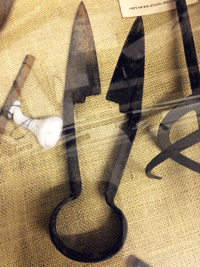
Of all the items in the display case in the pioneer hallway, the one pictured here peaked the curiosity of one of the women. By virtue of its placement, it was obviously farm related. Many of you will recognize it immediately, but I had to confess I did not know what is was.
I really had no clue other than it was maybe for cutting. But what? And how?
As others re-appeared, neither did they know. I grabbed the “pioneer hallway” folder from the nearby office and was busily searching through the accession forms hoping to find a clue, when Jean Wallis came through and said, “Why, they are sheep shears!” Of course, they are! My hand aches in sympathy at the mere thought of operating these shears to remove the wool of one sheep, let alone several.
Knowing, or thinking I did, that modern sheep shearing is done with machine shears similar to but much larger than hair clippers, further investigation informs that hand shearing is still done in a limited way. However, current blade shears consist of two blades arranged similarly to those pictured here except that there is a hinge at the end farthest from the points allowing some aid to the opening and closing of the tool. The cutting edges pass each other as the shearer squeezes them together to shear the wool close to the animal’s skin.
Shearing the wool from the animals is a farm activity that is a practical and economic necessity for sheep growers. Also, contests exist to test the athletic ability and speed of the shearer. Sheep are not hurt in the process and apparently not even disturbed as they are held on their lower backs with all four feet off the ground as the sheep is turned and the
wool is clipped off.
This particular pair of shears was presented to the museum in May 1971 by Clara Weishrupt and her sister Elizabeth Canuip who came here from Germany. All of Clara’s belongings were packed into a chest for the trip across the ocean. The chest is at the foot of the bed in the Weaver’s Room of the Highland House.
Home for Clara became a farm at Webertown, on the edge of Highland County bordering Brown County. We can probably assume sheep were raised on that farm and that the shears were acquired and used for the purpose of harvesting wool.
The Weaver’s room contains many items that show us how the wool was gathered, cleaned, spun into yarn, dyed and made into cloth. The curtains on the windows were hand woven by Mary Bennett. Other pieces (bedspread, cloth, dress) preserved in this room are hand loomed as well.
History. Questions, answers, assumptions – and more questions.