


Highland County Historical Society celebrates 50th anniversary, Part XXVII
By Pamela Nickell
H.C. Historical Society
Shoemaker, shoemaker, make me a shoe.
Have it ready by half past two.
We have a mighty fascination with shoes. My mother said, that for her, obtaining one pair of shoes at the beginning of each school year was as exciting as Christmas. She carried over that tradition to me.
In my day, it was Spalding saddles. Emotions ran deep from the high of getting that pristine new pair of school shoes to the low of the first mark on the white leather.
What care it took to keep the colors polished without bleeding one to the other and to keep the polish off the red soles.
One shudders to imagine the discomfort of early shoes and boots to the settlers. Because of the work and creativity and invention since, we now have access to well-fitting, comfortable and attractive footwear.
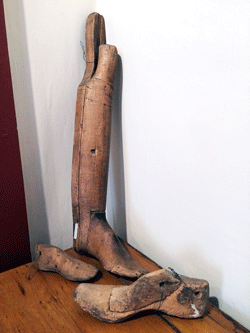
Located in the Pioneer Hall of the Highland House are several wooden shoe lasts, a couple of iron shoe lasts, a wooden boot form and a metal shoe lathe for shoe repair.
These all came to the museum in the first decade of the 2000s, but the wood lasts are products of two centuries ago.
A “last” is a form that has a shape similar to that of a human foot. It is used in the manufacture and repair of shoes.
In 1629, the Mayflower arrived at Plymouth, Massachusetts carrying a shoemaker among its passengers. Until the early 1900s, shoes were made in the home, farm, or shop of a master craftsman. Few tools were needed: bench, knife, hammer, pliers, awl, burnisher and shoe last.
Shoe lasts were originally made of hardwoods, usually maple or beech, because these materials retain their shape, even when in contact with wet materials like leather and subjected to the stresses of stretching and shaping shoes on them.
Blocks of wood were whittled by hand into foot-shaped pieces in sizes small, medium or large. Once the forms were made, leather was cut, stretched over the lasts and sewn together and heels tacked on.
It might typically take 12 hours or more to complete two pairs of shoes which were then polished with wax or oil. Both shoes in the pair were identical because they were simpler to make. The fit of the shoe had to come from actually wearing the shoe into shape.
In the 1900s, mass production capabilities moved shoemaking to centralized manufacturing. Shoe lasts came to be made of polythylene plastic which can be recycled and remolded.
Cordwainers are shoemakers working with fine leather and bespoke shoemakers are custom designers who use lasts that are specifically designed to the proportions of individual customers’ feet.
Made from various modern materials, these lasts don’t need to withstand the pressures of mass production machinery, but they must be able to handle tacking and pinning and the wet environment associated with stretching and shaping materials such as leather and canvas.
The Highland House has many primitive tools. Due to back entrance repair, the Highland House is now open by appointment only, so call 393-3392 and “walk on in.”