


Highland County Historical Society celebrates 50th anniversary, Part XVII
By Pamela Nickell
H.C. Historical Society
Deciding on the item from the Highland House about which to share each week is the easy part. Doing a little research on the item is the fun part. Focusing on an angle to present the item is the hard part. Luckily for me and you space here is limited, or I would probably try go all directions into the entire history of not only the selected object but all similar ones.
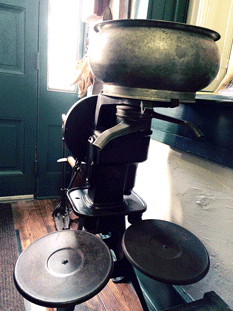
Browsing the Highland House this week, concentrating on all the farm items that will have to be moved temporarily from the Pioneer Hall to accommodate the back wall repair and making myself very anxious about how we will accomplish this safely and protectively, my attention was captured by a heavy piece of equipment that reminded me of my grandmother’s cream separator.
Like many small farmers of their time, my grandparents Leigh and Eva Engle had a few acres, a few chickens, a few cows and one mean-looking, snorting bull with a ring in his nose who occupied his own special room in the barn.
Sounds picturesque, but money was scarce, so Grandma sold cream and eggs to aid the family income. She also made butter and cottage cheese for home use. But first the butterfat had to be separated from the milk. I remember looking through the glass window in the machine as the milk “worked” and then watching how very carefully Grandma washed the equipment after the process.
Fortunately, John Glaze was at the museum at this same time, and he had more specific memories: His family’s separator was more like this particular one in the museum. The HH has two separators, quite different, but the one we are talking about here is a McCormick Primrose by International Harvester. John says he was allowed to ‘help’ until it came time to clean the machinery.
During the cleaning, he was not even allowed to get close. He remembers a series of funnels that had to be put back in precise order with no small hands allowed near.
The Primrose is a water separator in which cold water is added to the raw whole milk to hasten the separation of the cream from the milk while spinning it around. The centrifugal force makes the separation more complete and faster than earlier methods.
An ad for a similar separator in an April 5, 1923 newspaper shows an illustration of a smiling woman (Was this women’s work? It was in my family.) operating it. The ad claimed its bowl to be strong, seamless, anti-splash and easy to wash.
The Primrose at the Highland House is number 632 in our accessions book and was received in 1974, a gift from Walter Fenner. Dr. Fenner was a veterinarian in Hillsboro located on South West Street, where the Paul Mitchell Focus Salon is now.
Dr. Fenner was the father-in-law of Harriet Fenner and grandfather of Ben Fenner, members of the Highland County Historical Society.
I’m learning so much, but mainly I am learning how much I don’t know. It occurs to me that we actually extend our lives by “being there,” for instance in 1923, experiencing in our minds the improved, labor-saving cream separator newly available to make our product better and our lives just a bit easier.