


Highland County Historical Society celebrates 50th anniversary, Part XLVII
By Pamela Nickell
H.C. Historical Society
A mandatory fashion accessory from the early 1800s which went out of style and was no longer used after about 1925 has since become a popular collector’s item. There are national societies in Great Britain and the United States and large conventions for the collectors of these pieces.
They were individually made (perhaps by jewelers) or mass produced. In fact, if you have one of them, you know you have an antique since they were actually no longer manufactured after 1925. They are the ideal collector’s item in that they take up very little room, so you can amass hundreds of them and contain them in perhaps a 2’x3’x5’ etagere. We’re not talking about brooches or earrings, but hatpins. There are more than 600 hatpins in a case located in the Victorian bedroom on the second floor of the Highland House Museum.
The hatpins in the Highland House were collected by Charlotte Spilker Hern and were donated to the museum by Robert Hern in 2000 from his wife’s estate. Ms. Hern not only collected hatpins, but also holders made especially for them.
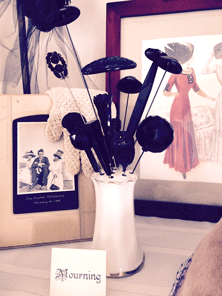
Ms. Hern obviously loved these fascinating accessories and had them sorted and displayed by type, such as: mourning, animal design, jewel, silver, gold, bone, porcelain, glass stones, enamel, ivory, stone, celluloid, tortoise shell, amber, jet, coral, fabric and so forth. Ladies sometimes used the military buttons of their loved ones as tops on the pins. Some were made for wearing while in mourning. Also in the display are pictures of the types of hats requiring pins to help secure the hats in place. Right now, many such hats are also on display in this room.
Wikipedia says “A hatpin is a decorative and functional pin for holding a hat to the head, usually by the hair.
“In Western culture, a hatpin is almost surely a female item.” Actually, a hatpin could be very dangerous, and care had to be taken, sometimes by putting nibs on the end of the points, to not scratch or poke an innocent nearby person. (Goodness, I am thinking Black Friday crowds!) They could also be used as weapons on a “not-so-innocent” nearby person.
When I was a little girl, actually long after 1925, my grandma was letting me look at her small box of jewelry when I did prick my finger on a long pin. There were three or four such pins in the box, and she told me they were to hold hats on one’s head. Whew! I could not imagine that and thought no wonder Grandma didn’t use them. Of course, you know that the pins went through the hat, chignon, and out the hat! But I didn’t! We didn’t have Wikipedia back then! Or a museum!
Now to retell a story here that I first wrote about in our newsletter, Museum Muses, that is worth repeating.
I was hosting one day in the upstairs of the Highland House when a very excited young (8- 9-year-old) girl came running over to the hatpin display with her grandmother in tow.
The girl proceeded to tell her grandma all about the hatpins. Seeing her delight was fun, but hearing her talk about them so learnedly was amazing and I said so. Her grandmother then told me that her granddaughter had been at the museum on a Girl Scout tour a few days earlier, and Avery Applegate had talked to them about the display. Our young guest then “made” her grandma come back so she could show them to her.
Does that not epitomize why we collect? Preserve? Record? Let’s keep on.