


Highland County Historical Society celebrates 50th anniversary, Part XI
By Pamela Nickell
H.C. Historical Society
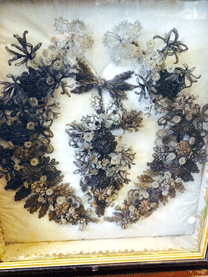
The most memorable image that remains with me from my first visit to the Highland House in early 1980 right after we moved to Highland County is the wreath that hung over the mantel in the East Parlor, also known as the Music Room.
As I walked very close to examine this unusual piece, my stomach clinched and I gasped upon discovering it was made of human hair. Studiously avoiding the area was my intention for the next three decades.
As with most anything that does not appeal, however, we find much more acceptable and interesting as we get to know more about it. In Victorian times, hair was used to express sentimental love to the living as much as in memories of the deceased.
Our Victorian Hair Wreath is now located in the Weaver’s room where there is also a feather wreath and a yarn wreath. All three are excellently and intricately done.
[[In-content Ad]]
I have found, though that, like me, most of our visitors have never before seen hair art. The most obvious questions are “How could that possibly be done?” and “Where did all the hair come from?”
A little bit of research has informed me that this was an art practiced in the latter half of the 19th Century. Intricately woven hair was used to fashion wreaths, jewelry, and keepsakes. Sentimental gifts such as watch fobs for men were made by their wives using their own hair.
Hair from deceased persons was used in mourning jewelry or pictures. Hair from friends was used to adorn autographs in books especially for that purpose. And hair from many different people was used in wreaths, the different shades of hair giving flowers unique colors.
According to “The Lost Art of Sentimental Hairwork – Victorian Gothic” on Google, a story is told by Helen Sheumaker in Love Entwined: The Curious History of Hairwork in America that Nila Bailey in 1864 was impassioned to make a wreath using hair from President Lincoln and other government leaders. In spite of the Civil War going on she was able to collect hair from 30 dignitaries, including Mr. Lincoln, and she completed the project.
Although the art fell into disfavor, there is a resurging interest both in how to accomplish
it and in collecting it.
We are extremely fortunate to have an excellent example of this nearly vanished art form in the Highland House. It was made by Miss Lettice Johnson,1845-1883, daughter of Allen Hiatt Johnson, prominent farmer and blacksmith from the Bridges area. Miss Johnson asked her friends for locks of hair which she used to create the wreath which is estimated to be 140-150 years old.
The wreath was the 15th item accessioned by the Highland House. It was donated by Mrs. Lyman Turner, great-niece of Miss Johnson.