


Who’s going to pay the taxes?
Lead Summary
By
Rory Ryan-hcpress@cinci.rr.com
I voted last week.
It may have been the earliest that I’ve ever cast a ballot. There were two reasons for my October stop at the Adams County Board of Elections: One, I had to be in West Union anyway; and two, I just wanted to get the voting over with. Let’s just say the enthusiasm wasn’t there in this presidential election year.
On my electronic ballot, if you read the first computer screen very fast, you might not even see the names of two particular candidates for president – but you must vote quickly – or touch-screen the lower right-hand corner of the screen and go to Page 2, where you can vote for Rob Portman without feeling bad about yourself and what has become of your right to vote.
But enough about Gary Johnson and Jill Stein and their venomous campaigns for the presidency in 2016.
After voting for Sen. Portman, Congressman Brad Wenstrup and local county candidates Judge Brett Spencer (a Democrat) and Prosecutor David Kelley (a Republican), I was feeling a little better. These four choices were much easier than voting for the next U.S. president. (And I am quite certain that I did not vote for the next president.)
A few more votes on the contested candidates later, and I was looking at what seemed an endless list of voting “for or against the levy.”
I think my ballot had four or five levies. I did not bother reading them. I’ve read them before.
However, I keep waiting for that one ballot initiative that I will support and work for with all my being: One that limits the maximum salaries of all members of the Ohio General Assembly – including the speaker of the House and Senate president what’s his name – to the state median household income and limits all county commissioners’ salaries to the average household income in their respective county.
A truly conservative approach would be to mandate that these full-time politicians’ salaries match the per-capita income levels in the state and counties, but I’ve grown more and more progressive as I’ve gotten older. So, let’s be politically correct and equally generous with other people’s money and give them the average HOUSEHOLD income as their salary. Thus, all of them would truly have skin in the game. Improve your state and local household incomes, and your salaries increase accordingly.
Surely, not one of Ohio’s humble politicians would argue with making the same pay as an entire household of workers and taxpayers. Right? Dream on. Even if a majority of voters passed such a measure, the politicians in the Supreme Court would negate it.
These never-ending ballot levies (save for this year’s Fairfield Local Schools Board of Education’s decision NOT to seek a renewal) always read the same. And that got me to thinking. (Never a good thing.)
How do counties with poverty rates at or near 20 percent pass these levies? Just who pays the fiddler? And who gets the money? Does anyone really know?
Granted, those within the government bureaucracy are prone to say that our tax dollars are stimulating local economies. But that ignores a basic lesson in economics best explained by Henry Hazlitt’s “broken window fallacy.”
Hazlitt explains that it is a fallacy to believe that a broken window is good for the economy due to its ability to stimulate money. “A young hoodlum heaves a brick through the window of a baker’s shop. The shopkeeper runs out furious, but the boy is gone. People gather and remind the baker that the misfortune has its bright side. It will make business for some glazier. The glazier will have more to spend with other merchants and so on. The smashed window will go on providing money and employment in ever-widening circles. The logical conclusion from all this would be that the little hoodlum who threw the brick, far from being a public menace, was a public benefactor.
“Now let us take another look. The shopkeeper is out the money that he was planning to spend for a new suit. Because he has had to replace the window, he will have to go without the suit. Instead of having a window (which he already had) and money for a suit, now he has merely a window. He must be content with the window and no suit. The glazier’s gain of business is merely the tailor’s loss of business. No new employment has been added. The people in the crowd were thinking only of two parties to the transaction, the baker and the glazier. They had forgotten the potential third party involved, the tailor, because he will not now enter the scene.”
When someone suggests that higher taxes stimulate the economy, remind them about Henry Stuart Hazlitt.
Now, let’s consider that Ohio’s state lawmakers and commissioners of the majority of the 88 counties earn (er, receive) more than the average total household incomes in Ohio. Thus, taxpayers are being – and have been – rather generous.
But are state politicians being at all generous or at all appreciative? Of course not. They don’t even pretend to respect their employers – the taxpayers. They respect their lobbyists. They fear the lobbyists. But they do not respect you.
In an Oct. 23 story in The Columbus Dispatch by Rita Price, Russ Moore offers some interesting observations. Moore is the executive director of Gallia County Children Services, which he says, exists solely on the state child-protection allocation.
“How many times have you heard that if the state of Ohio doubled its investment in child welfare, we’d still be 50th in the nation?” Moore told the Dispatch. “It’s true.”
In the same Dispatch story, Price writes: “Our state takes pride in saying local dollars take care of it,” said Tammy Osborne-Smith, who leads Jackson County Children Services in southeastern Ohio. “Well, that doesn’t work in Jackson County. It doesn’t work in Appalachia.”
According to the federal government, Ohio is one of just nine states where child-welfare services are administered by counties. Most are centralized at the state level.
Given that Highland County taxpayers have funded one existing levy for Children Services and given that taxpayers are being asked to fund an additional levy for Children Services, has anyone thought to ask why the state of Ohio – with its often-touted Rainy Day Fund – wouldn’t admit it if it were raining in a south Florida hurricane?
Has anyone thought to ask why Ohio House Speaker Cliff Rosenberger’s 91st House District has three of its four counties (including Highland) with poverty rates averaging 20 percent? (The one exception is Clinton County at almost 14 percent.) By the way, the young speaker’s salary for one year is more than $90,000. Not too shabby.
For comparison, Highland County’s annual average HOUSEHOLD income, according to the U.S. Census Bureau, is $39,855. (Which also is less than a single county commissioner’s salary.)
All Ohio lawmakers start with the annual base pay of $60,584 for what really is part-time “work.” (Some of us define real “work” differently.)
Ohio is technically a part-time Legislature, but it does meet throughout the year. It could do far less damage if it would go back to the days of honorable lawmakers like Jim Hapner and Joe Hiestand and meet less frequently. Take a few months off, already. Most of us won’t even notice.
Rambling on, as I’m apt to do, here’s another thought: Ohio provided $106 million in state aid last year to ECOT (Electronic Classroom of Tomorrow). For what?
The Columbus Dispatch reported this week that ECOT’s graduation rate of 39 percent last year was less than half of the statewide rate of 83 percent.
“One of every six high school dropouts in Ohio last year came from ECOT. More students at ECOT drop out or fail to finish high school within four years than at any other school in the nation, The New York Times found,” the Dispatch reported.
“The number of ECOT students who didn’t graduate in four years — 2,790 last year — is more than three times higher than the total for Cleveland City Schools, which had the lowest four-year graduation rate of Ohio’s big urban districts.”
In other words, Ohio’s governor and legislators are OK with $106 million a year to failing schools (with grand political lobbyists) paid by taxpayers, but when rural counties face budget crises and force more and more levies on the local level, Columbus might as well be the capital of Peru.
The fact is that the billions in the overall increase in state spending from the last year of the Strickland administration (2010) to the Kasich administration in 2016 would fund many (if not all) of the countywide levies on the Nov. 8 ballot across Ohio.
Instead, state and local officials who are making well above the state average household income, with far better benefits, health care and pensions, are asking the working class to do more and more.
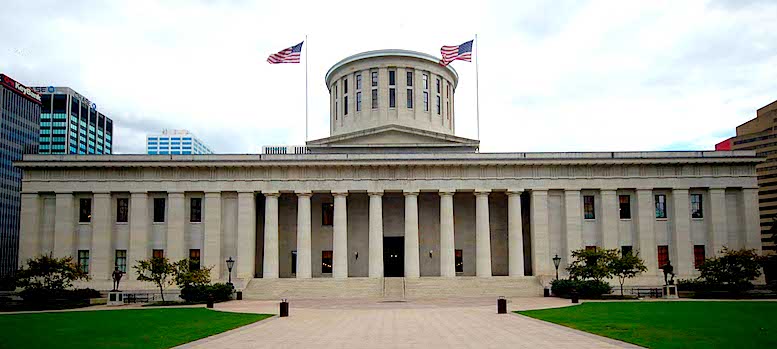
The money trail leads to Columbus. Do the honorable thing and send it back. Local taxpayers are doing all they can. Of course, the Republicans who control the governor’s office, the House, the Senate, the Supreme Court and most state offices are wise to all of this. But they don’t care. They know that taxpayers and voters aren’t always one and the same. As long as they can persuade more voters than taxpayers, they can maintain their cozy arrangements.
Funny, the Republicans used to complain about tax-and-spend Democrats who did this. Well, at least Ohio Republicans have taken it to an art form.
Rory Ryan is publisher and owner of The Highland County Press.
It may have been the earliest that I’ve ever cast a ballot. There were two reasons for my October stop at the Adams County Board of Elections: One, I had to be in West Union anyway; and two, I just wanted to get the voting over with. Let’s just say the enthusiasm wasn’t there in this presidential election year.
On my electronic ballot, if you read the first computer screen very fast, you might not even see the names of two particular candidates for president – but you must vote quickly – or touch-screen the lower right-hand corner of the screen and go to Page 2, where you can vote for Rob Portman without feeling bad about yourself and what has become of your right to vote.
But enough about Gary Johnson and Jill Stein and their venomous campaigns for the presidency in 2016.
After voting for Sen. Portman, Congressman Brad Wenstrup and local county candidates Judge Brett Spencer (a Democrat) and Prosecutor David Kelley (a Republican), I was feeling a little better. These four choices were much easier than voting for the next U.S. president. (And I am quite certain that I did not vote for the next president.)
A few more votes on the contested candidates later, and I was looking at what seemed an endless list of voting “for or against the levy.”
I think my ballot had four or five levies. I did not bother reading them. I’ve read them before.
However, I keep waiting for that one ballot initiative that I will support and work for with all my being: One that limits the maximum salaries of all members of the Ohio General Assembly – including the speaker of the House and Senate president what’s his name – to the state median household income and limits all county commissioners’ salaries to the average household income in their respective county.
A truly conservative approach would be to mandate that these full-time politicians’ salaries match the per-capita income levels in the state and counties, but I’ve grown more and more progressive as I’ve gotten older. So, let’s be politically correct and equally generous with other people’s money and give them the average HOUSEHOLD income as their salary. Thus, all of them would truly have skin in the game. Improve your state and local household incomes, and your salaries increase accordingly.
Surely, not one of Ohio’s humble politicians would argue with making the same pay as an entire household of workers and taxpayers. Right? Dream on. Even if a majority of voters passed such a measure, the politicians in the Supreme Court would negate it.
These never-ending ballot levies (save for this year’s Fairfield Local Schools Board of Education’s decision NOT to seek a renewal) always read the same. And that got me to thinking. (Never a good thing.)
How do counties with poverty rates at or near 20 percent pass these levies? Just who pays the fiddler? And who gets the money? Does anyone really know?
Granted, those within the government bureaucracy are prone to say that our tax dollars are stimulating local economies. But that ignores a basic lesson in economics best explained by Henry Hazlitt’s “broken window fallacy.”
Hazlitt explains that it is a fallacy to believe that a broken window is good for the economy due to its ability to stimulate money. “A young hoodlum heaves a brick through the window of a baker’s shop. The shopkeeper runs out furious, but the boy is gone. People gather and remind the baker that the misfortune has its bright side. It will make business for some glazier. The glazier will have more to spend with other merchants and so on. The smashed window will go on providing money and employment in ever-widening circles. The logical conclusion from all this would be that the little hoodlum who threw the brick, far from being a public menace, was a public benefactor.
“Now let us take another look. The shopkeeper is out the money that he was planning to spend for a new suit. Because he has had to replace the window, he will have to go without the suit. Instead of having a window (which he already had) and money for a suit, now he has merely a window. He must be content with the window and no suit. The glazier’s gain of business is merely the tailor’s loss of business. No new employment has been added. The people in the crowd were thinking only of two parties to the transaction, the baker and the glazier. They had forgotten the potential third party involved, the tailor, because he will not now enter the scene.”
When someone suggests that higher taxes stimulate the economy, remind them about Henry Stuart Hazlitt.
Now, let’s consider that Ohio’s state lawmakers and commissioners of the majority of the 88 counties earn (er, receive) more than the average total household incomes in Ohio. Thus, taxpayers are being – and have been – rather generous.
But are state politicians being at all generous or at all appreciative? Of course not. They don’t even pretend to respect their employers – the taxpayers. They respect their lobbyists. They fear the lobbyists. But they do not respect you.
In an Oct. 23 story in The Columbus Dispatch by Rita Price, Russ Moore offers some interesting observations. Moore is the executive director of Gallia County Children Services, which he says, exists solely on the state child-protection allocation.
“How many times have you heard that if the state of Ohio doubled its investment in child welfare, we’d still be 50th in the nation?” Moore told the Dispatch. “It’s true.”
In the same Dispatch story, Price writes: “Our state takes pride in saying local dollars take care of it,” said Tammy Osborne-Smith, who leads Jackson County Children Services in southeastern Ohio. “Well, that doesn’t work in Jackson County. It doesn’t work in Appalachia.”
According to the federal government, Ohio is one of just nine states where child-welfare services are administered by counties. Most are centralized at the state level.
Given that Highland County taxpayers have funded one existing levy for Children Services and given that taxpayers are being asked to fund an additional levy for Children Services, has anyone thought to ask why the state of Ohio – with its often-touted Rainy Day Fund – wouldn’t admit it if it were raining in a south Florida hurricane?
Has anyone thought to ask why Ohio House Speaker Cliff Rosenberger’s 91st House District has three of its four counties (including Highland) with poverty rates averaging 20 percent? (The one exception is Clinton County at almost 14 percent.) By the way, the young speaker’s salary for one year is more than $90,000. Not too shabby.
For comparison, Highland County’s annual average HOUSEHOLD income, according to the U.S. Census Bureau, is $39,855. (Which also is less than a single county commissioner’s salary.)
All Ohio lawmakers start with the annual base pay of $60,584 for what really is part-time “work.” (Some of us define real “work” differently.)
Ohio is technically a part-time Legislature, but it does meet throughout the year. It could do far less damage if it would go back to the days of honorable lawmakers like Jim Hapner and Joe Hiestand and meet less frequently. Take a few months off, already. Most of us won’t even notice.
Rambling on, as I’m apt to do, here’s another thought: Ohio provided $106 million in state aid last year to ECOT (Electronic Classroom of Tomorrow). For what?
The Columbus Dispatch reported this week that ECOT’s graduation rate of 39 percent last year was less than half of the statewide rate of 83 percent.
“One of every six high school dropouts in Ohio last year came from ECOT. More students at ECOT drop out or fail to finish high school within four years than at any other school in the nation, The New York Times found,” the Dispatch reported.
“The number of ECOT students who didn’t graduate in four years — 2,790 last year — is more than three times higher than the total for Cleveland City Schools, which had the lowest four-year graduation rate of Ohio’s big urban districts.”
In other words, Ohio’s governor and legislators are OK with $106 million a year to failing schools (with grand political lobbyists) paid by taxpayers, but when rural counties face budget crises and force more and more levies on the local level, Columbus might as well be the capital of Peru.
The fact is that the billions in the overall increase in state spending from the last year of the Strickland administration (2010) to the Kasich administration in 2016 would fund many (if not all) of the countywide levies on the Nov. 8 ballot across Ohio.
Instead, state and local officials who are making well above the state average household income, with far better benefits, health care and pensions, are asking the working class to do more and more.
The money trail leads to Columbus. Do the honorable thing and send it back. Local taxpayers are doing all they can. Of course, the Republicans who control the governor’s office, the House, the Senate, the Supreme Court and most state offices are wise to all of this. But they don’t care. They know that taxpayers and voters aren’t always one and the same. As long as they can persuade more voters than taxpayers, they can maintain their cozy arrangements.
Funny, the Republicans used to complain about tax-and-spend Democrats who did this. Well, at least Ohio Republicans have taken it to an art form.
Rory Ryan is publisher and owner of The Highland County Press.