


Remembering Sears home kits
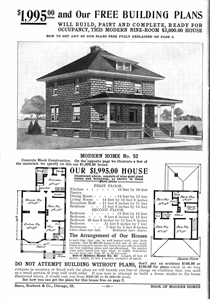
Until a Wednesday morning conversation several weeks ago with David Wyckoff, I can't recall ever hearing the phrase "Sears house."
Mr. Wyckoff is a board member for the Southern Ohio Pregnancy Center. The SOPC is located on West Walnut Street in a two-story brick building.
Mr. Wyckoff says this building is a "Sears house."
Maybe it is.
Frankly, I don't know.
In fact, I probably wouldn't know a Sears house from a Victorian or a Tudor or an antebellum mansion. I just never gave it that much consideration. I'm an outdoorsman and always have been.
To me, houses are a little bit like lifestyles: You need a good foundation and you can build from there.
However, after hearing about these Sears houses, my curiosity got the best of me and I just had to do a little research. (By "a little research," I mean that I went to a popular online search engine and typed in "Sears houses.")
Here's what I learned, mostly from www.searsarchives.com/homes/history.htm.
• The popular Sears Modern Homes were offered from 1908–1940 by Sears, Roebuck and Co.
• Approximately 75,000 to 100,000 homes were sold through a mail-order modern homes program.
• In 1918, Standard Oil Company purchased 192 houses for its mine workers in Carlinville, Ill.
• Sears, Roebuck and Co. had 447 different housing styles, "from the elaborate multistory Ivanhoe, with its elegant French doors and art glass windows, to the simpler Goldenrod, which served as a quaint, three-room and no-bath cottage for summer vacationers."
The Sears' website added this caveat: "An outhouse could be purchased separately for Goldenrod and similar cottage dwellers."
Unlike the majority of HCP readers, I am all-too-familiar with outhouses. (We never had a two-seater, though. We were not among such "elitists" in our rural neighborhood in the late 1960s and early '70s.)
According to the Sears website: "Entire homes would arrive by railroad, from pre-cut lumber, to carved staircases, down to the nails and varnish. Families picked out their houses according to their needs, tastes, and pocketbooks. Sears provided all the materials and instructions, and for many years the financing, for homeowners to build their own houses. Sears’s Modern Homes stand today as living monuments to the fine, enduring, and solid quality of Sears craftsmanship."
How much did a Sears home cost?
Well, not all that much.
Here are a few styles and prices:
In 1922, The Argyle sold for $827 to $2,150. The Somerset sold for $732 to $1,576. The Roanoke sold for $1,784 to $1,982.
For the upscale muckety-mucks, The Saratoga sold for $3,506.
In 1925, The Argyle held steady at $827 to $2,150. So did the Somerset at $732 to $1,576.
By 1932, the Lexington house was $4,365.
In the midst of the Great Depression, the 1938 Parkside house was $1,372 and the luxurious Ellison was $2,845.
"Sears was not an innovative home designer," according to its online history. "Sears was instead a very able follower of popular home designs, but with the added advantage of modifying houses and hardware according to buyer tastes. Individuals could even design their own homes and submit the blueprints to Sears, which would then ship off the appropriate precut and fitted materials, putting the home owner in full creative control. Modern Home customers had the freedom to build their own dream houses, and Sears helped realize these dreams through quality custom design and favorable financing."
For obvious reasons, there's no official record of the number of existing Sears mail-order houses that still survive today. More than 100,000 houses were sold between 1908 and 1940 through Sears’s Modern Homes program. It is estimated that several thousands of these houses survive today, some in better condition than others.
Mr. Wyckoff tells me Hillsboro is home to several Sears houses. That would not surprise me. Growing up here in the 1960s and early '70s, I knew many men (family friends) who were carpenters, electricians and plumbers – all in one. Back then, "working with one's hands" meant a lot more than texting on a cell phone.
My own family had several home-repair projects that, while not to the extent of building a house, were considerable, nonetheless. Family friends such as the late Harry Hopkins and Gerald Griffith completed many of these tasks for us. In fact, Gerald's son, Donald, recently solved an ongoing electrical problem in our home.
Suffice it to say, that the Sears home kits – in spite of their great value – wouldn't make it in today's world.
Between the overregulation from government and an under-skilled work force, this once great concept wouldn't stand a chance. That's a shame, too.
Professor Bill Horne used to explain that living in the country came with a prerequisite ability to be able to make something out of nothing. Indeed.
I thank David Wyckoff for the history lesson.
Rory Ryan is publisher of The Highland County Press.
[[In-content Ad]]