


Honoring '42'
In 1971, The Associated Press sports staff published "A Century of Sports," documenting everything from the Olympics, to baseball and football, to bowling, yachting, rodeo and even badminton.
Did you know that badminton originated in India centuries ago and it was called "poona?"
Me, neither.
"A Century of Sports" includes more than 400 pages. Fewer than five paragraphs from Pages 47-49 are devoted to Major League Baseball's first black player, a young man born on Jan. 31, 1919 in Cairo, Georgia, one Jack Roosevelt Robinson.
Jackie Robinson broke baseball's color barrier on April 15, 1947 at the age of 28 with the Brooklyn Dodgers in the National League.
Robinson was signed by Branch Rickey, who was born in Ohio in 1881.
The cigar-smoking baseball executive is featured on the famous Portsmouth floodwall murals, not far from where the Shawnee State University Bears play baseball at Branch Rickey Park. Several years ago, the minor league Portsmouth Spartans (Frontier League?) played their home games at the same park.
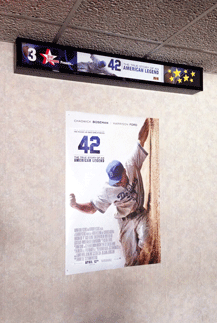
Shawnee State University recently hosted an advance screening of the new movie "42," about Robinson. (The film can be seen in Hillsboro at Star Cinemas on Harry Sauner Road.)
A story by Dan Sewell noted that among those attending the screening was Al "Scoop" Oliver, a Portsmouth native and star outfielder for the Pittsburgh Pirates.
Sewell noted: "Oliver said Rickey's role in opposing segregation is particularly notable for someone who came from the predominantly white Appalachian region that struggled with racism."
"Most people would not believe that someone from southern Ohio would have been the one to have made that move," Oliver said.
No kidding.
"(Rickey's) spiritual outlook on life was what made him the man he was," Oliver said.
Many years ago, Al Oliver was in Hillsboro at the then-new Subway restaurant on High Street to sign a member of Rick Earley's Hillsboro Indians – outfielder Aaron Boone – to a baseball scholarship at Shawnee State.
Oliver and I talked for several minutes about the great Pirates' teams that used to challenge the great Cincinnati Reds teams of the 1970s.
He laughed when I rattled off names like Dave Cash, Richie Hebner and Rennie Stennett.
He said, "You must've been an infielder."
By the way, Dave Cash, Rennie Stennett and Al Oliver are part of what is believed to be the first all-black starting lineup (including a few Latin-American players) in Major League Baseball history.
On Sept. 1, 1971, the Pittsburgh Pirates' starting lineup was: Rennie Stennett, 2B; Gene Clines, CF; Roberto Clemente, RF; Willie Stargell, LF; Manny Sanguillén, C; Dave Cash, 3B; Al Oliver, 1B; Jackie Hernández, SS; and Dock Ellis, P.
It was a formidable lineup, to be sure. If memory serves, that team won the 1971 World Series. (Was Danny Murtaugh still managing then?)
Oliver, understandably, gives all due credit to Jackie Robinson for his own professional career.
According to "A Century of Sports," Robinson "quietly took racial abuse in 1947, but he paved the way for others."
The book mentions Roy Campanella, Don Newcombe and Larry Doby, the first black player in the American League. Doby signed with the Cleveland Indians in 1948, giving the state of Ohio a very prominent role in changing America's national pastime for the better.
My late father grew up in Cincinnati's Over-the-Rhine, living with his grandmother on Chestnut Street. Knowing how much his son loved baseball, he often encouraged me to read about players like Satchel Paige, Josh Gibson and Jackie Robinson.
I took his advice.
And after reading about so many injustices, it was difficult for a baseball-loving youngster to comprehend. Consider: Around age 9, in 1970, I was playing baseball in Hillsboro for Jim Cumberland. The team included about the same number of black players as white players.
Personally, I didn't think about it. I just wanted to play baseball.
In almost a decade of playing baseball at what we now know as Shaffer Park, I had many great coaches: Gary Boatman, Ken Boatman, Jim Cumberland, Raymond Burns, Joe Cole, Vic Smart, Ron Hennison, Kelley Ferguson, and briefly, Dick Shaffer.
For the kids playing ball at that time, I'd say the majority of us were just having fun and trying – in much lesser fashion – to emulate the Pete Roses, the Joe Morgans, the Hank Aarons, or the Roberto Clementes of that era. Me, I just wanted to field like Ed Brinkman and Brooks Robinson.
[[In-content Ad]]
However, just a generation earlier, players like Satchel Paige, Josh Gibson and Jackie Robinson couldn't play baseball – at least not on the national diamond.
It took Branch Rickey's gamble and Jackie Robinson's commitment and dedication to change all that.
On April 15, all of Major League Baseball honored Jackie Robinson on the 66th anniversary of his historic moment.
Speaking about the April 15 tribute on the Cincinnati Reds' pre-game radio show Monday night, Reds manager Dusty Baker told Hall of Fame broadcaster Marty Brennaman: "I think that's a great tribute to Jackie Robinson and what he's meant to baseball, to our country, to black Americans and to white Americans."
Baker also reflected on Robinson's death at the relatively young age of 53. Baker quoted former Major Leaguer Jim Gilliam, who said he thought Robinson "died of a broken heart."
"He left his mark on this game and the world," Baker said. "It's a shame he gets all these accolades after he's gone. I hope, in the future, we give people some props while they're still alive."
Amen.
Jackie Robinson played his final Major League game on Sept. 30, 1956 at age 37. Six years later, he was inducted into the Hall of Fame by the Baseball Writers of America Association. But it was far from unanimous. He was voted in on only 124 of the 160 ballots cast. That's a damned shame.
With Robinson, the Dodgers won six pennants in his 10 seasons. Robinson was the NL MVP in 1949 with a .342 batting average and 124 RBIs.
When was the last time you saw a Major Leaguer steal home successfully?
Robinson stole home 19 times. And he was even faster before he reached the Big Leagues.
I haven't seen "42," but I will. You should, too.
As Al Oliver told Dan Sewell: "Anyone who watches that movie from southern Ohio should take pride, whether you're black or white. Maybe it will bring all of us just a little bit closer together."
Let's hope.
Rory Ryan is publisher of The Highland County Press.