


Hillsboro's James M. Davis served with elite, top-secret force
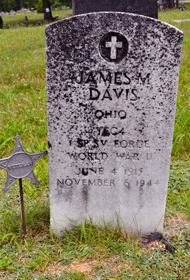
(Editor’s note: With special thanks to Denver Conley and Lynda Beacon.)
Not very many feet from Ohio Highway 138, just inside the grounds of the venerable Hillsboro Cemetery, stands a modest gravestone for one Sgt. James M. Davis.
Sgt. Davis was born June 4, 1915. He was killed in action in France on Nov. 6, 1944 toward the end of World War II.
He was a member of the esteemed First Special Service Force, as indicated on the grave marker.
The First Special Service Force (FSSF) was officially activated on July 20, 1942 under the command of Lt. Colonel Robert T. Frederick. The First Special Service Force was disbanded on Dec. 5, 1944, just weeks after Sgt. Davis’ death. Sgt. Davis was one of the last foremen to be killed in action.
The FSSF was a joint World War II United States-Canadian commando unit trained at Fort William Henry Harrison near Helena, Montana.
Many of today’s U.S. military Special Forces units trace their heritage to the FSSF.
They were nicknamed The Black Devils by the Germans and, later, The Devil’s Brigade. In fact, a movie by the latter name was made in 1968 and starred William Holden and Cliff Robertson, with Notre Dame’s 1956 Heisman Trophy winner and former NFL player Paul Hornung as “the lumberjack.”
Wikipedia reports (http://en.wikipedia.org/wiki/Devil%27s_Brigade) “Force members received rigorous and intensive training in stealth tactics, hand-to-hand combat, the use of explosives for demolition, parachuting, amphibious warfare, rock-climbing, mountain warfare, and as ski troops. From the outset, the 1st Special Service Force was armed with a variety of non-standard or limited-issue weapons, such as the M1941 Johnson machine gun
and the V-42 combat knife.”
There were approximately 1,800 soldiers trained as First Special Service Force members.
Serving with Hillsboro’s Sgt. James Davis was Carl William Beacon. He was known as C.W. or “Tiny,” and he was one of the Canadian members of the First Special Service Force, 1st Company, 1st Regiment.
Thanks to information provided by Highland County veteran Denver Conley, I was able to speak with Mr. Beacon’s daughter-in-law, Lynda Beacon, of Connecticut this week. Mrs. Beacon is researching the First Special Service Force and was interested in Sgt. Davis, who was one of several Ohio volunteers.
“The First Special Service Force members were rough-and-tough volunteers, many of them outdoorsmen,” Mrs. Beacon said. “The unit had in its ranks lumberjacks, miners, hunters, farmers and ranchers. They wanted the outdoorsmen, the men from the country.
“The unit James Davis was part of, the First Special Service Force, was recently was awarded the Congressional Gold Medal in 2013,” Mrs. Beacon said, “though the actual presentation has yet to take place.”
In July of last year, www.usmilitariaforum.com posted a story by Mitch Potter, the Toronto Star’s Washington Bureau Chief about Congress’ decision to award the Congressional Gold Medal.
“Canadian Ambassador Gary Doer hailed the news in Washington after both houses of Congress – in a rare show of bipartisanship – found two-thirds majorities required to grant the medal.
“‘We are grateful that the U.S. Congress has recognized the brave accomplishments of the First Special Service Force in World War II,” Doer said.
“‘The Devil’s Brigade were the first of their kind, and the legacy of bilateral defense cooperation that they inspired continues between our two countries to this day.’
“The joint Canada-U.S. Devil’s Brigade, a top-secret World War II unit that became the template for modern day special forces, began training in 1942 at Fort Harrison in Helena, Mont., specializing in high alpine combat, covert amphibious landings, parachuting and other non-conventional tactics."
The unit never failed a mission, suffering 2,314 casualties – 134 percent of its original combat strength of 1,800 volunteers – as it took on the liberation of Rome and other key raids against the German First Panzer Paratroop Division.
Mrs. Beacon estimates that perhaps as many as 200 members of the elite force may still be living.
“They have reunions each year, alternating between Canada and the U.S.,” Mrs. Beacon said. “But since not all Forcemen are able to attend, family members participate and carry on their memory and legacy.”
Old newspaper articles stated Sgt. Davis, the son of Mr. and Mrs. Henry Davis of Hillsboro and later of Otway in Scioto County, was inducted into military service from Highland County in May 1943 and James Davis’ World War II enlistment record confirms he enlisted in Cincinnati on May 8, 1943.
“The articles also mention he received his basic training at Camp Wheeler, Ga., and he was shipped to North Africa in late 1943,” she said.
She also referenced a helpful book written by Lieutenant Colonel Robert D. Burhans and published in 1947, “The First Special Service Force: A War History of The North Americans 1942-1944.”
During the war the 1,800-man (2,400, including officers and replacement troops) unit accounted for approximately 12,000 German casualties, captured more than 7,000 prisoners, and sustained an attrition rate of over 600 percent.
According to newspaper accounts, Sgt. Davis saw action in North Africa, the battles of Monte Cassino, Salerno and Anzio in Italy, and in France, where he was killed. (He was also wounded at Anzio Beachhead in May 1944, and was awarded the Purple Heart, according to the reports.
Sgt. James M. Davis was survived by his wife, Ruby; a daughter, Patricia Ann Davis of Catherine Street in Hillsboro; two sisters, Gladys Groves of Otway and Lillian Garman of Peebles; and a brother, Delbert Davis of Cincinnati.
If anyone has additional information on Sgt. Davis, please email me at roryeryan@gmail.
Rory Ryan is publisher and owner of The Highland County Press.
[[In-content Ad]]