


Paint Valley ADAMH reps share update; commissioners hold bid opening, hire new land bank coordinator
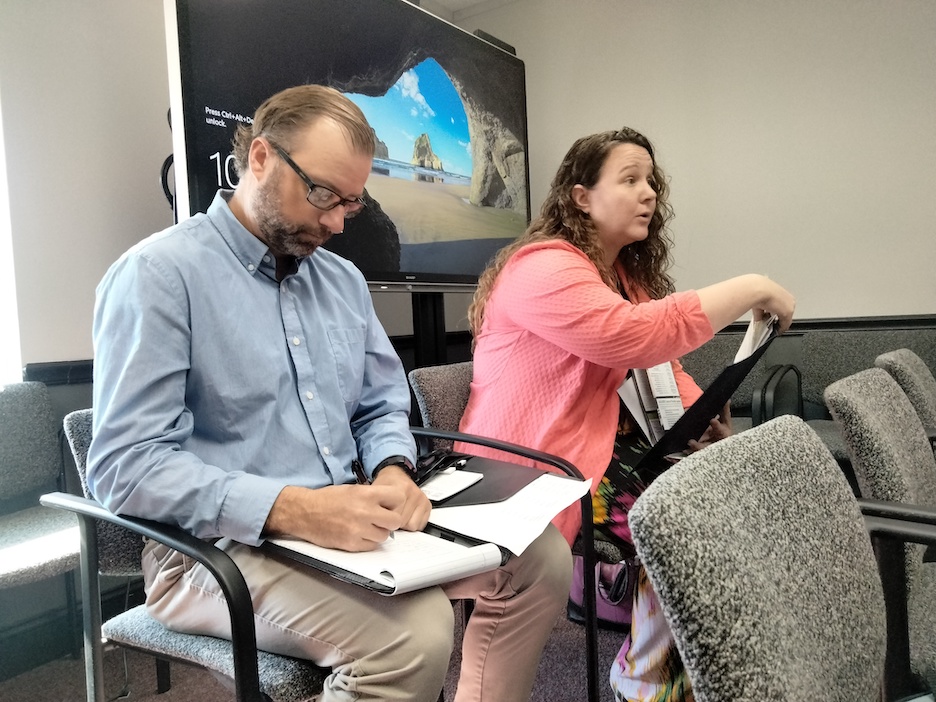
Paint Valley ADAMH Board executive director Melanie Swisher, right, addresses commissioners. Also pictured is associate director Kelly Dennis. (HCP Photos/Caitlin Forsha)
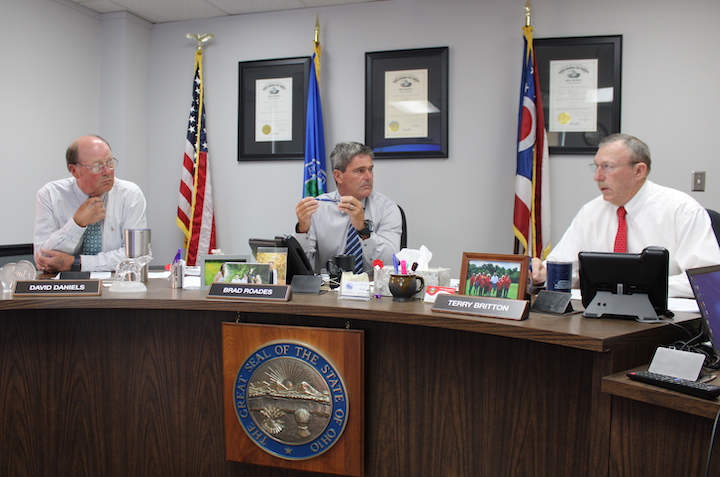
Paint Valley Alcohol Drug Abuse and Mental Health (ADAMH) representatives met with Highland County commissioners Terry Britton, David Daniels and Brad Roades for a brief introduction and update during the Wednesday, July 12 commission meeting.
As previously reported, former Paint Valley ADAMH Board executive director Penny Dehner retired in April after 18 years with the organization, including serving as director since 2017. She was succeeded by Melanie Swisher, who was formerly the associate director.
Swisher attended Wednesday’s commissioners meeting, accompanied by her replacement as associate director, Kelly Dennis, as well as Adam Dyer, the PVADAMH chief financial officer.
According to the organization, “The mission of The Paint Valley ADAMH Board is to enhance the behavioral healthcare system for its communities, ensuring individuals and families have access to person centered, evidence-based treatment and support. The Paint Valley ADAMH Board is a political subdivision of state government created in 1967 by the Ohio legislature to ensure the availability of community-based addiction and mental health services for the residents of Fayette, Highland, Pickaway, Pike and Ross counties.”
Swisher distributed handouts and gave some updates on the organization’s activities, including an update on their crisis system assessment.
Last August, Dehner shared results of the ADAMH’s needs assessment and recommendations report with commissioners and explained that the assessment led to the recommendation to “build a 23-hour observation unit to provide walk-in crisis support,” possibly in Ross County, and a “crisis stabilization unit to offer a less restrictive treatment option for those “in an acute behavioral health crisis,” possibly in Pickaway County. The assessment also outlined a need for “mobile crisis teams to provide coverage over the entire five-county area.” The teams would include master’s-level clinicians and peer support specialists with 24/7 community response.
According to a handout from Swisher, “The target population for the 23-hour observation unit and crisis stabilization unit are adults experiencing a behavioral health crisis from both the five-county PVADAMH region and surrounding counties who regularly access the emergency rooms in our region for behavioral health needs. The target population for the mobile health crisis teams are are both youth and adults who live in Fayette, Highland, Pickaway, Pike and Ross counties.”
Commissioners indicated their support for the project last year.
“I want to thank you because you signed a resolution to support our crisis planning,” Swisher told commissioners Wednesday. “We submitted a proposal to the state for some capital funding. We requested almost $8 million dollars to help build the brick and mortar part of that. We had all the commissioners’ support, we had sheriffs’ support, hospitals in our area. Even the state acknowledges that there’s a high need for that.”
According to the information provided by Swisher, PVADAMH is seeking $7,962,700.89 in funding. Their first priority goal is to have the “fully operational eight-chair 23-hour crisis observation unit and a fully operational eight-bed crisis stabilization unit,” with the second goal to have “mobile crisis teams deployed across the five-county area.” They are hoping to have both goals implemented by July 1, 2024.
“The other thing that we did is we put out an RFP [request for proposals] for the providers for these services, because we really just want to make sure that we have the absolute best provider,” Swisher said. “We have three applicants that we're digging through, seeing who we think will be the best, and trying to figure out how we're going to afford it.”
Also included in the packet from Swisher was Highland County’s profile from the Ohio Department of Mental Health and Addiction Services, which included statistics for the county and state with a side-by-side comparison.
The adult suicide death rate (17.3 per 100,000) in Highland County is higher than the state average (15.1 per 100,000), as pointed out by Swisher.
“Honestly, four out of five of our counties are higher than the state average in adult suicide deaths, and Highland is one of those,” Swisher said. “I appreciate all your support for the Highland County Suicide Prevention Coalition. They’re working hard to address that.”
The coalition, which meets monthly, has sponsored several QPR (Question, Persuade, Refer) trainings in partnership with ADAMH. Similar to CPR training, QPR involves “three steps anyone can learn to help prevent suicide,” according to the coalition.
“It’s a two-hour training that helps people identify signs and symptoms and then know what to do if they see it,” Swisher said. “A lot of times people won't seek help, but you know, if their friend or family member can see it, and then try to get them to get help, that helps.”
Swisher added that suicide deaths in men are higher than in women so it is important to “break down that stigma that men would seek help.”
Another community outreach service provided by the Highland County Suicide Prevention Coalition is the “Harvesting Healthy Minds” event during the Highland County Fair, which is a mental wellness discussion targeted at farmers.
“It's amazing,” Swisher said. “They're getting state attention. The Ohio State Fair wants them to come and do that there because they're doing such a good job.”
[Editor’s note: If you are feeling suicidal, talk to someone. The National Suicide Prevention Lifeline is a hotline for individuals in crisis or for those looking to help someone else. Call or text 988. The Lifeline is available for everyone and is free and confidential.]
Daniels asked Swisher if any other statistics in the county report “stand out to you.”
“The overdose rate, as well, is higher than the state average,” Swisher said. “Meth use is higher in a lot of our counties than the state average. You'll notice that's there, too.”
Locally, Highland County is above the state average in unintentional drug overdose deaths, with a rate of 38 per 100,000 compared to the state average of 35.4 per 100,000, and in methamphetamine use in the past year at 1.24 percent, compared to .67 percent statewide.
“Unfortunately, that reflects in our Children Services,” Britton said, referring to the number of children in the county’s care. “When you have those kind of numbers, it all trickles down.”
Highland County also ranks worse than the state average in tobacco product use in the past month (32.44 percent); cigarette use in the past month (25.61 percent); perceptions of great risk from smoking one or more packs of cigarettes per day (62.67 percent); and pain reliever use disorder in the past year (1.05 percent).
Areas that are listed as “needing attention” due to being within a range of one standard deviation of the state indicators are heroin use in the past year (.37 percent), pain reliever misuse in the past year (3.59 percent), perceptions of great risk from having five or more drinks of an alcoholic beverage once or twice a week (40.61 percent), illicit drug use disorder in the past year (2.97 percent), serious mental illness in the past year (6.38 percent) and receiving mental health services in the past year (19.07 percent).
However, Highland County is below the state average in a number of areas, including major depressive episodes; illicit drug use in the past month; marijuana use in the past year and month; perceptions of great risk from smoking marijuana or using cocaine once a month; first use of marijuana; cocaine, heroin, alcohol and binge alcohol use in the past year; perceptions of great risk from trying heroin once or twice; alcohol use disorder and substance use disorder in the past year; needing but not receiving treatment at a specialty facility for illicit drug use, alcohol use and/or substance use in the past year; and any mental illness, or serious thoughts of suicide, in the past year.
“There’s a lot that's better than the state average,” Swisher said.
Swisher also highlighted PVADAMH’s 2022 annual report, which included mentioning the Mental Health Community Champion Awards for Nathan Brown and Tara Campbell at the fourth annual Recovery Celebration in September 2022 for their suicide prevention efforts and a $500 scholarship for Whiteoak Junior High School student Carianna Dorsett, who won the county’s Write In Red essay contest in October of last year.
The Paint Valley ADAMH board also received a three-year Culture of Quality (COQ) certification since their last update to commissioners, according to Swisher.
“We're not required to get that, but we always require our providers to be certified in what they do, so we feel like we should be certified, too,” Swisher said. “We just had our last Culture of Quality review, and we had zero findings. We're working really hard to be the best that we can be.”
Looking ahead to later this year, Swisher invited commissioners to attend the fifth annual Recovery Celebration, set for Sept. 14 at Bell Manor in Chillicothe.
“We do this once a year just to celebrate recovery and really our providers,” Swisher said. “It gives them a chance to just take a breather.”
Nominations are being accepted until Aug. 11 for the awards presented at the celebration, including Mental Health Advocate of the Year, Substance Use Disorder Advocate of the Year, Prevention Advocate of the Year, Peer Recovery Supporter Advocate of the Year, Crisis Intervention Team Advocate of the Year and Community Champion Advocate of the Year.
“I know that you know people in Highland County that are doing good work,” Swisher said. “If you know anybody like that, and you want to recommend them or nominate them, we would love that.”
Dyer and Dennis also addressed commissioners, with Dyer thanking them for their “continued support.
“Everything you do to help us, we really do appreciate that,” Dyer said. “[In 2021] we passed the levy in all five counties that we represent, and at the county level, that starts with you guys.”
Dennis said he was looking forward to getting better acquainted with Highland County as he settles into his new role.
“My previous experience was in public health with local health departments, so I just haven't done a whole lot of work in Highland,” he said. “I’ll be making my way this over this way, once a week or once a month for coalition meetings and different types of meetings, so I'll be getting involved in some capacity on the side of our service area.”
Commissioners thanked all three representatives for the update.
“We appreciate you coming and thanks for the introductions,” Britton said. “If there's anything we can do to help you guys, I think we’re all in.”
• • •
In other discussion:
• At 9:30 a.m., commissioners held a bid opening for the proposed new county records storage building, receiving three multimillion-dollar bids.
Three bids were submitted through BidExpress, including: Alpha Construction Inc., $2,797,000; Miles-McClellan Construction, $3,350,000; and Elford Inc., $3,799,000.
The scope of the work includes “all necessary labor, materials, tools, machinery, warranties and all other items required to construct a new masonry two-floor 13,020 square foot building,” the bid description says.
Plans for the project have been ongoing for over a year, as commissioners voted in May 2022 to enter a contract with McCarty Associates, LLC for engineering and architecture design services for the building. The commission also passed a resolution in May 2022 to purchase a 0.236 acre lot on Beech Street in Hillsboro for construction of the property, which will be used to alleviate some of the storage issues seen in all county buildings.
During Wednesday’s meeting, McCarty Associates LLC architect Doug Karnes said that he thought the project estimate was $2.8 million.
Before the bid opening, Karnes said that cost estimates they have received from contractors recently are something they “can’t understand,” as they are so high.
“We’ve seen the same thing,” Britton said.
Karnes attributed the rising costs to “fewer and fewer” subcontractors available to work on projects and a smaller workforce in general, with some laborers opting to work in warehouses or other fields instead.
“There’s all kinds of factors,” Karnes said.
On June 28, commissioners opened and rejected bids for a proposed new Ohio State University Extension office building, as they came in above project estimates. The architect for that project said he had heard of issues with “construction material and labor” due to construction of the Honda/LG battery plant in Fayette County, which is reportedly going to be over two million square feet in size.
Karnes agreed Wednesday, adding that construction of the Intel manufacturing plant in Columbus is also “taking a lot of people.”
“Between those two projects, it’s probably 40 percent of the construction,” Karnes said. “It’s great, and it’s good news, but it does drain everything else.”
Karnes said he would review the bids and issue a recommendation in time for commissioners to award the project, if they so choose, at their July 19 meeting.
• At the recommendation of Human Resources director Amy Bradley, commissioners voted 3-0 to approve the hiring of two new employees, including the next land bank director.
The commission authorized the hiring of Jason Johansen as the Highland County Land Bank coordinator, effective July 17, while Clarabelle Lovensheimer was approved as a new kennel attendant, effective July 24.
It was announced in May that former Highland County Land Bank Coordinator Mackenzie Edison resigned, after serving in that role for one year. The Highland County Land Reutilization Corporation, or land bank, board has not had a public meeting since April as they are in the middle of this transition period.
“Thank you very much for all the work you've done on that,” Britton told Bradley on the hiring process.
• Britton reminded the community that they will host a special meeting Monday, July 17 at 10 a.m. for a bid opening for the proposed new OSU Extension building and for budget discussions.
• Following a public viewing Wednesday afternoon, commissioners resumed their open session and voted 3-0 to vacate three alleys in Boston, located west of Beechwood Road and south of U.S. Route 50 in Paint Township.
• Commissioners also held budget meetings with several different departments, including the Probation, Prosecutor/Victim Witness and Clerk of Courts offices, throughout the day Wednesday.
Commissioners made the following approvals, each by a 3-0 vote:
• Commissioners approved the signing of a management’s representation letter regarding compilation engagement performed by Millhuff-Stang, an accounting company used by the county.
“They assist with the compilation of our financial statements annually,” county auditor Alex Butler said. “The management's representation letter is just defining the scope of the work they perform. Myself and one of the commissioners sign off on that.”
• A resolution authorizing an additional appropriation from unappropriated funds in the amount of $2,000 to the 2370 Spay-Neuter fund.
• A request from the Land Bank for a budget modification within the 2505 County Land Bank fund in the amount of $600.
• A resolution in response to commissioners deeming it necessary to establish a new fund for the charitable donation of Donald K. and Myra Pendleton titled “Pendleton-Animal Care.” Also requested is an appropriation line in the Pendleton-Animal Care fund in the amount of $5,000.