


World War II veteran Charles Dawson reflects on 1941-45 military service
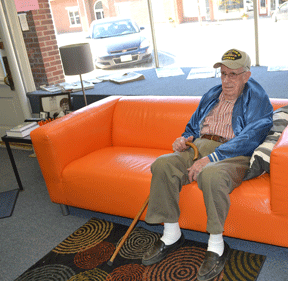
As communities across the country plan to commemorate Veterans Day 2015 on Nov. 11, one Highland County veteran remembers his service in a war that ended 70 years ago this summer.
World War II veteran Charles Dawson, 97, grew up in Berrysville, then moved to Sinking Spring, where he was living when he joined the U.S. Army. He served in the Army from March 1941-September 1945.
Dawson joined the military at age 22 and took basic training at Camp Wallace in Texas. From there, he and his comrades went to Fort Benning, Ga.; Camp Gordon (now Fort Gordon) in Augusta, Ga.; Fort Dix in New Jersey; Camp Johnson in Carrabelle, Fla., and finally to Camp Shanks, N.Y. “That’s where we loaded on the ship to go overseas,” Dawson said. “We landed in Liverpool, England and went down the southwest of England to a little place called Seton on the Channel.”
On June 6, 1944 – better known as D-Day – Dawson and his comrades landed on Utah Beach at Normandy 30 minutes after the first troops landed, Dawson said.
Dawson said they were under fire when they landed on the beach, “but not as bad as what it had been.”
“There was a big concrete sea wall along that beach,” Dawson said. “In a lot of places, there was enough sand washed up against it that a person could get over it, but there wasn’t any way to get the vehicles in.”
The soldiers had to get their vehicles through, so they backed away from the sea wall and used a tank to bulldoze a path through it. From Normandy, Dawson traveled to the port city of Cherbourg, France, then to Paris.
“When we left Paris, we went into Belgium, and took over the territory where the Battle of the Bulge turned out to be later,” Dawson said.
After the Battle of the Bulge began, Dawson’s battalion moved into Luxembourg and Belgium, then to Germany.
“We headed on into Germany, across the Rhine, and went to several different places there,” Dawson said. “They stopped us at Augsburg, Germany, and then the Russians took Berlin.”
Dawson said that he encountered several close calls while overseas. While fighting in Normandy, Dawson said that German fighter planes “came down so low you could see the pilot’s face in them.”
“They were trying to get away from our artillery guns, but they were flying that low,” Dawson said.
Dawson, who was working as a motor mechanic, said that he was working on a Jeep when he tried to walk back and found “five little roads that came together.
“I started on one of the little roads, and I thought I was on the right one,” Dawson said. “I got down there a little ways, and there was a glider there that landed across the road. I couldn’t go any further, so I turned around and went back and got straightened out and on the right road then.
“The next day, we found out the Germans were right on past that glider a little ways. I could have run right into them.”
Dawson also survived many bombing attacks from planes, which he said caused the ground to shake violently.
“If you stood on a board, and someone hit that board with a sledgehammer, that’s the way the ground felt under your feet,” Dawson said. “We were in a foxhole one night and a bomb dropped probably about halfway up the block from us. That really shook the ground up.”
Several of Dawson’s friends were injured or killed as well.
“I had one friend who carried a radio on his back, and he had the radio blown off his back in artillery,” Dawson said. “It didn’t hurt him, but he was in the hospital two or three months and came back to the outfit again.”
Dawson said that friend lived to be about 97 years old.
Another of Dawson’s friends was injured in an accident after having a vivid dream. “I had a buddy that was there one night laying out in a field asleep,” Dawson said. “He said he was dreaming there was a German right there standing over him, so he got ahold of his rifle and shot himself right in the foot.”
At one point, Dawson said a soldier got lost in hedgerows and was shot by a Chinese soldier who mistook him for a German soldier.
“He shot him right through the chest,” Dawson said. “It didn’t kill him or anything, but it was a couple months before he came back to the outfit.”
Dawson also laughed while remembering stories of some of the strange events that he witnessed.
One such story involved a man from Dayton, who Dawson said “couldn’t stand for his hands to be dirty” when they first arrived in France and found an old French farmhouse to take a sponge bath and shave.
“About that time, a German plane came over, and there was a ditch down there with weeds grown up,” Dawson said. “He dove right into that ditch, and there were nettle weeds everywhere.”
Dawson also told a story of a night that he and an Italian soldier were in a foxhole in France together where “the mosquitos were so bad we could hardly stand it.”
“There were no mosquito nets or anything,” Dawson said. “He said, ‘if you can stand the smoke, I’ll get rid of the mosquitoes.’ The Italian boy took a black cigar that was really strong and lit one of those up. The mosquitos didn’t stay around long.”
Dawson said that another unique experience was meeting General Theodore Roosevelt, Jr. – the oldest son of President Theodore and Edith Roosevelt – during the war.
“I met him one time and talked to him,” Dawson said. “On D-Day, I was getting off the beach and ran into him. He was running up there and didn’t even have a gun.”
[[In-content Ad]]
Dawson said that he met many kindhearted people in Europe who did their best to keep the soldiers comfortable.
“In Paris, we went in the next morning after Germans moved in that night, and there were people out in the streets to meet us,” Dawson said. “There was such a crowd there, you could hardly drive through town. They were all throwing flowers.”
They spent that night in a park in Paris, Dawson said, where civilians came out “looking around, because everything was all new to them.” He befriended one such civilian, a young French woman who spoke English well.
“There were a couple other guys standing there, and one had a civilian radio he’d gotten a hold of,” Dawson said. “It quit working, and he started messing with it. I heard someone behind me say, ‘You need some help with that?’ I looked around behind me and there was a nice-looking young woman, probably 20 or 21 years old. She could speak good English, so I got acquainted with her, and we wrote back and forth.
“The French people were all real friendly, and a lot of the German civilians were too.”
A German family allowed Dawson and his comrades to stay inside their house for a couple of days.
“There was a big garage there, and we were going to sleep in there,” Dawson said. “The old man at the house came out there. I couldn’t speak any German, but two or three of the boys could, so they talked to him and he said ‘No, we don’t want you staying out there in that old garage, you can come in and stay in the house.’
“They were as friendly as they could be. He said that every German wasn’t in favor of the war, just Hitler and his higher-ups kept it going.”
He also stayed in a house with a family in Luxembourg one Christmas, where he and the other men camped out in a large room in the house. Dawson said it was “a good place to get out of the weather,” as he said snowfall ranged from 18 to 30 inches in Luxembourg that winter.
“They weren’t supposed to have radios, but the old man there at the house had one he kept hid or something,” Dawson said. “Whenever they’d start a broadcast in English, he’d come get us to go listen to it.”
As the winters were bitterly cold, Dawson said they learned to keep warm by sleeping in large foxholes left behind by German soldiers. Six or seven soldiers could fit in each foxhole, Dawson said, on beds of sleeping bags and pine tree branches. A doctor who got lost one evening spent one night with them, afraid he would not be able to find the hospital he was assigned to in the dark.
“He was talking with us that night and said, ‘If any of you boys live to be 50 years old, you’ll have arthritis so bad you won’t walk,’” Dawson said. “Well, I’m just about twice that old, and I don’t walk that good anymore, but I still go.”
When the war ended, Dawson said that he was ending a 30-day leave in Ohio and had boarded a bus in Cincinnati to travel to Camp Atterbury, Ind.
“Just before we got to camp, we were stopped in traffic, and someone pulled up alongside the bus and went to hollering,” Dawson said. “The bus driver rolled his window down, and they told us the war was over in Japan.”
Dawson said that they were taken from Indiana to North Carolina, where they spent another six weeks before being discharged.
Upon his return from the war, Dawson worked at General Motors for 36 years in Dayton, doing assembly work for 20 years and working in quality control for 16 years, while living in Xenia with his wife. The Dawsons later moved to Seaman to be closer to his wife’s family, then moved to Hillsboro. Upon his retirement, Dawson restored antique furniture and learned to cane chairs, working for several years for Hop in the Woods in Peebles.
Dawson said that he had many other stories from his years in the Army, but most of them were ones he would prefer not to repeat. He and some of his fellow veterans reunited several years ago, where Dawson said one veteran told many stories about things he’d seen in the war.
“After he left, one of the other guys said he didn’t see half what he said he did,” Dawson said. “He said the ones who say they saw the most saw the least, and the ones who told the least saw the most.”