


The Visiting Bears of Summer, Part III
By Jim Carnes
Wildlife Officer
Ohio Department of Natural Resources
By now, most of Ohio and the eastern part of the country have been blanketed by snow from the winter storm that was named Jonas. It is not surprising that Old Man Winter was a bit delayed for this arrival unlike in the fall of 2014 and 2015. We Ohioans know all too well though how weather can change at the drop of the hat.
January signals the closure of many of the state’s hunting seasons. With this slow down and closure from the fall’s demands and complaints, I am able to direct my thoughts to other periodic job duties, such as journaling.
This article will bring final closure to a three-part series that was printed earlier in the fall named, “The Visiting Bears of Summer.”
In a way, I am glad this last journal was delayed in writing as you will find out why later on in its final content.
Previously, we were in the southeastern part of Ohio. Wildlife Programs Manager Suzie Prange commented that there was a location that was suspicioned to have a breeding population of bears. At that point and time, nothing had been confirmed, though.
It was during this time frame of investigation for the articles that I made some phone calls across the Ohio River with the West Virginia and Kentucky Wildlife departments.
Jeff McCrady has been managing West Virginia’s natural resources for close to 35 years. He is the District Wildlife Biologist in District 6 that includes many of the Ohio River counties on the West Virginia’s side. Wayne, Lucas, Mason are just a few of interest.
[[In-content Ad]]
“It is believed that all of West Virginia’s Ohio River counties have breeding populations of bears,” he noted, “even though the harvest numbers for those counties are lower than in other counties deeper in the state.”
Wildlife officials are encouraged and optimistic in this lower bear population river corridor that populations will continue to grow. Not only from local breeding populations, but those bears that are traveling from the mountain region located in the southeastern part of the state. It has been documented many times of bears swimming across from West Virginia to enter onto the banks of Ohio counties such as Meigs, Lawrence, and others that sit on this watershed.
Moving south down the Ohio River, we enter onto the foothills of Kentucky’s border.
Stephen Dobey is the black bear coordinator for the state’s Fish and Wildlife Department. It is estimated that there are upwards to 700 bears living within the bluegrass state. Most of those bears are located in the southeastern and south central portions. But as Kentucky’s bear population continues to grow, they have moved into the river areas of Lewis, Greenup, and Mason counties. All three, are a stone’s throw from the Ohio River counties of Scioto, Adams, and Brown counties.
“Most of our breeding populations are going to be in that southeastern part of the state which border Tennessee and West Virginia,” Stephen said. “We have radio collared a lot of bears in that portion of the state and indications are that is where that slower growing female population of bears are at. Males, however, move and roam throughout even into Western Kentucky and come across the river into Ohio.’
In the summer of 2014, one such Kentucky bear made his voyage into the Cincinnati area of Ohio making his appearance well known while being covered on both TV and radio news programs. Weeks later, it appeared he went back home swimming across the river to parts unknown.
With all this bear research and information from Ohio’s neighboring states of Pennsylvania, West Virginia, and Kentucky, pieces of the bear puzzle are starting to come together creating a picture of the future for Ohio’s bears.
All three have resident populations adjacent to Ohio. Wildlife officials have confirmed in two of those states, Pennsylvania and West Virginia, about having breeding populations adjacent to Ohio. Kentucky, confirming there are now young males just across the river line as well, but falling short of confirming a breeding population.
“At this point and time, we don’t believe there are breeding populations of bears in those Kentucky River counties, but that will change as the population continues to grow and expand”, Steve said. “Those young male bears that are there have only recently showed up in the last few years so the population density is not as high as elsewhere in the state.”
During the summer of 2015, it is believed there were three different young male bears roaming around in Highland, Adams, and Brown counties. This confirmation was made through witness sightings, pictures confirming the sighting, and the body size and hair pattern markings upon the bears themselves.
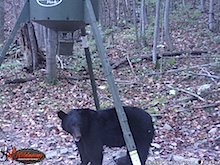
It appeared that all three eventually moved eastward, but one continued making his presence known to local sportsmen who had trail cameras set up over a deer feeder even toward the end of October.
The submitted photograph is from those sportsmen who were excited and protective about the bear as well as local wildlife officials. That location, well, was close by to most readers of these journals, but will be kept a guarded secret.
As the fall of 2015 continued its passage, other puzzle pieces of Ohio’s bears continued to fall into place. Remember our introducing comments with Suzie Prange?
“There is one spot, one location.” Well, during the early weeks of November when most wildlife officials are busy and pre-occupied with the ongoing archery deer season, a small band of dedicated wildlife management personnel were settling in behind the scenes of the fall season, for one thing, “history.”
The culvert trap was loaded and secured. The bolts and switches double checked for the doorway to close and lock behind. Driving the large trailer containing the culvert trap I’m sure tipped off local residents that something was amiss.
The truck and trailer eventually arrived at the property of a supportive landowner for the mission. Setting the mechanism on the trap door, all one could do was to wait. Finally, on Nov 14, 2015 in Vinton County, the dreams of a few were realized when the culvert trap indicated the catch.
An Ohio black bear was in the culvert. Safe and sound, the male was testy and concerned as wildlife technicians approached the area. All who were there soaked in the moment, pausing in the realization of what had been accomplished.
Under the guidance from Al Lecount, a retired Arizona Game and Fish biologist, the bear was lightly sedated and a radio telemetry collar was placed around the 3-year-old male black bear. Because of the bear’s size, estimated to be 250-300 pounds, it is believed he is a local male that has been making his presence known for some time.
And if he is staying around in the hillsides of southeastern Ohio, there is suspected that there is a female somewhere as well. But, for right now we know this: There is a radio collared male black bear giving wildlife biologists a never before seen look into Ohio bear biology and tracking. The radio collar will give two signals a day for up to five years.
Last contact indicated the male bear was somewhere in an old growth clear cut, presumed to be in his hibernation sleep. And how fitting it is, winter is now upon us in Ohio and the snow and ice has layered together a blanket of cold. But in a few more months, when the spring temperatures continue to rise and the redbuds and dogwoods pop in bloom, a new chapter will begin in the continuing stories and sightings from “The Visiting Bears of Summer.”