


'Upgrading your tool belt' key to success discussed at 'Ag Is Everyone's Business'
Embracing changes in agriculture and utilizing a variety of unique “tools” to increase productivity were the topics of the annual “Agriculture Is Everyone’s Business” event sponsored by the Highland County Chamber of Commerce, held Friday, Jan. 22 at the Southern State Community College Patriot Center.
Local farmers, political leaders, business owners, students and other members of the community heard from several speakers with experience in the agriculture industry after enjoying a breakfast provided by Ponderosa.
After viewing the Dodge Ram trucks commercial featuring Paul Harvey’s reading of “God Made A Farmer,” Southern State Community College president Dr. Kevin Boys echoed the words in Harvey’s moving speech.
“I am so glad that God made a farmer,” Boys said.
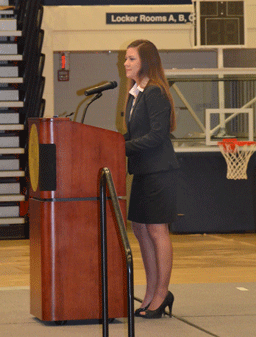
The invocation was led by Mark Armstrong of Crop Production Services. Hillsboro High School senior and 2015 Highland County Fair Queen Emily Burwinkel, who represented the Ohio 4-H Teen Advisory Council, led the crowd in the Pledge of Allegiance.
Highland County Chamber chair-elect Amy Hamilton of First State Bank thanked all of the event’s sponsors, including Southern State Community College, Bane-Welker Equipment, BioGene Seeds, Buckeye Country, Channel Seeds/Ethan Howard Ag, Carraher Ag, Crop Production Services, Ervin Hill Inc./Mark Edenfield Fuel/Holtfield LLC, Farm Credit Mid-America, First State Bank, Five Points Implement, Hamilton Insurance/Grange Insurance, Lerch’s Barnlot LTD, Merchants National Bank, NCB, Ohio Asphaltic Limestone Corp., Peoples Bank, Rick Williams Auction Company, South Central Power, Southern Hills Community Bank, Tom Pitzer Trucking, Trupointe, Western & Southern Life and Zimmerman Bros.
Hamilton also thanked many other individuals and businesses for their work on the event, including John and Andrea Holt of Ponderosa Steakhouse and their staff; Highland County FFA chapters and the Southern State Community College agriculture students and their advisers; Highland District Hospital; Hillsboro Kroger; Christy Larrick of The Linen Closet and W&W Dry Cleaners; and the Highland County Farm Bureau and Highland Soil and Water Conservation District.
Hamilton also thanked donors of three pedal tractors to be auctioned off: Bane-Welker Equipment, Five Points Implement and Steve and Sue Thompson of Thompson Funeral Homes, Preferred Midwest Title and Davis Law Office; Shawn Conlon, for making a video for the event; and Dr. Kevin Boys, Dr. Nicole Roades and the Southern State Community College staff for their work on the event.
“It is because of your generosity that this event is possible,” Hamilton said.
Later in the event, Rick Williams also thanked Jim Gorman of the Southwestern Ohio Farm Toy Collectors Club and his assistant, Don Kelly, who provided the display of farm toys in the Patriot Center lobby.
Highland County Chamber of Commerce president Melissa Elmore highlighted the importance of family as farmers face many challenges throughout the seasons.
“Throughout their day, a farmer wears many hats,” Chamber president Melissa Elmore said. “Mechanic, meteorologist, scientist, machine operator, financial planner, agronomist, computer operator, animal caretaker – and these hats come on and off with ease because a farmer’s job is never easy. Many long days, and even longer nights, make up a farmer’s year, and it always seems like we’re trying to stay one step ahead of Mother Nature.
“Centered around all of that is the family. The family unit is what holds the agricultural community together. None of us are getting any younger, and many of us are counting on a younger family member to take over our family farm.”
Elmore thanked the many families and farmers in the audience for their work and for making time to attend the event.
“The families in this room today are responsible for feeding families across the nation,” Elmore said. “This is not a simple task. It requires many hours of dedication, work and hard labor. Thank you for taking time out of your busy schedules to be with us today.”
Elmore also recognized one such family, Nick and Jessica Dailey of Dailey Farms in Sardinia. The Daileys were recently honored by the Ohio Farm Bureau Federation as the winners of the 2015 Outstanding Young Farmers Award.
“The contest is designed to help young farmers strengthen their business skills, develop marketing opportunities and receive recognition for their accomplishments,” Elmore said. “Contestants are judged on the growth of their farm business and involvement in the Farm Bureau and their community. Nick and Jessica farm over 1,800 acres of grain crops in Adams, Brown, Clermont and Highland counties. They also own a small trucking company and have three daughters.
“We are so proud to have Nick and Jessica with us today and most of all for all their accomplishments.”
Sarah Everhart, 19, of Bainbridge, who recently completed her tenure as the 2015 Ohio State Fair Queen, was the first guest speaker. The Ohio State University sophomore said that she traveled over 12,000 miles last year, attending 71 county fairs and spending 12 days at the Ohio State Fair, meeting “the world’s most incredible people.”
One lesson Everhart said she learned in the past year was that agriculture is not “just about food.”
“The fact that you all have a responsibility to feed our world isn’t the most important thing about the industry,” Everhart said. “It doesn’t mean that I don’t have an undying gratitude for the work that you do to provide for our nation, but what sets this industry apart from all the rest are the people in it.
“The passion and pride that you all have for your work is contagious. The commitment that you have for your community is compelling, and your investment into future generations is undeniable – so much so that people like me, the younger generation, are seeking jobs and careers in your field as well.”
Everhart said that she has received positive comments from many people who learn of her “goals to achieve a job in the agribusiness world” and share an appreciation for the “special” people who work as farmers.
“I could not agree more,” Everhart said. “I am wholeheartedly convinced that the agriculture community isn’t unique because of the basic needs that you provide us, but simply because of the characters you are and the roles you play in our community.”
Ohio Department of Agriculture Director David Daniels spoke about advances in agriculture, as he said he has been looking through archives in his office.
“Science and technology has taken us leaps and bounds from where we were,” Daniels said. “If we expect to feed 9 billion people by 2050, we’re going to have to embrace all these new technologies every day as we keep continuing to find better ways for agriculture to grow and survive.”
In addition to showing images of antique machinery, Daniels discussed the effect of railroads and canals to Ohio’s agriculture.
“Canals and barges seem like an archaic, old-fashioned way of moving our products across the United States,” Daniels said. “Barge transportation has and will continue to be a big part of how we get our products out. About one-third of all our exports out of the United States to markets originate on the Ohio, Missisippi and Illinois waterways. Last year, about 35,000 tons of Ohio corn, soybeans and wheat moved down the Ohio River to those markets.”
Daniels also spoke about the effect of electricity in rural areas, which began its implementation 80 years ago with President Franklin Roosevelt’s Rural Electrification Act.
“Think of all the things we can do today that we couldn’t do in 1935,” Daniels said. “A lot of people still remember when the lights came on here in Ohio.
“The year I was born, three percent of Ohio’s farms still did not have electricity on them. Look at what it’s allowed us to do – dry grain, refrigeration for dairy. All those things help us to be more productive.”
Daniels said that livestock genetics has also improved dramatically.
“We’ve been disease-free in this state since 1978,” Daniels said. “We’re watching avian influenza very closely.”
Even the Ohio Department of Agriculture itself has improved, according to Daniels.
“Our department has some of the best labs in the United States,”Daniels said. “As we look forward to our future operations, there’ve been a lot of changes in our department that we’re very proud of.”
Daniels said that “agriculture really is everyone’s business,” as the event’s name states.
“It’s our number-one industry,” he said. “It provides $105 billion of economic activity in the state and provides one out of every seven jobs. We’ve made tremendous advancements in the last several hundred years in agriculture, and in my lifetime, the advancements have been tremendous. Just stop and think about what we’re going to see in the rest of your lifetimes and the technologies that are going to change.”
Finally, Daniels encouraged the audience to educate the community about agriculture.
[[In-content Ad]]
“Our biggest challenge as we go forward is to make sure that the consumers we work for every day understand what we do,” Daniels said. “The only way that’s going to happen is by us continuing to have opportunities just like this where farmers, community members and consumers get together and let them know that we’re out there very day working very hard to make sure there’s clothing on their back, wood for their houses and food for the table.
“I can’t tell you how much I appreciate the opportunity to be here. It starts with you. Tell your story every time you get out. We try to do the same thing each and every day.”
The event’s keynote speaker was John Phipps, a humor and commentary writer from Farm Journal and Top Producer magazines and a former host and current correspondent on “U.S. Farm Report.”
Phipps, who in addition to running his family farm, has a degree in chemical engineering, geared his keynote address toward five tools in agriculture he encouraged the audience to utilize.
“I’m an engineer, and our chief goal is not to figure out what’s right or wrong,” Phipps said. “Our goal is to figure out how to make it better.
“When I look at 2016, it dawns on me we’re going to need some new tools.”
The first “tool” Phipps suggested are “logic jigs” to “help our brains out.”
“For those of you who weld or woodwork, a jig is a device you set up so when you finally do make the weld or cut or something like that, it’s one right,” Phipps said. “You spend more time getting the jig set up than you do actually doing the woodworking or welding.”
Phipps said that what some people call getting into “ruts” – sticking to a routine of either eating or wearing the same things – isn’t boring, but practical.
“Are their decisions on your operation or in your life that really, really don’t matter a whole heck of a lot?” Phipps asked. “Then for Pete’s sakes, learn to love the rut. It’s not a rut so much as a groove.”
Another part of that advice was to “identify conflicts of interest.”
“Suppose the answer to nutrient management, to keeping nitrogen and phosphate out of the water, is to grow, say, a third less corn,” Phipps said. “A lot of you are saying, ‘This is a really bad idea.’ That’s because your brain is in a conflict of interest.
“You need to identify and respect when you are in a conflict of interest and outsource that decision to somebody who doesn’t have that conflict of interest and respect what they’re telling you.”
Phipps recommended “decision widgets,” which included his slogan “WWMGLMD – what would most guys like me do?”
“You need to do this for yourself,” Phipps said. “This is called surrogacy – where you watch the actions of another and then judge for yourself. It’s an incredibly power tool to help you predict your own behavior, because of all the things we predict, that’s the one we’re worst at.”
Phipps also advised the audience to stop balancing too many projects.
“We continually go back to the idea ‘if I’m doing more, I am more,’” Phipps said. “The happiest, most content, most capable, most profitable people that I know are people who’ve decided ‘I’m going to do one, two or three things really well.’”
Phipps said to take advantage of “seven-minute windows when we’re out in the field” or other breaks to allow your brain time to “freewheel.”
“You have slack built in,” Phipps said. “Without freewheeling time – time when your brain has nothing on its agenda – you will not be able to innovate.”
Phipps’ second “tool” involves history, including lessons learned in the “severe downturn” in agriculture suffered in the 1980s.
“Safety nets really do save,” Phipps said. “The safety net that saved us in the ’80s were the friends and the relationships that we had. There is something restorative, reassuring and confidence-building when you sit down with your peers, someone you genuinely admire and trust and like and care for, and they’re sitting there telling you the same worries and concerns and hopes you have. It tells you ‘well, I’m not crazy.’ Either we’re all crazy, we’re all wimps or we’re all hopeless, but that’s probably not the case.
“That’s one of the reasons I love to be at events like this. The most important thing that happens here today is not my speech … it’s what happens at your table. You can rebuild part of your safety net to carry you through 2016 and beyond and make a new friend two counties away.”
Phipps also advised people to seek and embrace opportunities.
“The decisions you make coming up from 2016 to the next four or five years, I would guess – if it echoes the ’80s – those are the opportunities that will define your success 10, 15, 20 years from now,” he said. “I’m not saying leap at every harebrained scheme, but for crying out loud, recognize that your brain is not going to see this as a brilliant stroke of genius. It’s going to look like a lot of hard work and a lot of risk.”
The third “tool” shared by Phipps is “understanding media turmoil.”
Phipps spoke from the perspective of someone who works for both television and magazines. With what he calls “cafeteria customers” who all like different media, including printed publications, television, podcasts or radio, the media attracts consumers by sharing information that gets them more viewers – fear.
“We have no idea what our business model is,” Phipps said. “You have a media that is struggling with ‘how do we make money?’ and looking at an atmosphere where our customers and advertisers are trying to figure out ‘how do we make money?’ And what is it we go to? The one thing that people will continually come back and listen to is if you scare the bejeezus out of them.”
The fourth “tool” Phipps discussed was taking advantage of “cheap technology,” particularly smartphones, after his son gave him some advice on using his phone.
“If you are not using scheduling or reminding; if you are not using the calendar; if you are not allowing that phone to compensate for the fact that your brain cells are dying off, even as we sit here; the problem is not just that you’re not efficient as you should be, it’s that the rest of the world now has the expectation that you will be using those,” Phipps said. “There is no excuse anymore not to return a call or a text. It’s just rude. There’s no excuse to miss an appointment, to be late for a meeting.
“If you’re not willing to make sure you can accomplish all these things in a timely, efficient matter, there is someone who will. Whether you like smartphones or not, at least try to add your capacity in order to compete.”
Another important reason to utilize technology, Phipps said, is related to Gray’s Corollary, based on Arthur C. Clarke’s Law: “any sufficiently advanced incompetence is indistinguishable from malice.”
“There are no honest mistakes,” Phipps said. “We don’t cut people slack. If your billing is wrong, if your check is for the wrong amount or it’s late, any type of what we used to call ‘honest mistakes’ or overlooking something will be interpreted by a brain that’s swimming in a sea of fear as malice. ‘They’re doing this on purpose, and they’re doing it to hurt me.’
“You need to up your game, because the mistake you make with a vendor or lender or a landlord will immediately be filtered through the sunglasses that say ‘This guy is trying to cheat me or the system.’”
The final tool presented by Phipps was “patience.”
“Some of the problems that we’re worried about may take a decade,” Phipps said.
Phipps encouraged the audience to think “in terms of generations.”
Phipps told the audience that “upgrading your tool belt is never a bad idea.”
“These are tools that don’t cost much, that don’t take a whole heck of a lot of effort,” Phipps said. “They take a change in attitude. It inspires confidence. Having the correct tools means it becomes self-fulfilling. As you use more tools, you are capable of adding more tools.
“We are not helpless pawns or hopeless dupes, nor is our future to be found in trying to seek that status. We are the true inheritors of the people who brought this land into production.
“What we have, the tools that we have and the tools we can add, more than equip us for whatever 2016 has to bring. I’ve got good news – we get to get some new tools, and the tools are available.”
Following the keynote address, local auctioneer Rick WiIliams conducted an auction of three pedal tractors, which were purchased by Charlie Stevens of Stevens Hardware, who donated his tractor to the McClain FFA; South Central Power, who donated the tractor to be auctioned off again; Tom Pitzer Trucking; and Nathan Brown.
Highland County Chamber board chair Lynn Stevens of Stevens Hardware provided concluding remarks, thanking all of the sponsors, speakers and audience members.
“After four years of attending this event, you get a really good look at the audience present today,” Stevens said. “It’s encouraging to see old and new faces in the audience.”