


Treatment Court Month recognized by Highland County commissioners
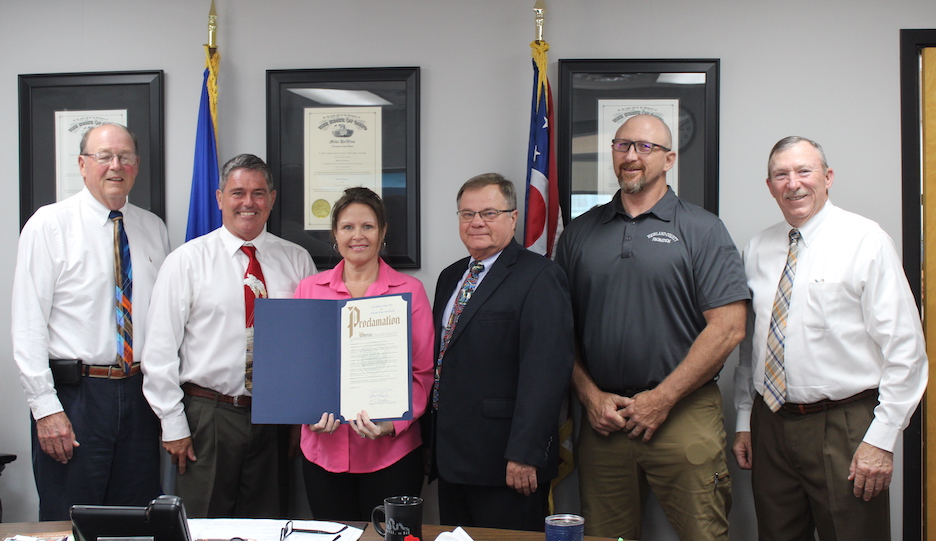
Highland County commissioners proclaimed May as Treatment Court Month May 8. Pictured (l-r) are commissioners David Daniels and Brad Roades; Highland County Probation Director of Programming & Clinical Services and Drug Court Coordinator Tonya Sturgill; Highland County Common Pleas Court Judge Rocky Coss; Highland County Senior Probation Officer Jon Parr; and commissioner Terry Britton. (HCP Photo/Caitlin Forsha)
Celebrating its fifth anniversary this year, the local New Way to Recovery Drug Court was highlighted Wednesday, May 8 as Highland County commissioners David Daniels, Brad Roades and Terry Britton proclaimed May as Treatment Court Month in Highland County.
Accepting the proclamation were Highland County Common Pleas Court Judge Rocky Coss; Highland County Probation Director of Programming & Clinical Services and Drug Court Coordinator Tonya Sturgill; and Highland County Senior Probation Officer Jon Parr.
As previously reported, according to Judge Coss, “the mission of the drug court docket is to enhance public safety by preventing recidivism; assisting participants in taking responsibility for their behavioral health issues by turning them from a path of self-destruction to a path of recovery; creating a continuum of approved treatment and rehabilitation services through community programs that meet the needs of participants; and using evidence-based practices in intervention and treatment of substance abuse and other co-occurring mental disorders or medical issues that offenders may have.”
The first drug court session in Highland County was held in August 2019, and the program includes four phases that take a minimum of 18 months to complete. Five graduation ceremonies have been held, with 40 individuals completing the program to date.
“We’ve had 94 admissions, 40 graduates, 22 terminations,” Coss told commissioners. “We currently have 30 active, and I have two that are absconders. We're running about between 70-75-percent compliance over that period of time, which is significantly better than just regular community control.”
Along with being required to participate for at least 18 months, those admitted to the drug court also must be sober for 12 months to graduate, according to Coss.
“Participants are randomly drug tested frequently with those in the first and second phases being tested at least 2-4 times per week,” Coss wrote earlier this year in the court’s 2023 report. “Participants are assigned a window of time in which they are required to call in daily including weekends to learn whether they are to be tested that day. If they are selected for a random test, they have a limited window of time to report to be tested.
“They also participate in intensive outpatient treatment and receive other programing and rehabilitative services through the probation department and other drug court treatment team member agencies.
“The Court continues to utilize local outpatient substance abuse treatment providers and inpatient programs, including the Lynn Goff House for women in Greenfield and the Massie House for men in Jackson Township. Out-of-county providers utilized include the STAR community-based corrections facility in Franklin Furnace and residential treatment facilities in Pike, Ross, Scioto and Adams counties.
“To date, most of the drug court participants have begun in residential treatment and are then placed in transitional housing and reentry programs. The drug court advisory committee and treatment team continue to work with local groups to develop additional sober living houses in Highland County for participants as they complete residential treatment and return to the community to continue their rehabilitation.”
In addition to the local numbers shared by Coss, the proclamation read by Daniels included national statistics courtesy of All Rise (allrise.org). According to All Rise, there are over 4,000 treatment courts nationally, which “annually refer more than 150,000 people to lifesaving treatment and recovery support services” and “save an average of $6,000 for every individual they serve.
“Treatment courts are the most successful intervention in our nation’s history for leading people with substance use and mental health disorders out of the justice system and into lives of recovery, stability and health,” the proclamation says.
Coss added that such specialized dockets are “a really important part of the administration of courts’ criminal cases in the 21st century.
“There are other types of courts that are also functioning, like veterans courts, mental health courts and human trafficking victim courts in other areas,” Coss said. “We’re part of a trend that I think is going to continue to expand in the future as we in the justice system, I think, become better educated and more collaborative with the people that provide services in terms of helping these individuals.”
Coss told commissioners that they are “proud” of the program’s success thus far.
“Tonya and Jon and the treatment team do a great job, and we appreciate support from everybody in the community,” he said. “We appreciate the support from commissioners.”
For more on the national Treatment Court Month observance, go to: https://allrise.org/national-treatment-court-month/.
Publisher's note: A free press is critical to having well-informed voters and citizens. While some news organizations opt for paid websites or costly paywalls, The Highland County Press has maintained a free newspaper and website for the last 25 years for our community. If you would like to contribute to this service, it would be greatly appreciated. Donations may be made to: The Highland County Press, P.O. Box 849, Hillsboro, Ohio 45133. Please include "for website" on the memo line.