


SSCC students measure electron mass with new apparatus
Lead Summary
By
-
SSCC students measure electron mass with new apparatus
How heavy is an electron? Students in Dr. Russell W. Kincaid’s physics courses at Southern State Community College can now answer that question with authority by using the department’s newly acquired Electron Mass Apparatus.
“Everything we do when working with electron mass is based on past experiments,” said Kincaid. “With the new apparatus, now we can do a reasonable job in replicating those experiments.”
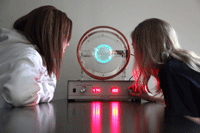
This new device allows students to measure the mass of an electron, a subatomic particle that carries a negative electric charge. The number on the left indicates voltage, while the number on the right measures the current in amps.
“The electron apparatus consists of two copper wire windings which produce a magnetic field, and an electron gun which provides a source of electrons,” Kincaid explained. “When these electrons attempt to move through a magnetic field, they are pushed into a circular orbit. By measuring the diameter of this circular orbit, as well as the electron gun voltage and the current running through the wire windings, students can measure the electron mass experimentally.
“In order to be able to see the electron path of travel, the electrons are produced inside a chamber which contains helium gas. This gas gives off light when helium atoms are struck by electrons, and this is the source of the bluish color in the photographs.”
How heavy is an electron? Students in Dr. Russell W. Kincaid’s physics courses at Southern State Community College can now answer that question with authority by using the department’s newly acquired Electron Mass Apparatus.
“Everything we do when working with electron mass is based on past experiments,” said Kincaid. “With the new apparatus, now we can do a reasonable job in replicating those experiments.”
This new device allows students to measure the mass of an electron, a subatomic particle that carries a negative electric charge. The number on the left indicates voltage, while the number on the right measures the current in amps.
“The electron apparatus consists of two copper wire windings which produce a magnetic field, and an electron gun which provides a source of electrons,” Kincaid explained. “When these electrons attempt to move through a magnetic field, they are pushed into a circular orbit. By measuring the diameter of this circular orbit, as well as the electron gun voltage and the current running through the wire windings, students can measure the electron mass experimentally.
“In order to be able to see the electron path of travel, the electrons are produced inside a chamber which contains helium gas. This gas gives off light when helium atoms are struck by electrons, and this is the source of the bluish color in the photographs.”
[[In-content Ad]]