


SSCC receives positive report from Higher Learning Commission
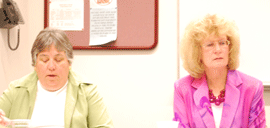
Southern State Community College has received a favorable report from the Ohio Learning Commission regarding assessment and program review monitoring.
The HLC said that, following a monitoring report submitted by the college "demonstrating the full implementation of assessment of student learning and comprehensive program reviews, "no further reports are needed."
SSCC President Dr. Kevin Boys had reported to the college board of trustees during their October meeting that Nicole Roades, Executive Director of Planning, was working on the report. Boys said that the small paragraph indicated the college no longer needed to report on its assessments was actually a huge achievement for SSCC and its staff.
According to the October president's report to the board of trustees submitted by Boys, "Efforts toward building and sustaining a culture of assessment are documented throughout the report and include student learning outcomes and assessment plans for all of Southern State's programs, certificates, and disciplines, as well as core educational areas. Prior to fall 2010, it was estimated that just over 50 percent of these areas had functioning plans which indicated that our monitoring report would likely be rated as insufficient. However, through the hard work, persistence and collaboration of faculty and others, it is likely we will submit a report for 100 percent participation. While substantial work lies ahead in terms of strengthening the plans and implementing them, this shift represents movement toward a culture of assessment and will undoubtedly be recognized by the commission."
The monitoring report was a follow-up from a 2006 site visit and "deficiencies in a 2007 follow-up report. The commission recommended the monitoring report to ensure that the systems for assessment and program review were fully operational. In response to the commissioner's recommendations, a comprehensive program review process was implemented," and included the following: evaluation of program's mission and goals; curriculum evaluation; student enrollment, persistence, achievement and satisfaction; student learning; faculty credentials, teaching effectiveness and professional advancements; resources and services; financial resources.
During the board's November meeting, held last week at the SSCC Wilmington Campus, Boys said he wanted to commend Roades and her staff "for the strong assessment."
Board member Dr. Vicki Wilson said she knew first-hand how much work went into receiving that one sentence from the Higher Learning Commission, and concurred with the congratulations from Boys, saying, "Wonderful job."
In other business, the board heard a report from Janeen Deatley, SSCC financial aid director, regarding the process through which student aid is assessed and the number of dollars disbursed. She explained the difference between direct costs and indirect costs, which are fees owed directly to the college for tuition, lab fees and book charges; and costs incurred through enrollment such as room and board, transportation and miscellaneous expenses, respectively.
Direct yearly costs to SSCC, she said, is $3,633 for tuition and an average of $2,067 for books, for a total of $5,700. Indirect costs are $1,700 for average room and board, $2,100 for average transportation for a total of $3,800. Total average costs for attending SSCC for one year is $9,500.
"Not all colleges can meet the need of a student by 100 percent, but the students who apply early and for all types of financial aid are the most likely to receive a higher percentage of need met," Deatley said. Most students at SSCC receive some form of aid.
Board member Michelle Cimis said that she felt the miscellaneous costs seemed "excessive."
In her presentation to the board, Deatley said, "All the student owes Southern State are the direct costs of tuition, lab fees and books of approximately $5,700. Since (for instance) we gave the student $8,500 in aid to meet the need, and the other $2,800 would go to the student. These funds are to cover the indirect costs of transportation and help with living and miscellaneous expenses. Just because a student receives overage checks, they never receive more money than the cost of attendance which is to cover tuition, books, living expenses and transportation."
SSCC has shown a three-year increase of $3,163,340 in total financial aid disbursements, with $4,462,513 given in fall 2008-09; $6,535,852 given in fall 2009-10; and $7,625,853 given in fall 2010-11.
In other business:
• SSCC Vice President of Business and Finance Jim Buck said that he would be presenting the board with a revised budget during the December meeting. Buck said that earlier this year the state had indicated that due to a lapse in funds they would be receiving $494,000 less than anticipated. A miscalculation in that figure has been corrected, and the college is now going to receive only $340,000 less than anticipated.
Buck said that "if not for the lapse, state funding (to SSCC) would have increased 12.99 percent," due to the college's significant jump in enrollment last year.
• The college has received a favorable audit, according to the board's audit committee, and reports will be available for review prior to the next meeting.
• The fall enrollment report has been completed, according to the president's report, showing a total of 40,536 enrolled credit hours, an increase of 6.26 percent; with a headcount of 3,729 for an increase in enrollment of 10.65 percent, compared to the fall 2009 enrollment report. Boys said that 15.9 percent of enrolled SSCC students are through the Post-Secondary Enrollment Option.
• Jessica Wise, director of the Fayette Campus, has been selected as Interim Dean of Liberal Arts and Core studies, and will be filling the position on a part-time basis until a full-time individual is hired.
• Sid Raisch, who was selected as the Enterprise Facilitator for the Highland County Enterprise Initiative, was introduced to the board, and spoke about the initiative. The HCEI was made possible through a $99,000 grant through the United States Department of Agriculture with the Highland County Chamber of Commerce, with Southern State acting as the facilitator.