


Sen. Brown announces $265,000 White House award to combat opioid abuse
Lead Summary
By
-
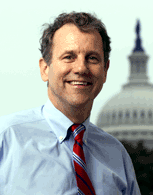
U.S. Sen. Sherrod Brown (D-OH) today announced that the White House’s Office of National Drug Control Policy has awarded grants totaling $265,000 to combat heroin and prescription opioid abuse in Ohio’s High Intensity Drug Trafficking Areas (HIDTA). Counties with HIDTA designations in Ohio include Adams, Cuyahoga, Fairfield, Franklin, Greene, Hamilton, Lucas, Mahoning, Montgomery, Scioto, Stark, Summit, and Warren.
The Ohio HIDTA program will use these federal resources to implement prevention initiatives and improve the daily operations of Ohio HIDTA.
[[In-content Ad]]“Ohio is on the front lines of the opioid epidemic and too many communities have been devastated by drug abuse,” Brown said. “This investment in preventing opioid abuse and addiction will give local, state, and federal law enforcement officers the resources they need to save lives and keep the public safe.”
Ohio HIDTA will receive a $70,000 award for prevention efforts, a $125,000 award to strengthen HIDTA infrastructure and operations, and a $70,000 award for Operation Street Smart. Operation Street Smart is a national program designed to provide current drug prevention education to community groups focused on the health and safety of youth and young adults.
This $70,000 will allow the Franklin County Sherriff’s Office to work with the South Central HIDTA Drug Task Force to link community groups with law enforcement to prevent drug abuse.
HIDTAs reduce drug trafficking and production by facilitating coordinated enforcement and intelligence sharing among federal, state, and local enforcement agencies. In a 2011 letter to National Drug Control Policy Director Gil Kerlikowske, Brown urged him to designate Adams and Scioto Counties as HIDTAs in order to secure additional tools for local law enforcements. Adams and Scioto Counties were the first non-high density urban areas in Ohio to receive HIDTA designation.
Brown continues his fight to help treat and prevent drug abuse. Last week, he called on the U.S. Department of Health and Human Services (HHS) to increase access to medication-assisted therapy (MAT) for patients struggling with opioid addiction. In a letter to HHS Secretary Sylvia Burwell, Brown and 12 of his Senate colleague urged her to raise the cap on the number of patients a physician can treat using MAT each year.
Of the approximately 2.5 million Americans who abused or were dependent on opioids in 2012, fewer than 40 percent received medication-assisted therapy for their condition.
This month, Brown announced the bipartisan the Stopping Medication Abuse and Protecting Seniors Act – legislation to create a patient review and restriction, or “lock-in” program that would limit Medicare beneficiaries with a history of drug abuse to seeing one prescriber and one pharmacy. This drug abuse prevention plan will also encourage insurers, Part D plan sponsors, and health care professionals to assist beneficiaries battling addiction in seeking substance abuse treatment.