


Poll: Voters back marijuana legalization; Strickland leads Portman in Ohio Senate race
Voters in three critical swing states, Florida, Ohio and Pennsylvania, support legalization of medical marijuana by margins of 5-1 or more and also support legalization of recreational marijuana use by smaller margins, according to a Quinnipiac University Swing State Poll released today.
Support for medical marijuana is 84-14 percent in Florida, 84-15 percent in Ohio and 88-10 percent in Pennsylvania, the independent Quinnipiac University Poll finds.
The Swing State Poll focuses on Florida, Ohio and Pennsylvania because since 1960 no candidate has won the presidential race without taking at least two of these three states.
Support for allowing adults "to legally possess small amounts of marijuana for personal use" is 55-42 percent in Florida, 52-44 percent in Ohio and 51-45 percent in Pennsylvania.
But swing state voters say they don't plan to use marijuana themselves:
• 17 percent of Florida voters say they "definitely" or "probably" would use it, while 81 percent say they "probably" or "definitely" would not;
• 14 percent of Ohio voters say they "definitely" or "probably would use it, while 84 percent say "definitely" or "probably" not;
• 15 percent of Pennsylvania voters say they are likely to try, while 83 percent say no.
"Bare majorities in Florida, Ohio and Pennsylvania say they support allowing adults to possess small amounts of marijuana for recreational use, and more than eight in 10 say it should be available for medical uses," said Peter A. Brown, assistant director of the Quinnipiac Poll.
"But it is worth considering the lesson of Florida in 2014, when a referendum on medical marijuana fell short of the 60 percent needed for passage."
* * *
[[In-content Ad]]
Ohio Senate Race
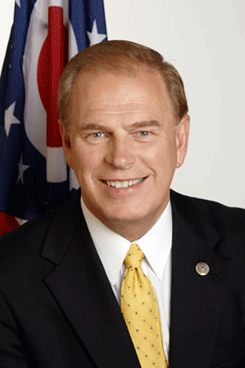
In the 2016 U.S. Senate race in Ohio, former Gov. Ted Strickland, the Democrat, leads Republican incumbent U.S. Sen. Rob Portman 48-39 percent. Independent voters back Strickland, 50-32 percent.
Portman tops another possible Democratic challenger, Cincinnati City Council member P.G. Sittenfeld, 47-24 percent.
Ohio voters approve 49-23 percent of the job Portman is doing and give him a 38-18 percent favorability rating. Strickland has a 49-29 percent favorability rating, while 89 percent of voters haven't heard enough about Sittenfeld to form an opinion of him.
Voters approve 52-27 percent of the job U.S. Sen. Sherrod Brown is doing.
Ohio Gov. John Kasich gets a 61-28 percent job approval rating, continuing his trend as one of the highest-ranked governors in any of the nine states surveyed by Quinnipiac University.
"Gov. John Kasich's strong cache with Ohio voters isn't helping his fellow Republican, U.S. Sen. Rob Portman, who trails former Gov. Ted Strickland in a head-to-head matchup," Brown said.
"One reason may be that Portman, who is now finishing his first term in the U.S. Senate, is not all that well-known to voters. Only slightly more than half of voters say they know enough to have an opinion of him. Strickland, who has been out of office since 2010, is very well-known. Three quarters have an opinion and it is favorable by 20 percentage points."
From March 17-28, Quinnipiac University surveyed 1,077 Ohio voters with a margin of error of +/- 3 percent.
* * *
Florida
Republican State Chief Financial Officer Jeff Atwater is the strongest candidate in an early look at the 2016 U.S. Senate race in Florida, getting 38 percent to 34 percent for U.S. Rep. Patrick Murphy. Atwater leads another possible Democratic candidate, U.S. Rep. Alan Grayson, 42 - 32 percent.
In other possible matchups:
• Murphy gets 35 percent to 31 percent for Republican Lt. Gov. Carlos Lopez-Cantera;
• Lopez-Cantera gets 33 percent to 32 percent for Grayson.
The percentage of voters for each of these candidates who don't know enough to form an opinion of them is 58 percent or higher.
Florida voters disapprove 49-42 percent of the job Gov. Rick Scott is doing, continuing a four-year streak of negative ratings.
Voters approve 54-35 percent of the job U.S. Sen. Marco Rubio is doing and give U.S. Sen. Bill Nelson a 45-30 percent approval rating.
"If U.S. Sen. Marco Rubio runs for president, the fight for his Senate seat will be a test of relatively unknown candidates on both sides of the aisle," Brown said. "Florida's Chief Financial Officer Jeff Atwater has a small edge in exposure to the voters, but we have a long way to go. Whoever wins will be the candidate who does the best job introducing themselves to the voters."
* * *
Pennsylvania
If the 2016 U.S. Senate race in Pennsylvania is a rematch of the 2010 race, Republican incumbent U.S. Sen. Pat Toomey leads Democratic challenger Joe Sestak 48-35 percent.
Toomey gets a 49-24 percent job approval rating and a 44 - 23 percent favorability rating. For Sestak, 61 percent don't know enough about him to form an opinion.
Voters approve 46-26 percent of the job U.S. Sen. Robert Casey Jr. is doing.
Pennsylvania's new governor, Tom Wolf, gets a 44-34 percent approval rating.
"It's an uphill fight for Joe Sestak who has to chip away at U.S. Sen. Pat Toomey's approval numbers while trying to win over Pennsylvanians who just don't know enough about him," said Tim Malloy, assistant director of the Quinnipiac University Poll.
"Gov. Tom Wolf brings good vibes back to the State House after four years of broad discontent with his predecessor, Gov. Tom Corbett."
For more information, visit http://www.quinnipiac.edu/polling.