


Ohio House bill could save billions in medical costs each year
By Jason Hart
National Labor Reporter
Ohio Watchdog
http://watchdog.org/215048/ohio-medical-reform/
With Medicaid spending skyrocketing due to Ohio’s Obamacare expansion, state lawmakers have introduced a bill to curb health-care costs.
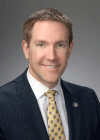
State Rep. Jim Butler, an Oakwood Republican, has drafted House Bill 157 in an ambitious attempt to reform Medicaid and rein in health-care expenses across the board.
“We have consistently poured money into an ever-expanding medical-industrial complex with a woeful return on taxpayer investment,” Butler wrote in a Dayton Daily News op-ed, noting state spending on Medicaid is expected to grow to $7.4 billion in 2017 from $4.7 billion in 2011.
Many Republicans in the Ohio House seem to agree. State Rep. Terry Johnson, a physician from McDermott, is a primary sponsor of HB 157, and the bill has 22 cosponsors.
[[In-content Ad]]
HB 157 cosponsors include Rep. John Becker, Rep. Tom Brinkman, Rep. Ron Hood, Rep. Nino Vitale and Rep. Paul Zeltwanger, the only five House Republicans to vote against a 2016-17 budget funding Republican Gov. John Kasich’s Obamacare Medicaid expansion.
Butler’s plan would not roll back the Obamacare expansion, but it aims to increase transparency and competition in the health-care industry with a focus on Medicaid.
Medicaid Health Savings Accounts and health-care price transparency, two major components of HB 157, were incorporated into the budget the House approved last week. The Ohio Senate is working on its own version of the budget.
To give Medicaid recipients more ownership of their health decisions, Butler’s proposal would divert Medicaid funding into personal Health Savings Accounts and require yearly premiums of $99 for adults, $49 for children and $149 for smokers.
Proposed transparency measures would require hospitals to give patients cost estimates before providing non-emergency care, allow providers to advertise prices and require insurers to disclose out-of-pocket costs for the top 20 percent of covered services.
Butler based the Health Savings Account idea on Indiana’s original Healthy Indiana Plan, which was watered down this year as part of Gov. Mike Pence’s Obamacare Medicaid expansion.
In an email to Ohio Watchdog, Butler said there are “large differences” between his Healthy Ohio Plan and Pence’s revised program, commonly referred to as HIP 2.0.
“One example is that in HIP 2.0, premiums are only required for access to optional services like dental and prescriptions. In HIP 1.0 and HOP, premiums are required for all coverage,” Butler said.
Whatever happens with HB 157, Butler’s top priority “is to make sure the Senate agrees to HOP and transparency staying in the budget.”
If enacted as introduced, HB 157 could save $10 billion per year in Medicaid expenses and private health-care spending, Butler explained in a video published on YouTube last week.
To reduce defensive medicine — needless tests, prescriptions and procedures from doctors afraid of being sued — HB 157 would create a state medical injury compensation system and end lawsuits against care providers.
Butler asserts data from the medical injury compensation system would help hold providers accountable. His bill includes incentives to foster competition among hospitals, independent providers and Medicaid managed care companies, as well.
Many of Butler’s proposals could take effect with support from Kasich and the Ohio Senate, but the HOP program would require U.S. Department of Health and Human Services approval.
HHS and other Medicaid reform opponents have considerable leverage because Kasich expanded Medicaid under Obamacare while accusing critics of wanting to leave the poor “out in the street.”
If Butler’s plan is implemented and proves effective, HB 157 could give lawmakers a way out of an Obamacare expansion, which has cost $3 billion in new federal spending in just 15 months.
For more information, go to: http://watchdog.org/215048/ohio-medical-reform/
Jason Hart is Watchdog.org's Ohio-based National Labor Reporter. Contact him at jhart@watchdog.org and follow him on Twitter @jasonahart.