


Lowell Chaney donates to Historical Society, Highland House Museum
Lead Summary
By
-
Courtesy of John Kellis
HCHS
The Highland County Historical Society (HCHS) exists to archive historical items of note preserving those items for future generations. Most of the items in the Highland House Museum have been donated to the society by families or individuals to share with the public and preserve their stories.
Many people ask if the public would be interested in their heirloom. Still others are fearful or hesitant to give up an item, not knowing what will become of it. You can be assured that the Historical Society is interested in reviewing your item and will take great care with all items accessioned to the Museum collection.
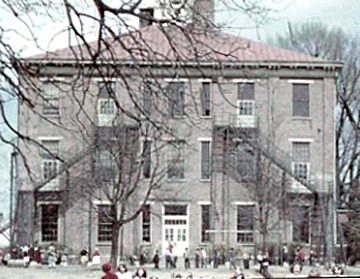
“Lowell Chaney himself is an archive of knowledge of the Hillsboro area as he has probably been through more buildings in Highland County than anyone,” said John Kellis, Society Trustee. His stories about the various Hillsboro and Highland County structures he worked in while performing electrical work can keep one’s interest for hours on end.”
The HCHS Collection Policy consists of three elements: Accessioning an item (accepting it), deaccessioning an item (removing it from the collection), and loaning an item (going in or out of the collection). Anyone considering a donation should contact the Society Director prior to bringing an item to the museum.
The donor should provide details about the item such as 1.) Name of Owner, 2.) Date(s), 3.) Events, and 4.) Historical significance to Highland County. The item should not be a duplicate of an item currently in the Museum.
The Collections Committee will meet to decide whether to accession the item. The decision lies solely with the Committee. Space prohibits the Society from accepting every potential donation. Generally, if an item is not in good enough condition to exhibit, we cannot accept it. It can be very expensive to restore and/or store it in acid-free boxes and frames.
Every item accepted may not necessarily go on permanent display. Some items are rotated in and out of storage for displays. This allows us to vary displays and to develop displays on a particular topic and to give visitors something new to explore.
After the donation is accepted, it is recorded in an accessions book by assigning a number unique to that item. That record will note the donor, name of the item, a brief description, and date. The information is then transferred to a newly-acquired museum software program called Past Perfect.
There a more detailed description and location is documented, including a photo of the item. It is very time consuming to properly document each item into the software, but essential that is done. It has taken almost a year to catalog over 1,600 items in the software and there are over 4,000 items at the museum not including newspapers and photographs.
Many of the older items were not documented and have no or very little provenance. Those items are documented as “Found in Collection.” Photographs are one item that we hope to digitize and save electronically in the near future. That effort will also be very time-consuming, but indeed will be worth the effort. A grant to cover those costs would be our first priority.
One final detail of the Society’s accessions policy is a written agreement developed between the Historical Society and the Donor. That agreement describes the item in detail and states whether the item is a donation (gift) to the society, or if the donor is lending it to the museum (generally 10 years).
The agreement may also state how the donor would like the item treated were the Society to decide to deaccession the item (i.e. return to donor, etc...). While the vast majority of items are given to the Museum, circumstances might make it appropriate for the item to be lent to the Society.
Like Mr. Chaney, many of us have items that might be good additions to the Highland House Museum. Anyone having questions about possibly donating an item or a collection may contact the museum to schedule a time to discuss a potential donation with Director Knauff.
The Society recently renovated the military room at the Highland House. As we discussed the exhibit with a number of veterans and families of veterans, it reinforced what we already knew, that there are a lot of people with items that would be a valuable asset to the Highland House and of great interest to the public.
HCHS
The Highland County Historical Society (HCHS) exists to archive historical items of note preserving those items for future generations. Most of the items in the Highland House Museum have been donated to the society by families or individuals to share with the public and preserve their stories.
Many people ask if the public would be interested in their heirloom. Still others are fearful or hesitant to give up an item, not knowing what will become of it. You can be assured that the Historical Society is interested in reviewing your item and will take great care with all items accessioned to the Museum collection.
“Lowell Chaney himself is an archive of knowledge of the Hillsboro area as he has probably been through more buildings in Highland County than anyone,” said John Kellis, Society Trustee. His stories about the various Hillsboro and Highland County structures he worked in while performing electrical work can keep one’s interest for hours on end.”
The HCHS Collection Policy consists of three elements: Accessioning an item (accepting it), deaccessioning an item (removing it from the collection), and loaning an item (going in or out of the collection). Anyone considering a donation should contact the Society Director prior to bringing an item to the museum.
The donor should provide details about the item such as 1.) Name of Owner, 2.) Date(s), 3.) Events, and 4.) Historical significance to Highland County. The item should not be a duplicate of an item currently in the Museum.
The Collections Committee will meet to decide whether to accession the item. The decision lies solely with the Committee. Space prohibits the Society from accepting every potential donation. Generally, if an item is not in good enough condition to exhibit, we cannot accept it. It can be very expensive to restore and/or store it in acid-free boxes and frames.
Every item accepted may not necessarily go on permanent display. Some items are rotated in and out of storage for displays. This allows us to vary displays and to develop displays on a particular topic and to give visitors something new to explore.
After the donation is accepted, it is recorded in an accessions book by assigning a number unique to that item. That record will note the donor, name of the item, a brief description, and date. The information is then transferred to a newly-acquired museum software program called Past Perfect.
There a more detailed description and location is documented, including a photo of the item. It is very time consuming to properly document each item into the software, but essential that is done. It has taken almost a year to catalog over 1,600 items in the software and there are over 4,000 items at the museum not including newspapers and photographs.
Many of the older items were not documented and have no or very little provenance. Those items are documented as “Found in Collection.” Photographs are one item that we hope to digitize and save electronically in the near future. That effort will also be very time-consuming, but indeed will be worth the effort. A grant to cover those costs would be our first priority.
One final detail of the Society’s accessions policy is a written agreement developed between the Historical Society and the Donor. That agreement describes the item in detail and states whether the item is a donation (gift) to the society, or if the donor is lending it to the museum (generally 10 years).
The agreement may also state how the donor would like the item treated were the Society to decide to deaccession the item (i.e. return to donor, etc...). While the vast majority of items are given to the Museum, circumstances might make it appropriate for the item to be lent to the Society.
Like Mr. Chaney, many of us have items that might be good additions to the Highland House Museum. Anyone having questions about possibly donating an item or a collection may contact the museum to schedule a time to discuss a potential donation with Director Knauff.
The Society recently renovated the military room at the Highland House. As we discussed the exhibit with a number of veterans and families of veterans, it reinforced what we already knew, that there are a lot of people with items that would be a valuable asset to the Highland House and of great interest to the public.