


Local officials tour Ohio lake communities
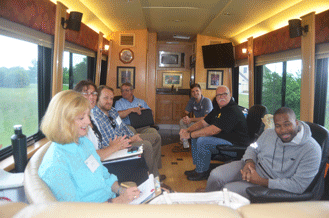
Thirteen local community leaders learned strategies to enhance Rocky Fork Lake Park during a fact-finding trip to comparable lake communities in Ohio.
As members of the Rocky Fork Lake Area Safety and Advancement Plan Project (RFL ASAP), the representatives participated in a bus tour that encompassed three similar lake communities: Buckeye Lake, Grand Lake St. Mary’s/Celina and Indian Lake.
These communities were chosen by the project team for their similarity to Hillsboro and Highland County in demographics and natural features.
“At each stop our group, which included Sheriff Donnie Barrera, Commissioner Jeff Duncan, Health Commissioner Jared Warner and Paint Township Trustee Randy Mustard, was met by local officials from the host community. It was very informative for our group to hear about each lake community’s challenges and successes in the areas of crime, economic development and social services,” said LuAnn Winkle, RFL ASAP Project Manager.
Representatives of the Local Initiatives Support Corporation, a national non-profit which supports comprehensive neighborhood revitalization, and Hunter Wright of Ohio Speaker Cliff Rosenberger’s office assisted the group in its analysis of the communities and the potential to bring good ideas back to the Rocky Fork Lake area.
The purpose of the tour, which was funded by the USDOJ Bureau of Justice Assistance Byrne Criminal Justice Innovation Program planning grant, was to enable members of the RFL ASAP Stakeholder Group to see first-hand how other lake communities have developed and evolved as economic engines.
[[In-content Ad]]
“Rocky Fork Lake is an incredibly valuable natural asset which could be developed responsibly and safely. We have a duty, before any suggestions are brought before the community, to evaluate the impact of those suggestions,” Winkle continued. “Not all development is good development and often the best of intentions can have unintended consequences.”
Unintended consequences at Buckeye Lake include the devastating economic impact of a state-led lowering of lake levels as a safety measure against a weakened four mile long earthen dam on which dozens of houses and cottages have been constructed. Buckeye Lake officials told the group that the local economy has suffered by at least 40 percent this summer due to the loss of boating traffic that patronizes lakeside business such as restaurants, fuel stations, a new winery and rental cottages. An ODNR representative praised the Highland County group for its desire to plan ahead of any potential lake development.
At Grand Lake St. Mary’s, the group learned the value of cooperation and coordination among county, township and city officials.
“In this community, there are no boundaries,” Celina Mayor Jeffrey Hazel told the group. “We share resources and work cooperatively to make our community stronger for our residents.”
Celina officials related their strategy of maintaining a mixed economy that balances manufacturing, agriculture, retail and tourism. This strategy is supported by elected officials, the local Chamber of Commerce, community groups and residents and additionally contributes to the very favorable 2.5-percent unemployment rate in the county.
The stop at Indian Lake provided insight into marketing and branding the lake community to reach potential visitors and patrons of local businesses. The value of a shared message was discussed at length.
The Indian Lake Chamber of Commerce coordinates a cohesive marketing strategy that emphasizes the water quality of Indian Lake, which is among the best in the state. A Water Quality Manager works closely with the community to ensure protection of the natural resource that draws so many to the region.
Each lake community is unique and each has its challenges with issues such as water quality, crime, poverty, uncontrolled development and infrastructure needs. Representatives stressed that proper planning well in advance of any action can help reduce or mitigate difficulties in the future.
Tour participants, including Diane Uhl of the local Board of Realtors, ODNR Parks Officer Cody Cover, consultant Angie Carl, RFL Alliance member Angie Mustard and Solveig Spjeldnes of Ohio University, participated in debrief sessions after each stop to identify what the group perceived as positives and negatives as well as strategies to move forward in the RFL area.
This analysis will be useful in preparing the final planning document and grant application for implementation funding next year.
“The RFL ASAP Project has started the conversation,” Winkle said. “The community has the opportunity to develop a shared vision for the RFL area through community meetings and listening sessions. We encourage you to attend a panel discussion on November 5 at 7 p.m. at the AmVets Post 61 at 11541 North Shore Drive.”