


Local officials react to State of the State
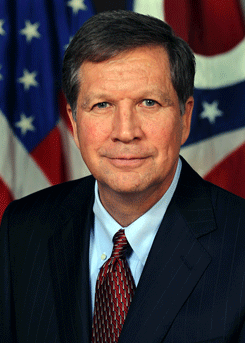
Jobs, budget and how the two will shape the future of Ohio were the main topics Tuesday during Gov. John Kasich's first State of the State address, held on the floor of the Ohio House of Representatives.
The address took place less than a week after the controversial Senate Bill 5, which seeks to reform collective bargaining for state employees, was passed by a slim margin to move on to the House. Kasich supports the Republican-sponsored bill, and there were protests outside the Statehouse Tuesday and some vocal demonstrations from the House floor during the speech.
Local officials were in the gallery during the address, including Highland County Commissioners Shane Wilkin and Tom Horst, both Republicans, and Ohio's 86th District Representative Cliff Rosenberger (R-Clarksville).
Wilkin told the Highland County Press that he was positioned behind the media section on the House floor, which was behind the Democratic section.
"From my vantage point, I think it was pretty well received on some things," Wilkin said. "I won't say on all things. Obviously when he mentioned collective bargaining, there were some shouts and boos and things like that."
"The state of the State and the future of Ohio is in our hands," Kasich said. "And I believe it is up to us as we reach a crossroads to decide if we will have the courage, if we will have the vision, if we will have the determination to make sure that our great state has renewed strength in this 21st Century, renewed strength."
Highland County Democratic Party Chairperson Dinah Phillips told The Highland County Press Tuesday that she thinks SB 5 will not help job creation.
"I think that it will be a job killer, not a job creator," Phillips said. "Gov. Kasich needs to focus on efforts that will create jobs, not efforts like Senate Bill 5 that will create a hardship on the middle class. I also think that this is a divisive issue at a time when Ohio needs to band together."
During the State of the State Tuesday, Kasich said, "The enemy in Ohio right now is joblessness. The enemy in Ohio right now is poverty. And it is up to all of us to work together to defeat that enemy ... We cannot tax our way to prosperity. We're one of the highest-taxed states in America, and we're not competitive. You get these calls from -- from companies saying we're thinking about going, we can't make a profit here, we can't make the numbers work.
"This budget - and you're going to get a look at it next Tuesday. This budget deals with an unprecedented $8 billion hole. People say they did a good job. I come to work, I've got an $8 billion hole. Never happened before in Ohio's history. Well, I tell you what, we've been looking at this for a long time, and we believe in not just cutting a budget - oh, there will be cuts, but that's not the way to get there. We believe in restructuring. Restructuring means providing a better product at a lower cost to the taxpayer. We have to do as much restructuring, and I would invite everyone when you see this budget to think about other things, other innovative solutions that can help us to get our job done by providing a better solution at a lower cost."
Wilkin said that Highland County is prepared to deal with the coming cuts in state funding, but it leaves the county with very little extra dollars.
"It's $8 billion they have to make up, and it has to come from somewhere. Nobody wants it to come from them," Wilkin said. "Nobody wants to take the cut when it comes to budget. I didn't have a single department head come to me and say, 'My budget is way too big, take this much away from me.' No one is going to do that. They are scrapping for whatever they can keep. And I know that local government is going to take some sort of hit. My focus was Highland County and what affects us. There was no hint as to what it was going to be. One thing (Kasich) did say that stuck with me was something like, 'Get on the bus, or the bus is going to run you over.' I thought that was a pretty strong statement."
Wilkin said that overall, his impression of the State of the State was that there are tough times ahead for Ohio, but everyone needed to be working toward a resolution.
"What I took from it is that we have a problem, and it has to be solved. The time for just talking about it has come to an end. Gov. Kasich said we'll do our best to work, and we're going to have disagreements, but let's get something done. I appreciate that. At the local level, we're going to take a hit. I don't have any delusions about that. We are not going to come out of this unscathed, and for the most part, I understand that. We have planned for it."
Wilkin said that Highland County's budget included a "50 percent reduction in local government funding" in preparation for potential cuts.
"About the lowest (cut) I have heard is 20 percent," Wilkin said. "I have heard (state funding for local governments) could completely disappear. Some legislators have said there is no way to do that. I don't know, but the figures I seem to hear more often than not are 40-60 percent. So we planned for a 50-percent cut, right in the middle."
Kasich addressed unfunded mandates in the address, which Wilkin said was something he was glad to hear.
"He made mention of the federal funding mandates to the state, and said that it is just as bad when state mandates go to the count levels, and if they are going to make us do something, they need to either figure out a way to pay for it or to give us some options."
Outside of jobs and the budget, Kasich addressed sentencing reform in the court systems, insurance issues for Ohio's older residents, and "thinking outside the box" on funding for Medicaid.
"Education, K-12 and post-secondary, of course it's critical to our economic future. But I want to tell you, more choice, more accountability, more dollars in the classroom instead of bureaucracy will improve our schools, and we are going to have a significant reform agenda by linking our education system with business opportunities, commercializing more products from our universities, letting our professors' research team own a piece of what they invent. It's going to improve higher education. All of these reforms are going to make us much stronger ... We have not been able to connect both K-12 and the vocational education and the higher education and our technical schools and community colleges and our universities to real stuff."
Kasich was interrupted a few times during the speech when he addressed collective bargaining issues.
Kasich said that growing up in the 1970s, he learned about protests and their power and the passion people have, and he respected those engaging in protests Tuesday.
"But you don't respect us," an unidentified woman in the gallery shouted.
"But they need to also respect those that don't always agree with them, okay?" Kasich said.
"Folks, it's not all easy, though. Because reform and restructuring cannot take us all the way to a balanced budget. It can't. Years of neglect, switching programs into the next fiscal year, smoke and mirrors, refusing to address the basic fundamental structural problems of our budget. That's what it is, a structural imbalance in our budget because we didn't take care of the foundation. See, we can't get all the way with restructuring. But you know what we're trying to do? As I mentioned earlier, we're trying to provide the tools to those affected to help them to absorb the loss of revenue and resources. We're trying to give everybody flexibility from state rules and regulations. Let's have common sense. We need to repeal these unfunded mandates that where we imposed -- you know, we don't like when the federal government comes and shoves things down our throat. We have no right to shove things down local government's throat and tell them that they've got to figure out a way to pay for it ... So we need to work together to repeal these unfunded mandates. We need to employ shared services with everybody ... And, frankly, folks, the provisions of collective bargaining reform are examples of what we wanted to do to allow people to be able to control their costs."
[[In-content Ad]]