


Local 4th grader undergoes ‘groundbreaking’ surgery in Philadelphia
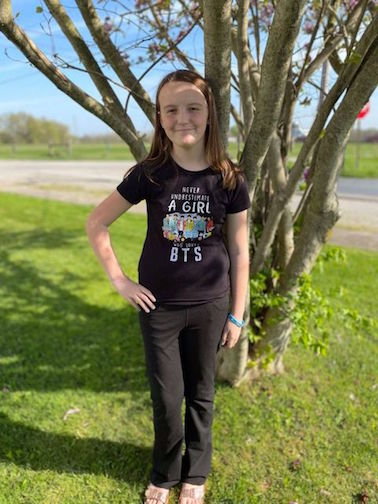
In her 11 years, one young Highland County resident has received 18 diagnoses, seen specialists at three different hospitals and spent a lot of time in relative isolation due to the pandemic. This April, Allyiah Brant traveled to Philadelphia, where she underwent vertebral body tethering surgery, a non-fusion treatment, to correct a rare form of scoliosis.
Allyiah is a fourth-grade student at Bright Elementary. She loves K-pop, especially BTS, and is trying to learn some words in Korean. She also happens to have scoliosis, which was discovered when she was a toddler.
“The craziest part is she looks absolutely normal,” her mom, Linda Klump, said. “She looks like every other kid. This is my goal, to bring awareness to invisible disabilities. What you see may not always be what you get.
“She has all these things going on, but really, that’s not who she is. She’s funny and the sweetest and a great little cuddle buddy. She gives the best hugs. She’s great. I just wouldn’t trade her for anything.”
Klump said Allyiah’s early-onset scoliosis diagnosis was particularly rare, as according to the Children’s Hospital of Philadelphia (https://www.chop.edu/), most children are diagnosed between the ages of 10 and 15. Initially, Klump noticed a lump on Allyiah’s back during a normal activity for a toddler: playing patty cake.
“It was really crazy,” Klump said. “I had her sitting on the kitchen table, and I was sitting on a chair and we were playing patty cake. I would tickle her belly, and she laid her head on my chest. I rubbed her back and felt a lump. I thought, ‘oh my God, she has a tumor.’ I called the pediatrician right away, and I said, ‘there is something wrong with her.’”
Allyiah’s doctor scheduled an amount and ordered X-rays, where they discovered that Allyiah, then 2, had scoliosis.
“We got a referral to Cincinnati Children’s, and it went from there,” Klump said. “Every year, her curves have progressed more and more.”
In an attempt to treat the condition, Allyiah has already had three back braces, and last year, Klump said Allyiah’s orthopedic doctor said that her curves were in the 40-degree range. According to Cincinnati Children’s Hospital (cincinnatichildrens.org), spinal curves measured between 25 and 40 degrees are considered moderate, while anything above 50 degrees is severe.
The next option Allyiah’s doctor suggested was a spinal fusion surgery, which “allows two or more bones in the spine (vertebrae) to grow together (fuse) into one solid bone so the spine cannot bend,” according to Cincinnati Children’s.
“He said she’ll completely stop growing, and her whole spine will be in a cage,” Klump said. Allyiah was only 10 at the time. “I said, I can’t even imagine doing that, with the growing pains she would have because her body wants to grow.”
Instead of the fusion surgery, Klump began researching Vertebral Body Tethering, or VBT, what she called a “groundbreaking surgery” option at Shriners Hospital for Children in Philadelphia, Pa.
“Fusion was the gold standard for many, many years, and it was basically the only treatment option people with scoliosis had,” Klump said. “Shriners stepped up to the plate.
“I think they did the first VBT procedure 15 years ago, but the hardware for it has only been approved by the FDA for the last year and a half. Basically, each one of these VBT surgeries was considered experimental.”
According to shrinershospitalsforchildren.org, “Anterior vertebral body tethering (AVBT) is a minimally invasive procedure, which produces stabilization for the anterior thoracic and lumbar spine and avoids spinal fusion. VBT uses a strong, flexible cord to gently pull on the outside of a scoliosis curve to straighten the spine. A screw is placed in each vertebra of the curve and then attached to the flexible cord with the spine in a straighter position. Scoliosis progression is stopped, the spine is realigned and can continue to grow, and flexibility is maintained.”
“The surgeons have very strict parameters,” Klump said. “As she continues to grow, the tether will straighten her spine. She won’t lose any flexibility. She wouldn’t have even been able to bend over to tie her shoes with the fusion.
“The recovery time is actually less with VBT. Hospital time is also less time than with fusion.”
Klump said she is a member of a support group for families with children with early-onset scoliosis, which is where she learned about the treatment.
“I am in a Facebook parent support group called Scoliosis Tethering (VBT & ASC) Support,” Klump said. “There is a screening process. Members must have scoliosis or have a child with scoliosis and are interested in fusionless treatment.”
She was able to schedule an appointment with Dr. Amer Samdani, chief of surgery at the Philadelphia Shriners, who determined Allyiah was a good candidate for VBT.
Klump said that as of November, Allyiah had a 29-degree curve in the cervical spine in her neck; a 53-degree thoracic curve; and a 58-degree lumbar curve. “That’s been a few months, and her curves have only gotten worse,” she said.
Further complicating matters is that when 2-year-old Allyiah was diagnosed with early-onset scoliosis, it was the seventh of what eventually became 18 diagnoses in her lifetime.
“This hasn’t been a journey, it’s been an odyssey, for sure,” Klump said.
Because of Allyiah’s numerous other diagnoses — including Ehlers Danlos Syndrome, epilepsy, kidney disease and Raynauds Disease — Dr. Samdani wasn’t the only physician involved. Klump said they had to “get clearances from five other specialists” before they received the go-ahead to schedule the VBT surgery.
“She has all these things that could’ve made it impossible for her to have this type of operation,” Klump said. “We’re really lucky got cleared by all the specialists.”
Klump said that Allyiah has a total of 10 specialists at three different hospitals — Cincinnati Children’s, Nationwide Children’s and Shriners.
“It seems like every six months since she was born, they found something else wrong with her,” Klump said. “It was pretty depressing. I thought, please tell me something that’s right.
“No one really needed to tell me what was right with her because although she has all these things, I think she’s perfect.”
And because of having EDS, Klump said Allyiah’s overall recovery from her surgery could take as long as six months.
“With her, because she’s a little more complicated, having a connective tissue disorder, it takes longer to heal,” she said.
Between the preparation for the surgery and all of Allyiah’s other preexisting conditions, Klump said she has “basically kept her in a bubble for the last year,” including doing virtual school and keeping Allyiah out of most public places.
“[The doctors] said if she got COVID was highly unlikely she could have the surgery,” Klump said. “I have been laughed at, made fun of. People have looked down their noses at me because they say oh, it’s just a big joke. She has been in three stores in the last year. She sits in the van while I go to the grocery store.
“She has kidney disease. Kids who get COVID, sometimes they’re getting that inflammatory disease with it. She already has kidney disease. I can’t risk it.”
Although Allyiah obviously has a number of different diagnoses that she and her mother are juggling, Klump said the most important thing right now is getting treatment for her scoliosis, especially since they are under this limited window of opportunity for this surgery.
“Right now, my focus has to be on the scoliosis because that’s what she needs the treatment for,” Klump said. “Most people have this belief that when you have surgery, you’ll be all better. Scoliosis is a lifetime disability. It doesn’t go away with surgery. She’ll still have to go through physical therapy. There is a risk that the tethers can break. She may have to have a revision in a year or two because she still has a lot of growth left.
“It’s just best to focus on what’s causing her the most problems.”
Allyiah’s surgery lasted nine hours, as she also recovered at the hospital for a week, plus had to have two chest tubes put in as doctors deflated both of her lungs..
“They’re basically working on her whole spine,” Klump said. “It’s not like with traditional fusion. With VBT, they go into the side. They put a chest tube in, deflate the lungs and kind of move the lung over to the side to have access to the spine.
“I have seen and researched videos and things showing fusion versus VBT. With [VBT], I think she’ll have two pretty big scars, about six inches.”
Surgeons performed a double tether on Allyiah’s thoracic curve and a double tether on her lumbar curve during the operation.
“Dr. Samdani was very pleased with the results,” Klump said. “However, he explained that there is a risk of over-correction because the success of VBT is based on how much growth she has left. There is also the risk that one or both of the tethers could break. Both of these scenarios will result in a surgical revision.”
Klump said that the surgeon and care manager at Shriners were “amazing,” coaching her through what to expect and helping her with accommodations.
“I would highly recommend Shriners and Dr. Samdani for anyone who has a child with scoliosis,” Klump said. “He was very kind and explained everything to me in advance.”
With Allyiah, it’s obvious that she has been through a lot in 11 years, but that isn’t always apparent to those who meet her or encounter her at school. Klump encouraged people of all ages to keep in mind that “invisible disabilities” exist.
“Invisible disabilities matter,” Klump said. “I am all for awareness of other disabilities, like Down syndrome and cerebral palsy, but those are visible.
“When someone has an invisible disability, the expectations for the child to do the exact same thing that other kids can do is ridiculous. You can’t see what’s wrong with her. You can’t expect her to do everything else everybody else is doing. It’s not because she doesn’t try. She is in pain on a daily basis.”
For example, she said, to look at Allyiah, you may not realize she has so many health problems.
“It’s crazy to think that a kid who looks completely normal has all of these issues going on,” Klump said.
Klump also knows about these “invisible disabilities” from personal experience, as she battled Ehlers Danlos Syndrome — a “connective tissue disorder that affects everything,” she said — without a diagnosis for decades. Allyiah and two of her sisters were all diagnosed with EDS within a span of six months. It wasn’t until after her children received official diagnoses that Klump was confirmed to have the disorder as well.
“She could not have a more dedicated mother,” Klump said. “I can’t imagine doing anything different than what I’ve done. In the face of people making fun of her, telling me I take her to the doctor so much — I’m never giving up on her. I’m never going to give up on making sure she has the best care.
“If I don’t advocate for her, no one will. That’s what I tell families I work with. You are your child’s best advocate. I think that’s the most important role for a parent to be their advocate.”
Because of Allyiah, Klump has worked as the Hopewell Center Region 14 Parent Mentor for nearly six years, where she assists other parents of children with special needs. She encourages parents to “keep pursuing the answers” if they feel something is going on with their child, since that’s how Allyiah received her scoliosis diagnosis.
“That’s our scoliosis story, just a simple game of patty cake,” Klump said. “I feel like parents, if they have a gut feeling that something isn’t quite right, pursue it. Don’t give up. You have to keep pursuing the answers. No one knows their child like their parent.
“If I can help one family with this story, and same with my job, it makes all the difference for one child. I feel like people should know it can happen to anyone.”