


Hillsboro Finance Committee denies hotel developers' request for TIF agreement extension
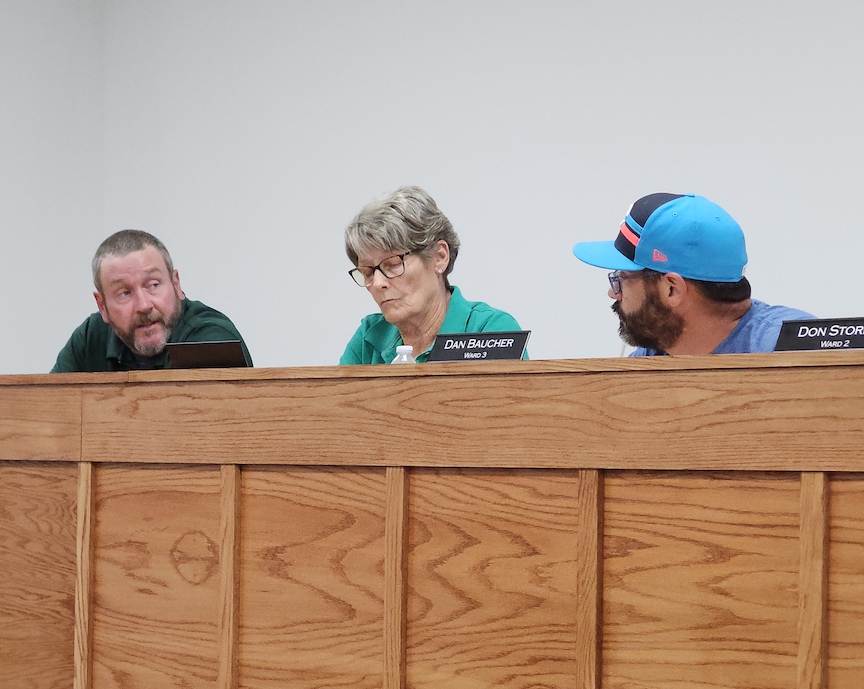
Pictured (l-r) are Hillsboro Finance Committee members Adam Wilkin, Mary Stanforth and Greg Maurer. (HCP Photos/Caitlin Forsha)
In a split decision, members of the Hillsboro Finance Committee voted Monday, July 29 to deny a request from developers of the long-planned Marriott Hotel to extend the length and amount of their tax increment financing (TIF) agreement.
Leo Capital, the developers of the project, had contacted the city in June with the request, as noted at the July 11 city council meeting.
As previously reported, both Hillsboro City Council and Hillsboro City Schools agreed in October 2019 to establish a tax increment financing [TIF] district for the proposed multimillion-dollar hotel project in the city of Hillsboro, near the state Route 73/Harry Sauner Road intersection. At the time of that approval, the city’s bond counsel Richard Spoor said that it would offset the cost of infrastructure, estimated at $3 million.
(Editor’s note: In an article July 13, the author of this article erroneously referred to Spoor as bond counsel for Leo Capital; we regret the error.)
Developers had originally asked for a 30-year TIF, but the resolution agreed upon by both council and school board nearly five years ago was for 25 years, at $3 million in bonds.
According to a copy of a June 26 email from Spoor to Hillsboro safety and service director Brianne Abbott, the hotel developers’ request was to “amend the TIF documents to allow an increase in total bonds from $3,000,000 to $3,250,000 and for the TIF term to be extended from 25 to 30 years.” The reason for the request, Spoor said, was the increase in interest rates as well as rising costs for infrastructure, labor and materials.
Hillsboro City Council president Tom Eichinger placed the matter in the finance committee for further review.
Finance committee chair Mary Stanforth invited Spoor to address the group at their July 29 meeting to share background on the agreement and on the new request.
The ordinance approved by the city in 2019 declared a five-acre tract at 1308 North West Street (state Route 73) “to be exempt from real property taxation” and “requiring annual statutory service payments in lieu of taxes.” The ordinance also creates the TIF fund for “the deposit of the balance of such statutory service payments.”
City council’s vote took place one week after Hillsboro City Schools’ approval of a compensation agreement, when all five school board members voted in favor of a resolution that granted a 100-percent exemption for 25 years for the parcel on state Route 73. The school district is slated to receive $1.5 million from the city of Hillsboro — $60,000 per year — over that span.
“Frankly, the biggest incentive for development like this is TIF in Ohio,” Spoor said. “TIF essentially uses the incremental property taxes produced by the development to provide for public infrastructure improvements that benefit the property. So in effect, the property taxes stay at home and are used to support the public infrastructure for the project.
“Often in these agreements, there are limitations both in compensation and time and amount. A TIF can go for 30 years in Ohio, if you wish. This particular one, the agreement limited it to 25 years. Also, the TIF will normally not have a cap on the amount of financing that can be done. That's usually driven by the dollars of the TIF. In this case, there was a cap put on for the public infrastructure costs, or actually the bond issue amount, of $3 million. Those are the two constraints that were put in the agreements.”
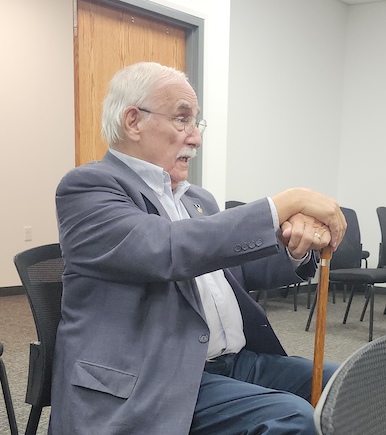
Spoor said that interest rates have “doubled,” and “the costs of labor and materials have gone up exponentially,” since the agreement was put in place, leading to Leo Capital’s request to extend the terms to 30 years and the amount to $3.25 million.
“The longer the term is, you know from just general finance, the lower the payments are,” Spoor said. “Also, with the increased interest rates, that compresses the net amount available for the construction costs because you have to have a debt service reserve fund, which is a function of one year's debt service. The more the debt service, the more the reserve fund has to be and the less net proceeds available.”
Spoor said that if council was on board with the request from Leo Capital, then they would also have to seek approval from the Hillsboro City Schools boards.
“The prime mover, if you will, is the city,” Spoor said. “The school district reacts to your proposal, so it's really up to the city.”
Regardless of the city’s decision, Spoor added that they would need to come back soon for council to vote on an ordinance to finalize the bonds for the project.
“They're ready to go with the bond issue and with their conventional financing,” Spoor said.
Spoor then asked the committee if they had questions for him. All three committee members asked about timelines for the agreement or for the project itself.
Finance committee member Greg Maurer, who was not on council at the time the original deal was made, asked if the past five years counted as “part of the timeline” for the 25-year TIF agreement.
“It doesn't start until the property first hits the tax rolls, so the period of time — whether it's for tax abatement or TIF — the period starts with the first year that it goes on the tax roll,” Spoor said. “So it hasn't started yet.”
Stanforth’s question also dealt with the timeline: “Why is it taking so long to get this project off the ground?
“I guess I have a hard time with this because of the length of time we've been dealing with this project since 2019,” Stanforth said. “We've seen nothing happening. They just keep wanting more money, or they have to go through different steps in that. It seems like this whole process has been extra long compared to other projects that we've had in our city, within the COVID era and everything.”
Spoor agreed that “this one has gone a long period of time,” although he said that he has worked on a project that is still ongoing after over 20 years and has seen projects “go this long” before.
“I think part of it is the size of the project of this nature, hotel and commercial. It's different from, let's say, a factory or for a large shopping center,” Spoor said. “I think it's taken them a good deal of time to get their financing put together.”
Finance committee member Adam Wilkin asked if Spoor had any idea of the “timeline of when they would break ground, whether or not we extend the TIF five more years.”
“They tell me, and I certainly believe them, that their conventional financing is in place, and they can do the bond, which would be yet this year, and they would start,” Spoor said.
As discussed in 2019 by Ankur Patel, one of the developers for the project, the investment is also to include a restaurant and a “retail plaza” along with the Marriott Hotel itself. Stanforth asked if “all of it has to be done at one time” once construction begins.
“I think that's their plan, because I think they figure the hotel is going to drive a lot of those businesses, particularly the restaurant and some of the other businesses,” Spoor said.
Eichinger, who was also present for the committee meeting, asked to speak. He addressed Spoor and said that he is “not really understanding” how the additional five years and $250,000 ”benefits [developers] all that much.
“How do they benefit from a relatively small increment in the bond value, and then again, a relatively small step forward in years compared to the 25 that they’ve already got?” Eichinger asked.
“The way it works is the revenues that pay the debt service on the bond’s principal and interest come from the taxes,” Spoor said. “The incremental taxes on this property are not all that much more than they anticipated back when they first were planning the deal, so the value of the vertical construction — the hotel and the shopping — produces the property taxes. The anticipated values of these properties are not much different now from what they projected when they were doing the original construction, so there's a finite amount of tax revenues that are being produced.
“The projected income has not changed in five years, so adding another five years to the bond issue gives them more revenue to pay the debt service on the bond.”
Spoor added that if the developers were doing “a conventional loan, [Eichinger’s] point would be very well taken,” but in this case the funding is “produced by property taxes” that are basically the same, while the costs and interest rates have increased in the past five years.
“That's why if they extend it out longer, it’s kind of like if you get a longer term home loan, your monthly payments are lower,” Spoor said. “It does help them. It's not a huge amount of money either way.
“I mean, this would be very helpful to them. In my opinion, it’s not going to kill the deal if you don't do it, but it's certainly every bit helps these days.”
Maurer asked if the city needed to make a decision “in haste” on whether or not to proceed. Spoor said it “would probably be best” to make a decision sooner rather than later because they will need to know before the bond is finalized.
“If we do it, you still have to take it to the school district?” Maurer asked.
Spoor confirmed that they would, but “the process is not as long” to make an amendment compared to the initial agreement.
“You could do it in an emergency ordinance, and then at the next school district meeting, they could decide up or down,” he said.
Stanforth also asked what the situation would be if the city and/or school district voted against the proposal.
“Then it’s back to square one,” Spoor said.
In response to a followup question from Maurer, Spoor said that if, for instance, council approved the amendment but the school board did not, the original contract would remain in place.
There was some discussion among council members, city administrators and Spoor regarding whether they thought the school board would sign off on the amendment if it was approved by council. Eichinger and public works superintendent Shawn Adkins raised several questions, including Adkins asking whether the school district could say they “want to back it off or they want more money” if an amendment is presented to them.
“They could say that, and then you’d decide whether you wanted to go through with it,” Spoor said. “They could say ‘yes, we’ll agree to five more years if you give us a million dollars.’ I'm just being facetious, but they’re a legislative body like you are. They could say, ‘well, we'll agree to it, but you have to increase the compensation,’ and then it might not make sense to do it. It could be worse, depending upon their position, but again, we can't tell what they're going to say.”
If that happened and council disagreed with the school district’s proposal, Spoor confirmed again that the “original agreement is ironclad” and it would revert back to that.
Stanforth opened the floor to comments from the committee, including sharing her own thoughts.
“I have a problem with it taking so long,” Stanforth said. “I guess I'm just an impatient person that I wanted to see some development done before this length of time was up.
“My thoughts are the school was very hesitant about going along with this with the current conditions that we have. I don't know that they will be favorable to this, but at the same time, we won’t know unless we agree with it.”
Maurer pointed out that city council approving the amendment “won’t hurt” the existing agreement should the school board reject it.
“I think that if it's something that can spur this project, $250,000 over five years — I don’t see that as being a bad deal,” Maurer said.
Wilkin disagreed, saying that “whether or not we move forward with this, they plan to break ground this year.” Spoor said he “can’t promise” that, but “all indications are that they will.”
“I’m more inclined to lean toward not sending it to the schools and sort of let them be happy with what they’ve got right now,” Wilkin said.
Maurer made a motion to recommend council draft and approve an ordinance for the proposed amendment as an emergency. Wilkin responded, “I vote no on that,” and Maurer said, “I vote yes.”
With Stanforth being the deciding vote, she said she was “hesitant not to” approve the agreement because, as Maurer said, it might “hurry things along, or at least we could see some progress.” After about a 15-second pause, Stanforth voted against the motion.
“I’m sorry, I’m going to have to vote no,” she said. “The motion did not pass, so nothing will be going to council.”
Stanforth thanked Spoor for attending the meeting.
“We will be coming back with the bond ordinance sooner than later, I hope,” Spoor said. “I would say that would be in the next month or two, I'll be back down with that.”
Publisher's note: A free press is critical to having well-informed voters and citizens. While some news organizations opt for paid websites or costly paywalls, The Highland County Press has maintained a free newspaper and website for the last 25 years for our community. If you would like to contribute to this service, it would be greatly appreciated. Donations may be made to: The Highland County Press, P.O. Box 849, Hillsboro, Ohio 45133. Please include "for website" on the memo line.