


Hillsboro City Council OKs property acquisition and transfers, AI policy; considers new pay ordinance
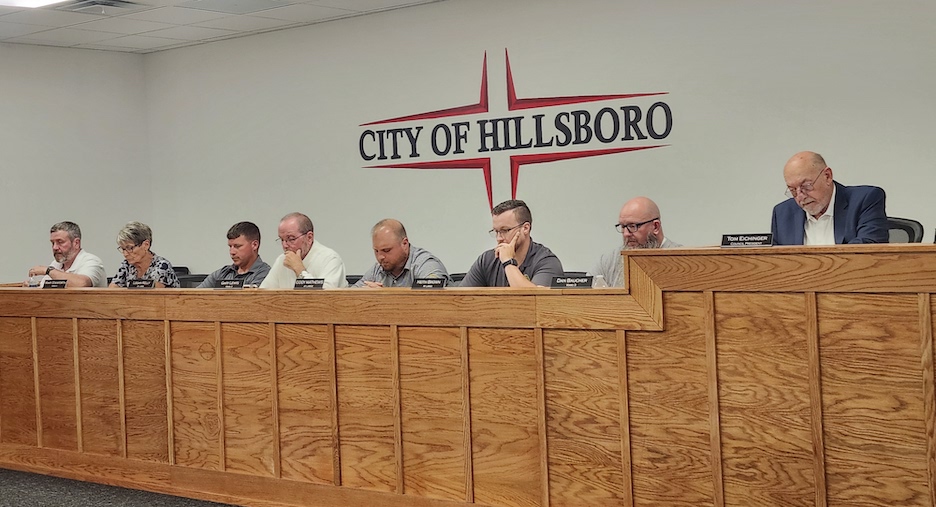
Pictured, from left, are Hillsboro City Council members Adam Wilkin, Mary Stanforth, Logan Kelly, Gary Lewis, Cody Mathews, Heith Brown, Dan Baucher and Tom Eichinger. (HCP Photos/Caitlin Forsha)
Hillsboro City Council members authorized the city’s acquisition or transfer of several different properties through the passage of three ordinances at their Thursday, June 11 meeting.
An ordinance authorizing the mayor to enter into an agreement to purchase real estate located on state Route 138 from the Marvin L. Wilson and Mitzi J. Wilson Living Trust dated March 24, 2008 was approved as an emergency by a 6-1 vote, following a 6-1 suspension of the three-reading rule. Council member Heith Brown voted against both motions.
The ordinance mentions the city’s “need to acquire additional lands that can be dedicated for economic development and public use.” According to the legislation, the land “abuts property owned by the City and currently used for Liberty Park.” It includes part of one parcel and all of three other parcels on state Route 138.
“I'm requesting the city council consider purchase of 200.15 acres adjacent to city-owned property, along with an already established subdivision,” safety and service director Shawn Adkins said. “This property is identified for the future growth within our Imagine Hillsboro comprehensive plan and presents a significant opportunity to advance the community’s long-term goals. The property can help address the city's goal in strengthening housing needs, supporting economic development by attracting new residents and businesses and strengthening the local workforce.
“In addition, acquiring this land will provide an important secondary access point into Liberty Park, improving traffic flow accessibility and public safety.”
The reason for the emergency was due to the offer expiring Monday, according to the safety and service director
“This offer has been made, presented to the City of Hillsboro in a cash-only offer, as only good until Monday, June 15, 2026 at $15,000 an acre,” Adkins said.
Also approved as an emergency was an ordinance authorizing the transfer of property owned by the city to the Hillsboro Community Improvement Corporation.
The legislation involves the transfer of 262 West Walnut Street as well as the parcels on Elm Street comprising the former Gross-Feibel Safe Company property to the CIC. For the West Walnut Street, Adkins said the city has a receivership on the parcel and wants the CIC to “put that one piece of property up for sale, so we don't have to maintain it,” while the city wants the former Gross-Feibel parcels to be used for economic development.
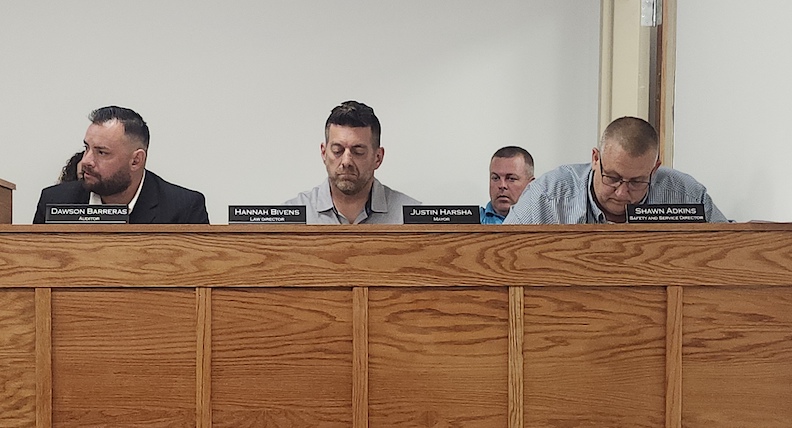
Council member Cody Mathews asked about the city’s plans for the Gross-Feibel property, and Mayor Justin Harsha said that the city’s hope is for a housing development there.
“We did have plans to try to develop some condos down at Crossroads Park, and the more that we've gotten into Crossroads, we've decided that's probably a little bit too much for that property,” Harsha said. “There's a lot of other uses for that little piece of property, so we would like to try to develop some condos down there.
“It's a collaboration of everybody on that [CIC] board to decide what to do, but that's kind of the initial plan, is to maybe develop into some condos down there. It’s right next to a daycare, right next to the [Rails to Trails] walking trail, right next to the football field, so I think it's a really good use of that property.”
Council member Mary Stanforth asked if council would have any further involvement in decision making for the parcels. Harsha said the matter “would not come back to the city” once transferred to the CIC but added that council members were welcome to attend future board meetings.
On its third reading, an ordinance authorizing the mayor to accept the transfer of real property located at 147 West Main Street and 149 West Main Street from the Hillsboro Community Improvement Corporation also passed by a 7-0 vote.
As discussed by Adkins in April, the parcels both “adjoin the Parker House” and are being used to create a new parking lot with up to 54 parking stalls. Council previously approved a partial alley closure for the project.
In unrelated legislation, council heard the first reading of an ordinance amending the compensation for elected officials of the City of Hillsboro, effective with the terms commencing 2028 and 2030.
Finance committee chair Gary Lewis said his committee reviewed the matter and made the recommendation.
“The consideration was the adjusting council compensation, so that in the future, a member would receive a full year of service credit through the Ohio Public Employees Retirement System,” Lewis said. “Currently, members receive $7,600 annually in compensation. However, elected officials must earn at least $9,249.24 annually to qualify for a full year of OPERS service credit.
“It was noted that OPERS has scheduled annual increases to the minimum earnings threshold of approximately 1.5 percent per year through 2029. Therefore, even if council compensation is adjusted to meet the current requirement, it would be out of date by the time it took effect, as the new compensation would not take effect until the next election cycle.”
The legislation also made an adjustment to the mayor’s compensation, which Lewis said “had not been adjusted since the 1990s when Dick Zink was mayor.
“[Hillsboro] mayoral compensation is currently at $25,000 annually,” Lewis said. “Currently, the Greenfield mayor receives $45,000 annually, while Wilmington's mayor receives $80,000-plus annually. That's just a couple comparisons.”
Lewis said the committee decided to adjust the pay rates for the auditor and law director as well as council members and the mayor, as the “base amount would be adjusted annually in accordance with OPERS estimates.” According to the legislation, their salaries “shall be calculated based upon ‘minimum base plus’ basis, which is calculated based upon OPERS annual cost of living estimates.”
“I made a motion to make the following increases to the future executive compensation: for the mayor, the annual base amount times six; for the auditor would be the annual base amount times seven; for the law director, the annual base amount times five; for council, annual base amount times one; and for president of council, annual base amount times two,” Lewis said.
Stanforth asked how the finance committee came up with those amounts.
“We were looking at some of those comparisons, like for instance, like the mayor, we knew what Greenfield pays in compensation as compared to Wilmington,” Lewis said. “If you do that times six, I think that brings that right around the $56,000 mark.
“That would change each year as that is adjusted, you know, so you don't have that possibility of falling backwards any with regard to the compensation.”
In response to a question from Adkins, Lewis also confirmed that this pay ordinance will “eliminate having to come back to change the elected officials’ pay” with additional ordinances. The legislation states that once this salary schedule takes effect, “any prior ordinances or resolutions setting salary for those individuals shall be repealed.”
“You no longer have that issue where the mayoral compensation will be lagging behind 25 years later,” Lewis said. “We're still getting paid the same. It will be adjusted accordingly every year, and that also goes with council members, because I know way back in the day it was adjusted by that dollar amount to give that full [pension service] credit, but then after that happened, it was never changed again, because nobody really bothered to look back and see what that was. This will automatically make those changes. As the cost of living goes up, this would go up as well.”
If approved, the legislation will become “effective in 2028 for the mayor, auditor, law director and those members of council starting new terms in 2028 and effective 2030 for those members of council and council president starting new terms in 2030,” the legislation says.
Another ordinance having its first reading, and ultimately passing as an emergency following suspension of the three-reading rule, was legislation for the use of artificial intelligence tools by the city, including for the auditor’s office.
The ordinance is “establishing an artificial intelligence use policy for the city, prescribing standards for the responsible, ethical and transparent use of artificial intelligence tools by city employees, officials, contractors and volunteers [and] establishing oversight and enforcement mechanisms.”
City auditor Dawson Barreras discussed the legislation, as he asked for it to be passed Thursday for its immediate implementation, after council president Tom Eichinger asked the reason it was presented as an emergency.
“This legislation will allow the city of Hillsboro and its approved employees to implement the use of artificial intelligence for day-to-day tasks,” Barreras said. “Last week, when I was on some continuous education that I have to get 30 hours of a year, there was many presentations of other cities using artificial intelligence for everyday tasks, especially for uses in finance and reconciliation and budgets and reports and things of that nature. To have this as a part of our day-to-day use would be a huge asset to the city and would save a lot of money for taxpayers.”
In response to questions from Brown, Barreras said that using AI for “reconciliation, some budgeting forecasts and reports” would eliminate the need for an additional employee, “which would save us at least $50,000 a year,” while the cost would be “about $1,000 a year.” Along with the auditor’s office, Barreras said the police department also plans to implement AI software for “reporting of cases and many, many other things.”
“What kind of ‘many, many other things?’” Brown asked.
“It can be redaction of public records requests, daily reports,” Barreras said.
According to the legislation, “permitted uses” for AI also include “drafting routing internal communications, memos, meeting agendas and newsletters; summarizing documents, reports or meeting notes; proofreading and formatting assistance; translating documents for public outreach; conducting background research on policy topics; summarizing public legislation, regulations or court decisions; assisting with grant narrative writing; drafting social media posts, press releases and web content; [and] personal skill-building, learning exercises or supervised training simulations.”
In all cases, work that is AI-generated is required to be “reviewed, edited and approved by a qualified city employee,” while said employees are required to “disclose the use of AI … unless otherwise directed by a supervisor” when it is used, the policy says.
Eichinger asked if Barreras could speak about his experience with the software.
“We were having some trouble reconciling the month of April due to our payment processor for our tax department,” Barreras said. “They were kind of taking our daily deposits and separating the deposits out between many, many days, which is almost impossible to find. I put that through the AI software that we purchased, and it found it almost immediately, what the disruptions were, and actually helped us close out the month of April.”
Stanforth also asked who would “oversee” the software, and Barreras said the IT director would be in charge, while the city policy is in line with existing state laws and comparable to other city policies.
In other legislation, council approved several ordinances making supplemental appropriations, each by a 7-0 vote. Those included an ordinance to appropriate an additional an $11,000 to council wages to cover Ohio Public Employees Retirement System (OPERS) contributions associated with council compensation; a $10,000 appropriation for audit fees; and an $18,620.10 transfer to the Pro Services line item for money received from cannabis sales in the city.
In other discussion:
• In lieu of a traditional report, Mayor Harsha used his time to introduce John Barney as the new executive director of Crossroads Park.
“Ever since we've been planning for Crossroads Park, we knew that we would either have to contract out a management service or find somebody that we could contract out here locally that could handle the duties of doing the day-to-day bookings and figure out plans for Crossroads,” Harsha said. “He's local, he has a lot of good ideas, and so early this month we contracted with John Barney to become the executive director of Crossroads Park, so he will be managing the amphitheater moving forward.
“I think he's going to be a great asset to the city, and he's going to do a great job.”
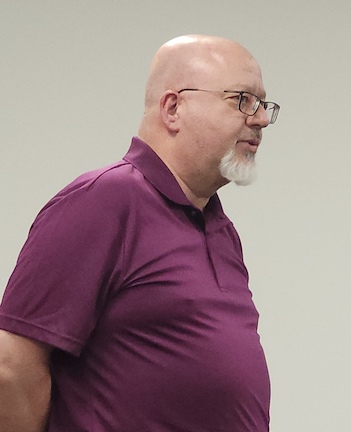
Barney told city council members that although it is still under construction, the park is garnering a lot of interest from prospective entertainers. He said that he and economic development director Lauren Walker have been working with communities, such as Canton, with similar amphitheaters for research.
“This is going to be a beacon for southern Ohio,” Barney said. “We had a nice talk with people in Canton, Ohio, that have a place kind of like what we're going to have, only they're in their third year, so they kind of told us the growing pains that they had.”
Barney added that he is “open for ideas on entertainment and any types of festivals” that can be held at Crossroads Park in the future.
“My guess is our first major entertainment thing will be somewhere in May of next year, though we will have some events probably in March and April,” Barney said.
In his report, Adkins said construction on the project is “moving along a little quicker than it was.”
Also in the safety and service director’s report, Adkins announced that the bonds for the Marriott Hotel project have sold, following council’s vote to extend a promissory note to the end of May.
“We’re waiting on next steps,” he said.
For ongoing city projects, Adkins said crews continue to work on preparations for the Rails to Trails project and a new parking lot on West Main Street, while the Ohio Department of Transportation has wrapped up work on U.S. 62 over Clear Creek Bridge.
Adkins reported that the city issued 13 building permits, including six commercial and seven residential, in May. On a related note, he asked to have council review the building department rates, with Eichinger placing the matter in the street and safety committee.
“Warren County sent us notice they could no longer handle us, so we're working with another building department, and they looked at our rates,” Adkins said. “Our rates have never changed since we started our building department, and we're way low, so we need those looked at.”
• Community enhancement committee chair Mathews discussed a recent meeting to discuss municipal trash collection, with the committee voting against further pursuing the proposal.
During the last city council term, the utilities committee had also looked into citywide trash collection, with council passing legislation to seek bids, but ultimately not contracting with any companies.
“Mr. Adkins discussed potential cost savings to residents and to reduce monthly trash service costs by at least $10 per month to residents,” Mathews said of the committee meeting. “Mr. Adkins also discussed concern with wear and tear on side streets with so many trash trucks running constantly, causing infrastructure costs in the future, and made the point that the city has a responsibility to maintain the roads. [There was] some discussion of the law director looking into putting the issue on the ballot for citizens to vote on, similar to electric aggregation.
“Committee members discussed many concerns about the proposal, including the impact it would have on smaller trash collection businesses, and that many residents are satisfied with their current trash service and options they have.”
When the utilities committee looked into the matter a couple years ago, there were several citizens who spoke out against the idea, and Mathews said they heard similar feedback at their May 27 committee meeting.
“Many citizens have reached out since notice of the meeting being posted, and most have spoken out against the committee moving forward with municipal trash collection,” Mathews said. “Citizens expressed that the issue keeps coming up, and there is not a big desire from citizens, apparently. The market in the city features many options. They are concerned that a big company could lowball the competition and eliminate them with a government contract.
“Citizens were concerned that this could worsen the monopoly issue of large trash collectors in our area and state. One citizen expressed concern that it could reduce individual recycling.”
Mathews said that after the meeting, which was approximately an hour long, the committee voted “to advise council to not proceed with city trash collection.”
• Early in the meeting, council and administration held an approximately 19-minute executive session at Adkins’ request to discuss the acquisition of property.
Publisher's note: A free press is critical to having well-informed voters and citizens. While some news organizations opt for paid websites or costly paywalls, The Highland County Press has maintained a free newspaper and website for the last 28 years for our community. If you would like to contribute to this service, it would be greatly appreciated. Donations may be made to: The Highland County Press, P.O. Box 849, Hillsboro, Ohio 45133. Please include "for website" on the memo line.
Like Glaze on Cracked Pottery
"This creates a dangerous dynamic: overconfidence.
Improved reasoning does not equal operational maturity. Businesses embedding AI into decision-making workflows must avoid assuming that technical performance benchmarks translate into regulatory compliance, data governance, or reputational protection.
Autonomous capability without layered oversight introduces enterprise risk."