


Highland County Historical Society celebrates 50th anniversary, Part XXXV
By Pamela Nickell
H.C. Historical Society
Saloons must go, saloons must go, Of home, sweet home, the deadliest foe. With prayers and work, the world we’ll show, Saloons must go!
– WCTU march, by Frances E. Willard
Miss Willard was the corresponding secretary of the national Women’s Christian Temperance Union. She was an educator, world traveler and college president who gave up her career to work full time for the cause of destroying “King Alcohol.”
The Hillsboro Chapter of the WCTU was led by Eliza Jane Thompson (1816-1905), the daughter of former Governor Allen Trimble and wife of Judge James Henry Thompson.
Mother Thompson, as she became known, and a band of other women marched on the 20 saloons in Hillsboro protesting the sale of liquor. These marches were referred to as direct, non-violent visitation bands. And the ladies were successful. The saloons in Hillsboro closed. This success influenced other towns in Ohio to adopt the same methods.Ultimately, the 18th Amendment (prohibition) was adopted.
The work of these women included effort toward the passage of the 19th Amendment (women’s right to vote) because they believed the liquor problem directly affected women and homes. The Highland County Historical Society is the repository and protector of furniture, objects, portraits, and records of the Hillsboro Chapter of the Women’s Christian Temperance Union. One can see, and in many cases actually touch the memorabilia of the work, ripples of the pebble in the pond (volcano in the ocean?), that still impacts us today.
Commendation is due Kelley Walker, the Presbyterian Church, the United Methodist Church and many, many others who laboriously worked to record and preserve this record. For instance, there is an inventory list of nearly 2,000 clippings and documents on this topic held by the Society. From one of these comes the following information:
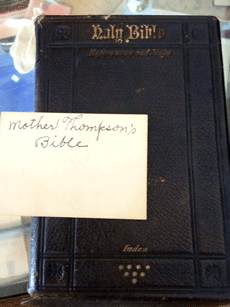
A Boston doctor spoke at the Hillsboro Music Hall in 1873 advising the women present to unite in prayer at local rum dispensaries. They did, and on Christmas Eve, getting first a druggist’s signature on a pledge to refrain from selling alcohol, continued the marches. By Feb. 7, the women had succeeded in closing most bars. The dedicated conviction of these women is phenomenal. They acted selflessly and in great discomfort (imagine the clothes and shoes) in all kinds of weather. They believed in “moderation in all things good and total rejection of all things bad.” The thought occurs that moderation was not their action style, however. In the WCTU Room (also known as the Mother Thompson Room) at the HCHS on the glass cabinet to the right of the door is a beautiful small wooden box. In this box is Mother Thompson’s Bible, obviously well used.
With just this very brief sketch of the WCTU story, don’t you just imagine what it must have been like in that time? Perhaps you will take a moment to reflect on how they affect our lives today or maybe you would like to come in to the Highland House to learn more about their era and work?
Please do.