


Highland County commissioners updated on new small-scale solar proposal; permissive sales tax receipts surpass $5M on the year
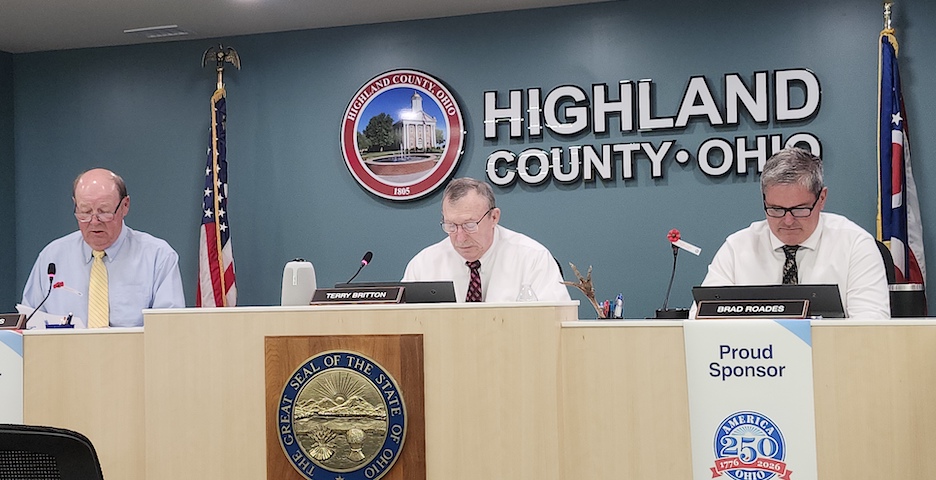
Pictured, from left to right, are Highland County commissioners David Daniels, Terry Britton and Brad Roades. (HCP Photo/Caitlin Forsha)
Highland County commissioners Terry Britton, David Daniels and Brad Roades heard details on a proposed new small-scale solar project west of Greenfield during their Wednesday, July 1 meeting.
Mark Brough of EDP Renewables met with commissioners about the proposal, as he said they are looking at building a five-megawatt facility on the Unger farm west of Greenfield.
“We're an independent renewable energy provider, meaning we develop, build and then own and operate small-scale solar,” Brough said. “This is called a community solar project, so it's five megawatts or less. We usually get lumped in with the utility scale solar, so utility is going to be 200 megawatt, whereas we're five, so you're talking about thousands of acres versus maybe 15 to 20 acres. All of the projects we do are single-parcel, single-landowner developments.”
Brough added that the location is one “we consider to be well sited, which means it's far off the road, and there's not a lot of neighbors around where we would have to do visual screenings or anything like that.”
As some of the larger solar projects in the area have contracts with Amazon, Brough said that this proposed project would have a Power Purchase Agreement (PPA) to benefit Walmart.
“The way that it works is it goes directly into the grid, and the off-taker is Walmart, and so what they do is they get the benefits of the output under an agreement that we have,” Brough said. “They're trying to get a smaller footprint in the state of Ohio for traditional power and supplement it with renewable energy, so I've got about maybe 15 or 20 projects throughout the state.”
Roades asked Brough to explain how Walmart benefits, given the location of the project.
“A PPA, a power purchase agreement, is just a lease,” Brough said. “This is a virtual lease, meaning, as you know, you don't get to control where electrons go. It goes in the grid, and then it goes wherever it's being called.
“They are getting the monetary value of the power that is put into the grid, but in reality the power will go to the neighbors, so the folks around the Greenfield area.”
In response to a question from Daniels, Brough confirmed that due to its size, the project “does not fall under the purview of the Ohio Power Siting Board.” Daniels referred to the commissioners’ solar resolution approved in November 2021, which says that for solar facilities not subject to OPSB jurisdiction, such as those “having less than 50 megawatts of nameplate capacity,” the commission policy will be to “oppose” such development.
“I would say right up front that it has been the policy of this board to oppose any small-scale solar that does not have the benefit of Ohio Power Siting Board oversight,” Daniels said. “What that means is that we probably object, not that that would make any difference or there's any way to impede that process. We believe that any project that's going into the grid needs to have some oversight in the state of Ohio.”
Brough said that as opposed to the large-scale solar projects that “are going into the transmission lines, ours are going into the distribution line.
“Because it's such a small footprint and project size, the lines that are going down the road is what we go in,” he said.
“I understand that, but you are still a power producing facility,” Daniels said. “You're going to be running wires. You're going to be connected into the grid somehow. For us to have oversight over that, we just don't have the people to do it. That's why we have relied on the Power Siting Board, their expertise, their ability to review these projects.”
Brough asked Daniels to “define the concern” commissioners have with small-scale solar projects.
“How do we know that you’ve installed it correctly, other than taking your word for it?” Daniels said. “How do we know that your connection into the grid is what it should be? How do we know all those criteria are met? How do we know that you met every safety standard? Those are things that the Ohio Power Siting Board, through their review, will determine, and once they put their stamp of approval on a project, then we have some sense of security and safety that somebody’s doing something right.”
Brough thanked Daniels for the clarification.
“The utility is the one that governs the quality, safety and otherwise, because the utility will build out to the point where we connect, and then you have to do a witness test with them, which could be a day or a week long,” Brough said. “They come out and test every piece of equipment that's plugged, because it's going into their network, right, and so they're the ones that have oversight on the distribution line that we plug into. I don't know if that gives you any comfort.”
Brough added that there is a detailed application and review process with AEP, as that would be the utility for this project, and AEP is “governing the whole process.” He told commissioners that he would be “happy to get a meeting with the project manager on these accounts” for commissioners to further discuss AEP’s oversight on this proposal.
Britton asked about the lease agreement and decommissioning plan for the project.
“Typically 20 to 25 years is the life cycle,” Brough said. “Internally, our own guidelines are we have what's called a decommissioning plan on every project, so we hire a third-party engineering firm that puts together the sort of scope of how to take it out and then the cost associated with it.”
He added that the county could also require a decommissioning bond if they were interested.
Daniels asked about the “projected program timeline,” as Brough said the company would not start construction until at least the summer of 2027.
Brough also asked commissioners about a possible Payment in Lieu of Taxes (PILOT) agreement for the project. Daniels pointed out that “for every solar project that we’ve had in the county,” commissioners have entered an agreement for the maximum amount available, at $9,000 per megawatt.
Commissioners thanked Brough for his presentation.
“I appreciate that you let us know,” Daniels said. “Because of the resolution that we've passed before, I don't see me offering support with the project, although I think that with our ability to, I guess, stand in the way, we really don't have the tools available to do that.
“I think that if it does go forward, I think that at least now we have time to consider what options that we might have. I appreciate you coming in here and talking to us early on in your project.”
In other discussion:
• Daniels announced that the county has topped $5 million in permissive sales tax receipts on the year, with the county collecting $863,853.07 in June 2026. That is a roughly $19,000 increase over the amount collected in June 2025 ($844,817.10).
Year to date, the county’s totals of $5,089,583.84 are 4.78-percent higher than the same time frame in 2025, when the current record of $9.8 million for the year was collected.
• David Bland, Director of Governmental Affairs for the International Union Painters and Allied Trades District Council 53, introduced himself, as he said Highland County was newly acquired by the council, and shared information about the union with commissioners.
According to the IUPAT website, “IUPAT proudly represents and fights for 140,000 workers in the finishing trades across the United States and Canada. We represent dozens of trades, primarily industrial painters, commercial and decorative painters, drywall finishers, glaziers and glass workers, sign and display workers, trade show workers, floor covering installers, and many more successful careers in the construction industry and public sector.”
“We have about 2,600 members in our area,” Bland told commissioners.
Bland said the union has a 96,000-square-foot training center in Weston, West Virginia, where their apprentices in Ohio, Kentucky and West Virginia receive training.
“We're now the first elevated water tank painting training center in the country,” Bland said. “They’re doing our first set of classes right now.”
Some of the union’s programs include working with Job Corps, a federal program that provides training for qualified individuals ages 16-24, and Helmets to Hardhats, which trains individuals honorably discharged from the military. Commissioners asked Bland to stop by the Highland County Veterans Service Commission office on his way out of town to share information about that program.
“When veterans get out of the military, they can come and join the trades — not just IUPAT, but any of the trades — within one year, and they can get direct hire,” Bland said. “Our apprentices only make 50% when most of them start out, but through this, they will take those veterans that are honorably discharged within one year, and the federal government will make up the rest of their wages, so they'll literally start out at full-scale wages.”
Bland also spoke about the importance of hiring local workers for construction projects.
“When you hire local people, they spend the money locally, they pay taxes locally, they support the local businesses,” Bland said. “The county gets more money, which they can reinvest in more projects, and you know, that's just common sense. I always just bring this up because of some projects that bring in southern contractors that aren't from around the area. If you're not hiring local people, you're really not helping the local economy.”
• Commissioners noted that they received a Qualified Energy Project application from Dodson Creek Solar LLC. Daniels said that he wanted to “look into” the request before determining whether the county will “approve or deny” the application.
• At 10 a.m., commissioners met with Chris Widener of WDC Group to review bid documents and specifications for the first phase of renovations to the Highland County Courthouse.
Commissioners also made the following approvals, each by a 3-0 vote:
• A $37,040.74 change order for HIG CR 5-E New Market & 5-F Prospect Road reconstruction and resurfacing.
• A motion to appoint Michael Davidson to the Airport Authority Board.
• A resolution authorizing “then and now” purchase order and authorizing the county auditor to issue warrants for payment.
• A request from Highland County Community Action for the creation of the following new line item within the 2580 fund: CHIP CDBG Repair Soft Cost FY26-27. Also requested is a budget modification within the 2580 fund in the amount of $25,000.
• A request from the Board of Elections for a budget modification within the 1000 County General Fund, BOE in the amount of $1,000.
• A request from Highland County Community Action for the creation of the following new line item within the 2585 fund: CHIP Home Rehab Soft Cost FY26-27. Also requested is a budget modification within the 2585 fund in the amount of $20,000.
Publisher's note: A free press is critical to having well-informed voters and citizens. While some news organizations opt for paid websites or costly paywalls, The Highland County Press has maintained a free newspaper and website for the last 28 years for our community. If you would like to contribute to this service, it would be greatly appreciated. Donations may be made to: The Highland County Press, P.O. Box 849, Hillsboro, Ohio 45133. Please include "for website" on the memo line.