


Health Department to seek reduced levy in May; commissioners hear financial updates
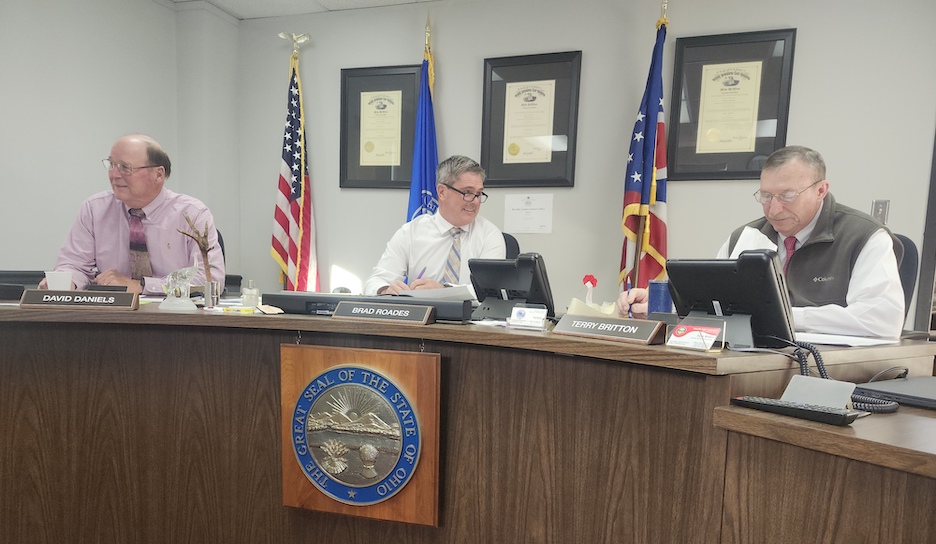
Pictured (l-r) are Highland County commissioners David Daniels, Brad Roades and Terry Britton. (HCP Photo/Caitlin Forsha)
Highland County commissioners Brad Roades, Terry Britton and David Daniels met with several county officials during their Wednesday, Jan. 22 meeting, as their agenda included approving a tax levy issue for the 2025 primary, hearing updates on financial matters and revising the county’s recently approved employee handbook.
After a discussion with Highland County Health Commissioner Jared Warner, commissioners voted 3-0, via resolution, to approve a “proposed tax levy replacement with combination and reduction for the Highland County Department of Health for the primary election to be held May 6, 2025.”
As previously reported, a proposed replacement and decrease levy for the Health Department failed in the November 2024 general election. That was proposed as a 0.7-mill, five-year levy, replacing two existing levies and decreasing by 0.3 mill.
The new proposal for voters to consider in May is for one half-mill levy, as the Health Department formerly received revenue through two half-mill levies. According to Warner and auditor Alex Butler, the levy would amount to $18 per $100,000 of the county auditor’s appraised value.
“This is sort of a repeat of the levy that we tried in November, and in this case, we've actually reduced the rate a little further,” Warner said. “Our next big job is to get people to understand what we're trying to do, and that this is really just money to help us operate. We're trying to keep the lights on to pay salaries and do the essential work that we do at the Health Department.
“This is us doing food inspections, providing vaccines to your kids, going out and doing nuisance complaints, tracking down different diseases that get diagnosed in the county and helping people deal with those. It's important work that we do, and we just need funding to keep doing it.”
Daniels asked Warner to discuss the Health Department’s budget and its different funding sources. Warner said that they have an overall budget that ranges from $1.2 million to $2 million, with the levies — before being voted down — accounting for half or more or their funding.
“The state of Ohio provides us about $18,000 a year in total to perform public health work in Highland County, so we get essentially nothing from the state,” Warner said. “All the money that we get to run the Health Department comes from local property taxes, from grants that we are able to get in and from the fees that we charge for different services.
“The percentages vary a little bit year to year, depending on how many grants we have in, but normally we’re looking at levy funding covering about 40 to 60 percent of our budget. Losing this levy means we lose potentially half of our operating expenses a year, so it's a pretty significant hit for us.”
Warner added that grants will usually “target specific issues,” while the tax revenue from the levies allows them to work on various areas that do not have any other means of funding.
“I’ll give you an example, our communicable disease work,” Warner said. “When someone gets diagnosed with an infectious disease in Highland County, we get notified of that diagnosis. We call that person and talk to them on the phone, explain to them what it is they have, how it's spread, and then talk to them about maybe they need to get the rest of their family tested. Maybe we need to talk to sexual partners. Maybe we need to do other things to prevent that disease from passing from that person to other people.
“All that work happens, and it's completely unfunded. There's no way for me to charge somebody for the fact that I called them and told them about the disease they have. The levy funds that we bring in cover those types of services that benefit the entire community, and that's why we ask the entire community to contribute toward supporting that.”
Commissioners thanked Warner for the information.
“I think it's very important that the public understands that we need this to keep things going,” Britton said.
In other discussion:
• The county’s permissive sales tax receipts are off to a slow start in 2025 after achieving record-high totals for a fifth straight year in 2024, according to a report from Highland County Auditor Alex Butler.
For January 2025 — which involves receipts collected in November 2024, Butler said — the county collected $778,342.04. That total is four-percent less than the January 2024 figure of $806,947.03, although it is still higher than the monthly totals for the previous two months. In November, the county collected $691,245.77, and in December, the total was $745,065.60.
• Highland County Treasurer Vickie Warnock conducted an investment advisory committee meeting, sharing December 2024 figures with commissioners.
Those totals as presented by Warnock included:
—STAR Ohio: $27,515.76 interest and 4.7-percent interest rate;
—STAR Plus: $9,178.89 interest and 3.12-percent interest rate;
—Fifth Third (CDs): $50,711.07 interest and 3.3-percent average interest rate;
—Checking account: $38,032.11 interest and 4.42-percent interest rate; and
—ICS account: $71,028.20 interest and 4.58-percent interest rate.
Overall, for 2024 interest, Warnock said the county “earned $2,399,684.76, which was $78,912.76 more than we did in 2023.”
Warnock also told commissioners that she recently reinvested $1.5 million at a considerably higher interest rate.
“We did have five CDs recently come due that were only paying anywhere from .65- to one-percent interest,” Warnock said. “We put $500,000 in at 4.15, $500,000 in at 4.25 and $500,000 in at 4.37.
“The 4.15 is in for a year, the 4.25 is in for two years and the 4.37 is in for two and a half years. We still have liquid money available there that we will be reinvesting also, because, like I've said before, I try to have money coming due every six, eight months, so we constantly have a little bit of liquid money if we would ever need it.”
In answer to Daniels’ standard question of whether they “need to move any money,” Warnock said that they are “good where we’re at” right now.
“I appreciate you shopping and moving our money,” Roades told her.
• Commissioners approved a change to their county employee handbook regarding calamity days at human resources director Amy Bradley’s recommendation. Highland County EMA Director David Bushelman also discussed a potential new way of notifying county employees when calamity days occur.
The revised 168-page Highland County Policy and Procedure Handbook was approved by commissioners in December. Bradley said they felt the need to revise their policy after county offices were forced to close one day in January due to weather.
“As Dave [Daniels] said last month, our handbook is a living, breathing document,” Bradley said. “It's been one month since it was approved, and we already need to revise it, based on the calamity days issue that we had with the previous snow.
“It says, if the Highland County Sheriff declares a level three snow emergency, and because of this designation, travel on county roads would lead to citation or arrest, it will be our policy to close all county offices to comply with this designation. As special circumstances exist in individual offices, elected officials may need to call in essential employees to address those needs. And if a level three emergency is declared, employees will be paid for up to two consecutive days and will not need to use time — meaning paid time off — for that.”
Bushelman said that the EMA’s free emergency alert mobile app, Hyper-Reach, could be modified to send alerts to county employees as well, notifying them in the event of a countywide calamity day.
As previously reported, according to a press release from Bushelman, “Hyper-Reach is a state-of-the-art mass emergency notification system designed specifically for public safety.
“The emergency alert system provides rapid notification of hazardous and urgent situations using a mix of telephone calls, text and email messages, and even TTY/TDD service for the hearing impaired. The system sends thousands of these messages to geographically targeted households in seconds, and can simultaneously deliver them to an even broader audience via social media, as well as sending broadcast messages to most current mobile telephones (made since 2011) in an affected area by providing access to FEMA’s Wireless Emergency Alert (WEA) system.”
Anyone can sign up for Hyper-Reach by visiting https://www.highlandcountyema.com, where a link to register is available on the homepage. The EMA implemented this feature in 2022.
“It's there for the county to use,” Bushelman said. “It's a mass notification system that's here in the county that's available for agencies to use if they so choose.
“You can also use it as an internal paging communication group, so we could set up a group for county employees, that whoever's the administrator could send that group a message.”
Bushelman pointed out that in order for that to work, however, “every county employee would have to have the Hyper-Reach on their phone.”
Roades suggested that the county work to implement Hyper-Reach “as our point of contact” to send alerts to all employees, while Bradley added that she will also work to contact employees via email as well.
“It’s going to take a good bit of work internally to get that set up,” Bushelman said.
“Well, that’s what we’re paying for it for,” Daniels said.
• Commissioners discussed two unrelated county building projects, including one that was unexpected and caused by recent weather and one that has been in the planning stages for several months.
First, Britton said that a portion of the roof at the Hi-TEC building will need to be replaced, as McCarty Associates is currently working on design plans. The roof that was affected is the portion covering the Job and Family Services agency’s storage area, according to Britton.
“Unfortunately, we got way too much snow for part of the roof,” Britton said. “It didn't collapse in completely, but it did stress the structure, and it's bowed down. We had to put some rigors underneath of it to hold it up.
“The bigger area is fine. We did have to take some snow off of it, just because of the amount of snow that we had.”
Britton and Roades added that due to drifting, there were “18 to 20 inches of snow” on that part of the “flat roof,” causing the damage.
On another construction-related topic, Roades read a report prepared by clerk Ashleigh Willey discussing planned improvements to the Administration Building. According to the report, “Cincinnati Commercial Contracting have been working to obtain bids” from contractors, and “the project has been reduced from six phases to three phases.”
Roades said that the project will focus on one floor at a time, starting at the top level and working downward.
“Dustin Belk of CCC, which is Cincinnati Commercial Contracting, will be preparing schedules for everyone to review and be passed along to the department heads as soon as we have them,” he said.
• Commissioners received communications from the Ohio Division of Liquor Control for a new liquor license application for a 1st Stop to be constructed in Highland. Roades said that they would give the public two weeks to comment on the proposed license before issuing a response.
• Following their regular meeting, commissioners held an executive session to discuss “confidential business information related to economic development assistance with a political subdivision” and an unrelated work session with Highland County Engineer Chris Fauber and the WDC Group to discuss the planned new truck barn for the engineer’s office.
Commissioners also made the following other approvals, each by a 3-0 vote:
• A motion to approve Bill Huhman as the county’s Ohio Department of Agriculture apiary inspector for 2025, at a rate of $20 per hour and 70 cents per mile.
• A resolution to declare a 1994 Dodge as no longer needed by the County and obsolete, pursuant to ORC 307.12 (A)(1). Therefore, the board declared the listed item to be surplus property and no longer needed.
• A budget modification within the CDBG FY22, 2520 fund in the amount of $42.
• A modification from County Transfer Out to County Advances Out for $1,200.00. Also requested is an advance to PY 24 in the amount of $1,200.
• A resolution to authorize the acceptance of the offer made by the Ohio Department of Transportation for FY2025 Ohio Airport Improvement Program in the amount of $2,365.
• A request from Probation for a budget modification within PSG FY 24-25, 2620, in the amount of $3,200.
• A request from Probation for a budget modification within Specialized Docket Subs, 2665, in the amount of $44,699.21.
Publisher's note: A free press is critical to having well-informed voters and citizens. While some news organizations opt for paid websites or costly paywalls, The Highland County Press has maintained a free newspaper and website for the last 25 years for our community. If you would like to contribute to this service, it would be greatly appreciated. Donations may be made to: The Highland County Press, P.O. Box 849, Hillsboro, Ohio 45133. Please include "for website" on the memo line.
Coronavirus State and Local Fiscal Recovery Funds
Of the $8.38 million emergency funding for Highland County, to offset expenses incurred due to COVID-19, how much was allocated specifically to the health department?